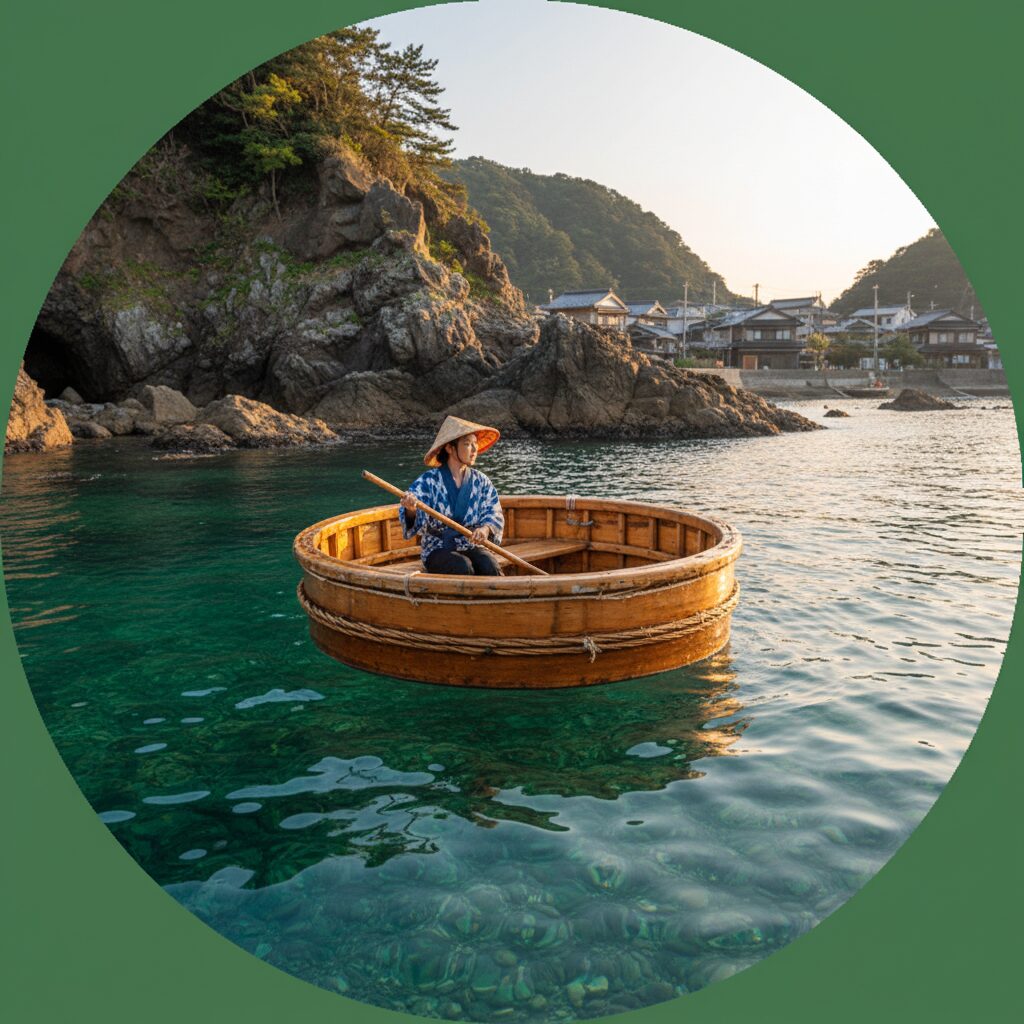
Yo, let’s talk about getting off the beaten path. Like, way off. Forget the neon glow of Tokyo for a hot minute and the packed temples of Kyoto. We’re going deep into the Sea of Japan to an island that’s a whole mood, a place where history isn’t just in books—it’s floating on the water. We’re talking about Sado Island, Niigata Prefecture’s epic, S-shaped treasure island. And the main event? The Tarai-bune, a legit tub boat that looks like it sailed straight out of a Ghibli movie. This isn’t just some tourist gimmick; it’s a living piece of culture, a throwback to a tougher, simpler time, and honestly, it’s one of the most uniquely Japanese experiences you can have. It’s the kind of adventure that’ll light up your feed and, for real, change your perspective on what Japan is all about. Sado is a vibe, and the tarai-bune is your ticket to ride. So, buckle up, because we’re about to dive into the emerald green waters of Sado’s Ogi Peninsula, where skilled boatwomen paddle these curious little boats with a grace that’s straight-up mesmerizing. This is the real Japan, unplugged and unfiltered.
What’s the Vibe? The Sado Island Scene
Before we even get to the boats, you need to understand the setting. Sado Island isn’t your usual sunny beach retreat. It’s dramatic, rugged, and has a deep-rooted soul. For centuries, this island served as Japan’s designated place of exile. If you were a troublesome political figure, a gifted artist who had fallen out of favor, or even an emperor on the losing side of a power struggle, you were sent on a one-way journey to Sado. This history of exile fostered a wild and fascinating cultural blend. Refined court culture from Kyoto aristocrats collided with the tough, hardworking lives of fishermen and farmers. The outcome is an island with an artistic heritage far beyond what you’d expect for its population. We’re talking an astonishing number of Noh theater stages, unique festivals, and a resilient spirit palpable in the air. The landscape itself plays a role in the story. The northern coast features jagged cliffs and dramatic rock formations battered by the Sea of Japan. In contrast, the south, where the Ogi Peninsula is located, offers gentler terrain with peaceful coves and crystal-clear waters perfect for—yes, tub boats. Driving around Sado is a memorable experience. One moment you’re passing terraced rice paddies glowing gold in the afternoon sun as they climb the mountainside; the next, you’re winding along coastal roads with stunning ocean views at every turn. It feels remote, and that’s because it is. Reaching this place requires effort, and that journey is part of the charm. It filters out casual tourists, leaving the island to those truly curious. The towns seem frozen in time. Places like Ogi and Shukunegi boast old wooden houses with weathered timber, narrow alleys, and a quiet broken only by seagulls and the distant hum of fishing boats. It’s a low-key, nostalgic paradise. The air is fresh, the seafood incredibly fresh, and the people radiate a warm, welcoming spirit nurtured by close-knit island communities. Sado is a place to slow down, breathe, and connect with a side of Japan that feels both ancient and vibrantly alive. It’s a complete system reset.
The Tarai-bune Lowdown: More Than Just a Meme Boat
Alright, let’s dive into it—the tarai-bune. At first glance, it looks almost humorous—a large, oversized washtub floating on water. But don’t be mistaken; this is a brilliant example of functional design and a tribute to the creativity of the local people. This isn’t some ancient relic from the distant past. The tarai-bune is actually a fairly modern invention, created out of necessity during the Meiji Period in the late 1800s. The story goes that locals needed a way to gather the ocean’s treasures—precious abalone (awabi), turban sea snails (sazae), and nutritious wakame seaweed—from the rocky, perilous shores of the Ogi Peninsula. The coastline here is a labyrinth of narrow inlets and sharp rocks where a standard long fishing boat, or ‘isobune,’ would be completely impractical. It couldn’t navigate the terrain and would likely be smashed to bits. The local artisans and fishermen required something small, stable, and incredibly agile. They turned their attention to what they already had—the ‘tarai,’ large wooden tubs used for laundry and bathing, and the ‘hangiri,’ a similar tub for mixing miso. An idea sparked: why not make a larger version? And thus, the tarai-bune was born.
The Original Eco-Friendly Vessel
These boats represent pure traditional craftsmanship. You won’t find any fiberglass or modern marine sealants here. They are crafted from local Japanese cedar, or ‘sugi,’ and bound together with hoops of ‘madake’ bamboo. The planks are carefully bent and fitted, with seams sealed using a blend of cedar bark and natural resins to ensure they’re watertight. The design’s genius lies in its simplicity. The round shape offers exceptional stability. While it might feel a bit shaky when you first step in, it’s very hard to capsize. More importantly, its shape allows for tight pivoting. A skilled paddler can spin it a full 360 degrees with a simple flick of the wrist. This was critical to its effectiveness as a workboat. A woman could paddle into a narrow, rocky cove, navigate right up to the reef, collect her catch, and exit without difficulty. It was the perfect tool for a very specific task. And who manned these boats? They were the island’s women. While the men ventured out on larger boats for deep-sea fishing, the women took to the shores in their tarai-bune, becoming experts of the coastline. They played a crucial role in the local economy, their daily harvest feeding families and earning income. These women, with their sun-weathered faces and remarkable strength, are the true heart of the tarai-bune tradition. They developed a distinctive paddling technique using a single oar, or ‘kai.’ Instead of rowing, they propel the boat with a sculling motion, moving the oar in a figure-eight pattern behind the vessel. This technique is quiet, efficient, and offers precise control. Watching them is like witnessing a water ballet; it’s all fluid, effortless grace honed through a lifetime of experience.
Your Epic Tarai-bune Adventure: What to Expect
So you’ve arrived in Sado and are ready for your tub boat adventure. You have several fantastic options, each offering a distinct experience. The ride itself is fairly consistent—a brief, scenic journey guided by a friendly local—but the setting is what truly sets each apart.
Yajima & Kyojima: The Picture-Perfect Destination
This is the star attraction, the highlight you’ve most likely seen on Instagram, and for good reason—it’s stunning. Yajima and Kyojima are two small, charming islands nestled in a peaceful cove, linked to the mainland by a beautiful, arched red bridge. The whole scene looks like a masterpiece painted by a skilled artist. The water here is incredibly clear, a sparkling emerald green that reveals the seaweed swaying on the ocean floor. Upon arrival, you’ll find the Yajima Taiken Koryukan (Yajima Experience Exchange Hall), which serves as your base. You’ll pay a small fee, generally around 600 yen, for the ride. Then you’ll be guided down to the water’s edge where tarai-bune and their pilots await. These pilots are almost always women, dressed in traditional indigo-dyed ‘kasuri’ garments and wide-brimmed straw hats to shield them from the sun. They are the heart and soul of the experience. They’ll help you board the boat and with a gentle push you’re off. The sensation is surreal—gliding silently over the impossibly green water, the only noise the soft splash of a single oar. The boatwoman skillfully navigates you around the islands, beneath the red bridge, and through the calm cove waters. Even without a shared language, there’s a connection: she points out fish, conveys history through gestures, and offers a warm smile that bridges the gap. Most pilots will invite you to try paddling yourself. Take the chance. It’s a way to truly appreciate their expertise. You’ll take the oar, attempt to mimic their smooth figure-eight stroke, and probably just spin the boat in a clumsy circle. It’s funny, humbling, and perfect for a photo. The ride lasts about 15-20 minutes—just the right length to savor the tranquility and snap that ideal shot without overstaying your welcome. This is the quintessential tarai-bune experience, blending natural beauty with cultural heritage seamlessly.
Ogi Port: The Original Experience
If Yajima is the polished showcase, Ogi Port is the authentic, unvarnished original. This is where the tarai-bune tradition runs deepest, right in the middle of a working fishing harbor. The atmosphere here focuses less on picturesque perfection and more on historical authenticity. You’ll see tarai-bune bobbing alongside real fishing boats, surrounded by the lively sights and sounds of an active port. The rides are typically shorter and slightly cheaper, making this a convenient choice if you’ve just disembarked at Ogi Port and are pressed for time. The charm remains intact as you’re paddled around the harbor, getting an up-close view of breakwaters and waterfront life. The water may not boast the ethereal green of Yajima, but the genuine feeling is unmatched. You can easily picture the boatwomen of generations past launching from this very spot to carry out their daily tasks. It feels less like a tourist activity and more like stepping into a living museum. After your ride, you can stroll through Ogi’s streets, which still retain much of their historic character. It’s a wonderful way to connect with the working legacy of these unique boats.
Shukunegi: The Quiet Treasure
For those eager to immerse themselves in Sado’s distinctive ambiance, a tarai-bune ride in Shukunegi is essential. Shukunegi isn’t just a town—it’s a time capsule. This former shipwright village is tucked away in a small, sheltered cove, with its streets forming a bewildering maze of narrow lanes and tightly clustered wooden houses. What makes it especially unique is that many of these homes were built using timber and parts salvaged from dismantled ships. The village stands as a tribute to the island’s maritime heritage. Tarai-bune rides here take you through the exceptionally calm waters of the cove. Instead of a dramatic red bridge, the backdrop is the tiered, historic houses themselves. Paddling here feels deeply intimate and tranquil. You glide past old storehouses and the distinctive triangular houses, gaining a perspective on the village you simply can’t get from shore. Pairing the boat ride with a walk through Shukunegi’s labyrinthine streets offers an iconic Sado experience. You can even visit one of the preserved houses, like Sankakuya (Triangle House), to see how shipwrights ingeniously repurposed every piece of wood. Though it’s a bit off the beaten path, the atmosphere and one-of-a-kind scenery make it well worth the journey.
Beyond the Tub Boat: Leveling Up Your Sado Trip
Look, the tarai-bune might be your ticket to Sado, but the island offers so much more. Just taking a boat ride there would be a missed opportunity. You need at least two or three days to truly begin exploring this remarkable place. Think of the tub boat as your introduction to the full Sado experience.
Sado Kinzan Gold Mine: A Journey into History
This is a must-see. The Sado Gold Mine is the island’s historical cornerstone. For nearly 400 years, from the early 1600s until 1989, it was one of Japan’s most productive gold and silver mines. It funded the Tokugawa shogunate and played a significant role in the national economy. Visiting here is like stepping back in time. You can explore two different tunnel courses. The ‘Sodayu’ route takes you through the early Edo-period tunnels, all hand-dug. The environment is dark, damp, and powerfully atmospheric. Life-sized animatronic dolls placed throughout realistically depict the harsh conditions miners endured. It’s a bit eerie, somewhat kitschy, but extremely effective at conveying the story. The ‘Doyu’ course showcases more modern, industrial-era tunnels, demonstrating how technology transformed mining. Don’t miss the museum at the end, where you can see a genuine 12.5 kg solid gold bar. You’re invited to try lifting it through a small hole in its case—it’s much heavier than you’d expect and a fun challenge. The mine’s history is deeply tied to Sado’s past as a place of exile, as many early miners were convicts or homeless people forced to work there. It’s a sobering but essential part of understanding Sado.
Toki Forest Park: A Beacon of Hope
Sado is also an island rich in nature and conservation, best exemplified at Toki Forest Park. The ‘toki,’ or Japanese Crested Ibis, is a stunning bird with delicate pink-tinted feathers and a bright red face, designated as a special natural monument of Japan. Sadly, due to overhunting and habitat destruction, the native Japanese toki became extinct in the wild in 2003, with the last one dying right here on Sado. But that wasn’t the end. Through a large collaborative conservation effort with China, a new population was bred in captivity. Toki Forest Park is where this miracle took place. Today, visitors can see these magnificent birds up close in a large enclosure that replicates their natural environment. It’s a deeply moving experience. The successful reintroduction of the toki to the wild in Sado is a huge source of pride for locals and a beautiful testament to nature’s resilience. It’s a wholesome, uplifting stop perfect for families and wildlife enthusiasts.
Northern Exposure: Senkakuwan Bay and Onogame
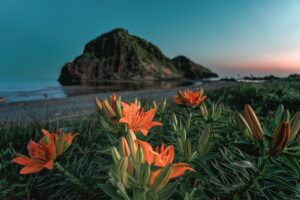
If southern Sado is calm and gentle, the north is rugged and breathtaking. A drive along the northern coast is a must. Senkakuwan Bay consists of five small inlets with towering, dramatic cliffs carved by the relentless Sea of Japan waves. The view from the Ageshima Yuenchi observation deck is stunning. Often called the ‘Norway of the East,’ this might be an exaggeration, but the dramatic landscape is undeniable. You can take a glass-bottom boat tour to see the cliffs from sea level and observe marine life beneath. Further along the coast are Onogame and Futatsugame. Onogame is a massive single rock monolith rising 167 meters into the sea—truly an impressive sight. In late May and early June, the surrounding area is covered in a vibrant blanket of yellow ‘tobishimakanzo’ daylilies, creating a breathtaking contrast against the green cliffs and deep blue ocean. Nearby Futatsugame (‘Two Turtles’) features two large rock formations resembling a pair of turtles, set in a bay with one of the island’s most beautiful beaches. The crystal-clear water makes it a popular spot for swimming and camping in summer. The northern coast is where you’ll find those sweeping, cinematic landscapes.
Fueling Up: The Sado Food Scene
Visiting Sado is also a culinary adventure. Being an island, seafood naturally takes center stage, and it’s as fresh as it gets. You must try the local ‘kaisendon’ (a bowl of rice topped with assorted fresh sashimi)—the quality is outstanding. In winter, Sado is renowned for ‘kan-buri’ (winter yellowtail), rich, fatty, and melt-in-your-mouth delicious. Squid (‘ika’) is another specialty, often served as ‘ika somen,’ thinly sliced like noodles. Of course, try the very seafood the tarai-bune were made to catch: ‘sazae’ (turban shells), usually grilled whole with a splash of soy sauce, and ‘awabi’ (abalone), a true delicacy. But Sado’s offerings go beyond seafood. The island is a major producer of ‘okoshi-gaki’ (dried persimmons), which you’ll see hanging in curtains from house eaves in autumn. Sado also boasts its own brand of beef and premium rice. And to wash it all down? Sake. The island’s pure water and quality rice make ideal conditions for sake brewing. Visit a local brewery like Hokusetsu Shuzo. Fun fact: their sake is exclusively supplied to all the globally acclaimed Nobu restaurants. A brewery tour and tasting makes for a fantastic afternoon activity.
The Nitty-Gritty: How to Sado Like a Pro
Alright, you’re convinced and ready to book your trip. Here’s the essential info you need to make it happen smoothly.
Getting There: The Journey Is Part of the Experience
Sado is an island, so there’s no bridge—you’ll need to take a boat. Your trip begins in Niigata City, which is easily reached from Tokyo via the Joetsu Shinkansen (bullet train) in about two hours. Once in Niigata, head to the Sado Kisen Ferry Terminal. From there, you have two options to reach Sado’s Ryotsu Port:
- The Car Ferry: This is the big, slow, and steady choice. The trip takes about 2 hours and 30 minutes. It’s ideal if you’re renting a car on the mainland to bring over or if you prefer a relaxed, scenic journey. You can stroll the deck, enjoy the sea breeze, and watch the mainland drift away. It’s cheaper and less likely to be canceled due to bad weather.
- The Jetfoil: This is the speedy option. The Jetfoil hydroplane literally flies over the water, making the trip in just over an hour. It’s pricier and requires you to stay seated, so no deck access. It’s also more prone to cancellations in rough seas, especially in winter. It’s perfect if you’re short on time but misses some of the romance of the sea journey.
There’s also a ferry from Naoetsu Port in Joetsu City to Ogi Port in the south of Sado, a great alternative if you’re coming from western Japan.
Getting Around: Rent a Car, No Exceptions
I can’t emphasize this enough: rent a car. Sado Island is much larger than you might think, spanning about 855 square kilometers, with attractions scattered far and wide. Public buses exist but run infrequently and may not reach all the remote spots you want to visit. Exploring Sado by bus is possible but demands meticulous planning and patience. A car lets you explore at your own pace, stop at random scenic spots, and find hidden beaches and small villages. You can rent a car at the ferry terminals in Ryotsu or Ogi—book ahead, especially during peak season. Driving on Sado is generally relaxed, with less traffic than on the mainland, but expect some narrow, winding coastal roads. It’s all part of the adventure.
When to Go: Sado’s Four Distinct Seasons
Sado can be visited year-round, but each season offers a unique atmosphere:
- Spring (April – May): Mild and pleasant weather, ideal for hiking and cycling. Cherry blossoms are stunning, and the island wakes from its winter rest.
- Summer (June – August): Peak season with hot, humid weather perfect for swimming, kayaking, and other marine activities. It’s also festival season, highlighted by the world-famous Earth Celebration featuring Kodo taiko drummers in August. It’s lively and fun, but book everything well in advance.
- Autumn (September – November): Many locals consider this the best time to visit. The crowds thin out, the weather cools to comfortable levels, and autumn foliage is spectacular. It’s also harvest season for rice and persimmons, making for excellent food.
- Winter (December – March): For the adventurous traveler. It’s cold, with heavy snow in northern parts. Rough seas can cause ferry cancellations, and many tourist spots reduce hours or close. However, the island is peaceful and quiet, perfect for food lovers eager to try fatty winter yellowtail and fresh oysters. Snow-dusted temples and coastlines create a magical scene.
A Final Word
Sado Island is more than just a place; it’s an experience. The tarai-bune perfectly embodies that feeling. It’s slightly quirky, deeply steeped in history, and harmoniously connected with its natural surroundings. A ride in one of these tub boats offers a quiet, reflective journey. As you glide over the clear green waters, driven by the steady, rhythmic sweep of the oar, the noise of the modern world fades away. You become linked to a tradition upheld by generations of strong, resilient women. You touch the very heart of island life. So, when planning your next trip to Japan, dare to go beyond the guidebooks. Hop on the Shinkansen, catch the ferry, and let Sado Island reveal a side of Japan you’ve never seen before. Take a ride in a tub boat. It’s a story you’ll cherish and share for years to come. Truly.