Yo, what’s good? Let’s talk about Japan. You’ve seen the pics, right? The hyper-futuristic cityscapes, the serene temples, the wild fashion. But bet you’ve also seen something way more low-key, something tucked into nearly every side street and alleyway: the humble vending machine corner. It’s a scene that’s become iconic. A row of brightly lit boxes, casting a solitary neon glow onto the dark asphalt, humming quietly in the dead of night. You might see one person, maybe two, standing there, grabbing a can of coffee or a bottle of tea. It’s quiet. It’s calm. It’s a whole vibe. But for real, what is the deal with these things? Why are there so many, over five million of them, scattered across the entire country? The easy answer is “convenience,” but that’s not the whole story. Not even close. That answer doesn’t explain the specific feeling these places evoke—a strange mix of loneliness and comfort, of public space and private refuge. It doesn’t explain why these automated sellers have become unintentional monuments to modern Japanese life. To really get it, you gotta look past the plastic buttons and the clatter of a falling can. You have to understand that these glowing beacons are more than just machines; they are a reflection of Japan’s history, its social contract, and its very soul. They tell a story about trust, technology, and the search for a quiet moment in one of the busiest places on Earth. This ain’t your average travel guide. We’re going deep, peeling back the layers to figure out why this everyday sight feels so significant. It’s a cultural deep-dive, no cap. Let’s get into the glow.
To truly understand this unique atmosphere, you might also want to explore the concept of Ekimelo, which acts as the perfect background score for navigating Tokyo’s urban landscape.
The Vibe Check: Beyond Convenience Culture
Alright, first things first, we need to break down the atmosphere. Anyone will tell you that Japan values convenience. The konbini, the train systems, the delivery services—they’re all incredibly efficient. So, having a vending machine on every corner fits that narrative perfectly. And yes, it really does. But if it were just about grabbing a drink quickly, the experience would feel different. It would be purely transactional, forgettable. The reality is something else entirely. Imagine this: it’s 1 AM in a residential neighborhood in Tokyo. The last train left long ago, the izakayas have closed, and the streets lie in complete silence. The windows of the nearby apartments are dark. The only thing breaking the quiet night is the soft, electric hum from a cluster of vending machines. The light they emit isn’t harsh; it’s a contained, gentle glow, creating a small pocket of artificial daylight amid the darkness. It’s a stage without actors. When you step into this light, you become the main character in a silent film for a moment. You fish out some coins, the metallic clink echoing in the stillness. You press a button, and with a satisfying thud and clunk, your drink is dispensed. For that brief moment, this little corner of the world belongs entirely to you. This experience is a genuine mood. It’s a liminal space, something neither here nor there. It’s not your home, nor is it a formal commercial spot. It’s an in-between place where usual social rules are paused. There’s no shopkeeper to greet, no other customers to navigate around. It’s just you, the machine, and the sleeping city around you. This distinction is important. In a society where social harmony and public face (tatemae) matter so much, these moments of pure, unobserved anonymity are rare treasures. The vending machine corner is a sanctuary of solitude. It offers a service without demanding anything in return—no smiles, no small talk, no social effort. It’s a silent agreement of utility. The sounds play a crucial role in this vibe, a kind of urban ASMR. The low hum of the refrigeration unit is constant, a baseline for the city’s heartbeat. The clinking of coins, the mechanical whir as the machine processes your choice, and the final heavy clunk of the product dropping into the retrieval slot—each sound is distinct, grounding, and oddly comforting. It’s a predictable, reliable sequence in a world that often feels chaotic. It’s a small, repeatable ritual that brings a bit of order to your night.
The Historical Receipts: How We Got Here
How did Japan become the undisputed global leader in vending machines? It’s not simply due to a modern fascination with robots and automation. The origins run much deeper, tracing back to the remarkable period of post-war economic growth. The story of the `jihanki` (the Japanese term for vending machine) mirrors the story of modern Japan itself. While the first vending machines appeared long ago, the industry truly exploded starting in the 1960s. This era marked the Japanese Economic Miracle, as the country rebuilt at a dizzying speed. Urban populations swelled as people left rural areas in search of work, and factories operated around the clock. This created the perfect conditions for automated retail to thrive. First, there was a rapidly expanding, increasingly thirsty urban workforce. People worked longer hours, commuted greater distances, and lived a faster-paced lifestyle, requiring quick and accessible refreshments at all hours. Traditional mom-and-pop stores with limited hours couldn’t keep up with this new tempo. Second, the economic boom caused labor costs and shortages to rise significantly. Staffing kiosks or small shops 24/7 became increasingly expensive. Vending machines provided the ideal solution: tireless, silent salespeople working nonstop without salaries, benefits, or complaints. It was a purely economic innovation—a clever hack to maximize productivity. The 1967 introduction of the 100-yen coin was another major factor. With a single, convenient coin for standard purchases, the process became much simpler and the machines far more user-friendly—no more fumbling with numerous small coins. This was a game-changer. Major beverage companies like Coca-Cola, Suntory, and Kirin saw a golden opportunity to build an extensive, decentralized distribution network. They began leasing small plots of land—sometimes just a square meter—outside apartment buildings, next to rice paddies, or in quiet alleys, paying modest rent and handling stocking and maintenance themselves. It was mutually beneficial: companies gained direct sales channels, and landowners earned passive income from otherwise unused spaces. That’s why vending machines appear in the most random, unexpected locations. It’s less about urban planning and more about millions of small, independent business decisions that have, over decades, covered the entire archipelago with automated dispensers. The technology inside these machines also advanced rapidly, reflecting Japan’s emergence as a tech powerhouse. They became highly reliable, handling transactions flawlessly and rarely breaking down. Later innovations included machines capable of dispensing both hot and cold drinks—an apparently small development that transformed daily life in a country known for hot summers and cold winters. A hot can of coffee on a freezing winter morning became a daily staple for millions of office workers and students.
The Social Contract: Trust, Safety, and the Unspoken Rules
Alright, we’ve covered the history and economics. However, there’s a crucial aspect that confounds most outsiders. When you spot a glass-fronted box filled with cash and goods sitting on a dark, empty street, your instinct might be, “Why doesn’t someone just break into it?” This question strikes at the very heart of why Japan’s vending machine ecosystem functions so well. The answer is both simple and deeply complex: an extraordinarily high-trust society. Japan’s low crime rate is widely recognized, but it’s something you need to experience firsthand to truly grasp. There is a basic, fundamental expectation of public safety and mutual respect that underlies daily life. People leave their laptops unattended on cafe tables when stepping away. Children commute alone on crowded subways from a young age. And vending machines remain untouched, even in the most remote places. This isn’t merely due to effective policing; it’s because of a deeply embedded social contract—a shared understanding that public property is a collective responsibility. Vandalism or theft is not just a crime against the owner; it’s viewed as a betrayal of the community, a breach of the unspoken rules that keep society orderly. It’s considered a major form of `meiwaku`, or causing trouble for others, which ranks among the worst social offenses in Japan. The vending machine symbolizes this contract. Its presence quietly affirms that everyone agrees to abide by these rules. It stands as a testament to collective civic-mindedness. This trust extends to the machine’s functioning: people believe the machine will accept their money correctly, dispense the right item, and give proper change—and 99.9% of the time, it does. This dependability is no accident; it results from meticulous engineering and, importantly, a dedicated, largely invisible workforce. Fleets of workers in small trucks traverse the country daily, safeguarding this automated system. They restock drinks, collect cash, clean glass, and conduct regular maintenance. Their efforts ensure the system runs with the smooth efficiency Japan is known for. Though rarely seen, their labor supports the illusion of an effortlessly convenient, self-sustaining machine. So, when you encounter a vending machine, pristine and fully stocked on a deserted road late at night, you’re not merely looking at a handy appliance. You’re witnessing a physical embodiment of Japan’s social fabric—a monument to safety, order, and a level of public trust that’s frankly unimaginable in many other places. It’s a subtle but powerful testament.
A Portrait of Solitude in a Hyper-Social City
Let’s focus on the human aspect, the emotional atmosphere of the vending machine corner. Cities like Tokyo and Osaka are paradoxical places. They rank among the most densely populated urban areas in the world, a vast sea of people where others are always close by. Yet, for many, these places can feel deeply lonely. The pressure to conform, the prioritization of group harmony, and the relentless speed of life can create a sense of isolation. In this setting, the vending machine corner plays a crucial psychological role. It offers a space designed for socially acceptable solitude. Consider this: in nearly any other public environment, being alone can seem awkward or stand out. At a restaurant, you’re the one dining solo. In a park, you might feel you should be accompanied by friends or family. But at a vending machine corner, solitude is the norm. You are there for a single, impersonal purpose: to complete a transaction with the machine. There is no expectation of social interaction. This brings a profound sense of relief. For a brief moment, you are released from the social demands of daily life. You don’t have to perform; you can simply exist. You can be lost in thought, listen to music, or zone out while waiting for your drink to clunk into place. This differs from the solitude of your own apartment, which can sometimes feel confining. It’s a type of public solitude—being alone yet connected to the heartbeat of the city. You are part of the urban landscape, but free from its social dramas. This anonymity and lack of judgment makes these spaces comforting. The machine stands as a silent companion in your moment of pause.
The Silent Witness
It’s helpful to personify the machine briefly. It serves as a silent witness to countless small stories of the city. It has seen the salaryman, tie loosened, sighing wearily after a grueling day of overtime. It has seen the student, energized by caffeine, grabbing one last energy drink before a long night of studying. It has witnessed the young couple sharing a warm can of cocoa on a chilly evening, their voices muffled by the cold air. It has observed the heartbroken, the joyful, the bored, and the tired. Through it all, it remains indifferent. It neither judges nor gives advice. It simply hums its quiet, steady tune and dispenses its goods. This steadfast neutrality is a source of great comfort. In a world that constantly demands reactions, the machine’s silence is a gift. It holds space for whatever you’re feeling, without a word. It is a dependable, impassive constant amid the emotional chaos of human experience. It’s a rock in the stream of city life, with people flowing endlessly around it.
The Unexpected Menu: More Than Just Coke
What the machine offers is an entire universe in itself. If you think Japanese vending machines only sell soda and green tea, you’re seriously missing out. The incredible variety is where things get fascinating, revealing a culture that delights in novelty and finds joy in the everyday. Here, the machine evolves beyond a mere utility into a form of micro-entertainment, a no-pressure treasure hunt. Of course, you’ll find the usual selections. But look closer, and you discover the unexpected, the strange, and the delightful. In the dead of winter, you can grab a piping hot can of sweet corn soup (`con-potage`), a surprisingly tasty and comforting treat. You’ll find cans of hot `oshiruko`, a sweet red bean soup with mochi pieces. Some machines sell bottled `dashi`, the essential soup stock of Japanese cooking, which you can drink straight for a savory boost or take home to use in recipes. Others dispense hot oden, a winter stew featuring fish cakes, daikon radish, and eggs, all packed neatly in well-insulated cans. In certain spots, machines offer crepes in jars, full-sized apples, bags of rice, fresh flowers, or even rare local craft beers. This wild assortment speaks volumes. It reflects a hyper-specialized, constantly evolving marketplace. It mirrors a consumer culture that values novelty and choice—even in the smallest deals. Discovering a quirky machine with a unique product feels like unlocking a secret level in a video game. It’s a small thrill, a story to share with friends. It transforms the simple act of buying a drink into a moment of discovery and joy. It embodies a tangible form of `gacha` culture, where a few coins might reward you with something entirely unexpected. This diversity ensures that the vending machine corner is never merely a backdrop; it’s an interactive part of the urban experience.
The Aesthetic of the Everyday: Finding Beauty in the Banal
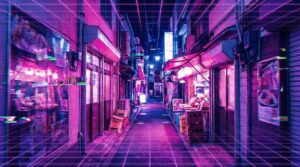
There’s no denying it: vending machine corners are strikingly photogenic. They have become a visual emblem of a particular side of Japan—futuristic, slightly detached, and bathed in neon light. This aesthetic has been repeatedly captured by photographers, both Japanese and international, and immortalized in anime, manga, and films. It represents the visual essence of cyberpunk. But what draws us so strongly to this image? It’s because it resonates with a fundamental Japanese aesthetic principle: discovering beauty in the ordinary and imperfect. This isn’t a constructed beauty, like that of a carefully designed temple garden or a sleek skyscraper. Instead, it is an emergent beauty, an accidental fusion of light, metal, and concrete that somehow works harmoniously. The enchantment lies in the contrast. It’s the sharp, clean, artificial glow of the machines piercing the organic darkness of night. It’s the vivid hues of the drink labels—a chaotic mosaic of branding—set against the muted, often weathered texture of the wall behind them. It’s the neon reflections on rain-slicked pavement, transforming a simple alleyway into something cinematic and profound. This is the real-life counterpart of the lo-fi beats channel you study to. The atmosphere is perfect because it feels genuine and un-staged. It’s not striving to be beautiful, and that’s exactly why it is. It embodies a sense of wabi-sabi, the appreciation of the transient and imperfect. The machines themselves may be dented or scratched. The stickers on them might be faded and peeling. The corner might be surrounded by overgrown weeds. Yet this imperfection adds character and tells a story. It’s a beauty that is lived-in and authentic, speaking to the passage of time and the quiet endurance of everyday life. In a sense, these corners are modern-day yokochō (the narrow, lantern-lit alleyways famous for tiny bars and restaurants). They are intimate, human-scale spaces carved out of the sprawling megalopolis. They offer a moment of visual poetry for those willing to pause and look, turning a simple errand into a brief aesthetic experience.
The Future is Automated (and Maybe a Little Lonely?)
So, what does the future hold for these luminous corners of Japanese life? On one side, they appear to be remnants of the 20th century—a cash-based system in an increasingly digital age. Many machines now accept IC cards like Suica or Pasmo, and some feature large digital touch screens. Yet the core model has remained largely unchanged for decades. On the other side, these machines feel more relevant than ever. They were the forerunners of the unmanned, automated retail experience that is now gaining global momentum. They are the natural predecessors to the staffless convenience stores and automated checkout systems emerging everywhere. In a way, Japan has been living in the automated future for quite some time. This leads us to a more thoughtful, critical question. While these machines symbolize trust, safety, and convenience, they also represent a society increasingly reducing human interaction in the name of efficiency. Each vending machine transaction replaces one less interaction with a local shopkeeper. Every corner store replaced by a row of machines means one less community hub and one less place for casual daily conversations. There is a subtle melancholy to this hyper-efficiency. The solitude offered by the vending machine corner is comforting, but it is also both a product of—and perhaps a contributor to—a society where people are becoming more isolated. Is the ultimate convenience of never needing to speak to another person for daily needs truly an unqualified good? It’s a complex question without an easy answer. The vending machine corner perfectly captures this duality: it is both a solution to and a symptom of urban loneliness. It is a quiet refuge existing because of a declining need for communal spaces. So next time you find yourself standing amid the hum and glow of a Japanese vending machine corner, pause for a moment. Appreciate the cold drink in your hand, certainly. But also appreciate the intricate cultural tapestry you inhabit. You are at the crossroads of post-war ambition, unwavering social trust, and a profoundly modern search for quiet in a noisy world. It’s not just a machine. It’s a silent storyteller, a midnight oasis, and a glowing, humming piece of the Japanese soul. Truly.