Yo, what’s the deal, fellow time travelers and vibe connoisseurs? Keiko Nakamura here, your local curator of the cool, the weird, and the wonderfully nostalgic. I’m coming at you live from Tokyo, but today we’re about to phase-shift, to slip through a crack in the fabric of modern Japan and land smack-dab in the middle of its most audacious, extravagant, and honestly, kinda wild era: the Bubble. We’re talking late 80s, early 90s. A time when the economy was in god mode, the Nikkei was hitting high scores like a gamer on a caffeine trip, and the whole country was riding a wave of seemingly infinite cash and even more infinite confidence. The motto was basically “go big or go home,” and Japan did not, under any circumstances, go home. Instead, it built. It built monuments of glass and steel, pleasure domes of marble and gold, and sprawling resort complexes so massive they looked like they were dropped onto the landscape by aliens with a taste for luxury.
This architectural fever dream left behind a legacy of concrete fantasies. Mega-resorts in scenic spots that screamed ambition, designed for a future of endless leisure that never quite panned out as planned. Now, you might have heard of “haikyo,” the art of exploring modern ruins. It’s a whole subculture, peeping into abandoned buildings and capturing their melancholic beauty. And let me tell you, the decaying husks of Bubble-Era hotels are a holy grail for haikyo hunters. They’re these majestic, silent titans slowly being reclaimed by nature, their dusty ballrooms and empty chapels telling stories of a party that ended decades ago. It’s a vibe, for sure. A powerful, poignant one. But let’s be real for a sec. Trespassing can be sketchy, dangerous, and legally messy. So I’ve gotta ask: why risk it for the biscuit when you can literally check in to a living, breathing time capsule? That’s the real 4D experience. You can sleep in the dream.
So that’s our mission today, should you choose to accept it. We’re going on a tour of Japan’s operational resort hotels that still rock that peak “faded glamour” aesthetic. These aren’t ruins; they’re survivors. They’re places where the over-the-top design, the sheer unnecessary scale, and the specific brand of 80s and 90s luxury have been preserved, sometimes intentionally, sometimes through sheer inertia. This isn’t about decay; it’s about patina. It’s about the lingering energy, the echoes in the cavernous lobbies, the soft hum of the era’s optimism that still vibrates in the walls. It’s a whole mood, a complex cocktail of nostalgia, wonder, and a little bit of that bittersweet feeling the Japanese call ‘mono no aware.’ So grab your conceptual Walkman, get ready to feel the texture of deep-pile carpets, and let’s dive into the glitch.
For a different kind of melancholic journey into Japan’s abandoned past, consider exploring the country’s ghostly mining towns.
The Cliffside Kingdom: Hotel New Akao, Atami
Welcome to the Showa-Era Citadel
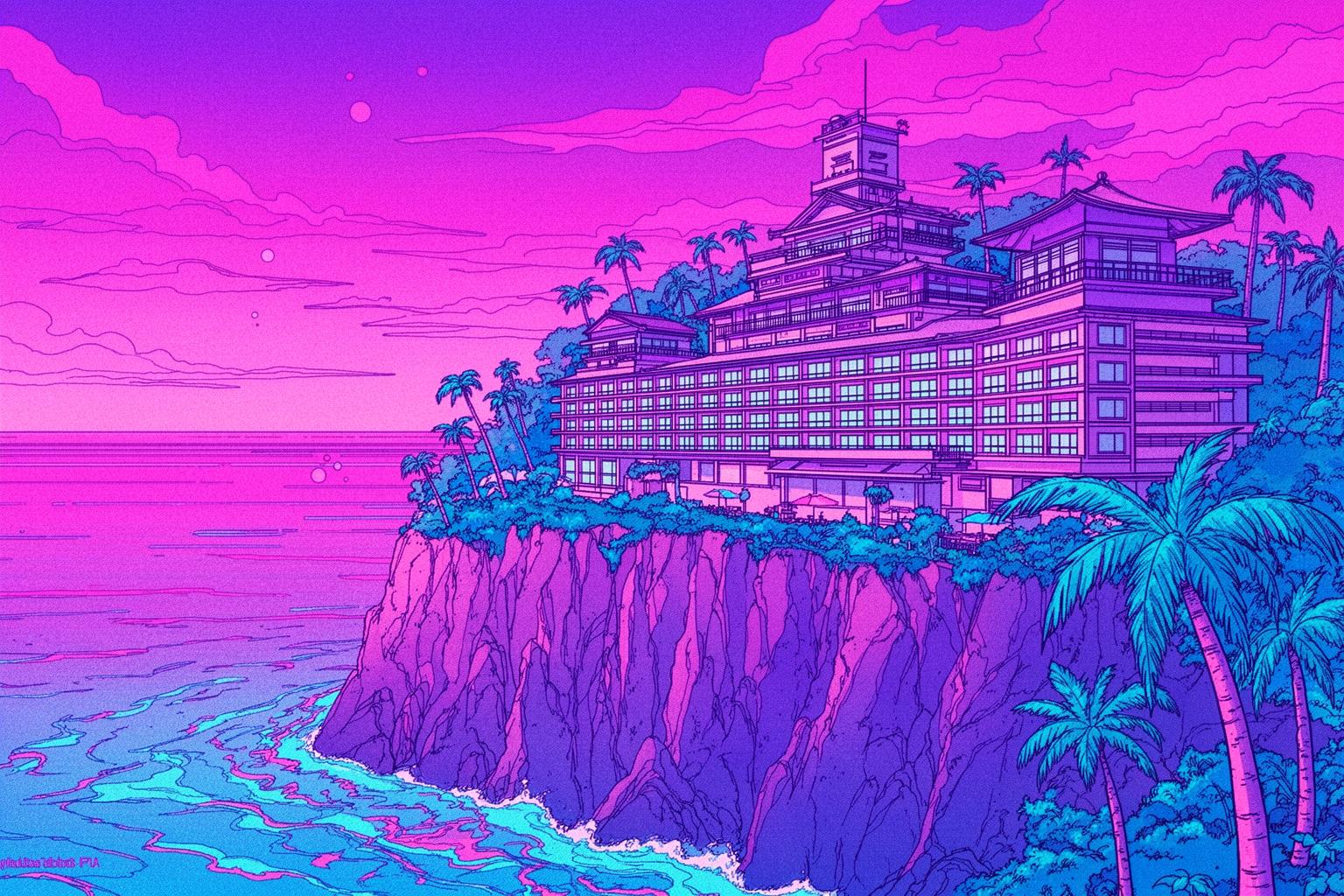
First, we’re off to Atami, a seaside city on the Izu Peninsula that acts as a living museum of Japan’s domestic tourism history. Atami thrived during the mid-Showa era as a bustling onsen town where company outings and family vacations were a regular ritual. Then came the Bubble, supercharging everything. Atami transformed into a playground for developers to realize their most extravagant visions. After the Bubble burst, like many similar towns, Atami entered a period of slow, graceful decline. That’s what makes it the ideal backdrop for our first exhibit: the iconic Hotel New Akao. This isn’t just a hotel; it’s a landmark. A fortress of hospitality. A citadel of Showa-era dreams clutching tenaciously to a cliffside. Calling it “oceanfront” barely does it justice—the hotel is literally integrated with the Nishikigaura cliffs, a remarkable engineering feat that epitomizes the Bubble Era’s fearless approach to challenging terrain. Viewed from the sea, it resembles a Bond villain’s lair; from the road, you enter through an unexpectedly modest gate before descending—into the dream.
The initial approach doesn’t prepare you for its scale. You wind down a narrow road into a parking structure seemingly carved from the rock itself. The air cools and the light dims. You’ve entered the mountain. From there, an elevator whisks you up to the lobby, where you ascend back into the light—but a different kind of light. It’s the filtered, chandelier-refracted glow of 1988. The first glimpse of the lobby is jaw-dropping. Vast. Almost cavernous. The soaring ceiling is adorned with chandeliers resembling crystalline sea creatures from another dimension. The carpet is a swirling vortex of outdated patterns and colors that somehow feel perfectly fitting here. Everything shines brightly: the marble floors, brass railings, and an impossibly long lacquered wood reception desk. Even with dozens of guests about, the expansive space feels oddly quiet, your footsteps softened by the deep-pile carpeting. You have arrived.
The Aesthetic: Peak Extravagance
Touring Hotel New Akao is like an archaeological dig into the heart of Bubble-era design. The hotel is a masterclass in maximalism. The color scheme is a rich blend of burgundies, deep sea blues, and gold—so much gold. It’s everywhere: trim, light fixtures, elevator doors. The very air seems to shimmer with a golden hue. The lobby lounge features a sunken conversation pit of grand proportions, filled with plush velvet armchairs arranged in intimate clusters spread far apart. It could host a G7 summit and still have space for a wedding reception. Immense glass windows offer panoramic, godlike views of Sagami Bay. The sheer confidence of the architecture is breathtaking, daring the ocean to match its drama.
The hallways to your room are an experience themselves. Long, impossibly long, stretching like cinematic dolly shots. The subdued lighting creates a moody, theatrical atmosphere. Every detail—the wallpaper, sconces, and door plaques—is a perfectly preserved relic. Upon entering your room, the first thing that strikes you is the view. Every room faces the ocean, a non-negotiable part of the hotel’s ambitious design. The Pacific becomes your personal widescreen. Rooms are spacious—a rarity in modern Japanese hotels. Furniture is heavy, solid, and built to endure, with chunky, rounded edges popular in the late 80s. Upholstered vinyl headboards, bathrooms with sturdy ceramic fixtures in beige or dusty rose—this is not the minimalist luxury of today, but a cozy, comfortable, slightly ostentatious luxury from another era.
Relics of the Boom Times
Hotel New Akao is a true time capsule, especially in its amenities, many running continuously since opening day. The crown jewel is the dinner show at the Main Dining Nishiki. This is no half-hearted entertainment attempt—it’s the real deal. The dining hall is a colossal, tiered theater that would put a Las Vegas casino to shame. Seated at your table, you enjoy a multi-course French-inspired dinner while a full-scale musical extravaganza unfolds on the massive stage below. Professional singers, dancers in glittering costumes, and a live band perform nostalgic numbers—old Japanese ballads and pop hits. The mostly older audience claps along, fully immersed. It’s surreal and deeply charming, a direct portal into Showa-era entertainment. You feel less like a tourist and more like an extra in a 1991 movie.
Then, there’s the onsen. No Bubble-era resort was complete without a sprawling, Roman-bath-scale hot spring complex, and New Akao delivers. Multiple baths indoors and out. The indoor pools are vast, tiled halls with high ceilings and enormous windows, sometimes featuring Greco-Roman statues for an extra touch of class. But the real magic is the rotenburo, the open-air baths perched on the cliff’s edge. Soaking in mineral-rich water, you hear waves crashing below and feel the salt spray on your face. It’s an elemental, powerful experience that connects you directly to the hotel’s dramatic setting.
But the hotel’s exploration doesn’t stop there. It’s a labyrinth. You’ll find a wedding hall with a chapel straight out of a sci-fi movie, all white curves and dramatic lighting. Conference rooms named for French palaces, a game arcade with a few vintage machines blinking in a dusty corner, and an expansive souvenir shop selling exclusive items. The hotel is linked by tunnels and escalators to its sister property, the Royal Wing, extending the territory. Don’t miss the Akao Herb & Rose Garden, a separate attraction on a nearby mountaintop connected by a branded shuttle. The entire operation’s scale and self-contained nature reflect the Bubble-era vision of a resort as its own self-sufficient pleasure universe.
Practical Vibe Check
Getting to this citadel is classic Izu. From Tokyo Station, hop on the Tokaido Shinkansen for a swift 45-minute ride to Atami Station. Upon arrival, look for the hotel’s shuttle bus. Even the bus feels like a throwback, and the winding coastal ride perfectly sets the mood. My tip: book a room in the main building—now known as the “Ocean Wing”—for the most authentic experience. Once there, the main attraction is the hotel itself. Set aside at least half a day to explore. Get lost in the corridors. Ride elevators up and down. Find a quiet lounge chair with an ocean view and simply sit. Listen to the subtle, piped-in BGM. Watch the light shift on the water. This is the main event. Don’t resist; let the hotel’s magnificent, quirky, wonderful atmosphere wash over you.
The Hokkaido Dream Palace: Rusutsu Resort
A European Village in the Middle of Nowhere
Alright, let’s shift from the seaside cliffs of Honshu to the vast, snowy wilderness of Hokkaido. Our next stop, Rusutsu Resort, is a different kind of Bubble-Era marvel. If Hotel New Akao represented dramatic, focused opulence, Rusutsu embodies explosive, sprawling, almost delirious ambition. This isn’t merely a hotel; it’s a ski resort, golf resort, and a full-scale amusement park, all woven together into one colossal monument to the idea that more really is more. Situated about 90 minutes from Sapporo, the journey itself builds the excitement. You drive through Hokkaido’s stunning landscapes of forests and mountains, and then, out of nowhere, this expansive complex of towers, rollercoasters, and faux-European architecture comes into view. It’s like discovering a theme park accidentally dropped in the middle of a national park. This was the Bubble dream in its purest form: a completely self-contained utopia of fun, regardless of how remote the location.
The resort is divided into several zones, linked by a delightfully retro monorail. The main hotel building, Rusutsu Resort Hotel & Convention, is where our tale begins. Stepping into the lobby is a sensory overload. It’s loud, colorful, and unapologetically whimsical. The designers clearly pursued a singular vision, which feels like a child’s fantasy realized by an army of architects with an unlimited budget. The entire space is themed as a fantastical European town viewed through a funhouse mirror. Cobblestone-patterned carpets, fake storefronts, and a general vibe of joyful absurdity abound.
The Aesthetic: Bizarrely Whimsical
Two features define the Rusutsu lobby and raise it to legendary status within Bubble-Era design. First is the two-story, genuine carousel, right in the hotel’s center. This isn’t a small decorative piece; it’s a full-sized, operational merry-go-round with gilded horses and twinkling lights, spinning slowly to cheerful carnival music. The image of families checking in, hauling ski bags and suitcases just feet from this whimsical machine, is pure surrealism. It completely knocks down any notion of stuffy, formal luxury and replaces it with pure, unfiltered fun.
As if that wasn’t enough, a few steps away stands the second icon: the talking tree. Situated in a small plaza, this enormous animatronic tree features a friendly, booming face that periodically comes alive to tell stories and greet guests. It’s deeply, delightfully weird and utterly charming. A relic from an era before smooth, impersonal touchscreens took over, it’s a clunky, endearing piece of analog magic that kids still flock to. These two elements set the tone for the entire resort: a place built for play, where you can forget the outside world and embrace the bizarre.
Beyond these focal points, the architecture is a wild mashup. The main hotel wing connects to Daniel Street, a huge shopping and dining area designed to resemble a European arcade, complete with a massive projection-mapping show on its ceiling that feels like a forgotten Epcot attraction. The effect is less a coherent design and more a collage of every fun idea the developers could imagine, all combined with infectious enthusiasm.
Living the High Life, 90s Style
The sheer scale of Rusutsu is central to its Bubble-Era DNA. The fact that you need to ride a monorail to get from the main hotel and amusement park zone to the Westin Rusutsu Resort—the quieter, more upscale tower—and the ski slopes says everything about the ambition here. This wasn’t just a place to stay; it was a destination to disappear into. The monorail ride itself is part of the experience, offering sweeping views of the entire complex and surrounding mountains, making it feel like you’re gliding through a real-life SimCity.
The activities on offer embody the all-in-one philosophy. In winter, it’s a world-class ski resort with legendary Hokkaido powder snow. In summer, the vast grounds come alive with an amusement park, featuring rollercoasters, a Ferris wheel, and dozens of other rides. The atmosphere is pure, classic fun. It may lack the polish of a Disney park, which to me is a big part of its charm. Multiple golf courses, a massive wave pool, and dozens of eateries scattered across the property serve everything from high-end sushi to food court pizza. You could spend a week here without eating at the same place twice.
Naturally, there’s also an onsen. The Rusutsu Resort Onsen is a large, public bath facility with views of the grounds. After a long day skiing or riding rollercoasters, soaking in the hot, mineral-rich water feels like a system reboot. It’s perhaps less thematically wild than the rest of the resort, offering a moment of classic Japanese relaxation amid the cheerful chaos.
Practical Vibe Check
Getting to Rusutsu requires a bit of travel, but that’s part of the allure. It feels like a pilgrimage. The most common method is a resort shuttle bus from Sapporo or New Chitose Airport. The ride takes you from the city deep into Hokkaido’s natural splendor. For the ultimate faded glamour experience, I highly recommend visiting during the shoulder seasons—late spring or autumn. The amusement park may be closed or operating on limited hours, and there’s no snow for skiing, but the resort is far quieter. The vastness combined with fewer guests creates an incredibly potent atmosphere. The grand, empty spaces and the cheerful music of the carousel echoing through an almost empty lobby make it feel as if you’ve rented out the entire wonderfully weird theme park for yourself. It’s a chance to truly appreciate the scale and ambition of the place in a contemplative, almost meditative way.
The Sun God’s Folly: Phoenix Seagaia Resort, Miyazaki
The Ghost of the World’s Greatest Beach
Now we head south, to the sun-soaked coast of Kyushu, in Miyazaki Prefecture. Here, nestled between the Pacific Ocean and a forest of black pines, stands perhaps the most legendary, infamous, and beautifully tragic symbol of the Bubble Era: the Phoenix Seagaia Resort. This was more than just a resort; it was a national venture, an enormous gamble to transform the quiet Miyazaki coastline into Japan’s answer to Hawaii or the Gold Coast. The ambition was immense, and its centerpiece was a creation so bold it still astounds: the Ocean Dome. It was the world’s largest indoor water park, a massive structure featuring pristine white sandy beaches, a computer-controlled artificial sky shifting from sunny day to sunset, a flame-spewing artificial volcano, and the world’s most ideal, perfectly consistent surfing waves. It was a technological wonder, a man-made paradise, the pinnacle of Bubble Era extravagance. And of course, it turned out to be an economic disaster. The Ocean Dome closed permanently in 2007 and was demolished in 2017. Yet its ghost—the sheer boldness of its memory—still haunts the entire resort, and that haunting is what makes visiting Seagaia today so profound.
The resort itself remains fully operational, anchored by a striking skyscraper: the Sheraton Grande Ocean Resort. This 45-story triangular tower is a stunning example of sleek 90s modernism. It rises like a futuristic shard of glass from the flat coastal plain, visible for miles around. Visiting here feels distinct from our earlier stops. It’s less about quirky charm and more about a grand, corporate, and somewhat sterile elegance. The dream here wasn’t whimsical; it was refined. It aimed to create a world-class, internationally recognized luxury destination.
The Aesthetic: Sleek, Grand, and A Little Empty
The heart of the Sheraton is its atrium. Oh, the atriums of the Bubble Era! They were the cathedrals of that time. But Seagaia’s atrium is different. Instead of being wide and sprawling, it’s astonishingly vertical. It’s a narrow, 43-story-high glass canyon rising straight up through the center of the building. Glass elevators glide silently along its height. At the bottom, there’s a lounge bar, “The Living Garden,” which from the upper floors appears as a tiny, manicured island in a vast, empty space. This atrium defines the Seagaia vibe. Architecturally breathtaking, clean, and flooded with light, it’s also so immense that it can feel profoundly empty and eerily quiet. The silence within this grand space carries the weight of absence; it’s the echo of a dream designed for ten times the people who actually inhabit it. It’s beautiful and heartbreaking—the very essence of faded glamour.
The guest rooms, many recently renovated, still reveal their 90s origins. They are exceptionally spacious, with huge windows offering breathtaking views of either the Pacific Ocean or the impeccably maintained greens of the Tom Watson Golf Course. From the 30th floor, observing the precise lines of the pine forest, the endless green of the course, and the deep blue ocean, you can almost sense the original vision. You see the blueprint of the paradise they aspired to build. The quiet elegance of the rooms, combined with that vast, solitary view, invites deeply contemplative moments.
Echoes of the Bubble
Though the Ocean Dome is no more, many other elements of the original grand design remain. The golf courses are a prime example. The Tom Watson Golf Course is a world-class, championship-level venue. During the Bubble Era, golf was the ultimate status symbol among Japanese executives, and having a course designed by a legend like Tom Watson was a huge lure. Today, these courses are immaculately kept, beautiful green expanses often visited by few. Walking them or simply gazing at them from your room, you grasp the intended clientele and lifestyle the resort was meant to serve.
The onsen complex, Shosenkyu, also remains. Situated in a separate, charming wooden building, it connects to the main hotel by a long, peaceful, covered walkway through the pine forest. The stroll itself is calming. The onsen is serene and elegant, with open-air baths nestled among the pines. It feels worlds apart from the sleek modernism of the hotel tower, a respectful tribute to traditional Japanese aesthetics within this larger, Western-influenced resort.
But the true experience at Seagaia is simply exploring the grounds and soaking in their scale. Wander through the massive convention center, the “World Convention Center Summit,” a venue built for international diplomatic events. Stroll the pine forest. Stand on the beach where the Ocean Dome once rose, and try to imagine the sheer, glorious absurdity of it all. The entire resort is a landscape of memory—a place for quiet reflection on dreams, ambition, and impermanence.
Practical Vibe Check
Seagaia is easily accessible, only a 20-minute drive or bus ride from Miyazaki Airport, which itself has a pleasant, semi-tropical, resort-like atmosphere. My tip for visiting Seagaia is to embrace the quiet. This isn’t a place for high-energy excitement but for mood and ambiance. Here’s the ultimate advice: in the evening, head to the bar at the top of the Sheraton tower. Order a classic, expertly made cocktail. Find a window seat, and just look out. Gaze over the dark Pacific Ocean on one side and the tranquil, empty resort landscape on the other. Feel the silence in the near-empty bar, the height of the tower, and the immense dream that was built here. It is one of the most sublime and melancholic travel experiences you can have in Japan—a moment of pure, unfiltered ‘mono no aware.’
The Shinkansen Ski Machine: GALA Yuzawa, Niigata
From Bullet Train to Gondola in 60 Seconds
Our final stop is a monument to a different, yet equally powerful, aspect of the Bubble-Era mindset: obsessive, technology-driven convenience. Welcome to GALA Yuzawa in Niigata prefecture, affectionately known as Japan’s “snow country.” The concept behind this resort is so outrageously bold, so perfectly Bubble-era, it sounds like science fiction. It is a full-scale ski resort whose base station is literally a Shinkansen bullet train station. Not nearby. Not a short walk away. The station is the resort. You board a bullet train at Tokyo Station, and in about 77 minutes, you disembark inside the ski resort’s main building. From the train platform, you can go straight to the ticket counter, the rental shop, the changing rooms, and then onto the gondola that carries you up the mountain. It offers the most seamless, futuristic, and absurdly convenient ski experience imaginable. This was the dream of the hyper-efficient Tokyoite: a ski day trip with zero wasted time, made possible by pouring an enormous amount of money into infrastructure.
The Aesthetic: 90s Functional Futurism
Unlike our previous examples, GALA Yuzawa’s aesthetic isn’t about lavish luxury or dreamy fantasy. Its appeal lies in its sleek, corporate 90s vision of the future. The main building, named Cowabunga (yes, really), is a hallmark of functional design from the era. Think less gold leaf and chandeliers, more curved lines, chunky plastic fittings, and a color palette dominated by teal, magenta, and gray. The signage, typography, and shape of the information counters all scream early 90s. It’s the kind of design you’d expect in a futuristic movie made circa 1992. It’s clean, efficient, and now wonderfully retro.
The ski rental area is the most impressive space: a vast, factory-like hall designed for a single purpose—to process thousands of people with maximum efficiency. Rows upon rows of skis and snowboards, long counters, and a streamlined flow through the process make it a masterpiece of logistical design. In quieter moments, it feels like a decommissioned airport terminal for a forgotten space airline. The food court is another perfect time capsule: a huge, open space with massive windows overlooking the gondola and the base of the slopes. The plastic trays, the ticket-machine ordering system, and the menu of Japanese comfort foods like katsu curry and ramen all contribute to the authentic 90s ski resort atmosphere.
Riding the Bubble Wave
The entire GALA Yuzawa experience is about flow. The journey from the Shinkansen platform to the mountain’s summit is a perfectly choreographed choreography of convenience. The main gondola ride, known as the “Diligence,” is a highlight. As you ascend, you float above the town of Yuzawa and see the valley spread out below, revealing the scale of the operation. On the slopes, the infrastructure is top-notch: fast lifts, well-maintained courses, and rest houses scattered across the mountain that often retain the same 90s functional charm. Skiing or snowboarding here feels like being part of a finely tuned machine, a system perfected decades ago.
And after a day on the slopes, what could be more convenient than an onsen right inside the station building? SPA GALA-NO-YU is the final touch, including a hot spring, a fitness pool, and a jacuzzi. You can ski all day, enjoy a relaxing soak, and then walk a few steps to hop back on the Shinkansen to Tokyo—all without ever stepping outside. It’s that kind of ludicrous, all-in-one convenience born from the boundless optimism and deep pockets of the Bubble era.
Practical Vibe Check
Access is, of course, the easiest of all our destinations. Simply book a ticket on the Joetsu Shinkansen from Tokyo or Ueno Station that goes directly to GALA Yuzawa station (note: the station operates only during the winter season). For the purest dose of faded glamour, visit on a weekday. The resort was designed to handle massive weekend crowds from Tokyo. On a Tuesday or Wednesday, the crowds thin out while the enormous infrastructure remains. Wide-open slopes, a half-empty food court, and acres of rental skis waiting patiently on racks—it’s on these quieter days that you truly appreciate the grand, slightly absurd scale of the entire operation. You feel less like a customer and more like an urban explorer discovering a fully powered, perfectly preserved vision of a 90s future.
Final Thoughts: More Than Just a Vibe
So there you have it: a journey through four vibrant, living monuments to Japan’s most fascinating economic and cultural era. These places—the cliffside kingdom of New Akao, the whimsical dream palace of Rusutsu, the beautiful yet lonely tower of Seagaia, and the hyper-efficient ski hub of GALA Yuzawa—are more than just kitschy throwbacks or Instagram backdrops. They are living museums, tangible reminders of a time filled with unbridled optimism, wild creativity, and occasionally, glorious folly.
Visiting them offers a unique form of time travel. It’s an experience that engages all your senses. You feel the softness of the carpets, see the bold color palettes, hear the echoes in the vast lobbies, and savor the nostalgia in the grand dining rooms. You sleep in the very rooms where the dream of the Bubble Era unfolded. The experience is simultaneously beautiful, melancholic, humorous, and deeply moving. It reveals a side of Japan you won’t find in the ancient temples of Kyoto or the neon-lit streets of Shibuya. This is a story of a more recent past—one that still hums with a powerful, electric energy.
So next time you’re planning a trip, consider stepping off the beaten path and into a time-slip glitch. Check in, wander the endless halls, and listen for echoes. The Bubble never truly burst; it just got real, real quiet. And within that quiet, you’ll discover something truly special. Peace out.