Walk down almost any major street in a Japanese city. Your senses are already working overtime, decoding the script on glowing signs, the jingles from storefronts, the murmur of the crowd. Then, you feel it before you see it: a wave of sound, a rhythmic, metallic roar that seems to leak from the very walls of a building. You look up and see a facade plastered with neon, flashing with characters from anime you might recognize, promising luck, fortune, and an escape. You’ve found a Pachinko Parlor. Peeking through the automatic sliding doors is like staring into another dimension—a cavern of light and noise, filled with rows upon rows of people sitting shoulder-to-shoulder, their faces illuminated by tiny screens, their bodies motionless except for a single hand delicately twisting a knob. The air, once thick with a haze of cigarette smoke, is now aggressively purified but still carries an electric charge. The sheer sensory violence of it all hits you like a physical blow. The question that immediately forms in your mind isn’t just ‘What is this?’ but ‘Why? Why would anyone choose to be in here?’ This isn’t just a game; it’s an environment so extreme, so overwhelming, that its popularity feels like a profound cultural riddle. It looks like a casino, sounds like a factory, and feels like the inside of a pinball machine, yet for millions of Japanese people, it’s a daily or weekly ritual. It’s a place of solace. How can a space designed for maximum distraction lead to a state of meditative focus? How can this deafening chaos be a sanctuary? This isn’t just about gambling or killing time. This is about understanding a uniquely Japanese method of managing the pressures of a society that demands so much. To get it, you have to step inside, past the noise, and into the mind of the player, to find the quiet center of the sensory storm.
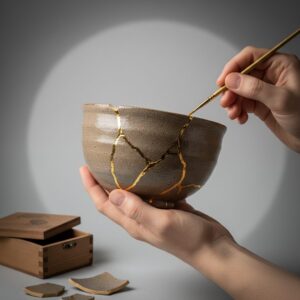
This paradoxical pursuit of finding peace in imperfection mirrors the principles of Kintsugi, the Japanese art of embracing flaws.
Deconstructing the Machine: The Anatomy of a Pachinko Parlor
To begin to grasp the ‘why,’ you first need to understand the ‘what.’ A pachinko parlor is a carefully crafted environment where every flash of light, every digital chime, and every cascade of steel balls is designed to evoke a precise psychological response. It’s a realm founded on legal loopholes, sensory bombardment, and visual allure. This is not merely a room filled with games; it’s a finely calibrated mechanism for shifting consciousness, all rooted in the strange legal balancing act it performs.
Beyond Just a Game: Officially Not Gambling
Here lies the first and most vital piece of the puzzle, the foundational absurdity supporting the entire multi-billion-yen industry: pachinko is not, legally, gambling in Japan. To an outsider, this is plainly absurd. You insert money, you play a game of chance, and you hope to leave with more money than you started with. That sounds like gambling. Yet Japanese law rigorously restricts gambling, with exceptions only for a few state-sanctioned activities like horse racing, boat racing, and the lottery. So how does pachinko operate? The secret is a brilliant exercise in plausible deniability called the ‘three-shop system’ (三店方式, santen hōshiki).
Here’s how it works. Instead of feeding cash directly into the machine, you spend money to buy or rent a number of small steel balls from the parlor. For example, you might pay 1,000 yen for 250 balls. You load these into the machine and start playing. When lucky and hitting a jackpot, the machine doesn’t dispense coins; it releases a surge of steel balls that fill trays at your feet. When finished, you take these trays to a central counter inside the parlor, where an employee processes them with an automated counting machine that prints a receipt. You then bring this receipt to the prize counter—also inside the parlor—to exchange your ball count for prizes. These prizes aren’t cheap toys or low-value gadgets; they’re tiered. For fewer balls, you get snacks or drinks, but for a large quantity, you receive ‘special prizes’ (tokushu kehin), typically small sealed plastic containers holding a tiny piece of gold.
Here’s the clever trick. You take the gold token and leave the pachinko parlor. Nearby, often just around a corner or down a narrow alley, stands a completely separate, unrelated business—often a small booth with a curtain resembling a currency exchange. You slide your gold token through a slot, and an unseen attendant returns the equivalent amount in cash. The three shops are: 1) The pachinko parlor, where balls are exchanged for prizes. 2) The TUC Shop (Tokyo Union Circulation), which buys prizes in exchange for cash. 3) A wholesaler who purchases gold tokens from the TUC shop and then sells them back to the pachinko parlor to reuse. Because the parlor never hands out cash directly, no gambling technically takes place. It’s an intricate ‘don’t ask, don’t tell’ arrangement, exemplifying the Japanese notions of tatemae (the outward facade) and honne (the underlying reality). Everyone understands what’s going on, yet the system’s structure preserves the illusion, keeping the entire industry in a legal gray zone while remaining functional. This sophisticated dance powers everything you experience inside.
The Symphony of Steel: Sound as a Purposeful Element
The most immediate and overwhelming aspect of a pachinko parlor is its noise. It’s a tangible force, pressing against your ears and chest. But it would be a mistake to regard it as mere background noise. Instead, it’s a deliberately composed symphony of immersion and information. The soundscape is the parlor’s primary tool to isolate each player and create a personalized bubble of experience.
At its base is the constant, rhythmic clatter of thousands upon thousands of steel balls—metallic rain producing a high-frequency white noise. This auditory wall drowns out outside distractions: the city, conversations, even intrusive thoughts. It establishes a sonic cocoon around your machine. Inside this cocoon, your machine communicates with you through a unique set of digital sounds. There are soft jingles signaling near-misses, heightening suspense. Specific musical cues tied to the anime or movie theme of the machine indicate when you’ve entered a ‘reach’ (rīchi) mode—a high-stakes animation suggesting a potential win. These sounds form a distinct language. Experienced players don’t need to constantly watch the screen; they understand the game’s status through audio cues alone.
Then comes the jackpot. When a player hits a ‘fever’ (fībā) or ‘ōatari’ (大当たり), the machine erupts into a triumphant cacophony. A celebratory anthem blares, lights flash wildly, and a pre-recorded voice congratulates the winner. This auditory spectacle serves two functions. For the player, it delivers a powerful dopamine surge, a crystal-clear signal of victory. For everyone in the parlor, it acts as an enticing reminder that winning is possible. It punctuates the continuous drone of play with moments of ecstatic release, fostering a shared anticipation. Though you may not know the person three seats away, when their machine erupts, you share the thrill vicariously. The sound isn’t a mere byproduct; it is the experience. It both isolates and connects, creating a focused immersion impossible to achieve in silence.
A Visual Feast of Controlled Chaos
Matching the auditory onslaught is an equally intense visual spectacle. Modern pachinko machines have evolved beyond simple boards of pins and nails. They are advanced entertainment devices, each centered around a large, high-definition LCD screen where the real drama unfolds.
Their aesthetics are extravagant, heavily borrowing from popular culture. Machines feature themes from blockbuster anime like Evangelion or Attack on Titan, historical samurai dramas, pop idol groups, and classic monster films. The design is deliberately maximalist. The screen is in constant motion, filled with animations, flashing numbers, and dramatic cutscenes meant to captivate the player’s attention, especially during long intervals between wins.
These visuals are not merely decorative; they comprise a complex semiotic system that players learn to interpret. Animations of characters powering up, the colors of flashing text, specific event sequences—all are part of the enshutsu (演出), or game production/direction. They signal the probability of a win. A weak enshutsu might indicate a 5% chance of jackpot, whereas a rare, intense enshutsu could guarantee one. This system transforms the player from passive viewer to active decoder. They constantly scan the screen for signs, hoping to see the rare animation that predicts victory. It creates a continuous feedback loop of hope and anticipation. Even when losing, the machine delivers a steady succession of ‘near misses’—dramatic almost-wins that suggest success is just ahead. This visual language traps players, turning a simple random number generator into a compelling narrative of struggle and potential triumph.
The Player’s Mindset: Finding Sanctuary in the Sensory Storm
Having analyzed the environment, we can now return to the central question: why? The answer resides in the psychological state this environment is designed to evoke. For many players, the pachinko parlor is not a source of stress but a place of release. It functions as a modern, secular temple where one can attain a state of mind increasingly rare in the outside world. This sanctuary, crafted from noise and light, offers an escape from the demands of a highly structured society.
The Zone: Reaching “Mushin” (無心) Amidst Distraction
In traditional Japanese arts such as Zen archery and calligraphy, there is the concept of mushin (無心), meaning ‘no mind’ or ‘mind without mind.’ It describes a state of effortless action in which body and mind are perfectly aligned, and conscious thought vanishes. The archer doesn’t consciously aim; the arrow finds its target naturally. The calligrapher doesn’t deliberate over each stroke; the character flows effortlessly onto the page. This state embodies pure focus, free from ego and self-anxiety. Paradoxically, the pachinko parlor has become one of the most common places for the average Japanese person to experience a modern, technological interpretation of mushin.
Consider the player’s experience. Sitting at the machine, the overwhelming soundscape washes over them, displacing nagging worries from work or social obligations. The flashing lights and vibrant animations command their full visual attention. Their consciousness narrows to one simple task: controlling the flow of silver balls. One hand rests on the knob, making subtle adjustments to the spring-loaded plunger. A slight turn right sends the balls too far; a slight turn left leaves them short. The objective is to find the ‘sweet spot,’ the perfect trajectory that directs the balls toward the ‘start chucker’ at the board’s center. This demands constant, delicate focus. The mind becomes fully absorbed by this simple, repetitive, yet skill-based task, leaving no room for extraneous thoughts. Past and future fade; only the present moment, the feel of the knob, and the path of the balls remain. This is the pachinko ‘zone,’ a form of enforced meditation. You cannot be anxious about an impending deadline when your brain is engrossed in processing the sensory chaos of a potential jackpot. This sensory overload is intentional—it’s what enables the ‘no mind’ state by short-circuiting the brain’s anxious, overthinking tendencies, providing a temporary but profound sense of freedom.
A Space of Anonymity in a High-Context Culture
Japanese society is often characterized as ‘high-context,’ meaning communication depends heavily on unspoken norms, social hierarchies, and shared understanding. There is a strong emphasis on the group over the individual, and constant, subtle pressure to maintain harmony (wa, 和) and fulfill one’s social roles. You are an employee, a parent, a neighbor, a subordinate, a senior—each role accompanied by intricate behavioral expectations. The pachinko parlor is one of the rare public spaces where all of that is stripped away.
Once seated at your machine, you become utterly anonymous. Interaction is not expected; indeed, speaking to the player beside you is considered a significant breach of etiquette. There is no small talk, no need to perform social roles. Your job title, family background, personal achievements, and failures mean nothing in the parlor. You are reduced to your purest essence: a player at a machine. This anonymity offers powerful relief. It is a space to be ‘alone, together.’ Surrounded by others sharing a common experience, you remain entirely isolated within your own sensory bubble. You need not worry about saying the right thing, using the proper polite language, or maintaining appearances. This temporary erasure of social identity serves as a crucial release valve for the accumulated pressures of everyday life. It stands in stark contrast to Western pubs or cafes, where social interaction is the main focus. Here, social dis-interaction is the goal, and for many, it provides a deeply comforting and necessary escape.
The Ritual and Routine
Humans find solace in ritual, and playing pachinko is steeped in it. For regular players—the salaryman dropping by after work, the housewife playing in quiet afternoon hours, the retiree who incorporates it into their daily routine—the process itself offers stability. The ritual begins before entering the parlor: selecting which one to visit, sometimes guided by recent payout statistics found in specialty magazines or online. Inside, there is the ritual of walking aisles, ‘reading’ machines, sensing which might be ‘hot.’ Some players observe personal rituals, such as cleaning the machine’s screen and knob before playing or choosing machines bearing specific numbers.
Then comes the core physical ritual: playing itself. The continuous, focused turning of the knob, the practiced scooping of balls from the lower tray to refill the loader, the rhythm of play—all combine into a familiar, predictable dance. In a chaotic, uncontrollable world, the pachinko machine offers a small universe the player can somewhat manage. Although jackpots are random, the player’s control over the knob provides a vital sense of agency. They are not passively pressing a button as on a slot machine; they actively engage in the game’s flow. This sense of control, regardless of how illusory it may be regarding the outcome, is psychologically essential. The routine—the recognizable sounds, predictable actions, and enclosed space—provides a structured escape, a reliable method to decompress and reset the mind after navigating the unpredictable complexities of daily life.
The Cultural and Historical Context: From Post-War Pastime to Modern Enigma
Pachinko’s peculiar status in Japanese society did not emerge in isolation. It is the outcome of a distinct historical path, transforming from a simple children’s toy into a complex, quasi-legal industry that reflects some of the fundamental tensions and contradictions of modern Japan. Its history tells a story of post-war opportunism, social hierarchy, and technological competition, all of which have shaped the pachinko parlors we see today.
A Child’s Toy Matures: The Origins of Pachinko
The predecessor of the modern pachinko machine was an American game called the ‘Corinthian Bagatelle,’ a straightforward tabletop game where players used a plunger to shoot balls through a field of pins. These games were imported to Japan in the 1920s and adapted as a children’s pastime, originally in candy stores where kids could win sweets. The name ‘pachinko’ likely derives from the onomatopoeia capturing the sound of the balls striking the pins: ‘pachi-pachi.’
Its evolution into an adult amusement and a vast industry was directly tied to World War II. In the ruins of post-war Japan, people desperately sought any form of affordable entertainment and distraction. Factories that had once supported the war effort were repurposed, and pachinko parlors began to appear amid the devastated urban landscapes. They were among the first and most accessible leisure options for a demoralized and impoverished population. In a period of severe scarcity, the chance to win a prize—even as modest as a pack of cigarettes or a bar of soap—proved highly enticing. The game offered a small spark of hope and a means to escape the harsh realities of everyday life. It became deeply rooted in the working-class social fabric during Japan’s rapid post-war economic revival, establishing itself as a national pastime long before other entertainment forms gained widespread popularity.
The Gray Area: Pachinko’s Complex Social Standing
Despite its widespread popularity, pachinko has never been viewed as a particularly respectable activity. It occupies a borderline social space, often linked to addiction, financial hardship, and a somewhat shady underworld. This reputation is not entirely baseless. The industry’s existence in a legal gray zone historically made it vulnerable to influence by organized crime, or Yakuza, although significant police crackdowns and corporate consolidation have greatly reduced this connection in recent years.
An even more urgent issue is gambling addiction. The game’s immersive, escapist nature makes it highly addictive for a susceptible segment of players. Stories of individuals losing their savings, families, and even their lives to pachinko addiction frequently appear in Japanese media. The government is aware of this problem and has periodically intervened to limit the industry’s excesses by restricting maximum payouts and regulating machine volatility. These measures aim to make it harder to win large sums quickly, thereby lessening the addiction risk, but the core problem persists.
Adding further complexity is the industry’s strong connection to the Zainichi Korean community (ethnic Koreans who are permanent residents of Japan). In the post-war period, discriminatory barriers made it difficult for Zainichi Koreans to enter many mainstream professions. Fringe industries like pachinko were more accessible, resulting in a significant proportion of parlor owners being of Korean descent. This has occasionally subjected the industry to nationalist criticism and linked its fate to the complicated and often tense relations between Japan and the Korean peninsula.
The Machine’s Evolution: From Analog Pins to Digital Spectacles
The experience of playing pachinko has changed dramatically over time, driven by advances in technology. The earliest machines were fully analog. They were simple vertical pinball-style devices where the player’s skill in launching the ball at the right speed could genuinely affect the outcome. Some skill-based machines, called ‘hane-mono’ (羽根物, literally ‘wing things’), still exist and have a dedicated group of enthusiasts. In these games, getting a ball into the central target causes small wings or flippers to open, temporarily creating an easier path to the jackpot.
However, beginning in the 1980s, the industry underwent a profound shift with the advent of ‘deji-pachi’ (デジパチ, digital pachinko). These machines featured a digital slot machine on a central screen. The mechanics changed fundamentally: while the player still launches balls onto the playfield, the ultimate result is no longer determined by the ball’s physical path through the pins. Instead, when a ball falls into the ‘start chucker,’ it triggers an internal random number generator (RNG). The elaborate animations and dramatic ‘reach’ sequences that follow are purely theatrical—the outcome has already been decided by the machine’s microprocessor. This change turned pachinko from a subtle skill game into one of pure chance and endurance. The player’s role is no longer to skillfully guide the ball, but simply to keep feeding balls into the start chucker as efficiently as possible while waiting for the RNG to favor them. The dazzling enshutsu of modern machines is a direct response to this shift, designed to keep players entertained and hopeful during longer losing streaks, masking the cold, random nature of the game’s core.
Is This For You? The Foreigner’s Experience in the Pachinko Palace
So, you’re curious about the paradox. You want to dive into this sensory onslaught and seek your own zen. However, the imposing facade, the overwhelming noise, and the rows of silent, focused players can be quite intimidating for a newcomer, especially a foreigner. The good news is that it’s more approachable than it seems. While it’s not exactly a tourist hotspot, stepping into a parlor for a brief session can offer a fascinating cultural experience—a short immersion into a side of Japan you won’t encounter in temples or gardens.
A Guide to Your First Spin: Breaking the Barrier
Forget about trying to talk to anyone. Your first interaction will be with a machine. Look for a vending machine near the entrance that sells pre-paid cards. Insert cash (typically 1,000, 5,000, or 10,000 yen notes) and receive a plastic card in return. This is your currency. Now, explore the aisles. Don’t be shy. Find an empty seat at a machine that catches your eye—maybe one featuring an anime you recognize. The machines are usually arranged by the ‘price’ of their balls. The most common are 4-yen and 1-yen pachinko. For beginners, 1-yen pachinko is highly recommended since your money will last much longer.
Once you’re seated, look for a slot on the left side of the machine to insert your card. Then press the ‘ball rental’ button (玉貸, tamakashi). A stream of balls will fill the top tray of your machine. Now for the main event. Find the round knob below the bottom right of the playfield. Rest your hand on it and turn it slightly to the right. This will launch a single ball. Turn it further, and a stream of balls will shoot out. Your goal is to get those balls into a small gate near the center of the board called the ‘start chucker.’ Each ball that enters the chucker spins the digital slot machine on the screen. The trick is to find the sweet spot with the knob—a position that consistently aims the stream of balls toward the center. That’s the ‘skill’ part. From there, you just watch and wait. If the numbers on the screen line up—typically three 7s for the jackpot—you’ve hit the ōatari. The machine will instruct you on what to do next, usually telling you to shoot balls toward a specific gate called the ‘attacker’ that will open and close, rewarding you with a flood of winning balls.
Reading the Room: Etiquette and Unspoken Rules
The most important rule is to stay in your own bubble. The space around your chair, your machine, and your ball trays is your personal territory. Never, ever touch another player’s machine or their balls—it’s considered extremely rude. Don’t stand behind someone and watch them play for a long time; it can feel intrusive or like you’re trying to steal their luck. The environment is anonymous, not communal. If you need to take a break, you can ‘claim’ your machine. People often leave a pack of cigarettes or their phone on the console to signal the seat is taken. However, if a machine is in the middle of a jackpot, you absolutely cannot leave it.
If you encounter a problem, like balls getting jammed (tamazumari), don’t try to fix it yourself. Every console has a ‘call’ button (呼び出し, yobidashi). Press it, and a staff member will quickly come to assist. They’re experienced with all sorts of issues and will be happy to help, even if there’s a language barrier. Pointing and gestures work perfectly. Staff are the only people you really need to interact with inside the parlor.
The Final Exchange: Cashing Out Your Winnings
If you’re lucky and finish your session with more balls than you started with, congratulations. Now you need to complete the three-shop-system ritual. First, press the card return button on your machine to eject your prepaid card (which may still have some yen left on it). Then, use the call button to summon a staff member. They will bring a large plastic box to your seat, and you’ll pour all your winning balls into it. The staff will carry the box to the automated counter, which will issue a receipt with your total ball count. Take this receipt to the in-house prize counter and hand it to the attendant. They’ll likely point you toward a display of ‘special prizes.’ You select the prizes corresponding to your winnings. They will hand you sealed gold tokens. With these in hand, you leave the parlor. Now for the final step: ask staff ‘TUC wa doko desu ka?’ or simply ‘exchange?’ They will usually discreetly point you in the right direction. Find the little window, slide your prize through, and receive your cash. You have successfully navigated the pachinko paradox.
The Future of Pachinko: An Analog Relic in a Digital World?
Despite its cultural importance, the pachinko industry faces an uncertain future. Its heyday is long behind it. The number of players and parlors has steadily declined for more than two decades. The core demographic is aging, and younger generations are not embracing the habit with the same enthusiasm. They have access to other, more convenient, and often cheaper forms of entertainment directly on their smartphones. Mobile gacha games provide a similar cycle of chance and reward without needing to visit a noisy, smoke-filled (or formerly smoke-filled) parlor.
Moreover, the legal landscape is changing. The passage of the Integrated Resort (IR) bill in 2018 opened the door for Las Vegas-style casino resorts in Japan. Although progress has been slow, the eventual introduction of legal, state-sanctioned casinos presents an existential threat to the gray-market pachinko industry. Why deal with the complicated three-shop system when you can simply go to a glamorous casino and win cash outright?
The industry is attempting to evolve. New parlors are being designed to be cleaner, brighter, and more inviting. Many have gone entirely non-smoking, a significant departure from their traditional image. They are adding more comfortable seating, providing free Wi-Fi, and striving to create a more pleasant atmosphere to attract a broader audience, including more female players. They are also increasing collaborations with popular anime and video games to appeal to a younger, pop-culture-savvy crowd.
Ultimately, pachinko is more than just a game or a form of quasi-gambling. It is a cultural institution that, for over seventy years, has served as a vital psychological outlet in a society that often values conformity and restraint. It embodies profound contradictions: isolating yet communal, chaotic yet meditative, a game of chance that imparts a sense of control. To dismiss it as merely a noisy, tacky distraction is to overlook a compelling insight into the Japanese psyche. It exposes a deep-rooted need for spaces of anonymous escape, a cultural affinity for enduring ritual, and the strange, creative ways a society carves out moments of mushin—pure, unthinking focus—in an overwhelming modern world. The clatter of those tiny steel balls is, in its own way, the sound of a nation decompressing.