You’ve probably seen the pictures, even if you didn’t know what they were. Impossibly large, sparkling eyes. Skin so smooth it looks like polished porcelain. Legs that seem to stretch for miles. And all of it covered in a chaotic riot of digital glitter, hearts, stars, and brightly colored text. This is the world of Purikura, a universe away from the drab, four-for-a-dollar photo booths you might find in a mall back home. In Japan, these souped-up machines aren’t just for novelty snapshots; they are the epicenters of a complex and enduring social ritual, a subculture built around the creation, decoration, and collection of tiny, sticky-backed artifacts.
To the casual observer, it’s just a photo. But that’s like saying a handwritten letter is just a collection of words. The act of taking Purikura is a performance. The frantic, timed scramble to decorate the photos is a collaborative art project. And the final product—a sheet of glossy stickers—is not a mere keepsake but a tangible form of social currency. It’s a token of friendship, a badge of belonging, and a meticulously curated record of one’s social life. This isn’t about capturing reality. It’s about manufacturing a shared, idealized memory. To understand this phenomenon is to understand something essential about friendship, self-expression, and the power of the tangible object in a relentlessly digital age. We’re going beyond the flash of the camera to explore the intricate culture that happens after the picture is taken, where the real art of Purikura truly begins.
This culture of manufactured, shareable moments finds a parallel in other uniquely Japanese social hubs, such as the konbini functioning as a real-life RPG save point.
The Anatomy of a Purikura Session
Entering the Purikura section of a Japanese game center, or gesen, is an overwhelming sensory experience. The air vibrates with a dozen competing J-pop anthems, each blasting from a different machine. The area resembles a canyon of towering, brightly lit booths, their surfaces covered with images of models whose features have been digitally enhanced into a hyper-cute aesthetic. It’s intense, loud, and for newcomers, completely bewildering. But for its target audience, this place is a sanctuary. And within this sanctuary, a very particular ritual is about to begin.
Step One: The Machine and The Choice
Choosing a Purikura booth is no casual decision. It’s a strategic choice made with the seriousness of a general planning a campaign. Groups of friends gather closely, pointing and discussing. The decision depends on the machine’s specific features, prominently advertised with bold graphics and catchy buzzwords. One machine might promise the most natural-looking large eyes, known as deka-me. Another might focus on bihada, or the beautiful skin effect, which smooths away every pore and blemish. A third could offer an advanced leg-lengthening filter, while a fourth features exclusive collaboration backgrounds with the newest anime or Sanrio characters.
This choice reflects the group’s desired outcome. Are they aiming for a classic, ultra-cute look? A more mature and fashionable style? Or a lively, character-themed shoot? The technology inside these booths is constantly advancing, with companies like FuRyu and Atlus competing fiercely to provide the most appealing digital beautification. The booth selected establishes the aesthetic foundation for the memory they’re about to create. It’s the vital first step in a process of intentional self-curation.
Step Two: The Performance Inside the Booth
After selecting the machine and inserting the coins, the curtain closes, enclosing the group in a small, private space. The interior is simple, usually just a green screen and a camera. Then the frenzy starts. A cheerful, high-pitched female voice bursts from a speaker, energetically guiding the participants. A timer appears on the screen. The pressure mounts.
What follows is a rapid-fire performance of rehearsed poses. The camera snaps six to eight shots in quick succession. There’s a shared vocabulary of standard, or teiban, poses everyone knows: the peace sign (naturally), the hand-heart, the “crying” pose with fists rubbed under the eyes, the “toothache” pose with a hand on the cheek highlighting the jawline. Although on-screen prompts suggest poses, experienced groups often bring their own pre-planned routines. It’s a frenzied, often hilarious dance against the clock, a communal moment of playful silliness that forms a key part of the bonding experience. You have only seconds to coordinate, pose, and reset before the next flash. There’s no room for shyness; only for full commitment.
Step Three: The Rakugaki Arena
Taking the photos is only the beginning. The main event follows immediately at the rakugaki (doodling or graffiti) station. Two styluses hang beside a large touchscreen, where the newly captured photos appear, ready for transformation. A timer, usually just a few minutes, starts counting down ominously. This is where creativity and personalization truly shine, a masterclass in fast-paced collaboration.
With quick, practiced motions, the friends divide tasks. One may begin adding text—the date, their names, an inside joke, the event they’re celebrating—while the other applies digital stamps. The options are overwhelming. Libraries brim with hearts, stars, sparkles, and food icons. Tools allow virtual makeup: lipstick, blush, even extra eyelashes. Hair color can be changed, faces slimmed, or a soft-focus light applied. The goal is to embellish, to contextualize, and to transform generic photos into unique keepsakes that declare this was us, on this day. The frantic energy of two people working together, shouting suggestions and passing the stylus back and forth, is the beating heart of the Purikura experience. When the timer runs out, the creation is finalized, and the machine prints the glossy sheet of stickers.
From Photo to Artifact: The Culture of Collecting
The hum and whir of the printer mark the final phase of the in-booth ritual. Moments later, a warm, laminated sheet of photos slides out of a slot. But the process isn’t finished yet. This photo sheet is a shared resource that must now be processed and distributed, cementing its role as a social artifact. The shift from collective creation to individual ownership follows its own set of unwritten rules.
The Cutting Ceremony
Most Purikura booths feature dedicated spaces for the next step: small, high-top tables equipped with scissors, often tethered to the table itself. Here, the group partakes in the “cutting ceremony.” They carefully cut along the perforated lines, separating the sheet into individual stickers. This act is both practical and symbolic—the moment the group creation is divided among its members. Decisions are made about who takes which photo. Frequently, duplicates are printed so everyone can keep a copy of the best group shot. The care taken in cutting and handling these tiny photos reflects their perceived importance. They are not simply disposable prints but cherished mementos of a shared experience.
The ‘Puri-cho’: An Analog Archive in a Digital Era
So where do all these little stickers end up? For dedicated collectors, they have a special home: the Purikura-cho, or Print Club book. This is a particular notebook—often a small binder with glossy, non-stick pages—crafted expressly for preserving Purikura. These books are treasures, tangible and physical timelines of a person’s social life, especially throughout their teenage years.
Flipping through someone’s puri-cho is like exploring a museum of their friendships. Pages overflow with stickers from different periods, highlighting shifting fashions, hairstyles, and friend groups. There are photos from school festivals, theme park visits, birthdays, and casual after-school hangouts. The stickers are often embellished with handwritten notes, dates, and memories. In a time when photos live in endless, algorithmically sorted clouds, the puri-cho stands as a deliberate act of curation. It’s finite, personal, and demands effort to uphold. Each sticker represents not just an image but a whole outing, adventure, or memory deemed worthy of the Purikura ritual.
Social Currency: Trading and Gifting
Purikura stickers go beyond mere souvenirs; they serve as social currency. They are intended to be seen, shared, and exchanged. Giving a friend a Purikura sticker of the two of you is a small yet meaningful gesture of affection. It reinforces your bond, signifying, “This moment we shared is important enough to remember and keep.”
These stickers become extensions of one’s identity, decorating personal items. They’re stuck on phone backs, inside pencil cases, on notebook covers, and even inside school lockers. This public display offers a visual map of one’s social circle, broadcasting friendships and loyalties. Displaying numerous Purikura stickers from various groups signals a vibrant and active social life. Within the complex social landscape of Japanese schools, these tiny, glossy images hold powerful meaning as symbols of inclusion and belonging.
The Unspoken Aesthetics and Psychology
To understand why Purikura has endured as a cultural phenomenon for decades, one must look beyond the technology and into the psychology it engages. It is a phenomenon that skillfully merges a distinct aesthetic ideal with a fundamental need for social connection and self-expression, creating a space that is both playful and deeply meaningful to its users.
The Pursuit of Idealized Kawaii
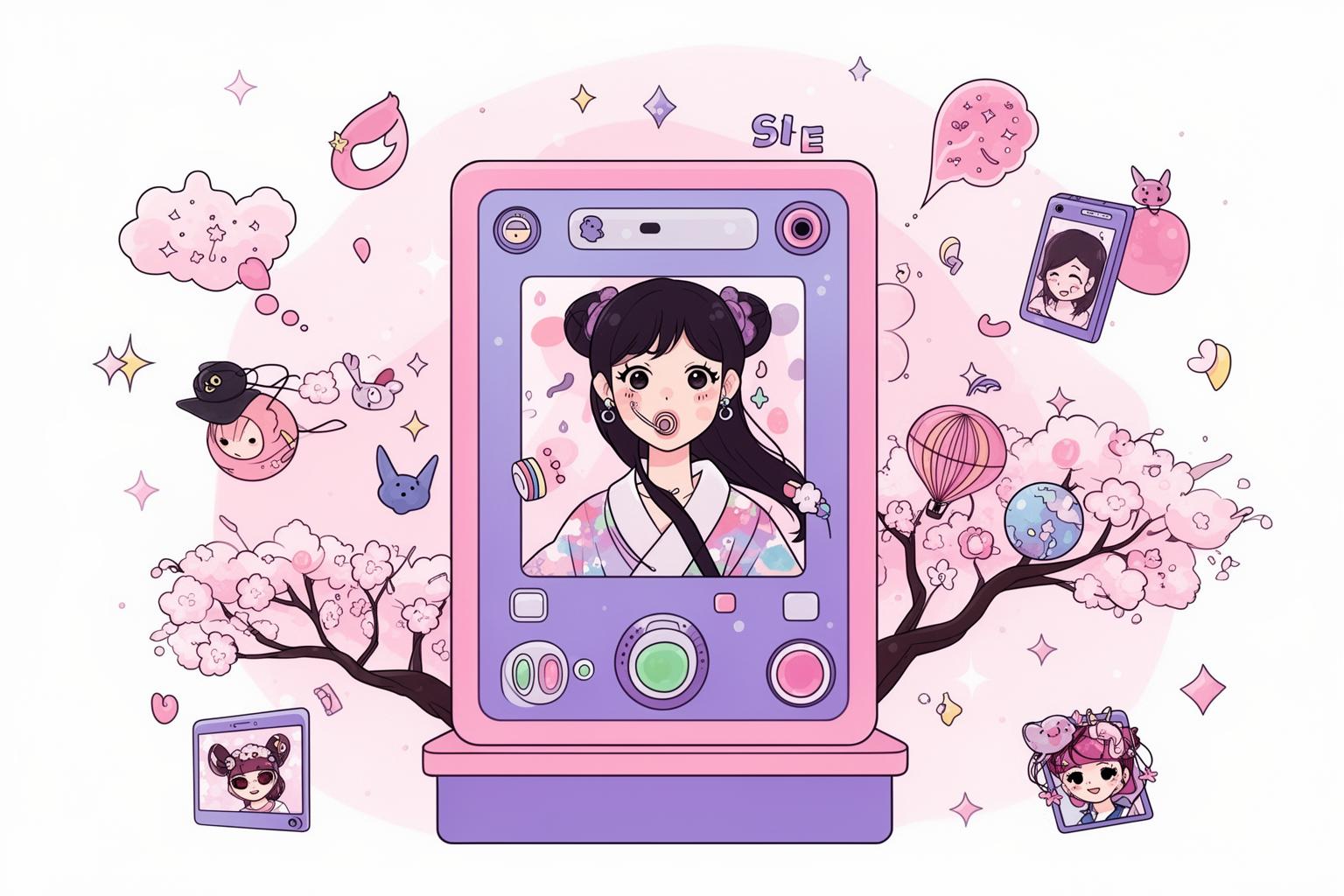
The aesthetic of Purikura is unmistakable and unapologetic—it embodies the pursuit of an idealized form of kawaii (cuteness). The technology is not intended to capture reality but to craft a fantasy. The oversized eyes, sparkling like anime characters, flawless skin, and slender figures are not meant to deceive but serve as a form of dress-up. It is similar to creating an avatar, a perfected version of oneself expressed through a shared visual language.
This comes not from insecurity but from playfulness. Participants are fully aware that their images are heavily modified—that is the whole point. They collaborate with the machine to create a piece of art that reflects a popular aesthetic. It is a way to engage with trends and express a collective identity. The enjoyment comes from watching the machine’s transformation and mastering the art of posing and decorating to produce the most appealing outcome within that imaginative framework.
A Safe Space for Expression
It is impossible to overlook the overwhelmingly female presence within the world of Purikura. The game centers where Purikura booths are found serve as important social spaces for teenage girls—a place to gather and socialize away from the structured settings of school and home. The booth itself is a private, enclosed bubble where they can be silly, loud, and uninhibited without fear of judgment or scrutiny through the male gaze.
This safe environment is essential. Inside the curtained booth and at the decoration station, groups of girls strengthen their bonds through a shared creative endeavor. The entire process—from selecting the machine to cutting out the stickers—is a collaborative act that nurtures group cohesion. They compliment each other’s poses, collaborate on designs, and share the final product. This ritual celebrates their friendship, and the resulting sticker serves as tangible proof of that celebration—a small monument to their relationship.
Analog Nostalgia in a Digital World
One of the most intriguing aspects of Purikura is its longevity. In an age when smartphone apps like Instagram and SNOW can apply beautifying filters instantly, why choose a bulky, costly machine? The answer lies in the power of the tangible. A digital photo is transient—one of thousands on a camera roll, easily lost in endless scrolling. A Purikura sticker, however, is a physical object. It occupies space, can be held, gifted, and stuck onto surfaces.
The effort required in the Purikura ritual—traveling to the arcade, paying the fee, engaging in the timed session—imbues the final product with a value that an impromptu phone selfie can never replicate. It represents a conscious act of memory-making. This physicality provides a sense of permanence that feels grounding in a fleeting digital culture. The puri-cho doesn’t rely on batteries and won’t be deleted to save storage. It endures as a stable, analog anchor amid the chaotic flood of digital content, making it a potent source of nostalgia and a treasured keepsake of youth.
The Evolution and Future of Print Club
Purikura is far from a static phenomenon. Since its inception in the mid-1990s, it has navigated waves of technological advancements and evolving youth culture, continuously adapting to endure. The first machines provided little more than novelty photo frames. The boom in the late 90s and early 2000s introduced the core features we recognize today: skin smoothing, eye-enlarging effects, and the essential rakugaki station.
The advent of the smartphone posed the biggest challenge to the industry. Suddenly, everyone had the power to take and embellish photos right in their pockets. In response, Purikura manufacturers embraced innovation. Modern machines are now closely integrated with the digital world. After a session, users can often choose their favorite photos to be sent directly to their phones, perfectly formatted for sharing on social media. Some services even offer short video clips or GIFs from the photo session. They have adopted the very technology that once threatened them, positioning Purikura not as a substitute for phone photography, but as a premium, event-worthy experience.
The aesthetic continues to evolve, with trends shifting toward more natural-looking edits and refined filters that replicate specific makeup styles. Yet, despite these changes, the core appeal remains intact. Purikura is about more than just a photo. It encompasses the entire experience: the trip to the arcade with friends, the laughter inside the booth, the energetic, creative frenzy of decorating together, and the final, tangible keepsake of that shared moment. As long as there is a desire to celebrate and memorialize friendship in a meaningful, deliberate way, Japan’s little sticker booths will keep opening their curtains.