Yo, what’s the deal with samurai movies? For real. You’re watching one, the tension is cranked to a thousand, two warriors are staring each other down for what feels like an eternity. The wind is the only thing making a sound. You’re holding your breath, popcorn halfway to your mouth, waiting for this epic, drawn-out battle… and then, shing. It’s over. One slice. One dude falls. Roll credits. You’re left sitting there like, “Wait, that’s it? After all that buildup?” It can feel super anticlimactic if you’re used to Hollywood action scenes that last a solid ten minutes with explosions and non-stop punches. But that single, decisive moment? That’s not the appetizer to the fight; that is the fight. It’s the whole story, the whole philosophy, the whole vibe packed into a single, perfect, and devastating instant. It’s a whole aesthetic, a deep-seated cultural thing that’s about way more than just sword fighting. We’re talking about a choreographed conversation about life, death, and honor, where the blade does all the talking. It’s a concept that’s so fundamentally Japanese that once you get it, a whole universe of art and culture just clicks into place. It’s not about the flurry of blows; it’s about the crushing weight of the one blow that matters. So, let’s break down why that one-second finale is actually the most epic part of the whole movie. Forget what you think you know about action. We’re diving into the soul of the blade, the silence between heartbeats, and the brutal beauty of the final cut. This is the real Japan, not the highlight reel. It’s deep, it’s intense, and honestly, it’s kinda beautiful. Let’s get into it.
To truly appreciate this philosophy, consider how the concept of the blade extends far beyond the screen, as explored in our article on the unbroken blade of Japan.
The Silence Before the Storm: It’s All About the Ma (間)
First and foremost, we need to address that long, silent stare-down. It’s not merely the director creating suspense for effect; it embodies a fundamental Japanese aesthetic concept called Ma (間). While the direct translation might be “interval,” “space,” or “gap,” that doesn’t capture its true essence. Ma is not empty space—it is charged space. It is the silence between musical notes that shapes the rhythm of a melody, the unpainted section of an ink wash painting that defines its subject, and the pause in a conversation that carries more meaning than the spoken words. In a samurai duel, Ma is everything: it is the battlefield. The physical space between the warriors buzzes with energy, a tangible tension you can almost see. This is where the real battle unfolds—the psychological warfare. It’s a high-stakes test of wills, each warrior striving to read the other’s soul.
In Western filmmaking, silence often serves to trigger jump scares or signal a lull before chaos. The emphasis lies in filling the screen and soundtrack with constant action: nonstop movement, sharp dialogue, and swelling orchestral scores. Ma stands in direct opposition; it demands you lean in and observe the finest details. You begin to notice subtleties often overlooked: the slight shift of a samurai’s weight, the faint twitch of a finger on the sword’s hilt, the rustling of leaves, the sound of breath. These are not mere background elements—they carry vital information. Each warrior projects their spirit, their ki (気), into this space, vying for dominance, searching for any flicker of doubt or weakness in the opponent. A samurai who breaks the Ma prematurely—out of impatience or fear—has effectively lost. Their mind is clouded; their spirit falters. The duel tests spiritual strength as much as physical skill.
Consider the iconic duels in Akira Kurosawa’s films. In Sanjuro, the final showdown between Toshiro Mifune’s character and his rival, played by Tatsuya Nakadai, is a masterclass in Ma. They remain perfectly still for nearly a full minute of screen time; only the wind moves. The tension escalates to a nearly unbearable level. You, the viewer, become acutely aware of every minute detail, entering the same state of focused perception as the duelists. When the strike comes, it erupts like a geyser of blood—an explosion of released energy made even more shocking and sudden by the profound stillness that preceded it. The Ma gives that single moment devastating power. Without such charged silence, the strike would be just another movement; with it, it becomes the climax of a spiritual war—a resolution to a conflict waged entirely within the silent space between two souls. This approach to storytelling is fundamentally different. It trusts the audience to feel tension rather than simply see it. It invites participation in the psychological struggle, emphasizing that what does not happen can be as important, if not more so, than what does.
This aesthetic extends beyond cinema and is deeply rooted in Zen Buddhist philosophy, which has greatly influenced Japanese art forms. Zen stresses mindfulness, presence, and the significance of the void. This emptiness is not nothingness but pure potential. In a duel, Ma embodies that space of pure potential; anything might occur. The warrior who remains the calmest, most centered, and most aware within this potentiality will perceive the slightest opening—the momentary lapse in an opponent’s focus—that permits a single, perfect strike. It involves attaining a state of mushin (無心), or “no-mind,” where the body responds instinctively, free from distracting thought and emotion. The lengthy standoff is the process of shedding those thoughts, becoming one with the sword, the opponent, and the moment itself. So next time you witness that long, quiet face-off, don’t dismiss it as a lack of action. Recognize it for what it truly is: the most intense action there is. It’s a silent, deadly game of chess where the board is the very air, and the pieces are pure will.
More Than a Fight: The Duel as a Dialogue of Souls
To truly understand the Chambara duel, you must stop viewing it as a mere physical contest. It isn’t about who is stronger or faster in purely athletic terms. Rather, it’s a philosophical confrontation where the ultimate stakes are life and death. It’s a dialogue of souls, with swords serving as the medium of communication. Each warrior brings their entire life into that one moment: their training, history, sins, code of honor, and their reasons for living—and dying. When their blades are about to clash, what is really colliding are two entire worldviews. This is why such duels often occur between a hero and a villain who reflect each other, a former friend, or a master and student. The stakes are deeply personal, ideological, and spiritual. The fight transcends mere survival; it’s about affirming one’s chosen path in life.
The Blade as an Extension of the Self
In Japanese culture, the katana is far more than just a weapon; it is considered nearly sacred. It is often called the “soul of the samurai.” This phrase is not just a poetic expression; it is meant literally. Forging a katana was a profoundly spiritual Shinto ritual. The swordsmith would purify himself, pray, and infuse the blade with his own spirit. The finished sword was believed to possess its own spirit and personality. It embodied the honor of its maker and later, that of its wielder. Samurai would name their swords, and the bond between warrior and blade was profound. Losing one’s sword meant losing one’s honor—it was an extension of the samurai’s very self. So when a samurai draws his sword, he is not simply brandishing a weapon; he is revealing his soul to his opponent. The blade’s quality, how well it is maintained, and the manner in which it is wielded—all reflect the samurai’s inner character. A fractured soul wields a merciless blade; a noble spirit commands a purposeful sword. In films like The Sword of Doom, the protagonist’s descent into madness and evil is mirrored by the increasingly demonic and chaotic way he uses his sword. His blade becomes the instrument of his own damnation. On the other hand, for a hero, the sword is a tool of justice and a protector of principles. It is clean, precise, and used only when necessary. The sword is not a mere accessory—it is a central character in the story, conveying the master’s inner state without a single spoken word.
Reading the Opponent: The Art of Iai (居合)
This dialogue of souls leads us to the concept of Iai, or more broadly, Iaijutsu. This martial art involves drawing the sword and cutting in one smooth motion. Yet the true essence of Iai lies not in the physical technique but in the mental and spiritual state that precedes it. The highest skill in swordsmanship was said to be winning without ever drawing the sword. This outcome is achieved through intense spiritual pressure and an almost supernatural ability to read the opponent’s intentions. It is all about perception. A master swordsman can detect the “intent to kill” in his foe before they move a muscle. He reads subtle shifts in breath, tension in the shoulders, flickers in the eyes. The duel is a battle of perception, of ki. Standing in the charged silence of Ma, they scan each other, seeking that moment of hesitation, that opening. The physical cut, when it finally comes, is merely the conclusion of a battle already won in the spiritual realm. In the Lone Wolf and Cub series, the protagonist Ogami Itto frequently appears to win fights before they even start. His stoic, inscrutable presence acts as a weapon itself. His opponents are undone by their own fear and doubt in the face of his vast spiritual strength. They falter, revealing a vulnerability, and only then does his blade strike. The draw and the cut are one action, a physical punctuation at the end of a sentence written with pure killing intent. This is why a single strike suffices. By the time the blade is drawn, the outcome has already been decided by this silent, intense spiritual exchange. What follows is simply formality.
The Beauty of the Single Cut: Ichigeki Hissatsu (一撃必殺)
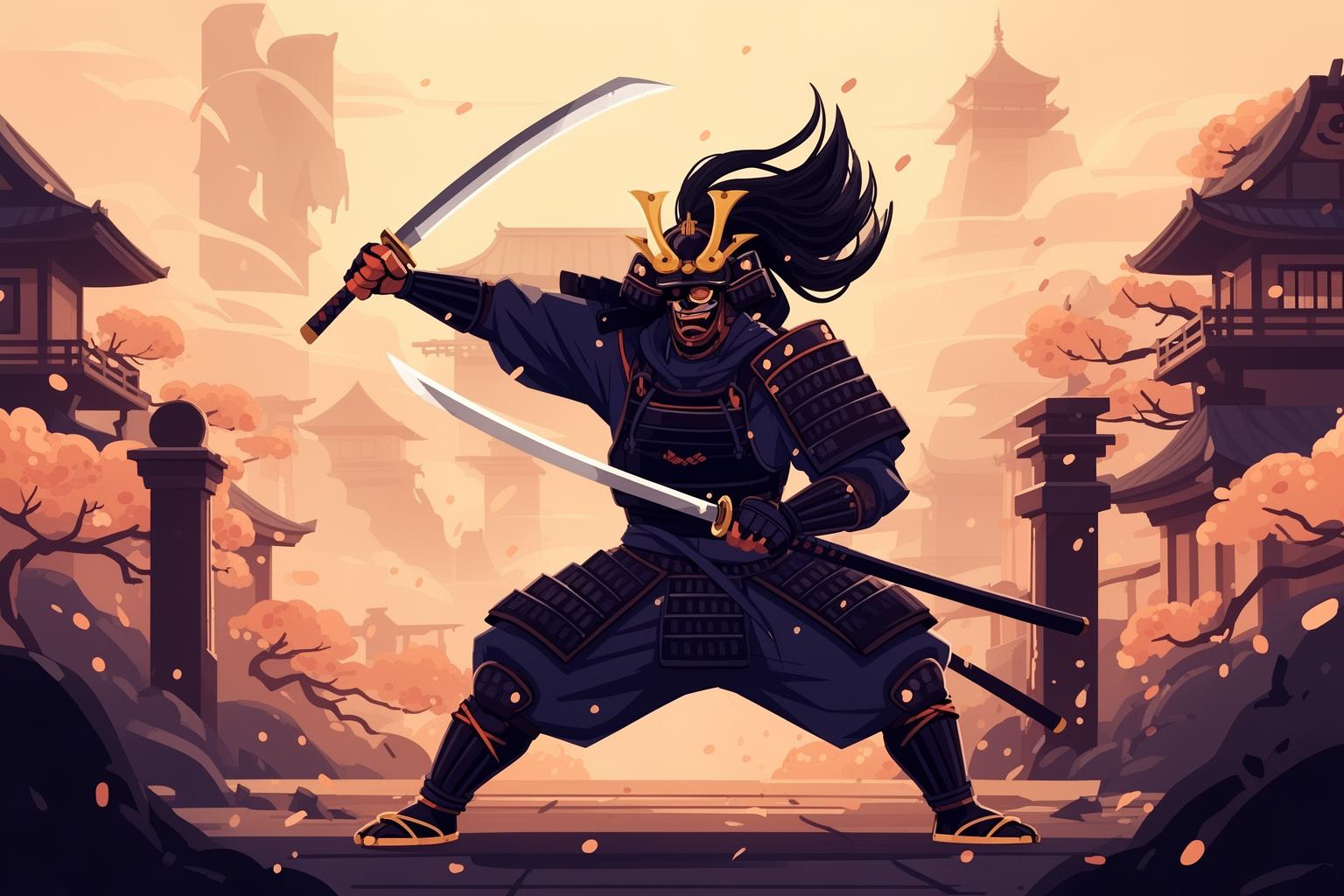
Now we arrive at the core of everything—the strike itself. The guiding philosophy at this moment is Ichigeki Hissatsu (一撃必殺), meaning “one strike, certain death.” This represents the ultimate ideal in many Japanese martial arts. The objective is not to exchange blows back and forth or to engage in a prolonged sequence of blocks and parries. Rather, the goal is to resolve the conflict with a single, flawless, and absolutely decisive technique. This is not about laziness or an anticlimactic approach; it embodies the highest form of efficiency, precision, and mastery. To achieve Ichigeki Hissatsu is to have perfectly grasped the encounter—the timing, the distance, the opponent’s vulnerability—so that only one movement is required. Any additional actions are unnecessary, revealing incomplete understanding. This ideal shapes the entire choreography of the Chambara duel, elevating the final cut beyond mere violence to a moment of sublime, though terrifying, artistry. It is the physical expression of a lifetime of discipline and the culmination of the psychological battle that precedes it.
Life and Death in an Instant: Setsuna (刹那)
The concept of Ichigeki Hissatsu is intimately connected to the Buddhist notion of time, specifically the idea of a setsuna (刹那). A setsuna is the smallest conceivable unit of time—an indivisible instant. It is the blink of an eye, a flash of lightning. Zen philosophy teaches that enlightenment and truth reside within this single moment. The past has vanished, and the future has yet to arrive; only the present instant truly exists. The samurai duel is the ultimate embodiment of this idea. A warrior’s entire being—their training, honor, regrets, and purpose—is concentrated into that one setsuna, the moment when life and death are determined. There is no space for hesitation, second thoughts, or fear. Only the pure, focused act of the cut remains. This is why the moment holds such profound significance. It is not merely the end of a life; it is the essence of a life distilled. The duel forces an absolute and immediate confrontation with mortality. To face death in a setsuna is to truly comprehend life. In the film Harakiri (1962), the duels are brutal and unbearably tense because they are stripped of all romanticism. They focus on survival and the desperate preservation of honor in a corrupt world. The final strike is not glorious; it is tragic. Yet it still operates within the framework of the setsuna. The moment the decision is rendered, the instant the blade moves, everything is resolved with terrible clarity. This emphasis on the instantaneous renders the violence poetic, discovering a stark, haunting beauty in the fleeting nature of life, a core Japanese aesthetic known as mono no aware (物の哀れ), the gentle sorrow of things passing.
The Choreography of Honor: What Happens After the Cut
Equally important as the strike itself is what unfolds immediately afterward. The duel does not conclude the moment the blade lands. The aesthetic continues in the seconds that follow. Often there is a pause. The victor stands—sometimes with their back turned to their fallen opponent—holding the finishing posture (zanshin, 残心), a state of sustained awareness. The defeated warrior remains upright for a brief moment, disbelief etched across their face, before slowly, almost gracefully, collapsing. This is not merely for dramatic effect, though it is undeniably dramatic. It is the final act of their silent dialogue—a reflection of how one faces death. To die with honor, accepting the duel’s judgment without outcry, is the ultimate test of a samurai’s character. There may be a final exchange of words, a moment of mutual respect, an acknowledgment that both were worthy adversaries who simply walked different paths. The victor seldom celebrates. More often, a sense of melancholy prevails—quiet contemplation of the life recently taken. The act was necessary, but it was not joyous. This choreography underscores that the duel is not a sport. It is a deadly serious ritual governed by the strict code of bushido (武士道), the way of the warrior. Honor dictates every movement, from the opening bow to the final silent collapse. Winning matters, but winning (and losing) with honor is paramount. This is why, even in death, the defeated samurai often retains a measure of dignity. Their final moments stand as a testament to the code they lived by, rendering their death meaningful rather than a mere physical defeat. The duel’s aesthetic is a complete narrative, from the silent beginning to the honorable end—a full-circle story about the burdens and beauties inherent in a warrior’s life. It is this unwavering dedication to a philosophical and artistic vision of combat that makes the Chambara duel a timeless and endlessly captivating element of cinema.
Real vs. Reel: Deconstructing the Myth
Alright, let’s pause for a moment and get honest. Did samurai really fight like that? The short answer is: probably not. Honestly, real sword fights in feudal Japan were likely chaotic, messy, and brutal. They were less like a graceful, silent ballet and more like a desperate, muddy, screaming brawl. Armor played a role, fighting multiple opponents was common, and victories often came through strategy and brute force rather than a single elegant strike. The clean, ritualistic one-on-one duel to the death depicted in Chambara films is mostly a romanticized and highly stylized invention. It’s a cinematic myth, a piece of historical fiction. But here’s what makes it interesting: the fact that it’s a myth doesn’t lessen its cultural significance; it actually enhances it. We need to ask: why was this particular myth created? Why the aesthetic of silence, honor, and the perfect single strike? The answer reveals more about the Japan that produced these films than about the actual historical samurai. Chambara films, especially those from their golden era in the 1950s and 60s, were not made as documentaries. They served as a way for post-World War II Japan to grapple with its identity, history, and traditional values. The samurai on screen became a symbol to explore enduring Japanese ideals. The stoic, honorable warrior, bound by a strict code, was a powerful figure in a nation undergoing profound social and cultural transformation. These films looked back on a romanticized past to highlight virtues like discipline, self-sacrifice, honor, and a deep appreciation for beauty and impermanence. The duel’s aesthetic became a canvas on which these values were vividly and ideally portrayed. The duel is the perfect narrative device— a self-contained story with a clear beginning (Ma), middle (Ichigeki Hissatsu), and end (the honorable death). It lets filmmakers explore complex philosophical ideas in a visually striking and emotionally impactful way. It’s a distilled form of the bushido code, presented in its most powerful and cinematic expression. The beauty in the duel reflects other essential Japanese aesthetics, such as wabi-sabi (侘寂)—the appreciation of beauty in imperfection and transience. The lone warrior, the fleeting moment of the strike, and the scar it leaves behind—it all embodies wabi-sabi. Choosing to portray the duel as clean and precise rejects the chaotic ugliness of real violence, transforming a brutal act into high art, a meditation on existence. So, while you’re not getting a history lesson, you are receiving a deep cultural lesson. You’re witnessing how a culture reflects on its own ideals and soul. It’s a myth, yes, but one that reveals deeper truths about Japanese philosophy and art.
The Legacy on the Screen: From Kurosawa to Anime
The ripple effect of this particular aesthetic is immense. It’s quietly one of Japan’s most significant cultural exports, and once you notice it, it seems to appear everywhere. The essence of the Chambara duel is woven into much of global pop culture, spanning blockbuster movies, video games, and, naturally, anime. The mastermind behind much of this visual style was undoubtedly Akira Kurosawa. His films like Seven Samurai, Yojimbo, and Sanjuro didn’t simply shape the genre; they essentially wrote the manual on filming sword fights imbued with philosophical depth. Kurosawa was a genius at using weather elements (wind, rain, heat haze) to heighten the tension of the Ma. He perfected the choreography of a single, lightning-fast strike followed by a dramatic pause. His innovations were so revolutionary that they were quickly recognized and replicated worldwide. The most famous example? George Lucas has openly credited Kurosawa’s The Hidden Fortress as a major inspiration for Star Wars. And what is a lightsaber duel if not a futuristic version of a samurai battle? The hum of the blades, the prolonged, intense standoffs, the concept of the Force as an extension of a warrior’s spirit (ki), the master-student dynamics—it’s all there. The final duel between Obi-Wan and Darth Vader in A New Hope is pure Kurosawa: two masters, a tense pause, and a single, decisive strike. The legacy is unmistakable. Within Japan, the aesthetic evolved but never vanished. It became a core element of anime. Consider how often you’ve seen two anime characters confront each other, a breeze stirring leaves between them, followed by a flash of light and a delayed reaction as one falls—that’s pure Chambara. In Rurouni Kenshin, the duels emphasize clashing ideologies, and Kenshin’s signature move allows him to win without killing, representing a philosophical advancement of the Ichigeki Hissatsu principle. Samurai Champloo fused the classic samurai aesthetic with a modern hip-hop flair, yet the heart of the duels—the emphasis on style, flow, and personality through swordsmanship—stems directly from the old-school tradition. Even in series unrelated to samurai, like Dragon Ball Z or Naruto, the trope of a high-stakes, one-on-one battle resolved by a single ultimate move is a direct descendant of the samurai duel. It’s a compelling storytelling device that has shown remarkable versatility, offering a structure to explore themes of rivalry, honor, and personal growth that resonate universally. From the dusty towns of Westerns (many of which were themselves reinterpretations of Kurosawa films) to the futuristic settings of sci-fi, the spirit of the samurai and his single, perfect strike endures. It stands as proof of an aesthetic that is much more than just a fight scene—it’s a unique way of perceiving the world.
The final duel in a Chambara film, therefore, is a universe condensed into a single moment. It’s a complex, layered cultural artwork that appears simple on the surface but is founded on centuries of philosophy, spirituality, and artistic tradition. That long, silent standoff is not emptiness; it’s a battle of wills fought within the pregnant pause of Ma. The sword is not merely a weapon; it’s the warrior’s soul forged into steel. And the final, solitary cut is not an anticlimax; it is Ichigeki Hissatsu, the ultimate display of mastery, a lifetime of discipline released in a brief, fleeting setsuna. It’s a performance of honor, a conversation about life and death itself, and a rejection of chaos in favor of stark, focused, and transient beauty. Though it may be a romanticized myth, it’s one that has profoundly influenced not only Japanese cinema but the global visual language of action and conflict. So next time you watch such a duel and feel that tension rising in the silence, lean into it. Watch the eyes. Sense the energy in the air. Because the real battle is already underway. The blade is just the final word—and it only needs to be spoken once.