You’ve probably seen it scrolling through your feed. That sleek, impossibly long stretch of green perched atop a low-slung building, backdropped by the electric chaos of Shibuya’s skyline. Skaters carving up a concrete bowl, fashionistas posing against brutalist grey walls, a Starbucks logo glowing softly as the sun sets. This is Miyashita Park, Tokyo’s rooftop runway. But let’s be real for a sec. You see the pics, you hear the hype, and a question starts nagging at you: A park… on top of a luxury shopping mall? Is this for real? It doesn’t look like any park you know. Where are the sprawling lawns, the ancient, twisting trees, the quiet escape from the city? Instead, you get Louis Vuitton, a bouldering wall, and a perfectly manicured strip of artificial turf. It feels less like a public green space and more like a members-only club for the effortlessly cool. And you’re right to be confused. This place is a total vibe, but it’s also a puzzle box of modern Tokyo. It’s a statement about how this city works, what it values, and where it’s headed. To get Miyashita Park, you have to get Tokyo itself—a city that’s constantly rewriting its own rules on how to live, work, and play in a concrete jungle. It’s not just a park; it’s a masterclass in Japanese urbanism, a living mood board of contemporary culture, and a case study in the relentless cycle of reinvention that defines this metropolis. So, let’s unpack it. Let’s look past the slick surfaces and figure out why Tokyo would build a park in the sky, and what it tells us about the future of city life here. This isn’t just a travel guide, it’s a deep dive into the DNA of Shibuya’s concrete-cool heart.
To truly understand this relentless cycle of reinvention, it helps to visit a neighborhood that has consciously resisted it, like the old-world streets of Yanaka.
The DNA of Tokyo: Scrap, Build, Repeat
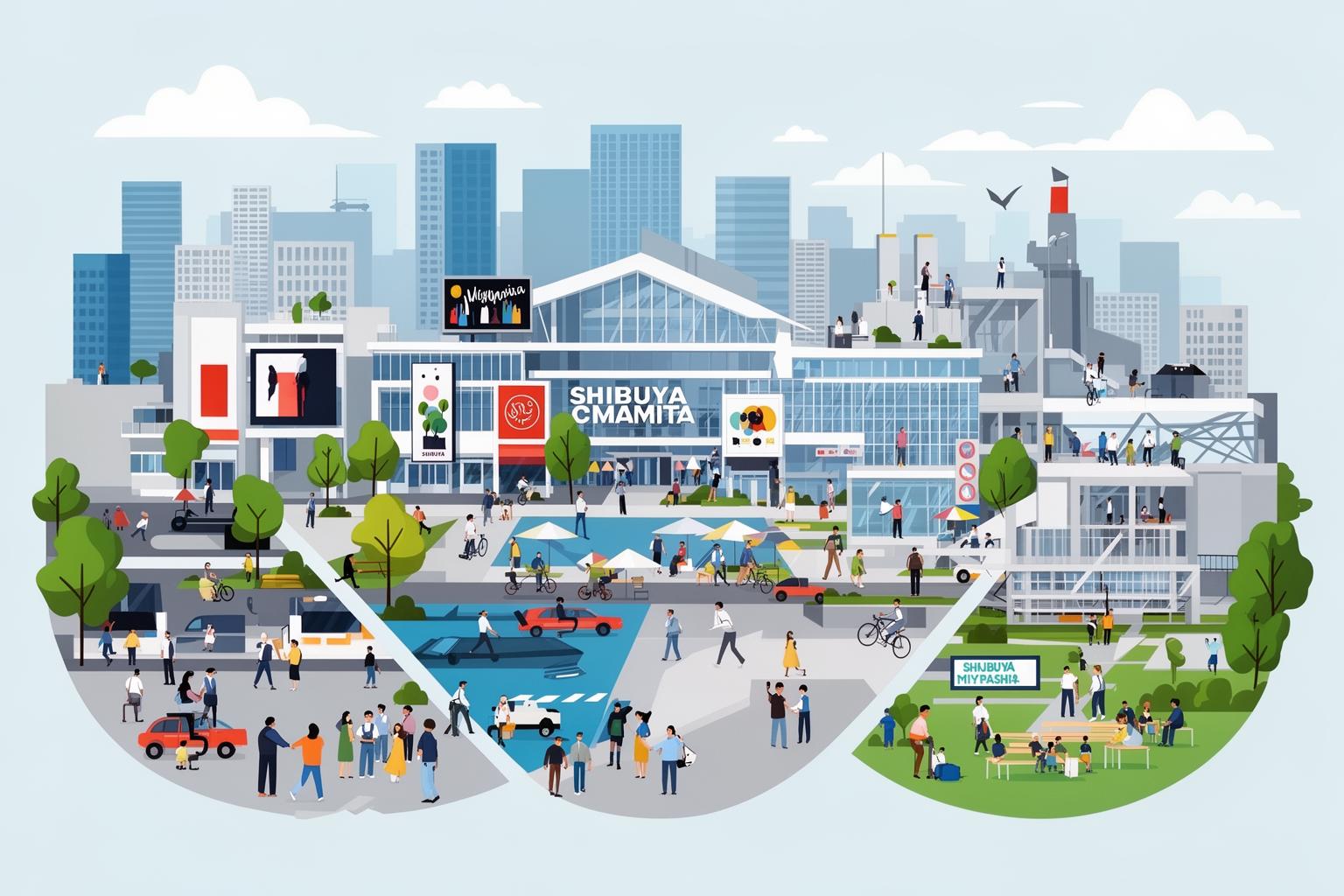
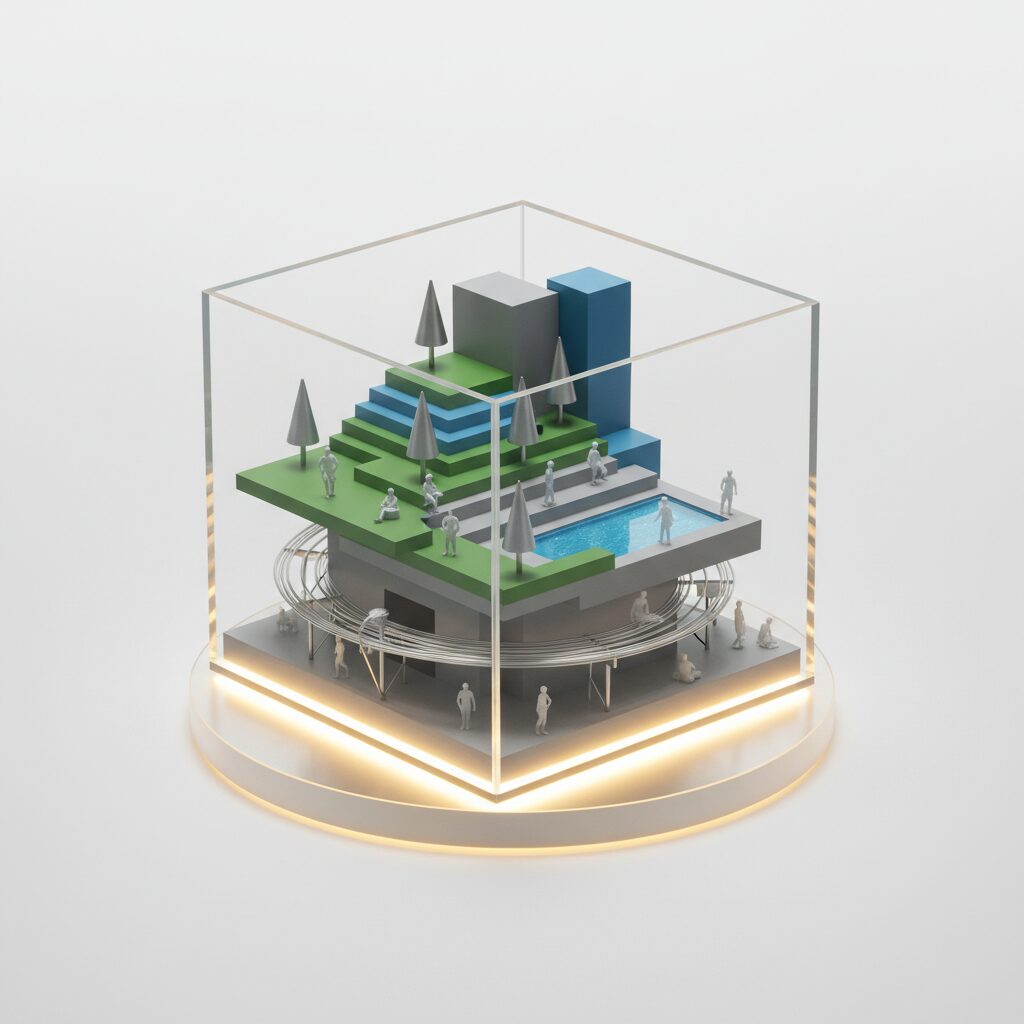
To understand why a park is located on a rooftop, you first need to grasp the fundamental rules of Tokyo. This city operates under a unique set of dynamics, shaped by two major forces: an acute shortage of space and a cultural fixation on novelty. Tokyo has perfected vertical living and the cycle of dismantling and rebuilding. Miyashita Park is not an exception; it embodies the city’s core programming. It represents the necessity of fitting a park, shopping mall, community center, and hotel into a narrow strip of some of the most expensive real estate on Earth. It’s a solution born from constraints—a polished, commercial answer to the enduring challenge of creating more living space in a city already bursting at the seams.
The Land is Lava (and Extremely Expensive)
The first rule of Tokyo: there’s no space. Seriously. Every inch is valuable, contested, and monetized to the fullest extent. Land prices in central Tokyo are sky-high, influencing nearly every architectural decision. You simply can’t afford a sprawling, single-use park in a prime area like Shibuya. It’s financially unfeasible. This economic pressure compels developers and planners to think vertically. Why build outward when you can build upward? Why settle for just a park when you can have a park and a three-story shopping mall underneath generating income? This multi-layered, multifunctional land use is quintessential Tokyo. Consider major transit hubs like Shinjuku or Shibuya Station—they’re not merely stations but massive, multi-level complexes housing department stores, restaurants, and offices. You could spend your entire life inside one of these station-cities. Or look at the extensive underground malls (chika-gai) sprawling beneath the streets, forming subterranean commercial worlds. Tokyo has long embraced stacking functions. Miyashita Park applies this logic to public spaces. The commercial complex, RAYARD MIYASHITA PARK, isn’t adjacent to the park; it forms its foundation. Rent from high-end stores like Gucci and Balenciaga helps subsidize the public space above. It’s pragmatic, if somewhat soulless, but this is the core reason: the park is on the roof because, within the framework of modern Tokyo development, it was the only feasible location. This is an ingenious solution to urban economics, transforming unused airspace atop a building into a public asset.
The “30-Year Rule” and Japan’s Obsession with the New
The other piece of the puzzle is Tokyo’s penchant for rebuilding. Unlike many Western cities, where old buildings are cherished and preserved, Tokyo often treats structures as having a limited lifespan. There’s an unwritten cultural and economic principle called the “scrap and build” (スクラップアンドビルド) cycle. Commercial buildings are often designed with a lifespan of about 30-40 years. After that, they’re deemed outdated, inefficient, or unfashionable, and demolishing to rebuild is usually cheaper and more desirable than renovating. This trend has multiple causes. Practical considerations include evolving earthquake resistance standards, making newer buildings inherently safer. Economically, the land retains its value, but the structure depreciates rapidly, like a vehicle. Culturally, Shintoism—a native Japanese religion—embraces ritual renewal, exemplified by the Ise Grand Shrine, rebuilt every 20 years. This cycle of renewal, purity, and freshness has influenced the secular mindset. Newness symbolizes cleanliness, safety, and progress. Rather than physically preserving the past, it is honored by building the next version. So, when people mourn the loss of the “old” Miyashita Park, they are expressing a feeling that often counters Tokyo’s prevailing development logic. The previous park, a post-war creation, had simply reached the end of its cycle. For the city and its corporate stakeholders, it was time for a refresh—a complete reimagining suitable for the 21st century. The new Miyashita Park is not a rejection of the past; it is the 2020 edition, perfectly aligned with Tokyo’s relentless forward momentum. It’s sleek, commercial, safe, and current. And in 30 or 40 years? It will likely be replaced by whatever version of Tokyo emerges next.
Deconstructing “Miyashita”: From Counter-Culture Hub to Commercial Hotspot
To truly understand the full story of the new Miyashita Park, you need to know what it replaced. This sleek, sanitized rooftop oasis wasn’t constructed on an empty plot; it was built over the ghost of its predecessor, a place with a very different energy and purpose. The shift from the old Miyashita Park to the new one is a tale of gentrification unfolding at hyper-speed, Tokyo-style. It reflects the transition from an uncurated, organic public space to a tightly controlled, commercialized environment. The story raises questions about who gets to use public space in one of the world’s most crowded cities and which values—gritty authenticity or clean, safe commerce—ultimately prevail. This isn’t just about a new building; it’s about a fundamental change in the neighborhood’s character.
The OG Miyashita Park: A Vibe Check from the Past
The original Miyashita Park, which opened in 1966, was an entirely different world. It was a long, narrow strip of land running alongside the JR Yamanote Line tracks, built on an artificial foundation over the Shibuya River. For most of its existence, it was a bit rough around the edges. It was a ground-level park, dimly lit, and known as a gathering spot for Shibuya’s subcultures. Skaters and BMX riders claimed its concrete plazas long before a dedicated skate park was ever considered. It was also a well-known refuge for Tokyo’s homeless population, who created a small community of cardboard and blue-tarp shelters within its boundaries. It was a space that felt genuinely public, in the messiest sense of the word. It wasn’t designed for Instagram; it simply was. It exuded a palpable, gritty energy authentic to Shibuya’s underbelly, sharply contrasting the gleaming department stores just a block away. It was a space of tolerance, if not always comfort, where disparate worlds collided. You’d see office workers cutting through on their way to the station, kids practicing dance moves, and people with nowhere else to go finding moments of rest. It wasn’t pretty or always comfortable for mainstream visitors, but it was real. It represented a side of Tokyo increasingly being polished away—the unplanned, unregulated, slightly chaotic spaces that allow true counter-culture to thrive.
Gentrification, Tokyo Style
The redevelopment project that created the new Miyashita Park is a textbook example of gentrification, but with a distinctly Japanese twist. The process was driven by a Public-Private Partnership (PPP), a model increasingly used to update Japan’s aging public infrastructure. Here’s how it worked: the local government (Shibuya Ward) owns the land but lacks the large budget needed for a state-of-the-art rebuild. So, they partner with a private real estate giant, in this case, Mitsui Fudosan. The developer receives a long-term lease on the public land to build a profitable commercial facility (the mall and hotel). In return, they are responsible for constructing and maintaining a new, improved public park on top. On paper, it’s a win-win. The city gains a shiny new public asset without a heavy tax burden, and the developer acquires prime Shibuya real estate. But the reality is more complicated. This model inherently prioritizes commercial viability. The park becomes an amenity of the mall, designed to attract the right kind of consumer. The most glaring and contentious outcome of this redevelopment was the displacement of the homeless community. Their removal was a prerequisite for starting the project, a move that sanitized the area and made it attractive to high-end brands and affluent shoppers. The skaters and street artists who gave the old park its character were also pushed out, only to be invited back into a designated, controlled, and monetized version of their former playground—the rooftop skate park. This is gentrification executed with Japanese efficiency and precision. It’s less about slow, organic change and more about a top-down, corporate-led total reset. The soul of the place was traded for a sleek, profitable, and far more manageable new identity.
The “Anzen Anshin” (Safety and Peace of Mind) Obsession
To grasp why this sanitized version of the park appeals so much to those in power, you need to understand the cultural concept of 安全安心 (anzen anshin). This phrase roughly translates to “safety and peace of mind,” and it’s a cornerstone of modern Japanese society as well as a powerful marketing tool. It promises a predictable, orderly, and risk-free environment. The old Miyashita Park—with its homeless population, dim lighting, and unregulated activities—was the antithesis of anzen anshin. From the viewpoint of city officials and many residents, it was unsettling, unpredictable, and perhaps even somewhat dangerous—a blemish on Shibuya’s otherwise vibrant image. The new Miyashita Park physically embodies anzen anshin. It is brightly lit, under constant security patrol, with clear rules of conduct. Access is regulated, and the entire space is designed to feel clean, orderly, and above all, safe. This appeals to families, tourists, and shoppers who want to enjoy Shibuya’s “cool” without any of the grit. It creates a comfortable bubble where one can consume the urban experience without any friction. This obsession with perfectly safe, controlled environments defines many contemporary Japanese public spaces. While it undoubtedly provides a pleasant, stress-free experience for many, it also comes at a cost. It eliminates spontaneity, squeezes out non-commercial activities, and excludes those who don’t fit the desired demographic. The park is no longer a messy reflection of the city’s diversity; it is a curated space projecting the image the city wants to be: safe, sophisticated, and open for business.
The “Concrete-Cool” Aesthetic: Why It’s More Than Just a Look
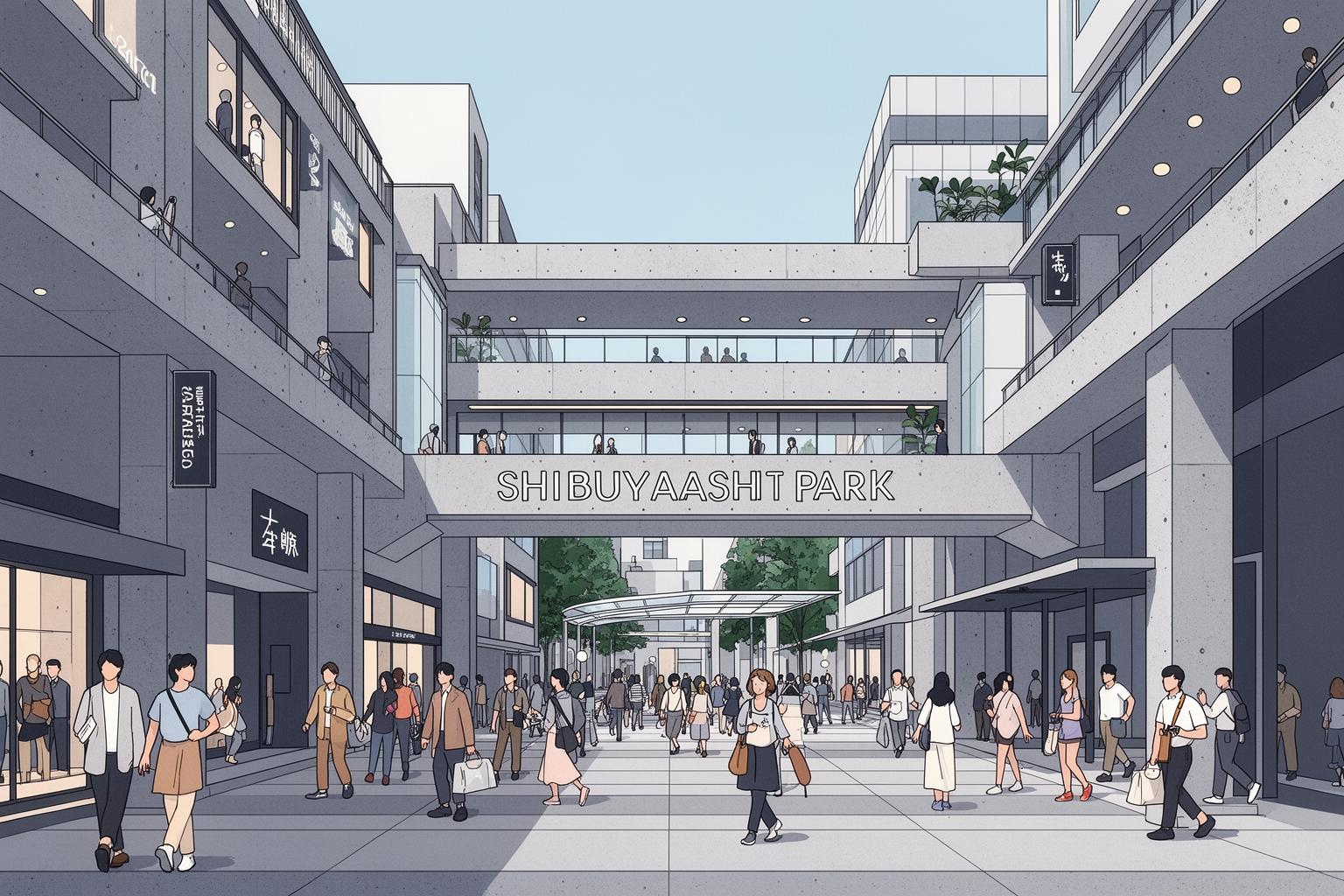
The first thing that catches your eye about Miyashita Park is its aesthetic. The entire complex is a harmonious blend of exposed concrete, black steel, and glass. It’s minimalist, industrial, and undeniably stylish. But this “concrete-cool” vibe isn’t a random stylistic choice; it’s a purposeful and deeply meaningful decision that connects to decades of Japanese architectural tradition and the hyper-visual demands of the social media era. This aesthetic speaks volumes about what “luxury” and “style” mean in Tokyo today. It’s not about ornate decoration or classical beauty; it’s about raw materials, clean lines, and a perfectly crafted backdrop for the main event: you. This look both references a sophisticated architectural heritage and serves as a smart strategy for the future of retail and public spaces.
Brutalism’s Chic Descendant: Tadao Ando and the Cult of Concrete
Exposed concrete in Japanese architecture is more than just a building material; it’s a statement. Its elevation to an art form is largely attributed to the iconic self-taught architect Tadao Ando. Beginning in the 1970s, Ando pioneered a style that used smooth, unembellished concrete walls to create spaces of remarkable simplicity, drama, and tranquility. His work, often seen as a form of critical regionalism, merged the minimalist aesthetics of modernism with traditional Japanese concepts of space, nature, and light. For Ando, concrete was not cold or oppressive; it was a pure, elemental material capable of capturing the interplay of light and shadow, creating a sense of serenity and deep connection to the natural environment. This philosophy has profoundly influenced generations of Japanese architects and designers. The concrete at Miyashita Park is a direct heir to this legacy. It’s not the rough, heavy, and aggressive concrete of classic European Brutalism. Instead, it’s smooth, precise, and almost velvety in texture—testament to Japan’s renowned construction excellence. The choice of concrete signals a particular kind of refined, minimalist luxury. It rejects gaudy ornamentation in favor of something more essential and enduring. It aligns with Japanese design ideals like wabi-sabi—the appreciation of beauty in imperfection and impermanence—but reinterpreted for a hyper-modern, commercial environment. The concrete provides a raw, honest canvas, a neutral stage on which the vibrant life of Shibuya—the people, the fashion, the brands—can shine. It’s a quiet, confident backdrop that says, “We don’t need to shout to be cool.”
Engineered for the ‘Gram: Designing for the Social Media Gaze
Let’s be frank: modern commercial spaces are no longer just designed for people; they’re designed for phones. Miyashita Park is a masterclass in creating an environment that is irresistibly photogenic. Every design decision seems made with Instagram, TikTok, and whatever platform follows firmly in mind. This is no accident. In the digital age, the “shareability” of a space is a key measure of its success. A location that people want to photograph and share becomes a powerful, self-sustaining marketing engine. The architecture of Miyashita Park is a content creator’s dream. Its long, linear layout creates striking leading lines, guiding the eye along its 330-meter span. The iconic, arching black steel roof offers a dramatic frame against the sky. The stark concrete walls serve as a perfect neutral backdrop that makes outfits and subjects pop with clarity. The open-air design invites beautiful natural light during the day and captures the electric neon glow of Shibuya at night. Even the placement of benches, staircases, and planters feels intentional, crafting countless small vignettes and photo opportunities. The space functions less like a traditional park and more like an expansive outdoor photo studio. The “concrete-cool” aesthetic is central to this approach. Its minimalist, monochrome palette ensures that the colorful and ever-changing street style of visitors remains the focus. The park becomes a stage, and everyone in it a potential performer, showcasing their personal brand against a backdrop instantly recognizable and globally regarded as “Tokyo cool.” The building’s design is not just about accommodating commerce; it actively encourages the creation of social media content that promotes the location and its tenants, forming a perfect, self-sustaining cycle of digital-age capitalism.
How to “Read” Miyashita Park Like a Local
So you’ve absorbed the backstory, economics, and aesthetics. But how do you actually use this place? For visitors, Miyashita Park can still feel somewhat confusing. It resists simple classification. Is it a park? A mall? A food court? A sports facility? The answer is yes—it’s all of these things. To truly understand it, you need to stop trying to fit it into a Western framework and begin viewing it through a local perspective. For Tokyoites, especially the younger generation, this hybrid space makes perfect sense. It’s not a retreat from the city; it’s a new way to engage with its core. It offers a curated, vertical slice of urban life, presenting a variety of experiences from high fashion to street food, all in one stylish and convenient package.
It’s Not a Park, It’s a “Third Place”
In sociology, a “third place” refers to a setting separate from the two usual social environments of home (the “first place”) and work (the “second place”). Examples include cafes, pubs, libraries, or community centers—places where community life anchors, and people relax, socialize, and connect. In Tokyo, a city known for its tiny apartments and demanding work hours, quality third places are essential for maintaining a healthy social life. Miyashita Park is among Tokyo’s newest and most impressive third places. Visitors don’t necessarily come here seeking nature; they come to exist in public. It serves as Shibuya’s communal rooftop terrace. You can grab a coffee from Starbucks and lounge on the astroturf, watching trains pass below. You can meet friends for a beer at Shibuya Yokocho before heading to a club. Or you can simply stroll from one end to the other, people-watching and soaking up the city’s energy. What sets it apart from a traditional park is its elevation. Positioned on the fourth floor, it places you just above the hectic streets beneath. You can view the chaotic Shibuya Scramble Crossing from a distance, hear trains rumble, and see the towers of Shinjuku on the horizon. You’re fully immersed in the urban spectacle, yet in a somewhat more relaxed and controlled setting. You’re not escaping the city; you’re gaining a better perspective on it. This shift in mindset is key. Don’t visit Miyashita Park expecting quiet solitude. Go there to find a comfortable vantage point from which to observe and engage with Tokyo’s vibrant, relentless performance.
The Tenant Mix: A Curated Slice of “Tokyo Now”
To understand the park’s intended audience, simply examine the list of shops. The tenants in RAYARD MIYASHITA PARK form a carefully curated collection that captures “Tokyo Now.” It’s not a department store trying to cater to everyone. Instead, it’s a precise selection of global and local trends. On one side, international luxury powerhouses like Louis Vuitton (with its first men’s flagship in Japan), Gucci, Prada, and Balenciaga set a tone of affluence and global fashion awareness. On the other, quintessential Japanese streetwear and lifestyle brands such as Soph., Wander, and Neighborhood root the space in authentic Tokyo street culture. Layered atop these are niche, contemporary brands, concept stores, and lifestyle shops catering to specific subcultures—from high-end eyewear to curated vinyl records. This mix is deliberate. It’s designed to foster an ecosystem that attracts a particular kind of customer: someone globally savvy, brand-conscious, and who views shopping as cultural expression. Then there’s Shibuya Yokocho on the first floor—a collection of small izakaya-style eateries recreating the chaotic, retro atmosphere of a traditional Japanese alley. It’s a clever strategy—offering a glimpse of old-school, gritty Japan in a brand-new, tidy, tourist-friendly environment. It packages nostalgia for mass appeal, the perfect complement to an afternoon of luxury shopping. The entire tenant mix tells a story: this is where global luxury meets local cool, and even the past is served up in a sleek new form.
The Rooftop as an Amenity
Finally, let’s consider the “park” on the roof. While the strip of artificial grass may invite cynicism, a closer look reveals much more. Here you’ll find a state-of-the-art skate park, a bouldering wall, and a multi-purpose court for sports like sand volleyball. These aren’t just random recreational features; they are curated lifestyle amenities that align perfectly with the brands and image promoted below. Skateboarding and climbing are not merely sports; they are global lifestyle trends with their own aesthetics, fashion, and cultural significance. Including these activities strategically reinforces the park’s identity as a hub for active, urban, and trend-conscious individuals. This creates a seamless brand narrative: you can buy the latest streetwear from a skate heritage brand, then head upstairs to skate. You can purchase high-performance outdoor gear and put your skills to the test on the bouldering wall. The park’s activities are not separate from the retail experience; they are its experiential extension. It’s a place that doesn’t just sell products—it offers a fully realized lifestyle. The rooftop serves as the ultimate amenity, a living, breathing proof of concept for the brands within the complex. It transforms passive consumption into active participation, all within the same carefully curated ecosystem.
So, Is It Worth the Hype? A Final Take
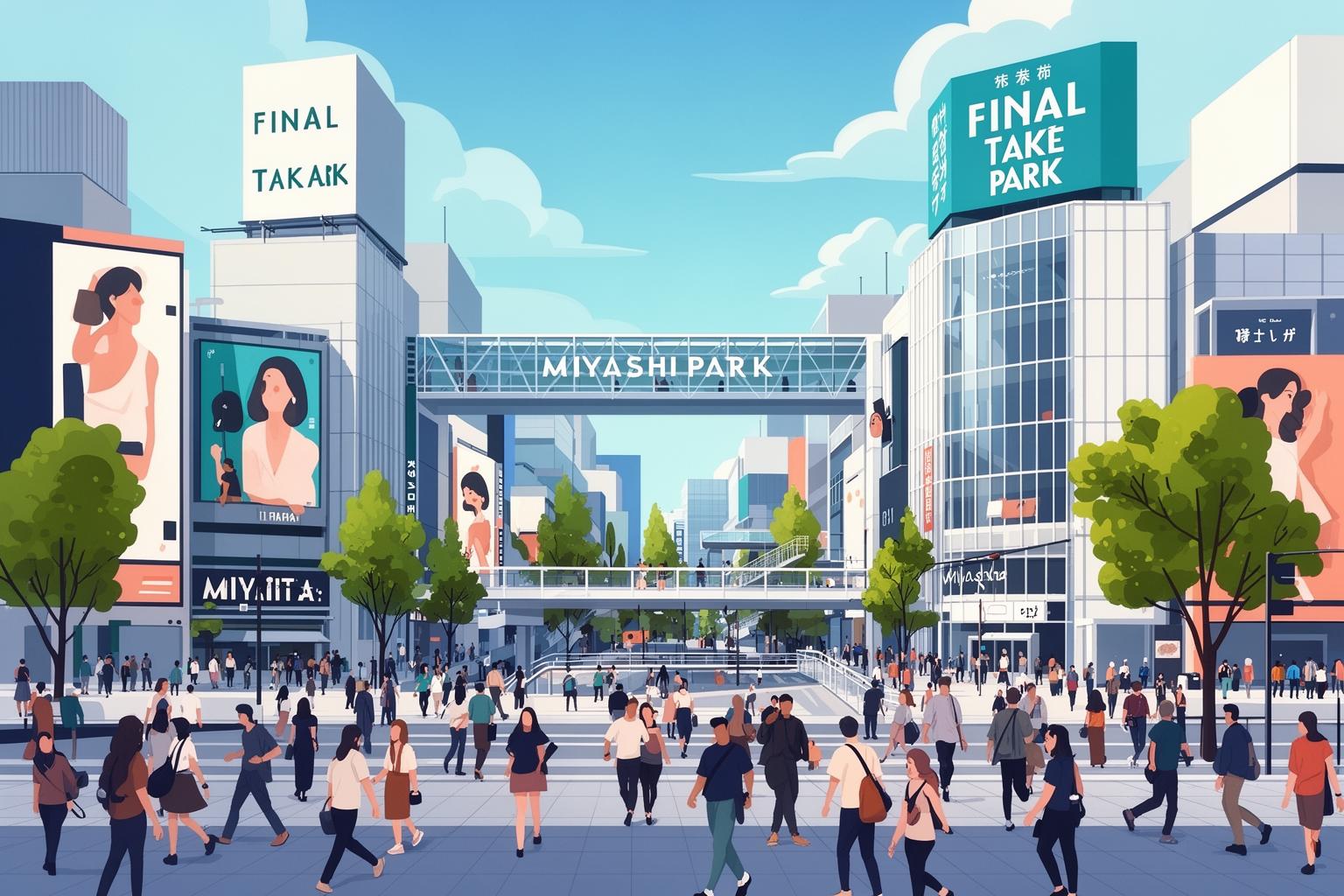
After sifting through the layers of commerce, culture, and concrete, we return to the original question: Is Miyashita Park worth a visit? And is it truly a “park”? The answer, much like Tokyo itself, is complex and depends entirely on what you’re seeking. If your idea of a park is a green sanctuary, a place to escape the noise and connect with nature, you will likely be deeply disappointed. In that regard, Miyashita Park falls short. It’s a park in name only, a greenwashed commercial development that prioritizes profit over peace and quiet. But that viewpoint is quite limited. If you shift your perspective, you can appreciate it for what it really is: a brilliant, highly functional, and deeply insightful example of 21st-century urbanism. It is not a failed park; it is a strikingly successful model of a new kind of hybrid public space. It’s a living, breathing illustration of the forces shaping modern Tokyo. It stands as a testament to the city’s ingenuity in addressing land scarcity through vertical, multi-use design. It reflects the cultural preference for the “scrap and build” cycle rather than historical preservation. It is a stark, and for some, unsettling example of gentrification and commercialization of public spaces, wrapped in the reassuring promise of anzen anshin. From my perspective, as someone immersed in fashion and street culture, Miyashita Park is a must-visit. It’s not a place where I go to relax; it’s where I go to take the city’s pulse. It’s one of the best spots in Tokyo for people-watching, to observe how global trends are interpreted on the streets, and to experience the forward momentum of Shibuya. It’s a place that recognizes that in the age of social media, the backdrop is as important as the action. So, is it worth the hype? Absolutely. But don’t go expecting a traditional park. Expect instead to see a perfectly imperfect reflection of Tokyo itself: a city that is dense, dynamic, commercial, and constantly building its future, quite literally on top of its past. It’s not an escape from the city; it is the city, distilled and elevated.