
Imagine you’re at a beautiful, serene restaurant in Japan. Perhaps it’s a high-end kaiseki establishment in Kyoto or a rustic inn nestled in a mountain hot spring town. A series of small, exquisitely arranged dishes arrives. Among them is something you don’t recognize: a tightly furled green sprout, deep-fried in a delicate tempura batter, or a collection of strange-looking ferns steeped in a light, savory broth. You take a bite, and your palate, conditioned by a lifetime of Western cuisine that prizes sweetness, saltiness, and richness, gets a jolt. It’s bitter. Not just a little bit bitter, like dark chocolate or a strong IPA, but a complex, earthy, almost medicinal bitterness that seems to echo with the taste of wild soil and cold mountain air. Your first instinct might be confusion. In a cuisine so famously dedicated to balance and subtlety, why would this aggressive flavor be so celebrated?
This is your introduction to the world of sansai (山菜), or wild mountain vegetables. And that challenging bitterness isn’t a culinary flaw; it’s the entire point. In the West, we’ve spent centuries breeding bitterness out of our vegetables, selecting for sweetness and uniformity until our kale is mild and our grapefruits are practically candy. But in Japan, when the snows begin to melt and the first signs of spring appear, people don’t just welcome the season—they venture into the mountains to find and eat it. They seek out these wild, untamed plants precisely for their assertive, often bitter, flavors. This annual ritual is far more than just a matter of taste. It’s a deep-seated cultural practice that connects food to nature, seasonality, and even wellness. To understand why Japan embraces sansai is to understand something fundamental about the nation’s relationship with its environment and the turning of the seasons. It’s about tasting the very essence of spring—wild, untamed, and powerfully alive.
For those eager to delve deeper into the interplay of tradition and modernity in Japanese dining, exploring the evolution of traditional kissaten culture offers a fascinating complement to the seasonal ritual of sansai.
What Exactly Are We Talking About? A Mountain Vegetable Primer
Before exploring the ‘why,’ let’s clarify the ‘what.’ The term sansai broadly refers to a wide variety of wild, edible plants gathered from mountainsides and forests rather than cultivated on farms. Although some appear in other seasons, sansai’s peak is unquestionably early spring, when they emerge as the first green shoots after a long, cold winter. They serve as nature’s earliest signal that the world is awakening.
The range of sansai is vast, with many species being highly regional and known only to locals of specific mountain areas. However, a handful of standout sansai regularly feature on menus and in households nationwide each spring. Becoming familiar with these is the first step to appreciating their distinct charm.
Fukinoto: The Harbinger of Spring
Among the earliest to emerge, fukinoto (蕗の薹), or butterbur scape, is the tightly closed flower bud of the fuki plant. It pushes through the frozen earth, sometimes even breaking through snow patches. Its appearance is a profound emblem of resilience and the approaching warmth. Its flavor is bold: intensely aromatic and sharply bitter. This bitterness doesn’t just hit the tongue but seems to fill the entire head with the scent of damp, thawing earth. Due to its intensity, it is rarely eaten raw. The classic preparation is tempura, where a quick, hot fry in light batter mellows the bitterness and transforms the bud into a crispy, fragrant treat. Another popular use is fuki-miso, a condiment made by slowly cooking finely chopped fukinoto with miso paste, mirin, and sugar. The final savory, sweet, and bitter paste captures the essence of spring and can be enjoyed over hot rice or as a tofu topping for weeks.
Warabi and Kogomi: The Fiddlehead Ferns
Fiddlehead ferns are commonly found in spring foraging baskets. The most well-known is warabi (蕨), or bracken fern. Its tightly coiled head, resembling a violin scroll, is a stunning geometric form. Warabi has a slightly slimy, mucilaginous texture that is highly prized but comes with a caveat: it’s toxic when raw due to the carcinogen ptaquiloside. Traditional food knowledge addresses this by employing aku-nuki (灰汁抜き), meaning to remove harshness or lye. The fiddleheads are coated with wood ash or baking soda and then steeped in boiling water overnight. This process neutralizes toxins, reduces excessive bitterness, and firms their texture. Once prepared, warabi is often served ohitashi (steeped in dashi) or dressed with soy sauce and bonito flakes.
A milder counterpart is kogomi (こごみ), or ostrich fern, which has a bright green hue and a satisfyingly crunchy texture. Importantly, kogomi doesn’t require the extensive aku-nuki process, making it easier to prepare. A brief blanch suffices before it is enjoyed in dressed salads (aemono), often with sesame or miso dressing, or simply fried with butter and soy sauce. It provides a gentler entry into the world of mountain ferns.
Tara no Me: The King of Sansai
If there is a king among wild vegetables, it’s surely tara no me (タラの芽), the bud of the Japanese angelica tree. Foragers prize this small but potent shoot, often found on spiky branches that make harvesting somewhat hazardous. Its flavor is rich, buttery, and nutty, with a pleasant mild astringency that’s far less intense than fukinoto. It offers a uniquely complex taste. Because of its delicate and coveted flavor, tara no me is almost always prepared as tempura. The batter protects the tender bud, cooking it just enough to soften the center while the leafy tips crisp up. Eaten with just a pinch of salt, a single bite of tara no me tempura is, for many, the quintessential taste of spring. Due to its popularity, it is now often cultivated in greenhouses to meet demand, but enthusiasts will say the wild-foraged version boasts an intensity and aroma that can’t be matched.
Udo: The Mountain Asparagus
Udo (独活) is a large herbaceous plant whose stalks and shoots are consumed. Dubbed ‘mountain asparagus,’ this comparison relates more to its status as a valued spring shoot than its flavor. Wild udo has a strong, resinous, almost pine-like aroma and a crisp, refreshing crunch. The thick white stalks, growing up to one and a half meters tall, can be thinly sliced and eaten raw like sashimi with a hint of miso or soy sauce. Texture is crucial here—wonderfully crunchy and juicy. The green tips and leaves are more bitter and are typically enjoyed as tempura or in stir-fries. Udo is a great example of how different parts of a single plant can offer a variety of flavors and textures, each calling for distinct culinary treatments.
The Taste of the Season: Beyond the Five Flavors
So, why is there such devotion to these challenging flavors? The answer lies in both a cultural and physiological appreciation of what bitterness represents. In Japanese culinary philosophy, bitterness (nigami 苦味) is not an unpleasant taste to be avoided but rather an essential element of a balanced and engaging meal. It serves as a palate cleanser, cutting through the richness of fatty dishes and offering a complex contrast to sweet and savory flavors. A meal composed solely of sweet and salty tastes is seen as one-dimensional and ultimately unsatisfying.
This appreciation is closely connected to the concept of shun (旬), the peak seasonality of an ingredient. Shun goes beyond just ideal flavor; it involves eating food when it is at its most vibrant and nutritionally rich, thereby aligning the body with the rhythms of nature. Sansai embody shun perfectly, being among the very first edible things to emerge from the dormant winter landscape. Their intense, bitter flavors are regarded as a concentration of life force—the stored energy of the plant breaking forth.
Traditional Japanese wellness holds a long-standing belief that the body slows and becomes stagnant during winter, accumulating fats and toxins. The bitterness of spring sansai is believed to act as a natural stimulant, a powerful tonic that “awakens” the digestive system and cleanses the body. The polyphenols responsible for their bitter taste are, in fact, antioxidants and beneficial compounds with detoxifying properties. For centuries, long before modern nutritional science existed, people intuitively knew that eating these early spring greens improved their well-being. It was a kind of spring cleaning for the body, gifted by the mountains themselves.
Eating sansai is therefore a form of communion with nature. It is a way of literally ingesting the changing season, tasting the wildness and vitality of the mountains. Their flavor profile directly reflects the environment: the minerality of the soil, the chill of the meltwater, and the crispness of the spring air. This taste cannot be fully replicated by farmed produce, which is bred for uniformity and mildness. The appeal of sansai lies in their authenticity, their untamed spirit, and their fleeting nature.
The Ritual of the Forage: More Than Just Picking Plants
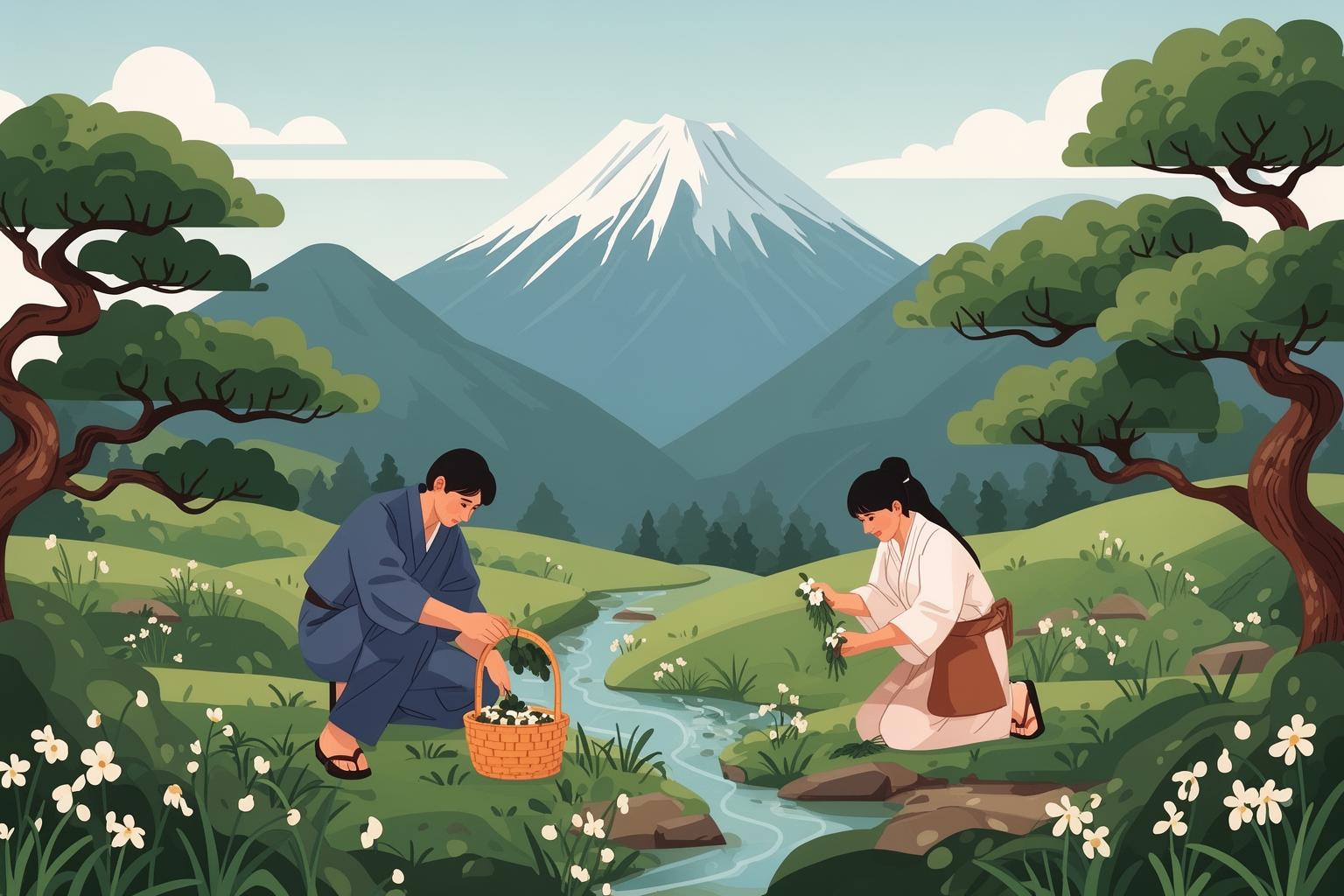
The deep significance of sansai lies not only in eating but equally in the gathering. The practice of sansai-tori (山菜採り), or mountain vegetable foraging, is a cherished tradition, especially among older generations in rural Japan. It is a quiet, meditative activity requiring great skill and an intimate, profound knowledge of the local landscape.
This is far from a casual stroll in the woods. Experienced foragers, often men and women in their 60s, 70s, or even 80s, know their local mountains like the back of their hand. They understand which slope the kogomi favors, the exact grove hiding the best tara no me, and the precise week—or even the exact three-day period—when the warabi is perfectly unfurled. Such knowledge is passed down through generations, forming a mental map of the forest’s bounty that is never written down. They carry special baskets, frequently woven from bamboo, and small, sharp knives, moving with practiced efficiency through terrain that would challenge people half their age.
The ritual is guided by unwritten rules grounded in respect and sustainability. A true forager never takes everything. When harvesting tara no me, only the central, primary bud is picked, leaving smaller, secondary buds so the tree can continue growing. They carefully cut fukinoto without disturbing the root system. They gather only what is needed for their family and perhaps a little to share with neighbors, recognizing that the mountain’s bounty—yama no sachi (山の幸)—is a gift to be shared with both humans and the animals that rely on it. This ethic of restraint sharply contrasts with the commercial agriculture mindset, which focuses on maximizing yield.
Foraging is also a multi-sensory experience. It involves listening for the sound of running water that might indicate a good spot for certain ferns, smelling the distinct earthy aroma of udo before seeing it, and feeling the texture of leaves to confirm identification. This process demands deep, focused awareness of one’s surroundings. For many, this solitary time in the quiet mountains serves as a spiritual balm and a way to reconnect with a world that is increasingly digital and disconnected from nature.
From Mountain to Plate: The Art of Preparation
Bringing sansai from the mountain to the table is an art in itself, a vital step that transforms potentially harsh and even toxic plants into exquisite delicacies. This transformation depends on careful, often time-consuming preparation that reflects a deep reverence for the ingredient.
As noted with warabi, the process of aku-nuki is essential to preparing many types of sansai. It represents the patient, trial-and-error wisdom of generations who discovered how to make these wild plants not just edible, but delicious. This is not a quick rinse—it’s a deliberate, almost ceremonial procedure requiring expertise and patience. The use of natural materials like wood ash ties the preparation back to the natural world, completing a cycle from forest, to fire, to food.
Once the preparatory work is complete, the cooking methods are usually simple, designed to highlight the unique character of each vegetable rather than conceal it. The aim is not to remove bitterness but to balance it, presenting it in a way that reveals its complexity.
Tempura: Perhaps the most universally loved method for sansai. The high heat of the oil cooks the vegetable quickly, softening any toughness while preserving its fresh flavor. The light, crispy coating adds a delightful textural contrast and a touch of richness that balances the vegetable’s natural bitterness. For tara no me and fukinoto, this is often regarded as the ideal preparation.
Ohitashi: This simple technique involves blanching the sansai and then soaking it in a chilled, light broth made of dashi, soy sauce, and mirin. It’s a pure and elegant preparation that allows the clean, subtle flavors of the vegetable to emerge, cooled and enhanced by the umami of the dashi.
Aemono: Referring to dressed dishes or salads. After blanching, sansai can be tossed with various dressings. A sesame dressing (goma-ae) introduces a nutty richness, a miso-vinegar dressing (sumiso-ae) offers a tangy, savory contrast, and a tofu dressing (shira-ae) provides a creamy, subtle sweetness. Each pairing is carefully chosen to complement the vegetable’s specific flavor profile.
Takikomi Gohan: Sansai can also be cooked together with rice. The vegetables are finely chopped and added to the rice cooker with dashi and seasonings. As the rice steams, it becomes imbued with the delicate, earthy aroma of the mountains, creating a dish that is deeply comforting and evocative of the season.
These preparations are not about heavy sauces or overpowering spices; they focus on precision, balance, and a minimalist aesthetic that places the ingredient itself at the heart of the experience.
Sansai in Modern Japan: A Fading Tradition or a Renewed Appreciation?

Like many traditional practices in a rapidly modernizing Japan, sansai culture stands at a crossroads regarding its future. The deep, embodied knowledge of foraging is largely held by the older generations. As rural communities age and young people continue migrating to cities, there is a genuine risk that this intricate understanding of the local ecosystem may fade away. Fewer young people have the time, access to the mountains, or the direct mentorship needed to become skilled foragers.
Yet sansai is far from vanishing. In fact, it is experiencing a revival in certain circles. Among high-end Japanese cuisine, leading chefs in Tokyo and Kyoto eagerly anticipate the first shipments of wild sansai from their trusted foragers. For them, using these vegetables in their menus represents the ultimate expression of seasonality. Serving a dish of perfectly prepared wild kogomi or a single, exquisite tara no me tempura makes a powerful statement about their dedication to the freshest, most fleeting ingredients. These dishes can command high prices, turning the humble mountain vegetable into a luxury item.
At the same time, there is growing interest among younger urbanites in food provenance, sustainability, and reconnecting with nature. Foraging, once seen as a rustic hobby of rural grandparents, is gaining a new kind of appeal. Some rural towns have started offering guided sansai-tori tours, where city dwellers can pay to learn the basics from local experts. This approach helps monetize and preserve traditional knowledge while meeting a modern desire for authentic experiences.
Sansai can also be found in most supermarkets during spring, neatly packaged and ready to cook. This accessibility is both a benefit and a drawback. It allows more people to enjoy the taste of spring, but it also separates the food from its context—the mountain, the ritual of foraging, and the knowledge of preparation. It becomes simply another commodity, its wild essence contained by plastic wrap and a barcode.
In the end, the story of sansai is one of a flavor profile and food ritual that has endured because it provides something modern, industrialized food cannot. It offers a direct, tangible connection to the wild. To eat sansai is to take part in an ancient cycle, to taste nature’s resilience, and to embrace a more complex and demanding definition of deliciousness. That bitter note, so startling at first, is not a flaw. It is a taste of authenticity—the flavor of the mountain awakening from its long winter rest—and once acquired, it is a taste impossible to forget.