Yo, what’s the deal? You’ve probably seen them, right? In that one anime with the laser bikes, or maybe in some gritty yakuza flick. A screaming pack of riders on bikes that look like they crashed into a Gundam factory, all chrome and chaos, splitting the silent Tokyo night in two. They’re called the Bōsōzoku—the “running-out-of-control tribes.” Your first thought is probably, “Okay, so just biker gangs, right? Trouble.” And yeah, you’re not totally wrong. They’re loud, they’re a menace on the roads, and the cops are definitely not their biggest fans. But if you stop there, you’re missing the whole vibe, the real story. You’re asking why a country that’s so crazy about politeness, rules, and not bothering your neighbor has this? This screaming, rebellious, in-your-face spectacle? That’s the real question, and the answer is kinda wild. You gotta stop thinking of them as just a gang and start seeing them for what they really are: a modern-day fire festival. A chaotic, mechanical, and totally unsanctioned matsuri on wheels. It’s a ritual, a performance, and a desperate scream for a place to belong in a world that’s trying to sand down all your sharp edges. It’s not just about breaking the law; it’s about creating a temporary, sacred space where the outcasts are kings, and the roar of an engine sounds like a prayer. Let’s peel back the layers on this asphalt ceremony.
To understand this raw, explosive energy in a more traditional form, you can explore the primal power of Japan’s Tezutsu hand-held firework festivals.
The Sound and the Fury: Deconstructing the Bōsōzoku Aesthetic
To truly understand what the Bōsōzoku are all about, you need to see beyond the noise and their delinquent reputation. You have to interpret their style, because every element is symbolic, part of a much larger ritual. This isn’t mere random rebellion; it’s a carefully orchestrated performance. Their bikes, their clothes, even the way they rev their engines—they all follow a script passed down through generations of disillusioned youth. It’s a language expressed in chrome, embroidery, and decibels, and once you begin to grasp it, the entire chaotic scene starts to make an unusual kind of sense. You realize you’re not just witnessing a group of angry teens, but the priests and participants of a very particular, very modern ceremony.
The Bike as a Divine Palanquin (Mikoshi)
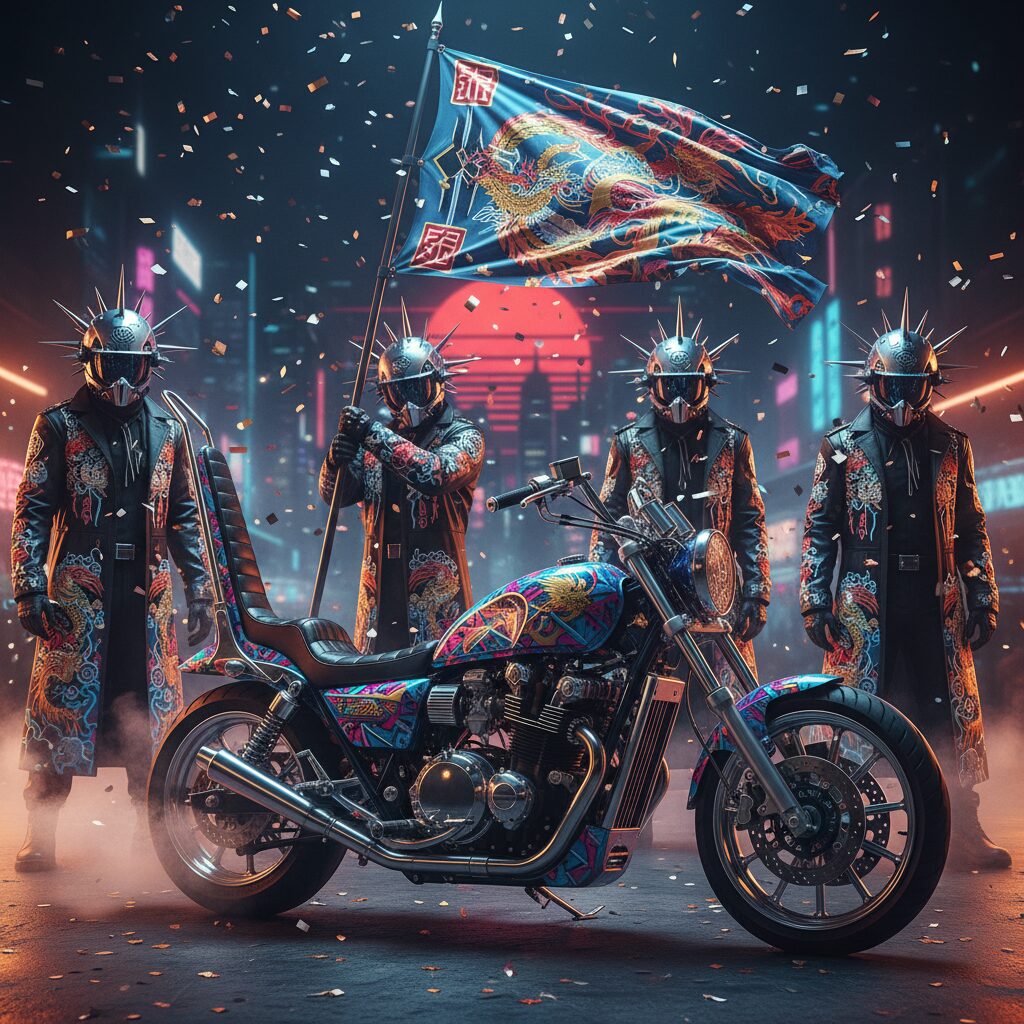
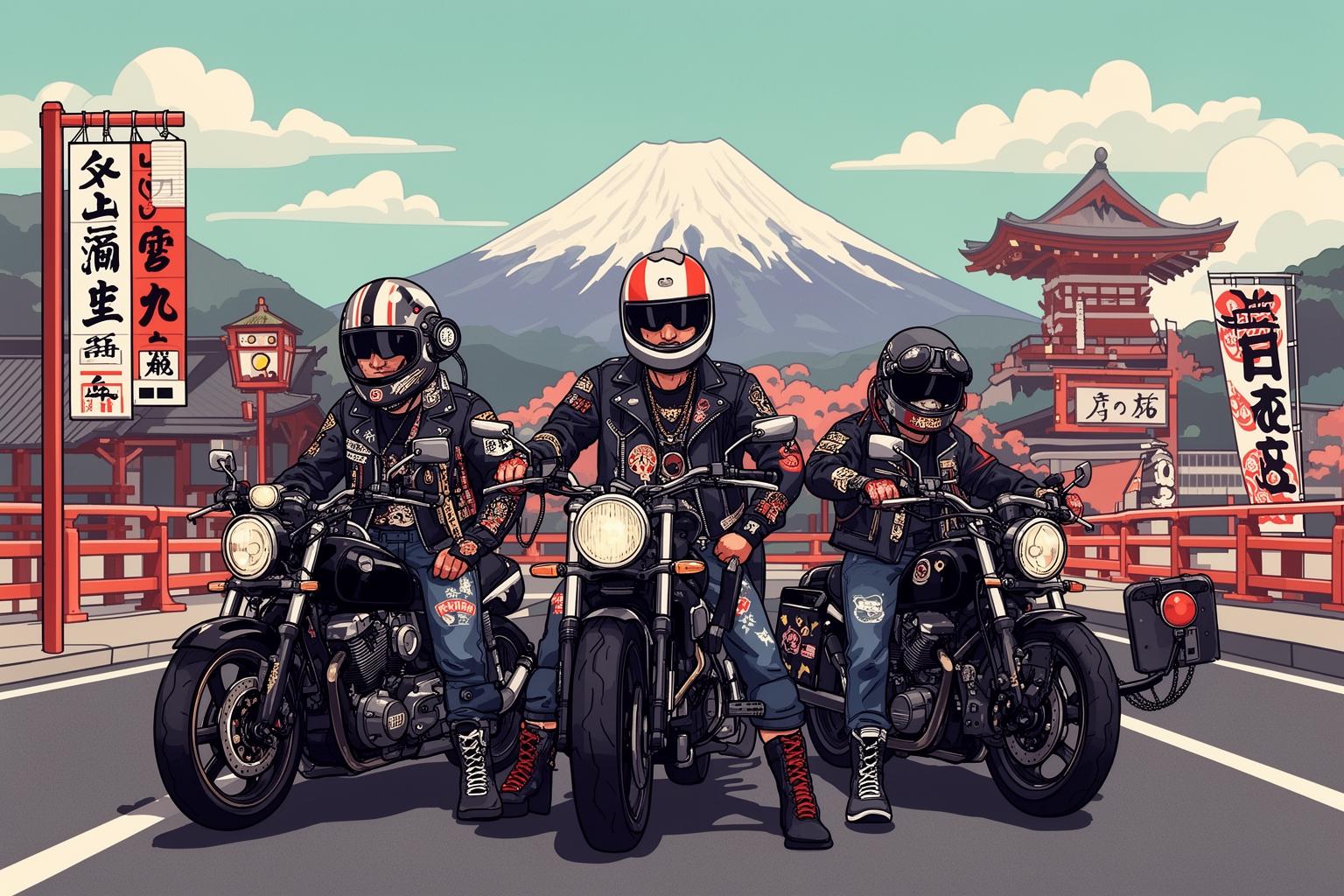
Have you ever been to a Japanese festival, a real matsuri? If so, you’ve seen a mikoshi. It’s a large, ornate portable shrine carried on the shoulders of many people, usually men in loincloths, as they shout, sweat, and rock it through the streets. It’s loud, chaotic, and the focal point of the event. The mikoshi is believed to carry the local deity, and the procession is intended to display its power and energize the community. Now, take a close look at a Bōsōzoku bike. I mean, really examine it. It’s not designed for speed, and those modifications aren’t for performance. It’s made for presence. It’s a rolling mikoshi. The bike is the sacred object of the Bōsōzoku tribe. Each modification is a prayer, an offering to their gods of rebellion and brotherhood. The towering three-tiered seats, called sanren-shīto, aren’t for carrying three people; they’re an absurd throne, a defiant gesture against practicality that reaches toward the sky. The oversized front fairings, known as rocket cowls, resemble spaceship nosecones but serve no aerodynamic function—they are the elaborate roof of the shrine. The paint jobs are wild—glittery flakes, rising sun motifs, cherry blossoms, and fierce dragons curling around the gas tank. This is no simple paint job; it’s the intricate lacquer and gold leaf of their sacred palanquin. And the sound—oh, the sound. They remove the baffles from their exhausts or fit custom ones, a practice called shugo, to make the bike roar. It’s a deafening, bone-shaking noise announcing their arrival from blocks away. This isn’t the smooth hum of a finely tuned machine; it’s the clamor of festival drums and chanting, designed to jolt the world awake and declare, “We are here. You cannot ignore us.” The bike is their deity, their centerpiece, the tangible soul of the group. It’s not just a vehicle; it’s a vessel for their spirit.
The Uniform as a Festival Coat (Happi)
At a festival, participants wear matching coats called happi. These simple, vibrant jackets, printed with the crest or name of their neighborhood or shrine, immediately mark membership. The uniform erases individual identity, replacing it with collective purpose. For that day, you are not Tanaka-san, the office worker; you are a servant of the shrine, a carrier of the mikoshi. The Bōsōzoku have their own version of the happi coat, but far more intense: the tokkō-fuku. The name means “Special Attack Uniform,” a stark reference to the kamikaze pilots of World War II. It’s a long military-style coat, often worn open to reveal the bandages wrapped around their torsos, called sarashi. The uniform itself is a defiant, almost suicidal statement of dedication to the gang. But it’s the embroidery that elevates it from clothing to sacred scripture. On the back, the team’s name—Black Emperor, Specter, God Speed You!—stands out in massive, intricate kanji stitched in gold or silver thread. Surrounding these are slogans and rebellious poems. Phrases like Tenjō Tenge Yuiga Dokuson (“Throughout Heaven and Earth, I alone am the Honored One”—a repurposed Buddha quote with supreme arrogance) are common. Rising sun flags appear not merely as nationalist symbols but as bold visual shouts of defiance. Cherry blossoms are another frequent motif, symbolizing the beautiful yet fleeting life of a warrior. Every stitch declares their values: loyalty, brotherhood, and total rejection of the mainstream. It’s their team jersey and their religious vestment at once. When they don the tokkō-fuku, they cease to be a high school dropout or disgruntled part-timer. They become a warrior, a tribe member, a participant in the sacred night ride ceremony. It’s their festival costume, the skin they wear to become something larger and more powerful than themselves.
The Roar as a Ritual Chant
If you think the noise Bōsōzoku make is merely random throttle-twisting, you’re missing the music. It’s a performance, a deliberate and rhythmic act called kōru, meaning “call.” They treat the engine like an instrument. One rider revs the engine in a specific pattern, and another answers. Together, they create a noisy symphony, a call-and-response that echoes through the city’s concrete canyons. Some even install musical horns that play snippets of pop songs or the theme from The Godfather, adding an extra layer of surreal melody to the mechanical orchestra. This noise isn’t chaos for chaos’s sake. It’s a ritual chant. Think of the rhythmic shouts at a matsuri—“Wasshoi! Wasshoi!”—chanted in unison by mikoshi carriers to maintain rhythm and build energy. The Bōsōzoku’s engine call serves the same purpose. It unites the group, synchronizing their movements and mindset. It also marks territory. Their sound is a sonic flag planted in the quiet, orderly neighborhoods they pass through. It’s a temporary conquest, a declaration that for these few hours, this street, this city, belongs to them. This chant’s purpose is to deliberately disrupt wa, the Japanese ideal of social harmony. In a society where being a nuisance (meiwaku) is the worst offense, the Bōsōzoku’s very existence is defined by being the ultimate nuisance. Their engine roar is a precisely crafted sonic weapon against the silence and conformity of the world they feel has rejected them. It is the sacred, disruptive music of their fire festival.
The Social Engine: Why Do Kids Join Bōsōzoku?
So, we’ve unraveled the aesthetic. We view the bike as a shrine, the uniform as a sacred garment, and the noise as a ritual chant. Yet, this still leaves the biggest question unanswered: why? Why does this resonate with anyone? Why would a teenager choose a life filled with noise, danger, and police attention? The answer has almost nothing to do with motorcycles and everything to do with the overwhelming, soul-crushing pressure of being a young person in modern Japan. The Bōsōzoku aren’t born from a passion for engines; they emerge from a desperate need to escape and a craving for identity in a system that often tries to suppress it.
Escaping the Pressure Cooker of Japanese Society
From the moment you can hold a pencil in Japan, the pressure begins. It’s an unrelenting climb up a very narrow ladder. You must enter the right kindergarten to get into the right elementary school, which leads to the right junior high, crucial for gaining admission to a top high school. All of this is just the prelude to the real battle: the university entrance exams, often called “examination hell” (juken jigoku). Your entire future seems hinged on a single test score. Succeed, and your path is set: a good university, a stable job at a big corporation, and a life of respectable conformity. But what if you don’t? What if you’re not academically gifted? What if you’re seen as a troublemaker, a dreamer, or simply someone who doesn’t fit into that tiny, prescribed box? For those kids, society offers few good alternatives. You’re branded a failure early on, funneled into vocational schools or dead-end jobs, and become invisible. The Bōsōzoku world is a direct response to this. It’s a parallel universe with its own rules and definitions of success. In the gang, nobody cares about test scores; they value loyalty, courage, and readiness to ride. It provides a potent, intoxicating alternative form of validation. For a kid repeatedly told he’s not good enough, the Bōsōzoku offers a chance to reign. The roar of his bike is a scream back at the system that rejected him. The gang becomes a surrogate family, a place where he isn’t just seen, but celebrated for the very traits—aggression, defiance, non-conformity—that made him an outcast. It acts as a pressure valve for the broader social system, a space where those deemed failures craft their own twisted version of glory.
The Senpai-Kōhai System on Two Wheels
Here’s the greatest irony: despite all their talk of rebellion and rule-breaking, Bōsōzoku gangs are structured in an intensely, almost humorously Japanese way. They are organized around the rigid hierarchical senpai-kōhai (senior-junior) system that shapes relationships in all areas of Japanese society, from school clubs to corporate offices. Within the Bōsōzoku, this structure is distilled to its rawest, most brutal form. The senpai (seniors) hold absolute authority; their word is law. The kōhai (juniors) are expected to show unwavering respect and obedience, running errands, cleaning bikes, and taking the fall if the police arrive. Disrespecting a senpai can lead to a harsh beating. This is no free-for-all of anarchic rebels; it’s a micro-dictatorship on wheels. So why do people join? For kids unable to navigate the mainstream senpai-kōhai system, the Bōsōzoku version—though harsher—is also more concrete and, oddly, more honest. The goals are clear: demonstrate your loyalty, endure the trials, and eventually become a senpai yourself. You earn the respect and power society denied you. It’s a distorted reflection of the very social structure they claim to defy. They haven’t escaped the system; they’ve recreated it in their own image, swapping business suits for embroidered uniforms and corporate ladders for gang hierarchies. It provides the structure and sense of belonging they seek, but on their own terms, in a world where they get to set the rules.
A Temporary Kingdom: The Graduation Ritual
This aspect truly strengthens the festival analogy. For most members, being a Bōsōzoku is not a lifelong career. It’s a phase—a fiery, intense, and deliberately temporary chapter in their youth. Just like a festival has a set start and end, so does a Bōsōzoku career. The conclusion usually arrives at age 20, the legal age of adulthood in Japan. At this point, they hold a retirement ceremony, the intai-shiki. This is a significant event, a formal graduation from youthful rebellion back into adult responsibility. The retiring member might receive a ceremonial beating from juniors as a gesture of tough love and respect, or lead the gang on a final, epic ride—a last blaze of glory before retiring the tokkō-fuku for good. After the intai-shiki, he’s expected to become a shakaijin—a “member of society.” He finds a regular job, often in construction or trucking, marries, has children, and settles down. He might keep his old bike in the garage as a trophy from his past, but his days of raising hell are over. This built-in expiration date is essential. It demonstrates that the Bōsōzoku world isn’t meant as a permanent alternative to society, but rather a ritualized coming-of-age journey. It’s a space to be wild, test limits, and forge a powerful identity before donning the uniform of the Japanese salaryman. It’s a festival of youth that, by its very nature, must end, leaving behind only scars, stories, and the faint echo of a roaring engine.
The Road to Oblivion? The Decline and Evolution of Bōsōzoku
If you come to Japan now expecting to see massive packs of Bōsōzoku shutting down the Shibuya crossing every Friday night, you’re likely to be disappointed. The golden age of the Bōsōzoku, during the 1980s and 90s, is long behind us. The tribes that once numbered in the hundreds have dwindled into small, scattered groups, if they still exist at all. The deafening roar that once defined the Japanese night has quieted to a whisper. However, this doesn’t mean the spirit is dead; it has simply evolved. The festival hasn’t been canceled—it’s just shifted venues and found new, more subtle ways to express itself. The story of the Bōsōzoku’s decline is one of police crackdowns, changing social norms, and the remarkable adaptability of rebellious energy.
The Crackdown: When the Party Got Too Wild
For a long time, the police viewed Bōsōzoku as more of a juvenile nuisance than a serious threat. But as the gangs grew larger and more violent in the ’80s, clashing with rival groups and sometimes with the public, society’s tolerance ran out. The festival was spiraling out of control. The turning point came in the early 2000s, with a series of new traffic laws specifically aimed at dismantling the Bōsōzoku lifestyle. These laws made it easier to prosecute entire groups for the actions of a few members. Their signature riding style—weaving through traffic in large groups, ignoring traffic lights, and causing major public disturbances—became a serious crime with harsh consequences. Police began using sophisticated tactics, like videotaping rides from unmarked cars and helicopters to identify riders later, instead of engaging in dangerous high-speed chases. Penalties became severe, not only for the riders but also for those who sold them modified parts or gasoline. The party was over. The risk outweighed the reward. The cost of joining the festival—potential jail time and a lifelong criminal record—became too steep for most young people.
From Gangs to Kyūshakai: The Nostalgic Ghost Riders
So what happened to all those who “graduated” or were forced out by the crackdowns? The spirit didn’t disappear. It mellowed. It matured. It became the kyūshakai, which literally means “old car club.” These groups consist mostly of older men in their 30s, 40s, and 50s who were once Bōsōzoku. They still love the bikes and the style but have left behind the hardcore gang life. They carefully restore and customize vintage motorcycles in the classic Bōsōzoku style—the rocket cowls, towering seats, and flashy paint—but now with the precision and budget of middle-aged hobbyists. They hold meetups and shows in parking lots to admire each other’s creations, polish chrome, and swap stories about the good old days. They might ride in groups, but generally obey traffic laws. It’s the Bōsōzoku festival transformed into a historical reenactment society. All the ritual elements remain—the bikes, the style, even some old uniforms—but the dangerous, anti-social performance is gone. It’s a way to hold onto a piece of their wild youth, to remember who they were before becoming husbands, fathers, and salarymen. The kyūshakai are the ghost riders of a bygone era, preserving the aesthetic as a nostalgic art form, long after the original fire has burned out.
The Modern Mutations: Drifting and VIP Style
The rebellious energy that once fueled the Bōsōzoku didn’t vanish; it simply transformed. It found new vehicles, quite literally. The kids who might have joined a Bōsōzoku gang twenty years ago are now involved in different subcultures that share the same core spirit. Consider the world of illegal street drifting, which has all the classic Bōsōzoku elements: heavily modified, impractical vehicles; an emphasis on spectacle and skill over raw speed; organized teams with their own logos and identities; and high-stakes cat-and-mouse games with police on remote mountain roads (touge) late at night. The spirit of collective, anti-social performance remains alive and well. Or look at the Bippu, or VIP Style car scene. This involves taking large, conservative luxury sedans—the kind a corporate CEO might ride in—and lowering them to the ground, fitting ridiculously wide wheels with stretched tires (hippari), and giving them loud exhausts. It’s automotive subversion, turning a symbol of mainstream Japanese success and wealth into something aggressive, impractical, and rebellious. It’s the Bōsōzoku ethos applied to four wheels. The festival goes on, but the mikoshi is no longer a Honda CB400—it’s a Toyota Celsior with a demonic camber. The spirit of finding community, expressing identity through extreme customization, and carving out a rebellious space within the mainstream remains a powerful force that will always find an outlet.
The Fire Festival Analogy: Tying It All Together
So, we return to our starting point. Why is it helpful to view the Bōsōzoku as a contemporary fire festival? Because it shifts them from being seen merely as a social problem to a complex cultural phenomenon. This perspective helps us grasp the “why” behind the noise. It’s not just about delinquency; it represents a deep-rooted human need for ritual, community, and release, especially within a society as rigidly structured and pressure-filled as Japan. The Bōsōzoku are simultaneously a symptom, a reaction, and an oddly creative response to the challenges of growing up on the fringes of this culture.
A Space for Controlled Chaos
Japan’s long and celebrated tradition of festivals is anything but calm and orderly. Consider the Onbashira festival, where men ride massive logs down a mountainside, or the Nachi no Hi Matsuri, where participants carry huge, flaming torches up a sacred stairway. These events are terrifying, dangerous, and chaotic. They are officially sanctioned spaces where everyday societal rules are briefly suspended, allowing a release of raw, primal energy usually kept tightly controlled. In their own way, the Bōsōzoku fashioned their own unsanctioned festival of chaos. Seeing a society that had no place for their wild youthful energy, they created a space for it themselves on the asphalt of the nation’s highways. Their weekly night rides were rituals that let them momentarily rise above their dull, powerless daily lives and become something mythic, feared, and real. It was their equivalent of riding the log down the mountain—a self-made ceremony of controlled danger and ecstatic release. The problem, of course, was that their festival was never officially approved. It intruded into the lives of everyday people, and eventually, authorities had to end it. Yet the impulse behind it—the need for a space to unleash the fire within—is a fundamental element of the Japanese cultural psyche.
The Beauty in the Noise
It’s easy to dismiss the Bōsōzoku as nothing more than ugly noise, a disturbance to the otherwise peaceful Japanese night. For many, that was all they ever were. But if examined closely, and with the right perspective, a strange and fleeting beauty emerges in what they created. There is a profound aesthetic at play here, one that feels distinctly Japanese. It lies in the meticulous, almost obsessive care given to their bikes and uniforms. Every part is selected and customized deliberately, contributing to a cohesive, spectacular whole. It’s found in their deep sense of group loyalty and the theatrical nature of their rituals—from the initiation of new members to the retirement of seniors. Above all, it’s embodied in the transient, explosive quality of their existence, a concept the Japanese call hanabi—fireworks. The Bōsōzoku life was like a firework: a brilliant, deafening, beautiful burst that lights up the darkness for a breathtaking moment before disappearing entirely, leaving only a fading echo and the scent of smoke. It was never meant to endure. It was a fiery, passionate outburst of youth against the silent, immovable background of Japanese society. Their protest, their art, and their ceremony. Their modern-day fire festival—a roar of defiance before the inevitable silence returns.