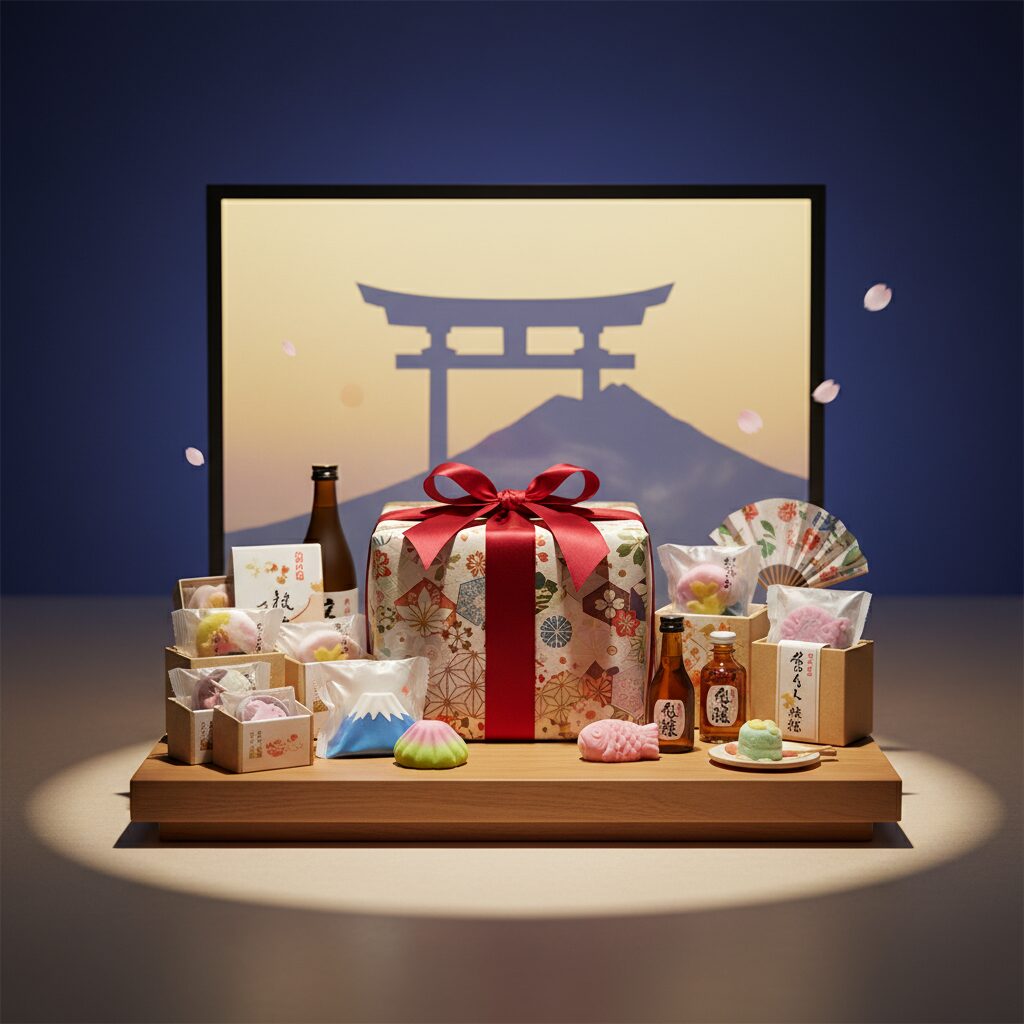
You’ve seen them. If you’ve spent more than ten minutes in a Japanese train station, airport, or highway rest stop, you’ve seen them. Endless, immaculate stacks of beautifully designed boxes, each one promising a regional delicacy. White chocolate cookies from Hokkaido, tiny maple leaf-shaped cakes from Hiroshima, green tea langue de chat from Kyoto. The sheer volume is staggering. You watch as people, often in a hurry, grab several boxes at once, rushing to a checkout counter before their train departs. And you’ve probably wondered, “Who on earth is buying all of this? And for whom?”
It’s a fair question. In most parts of the world, a souvenir is a personal memento. A keychain, a t-shirt, a magnet for the fridge—a small totem that says, “I was here.” But these boxes of cookies and cakes? They aren’t for the person buying them. They are for the people who weren’t there. They are omiyage (お土産), and they represent one of the most ingrained, non-negotiable social rituals in modern Japanese life. To mistake omiyage for a simple souvenir is to misunderstand a fundamental piece of the cultural machinery that keeps Japanese society running smoothly.
This isn’t just about being nice or thoughtful, although that’s part of it. Omiyage is a social obligation, a proof of travel, a token of apology, a conversation starter, and a tangible piece of a complex system of unspoken social debt and reciprocity. It is a vital thread in the fabric of group harmony. Forget to bring back omiyage for your office after a vacation, and you haven’t just committed a minor faux pas; you’ve subtly signaled that you don’t understand—or perhaps don’t care about—the delicate balance of your workplace community. Understanding omiyage is to have an ‘aha!’ moment about Japan itself, realizing that behind a seemingly simple box of snacks lies a deep well of social logic. So, let’s unpack it.
Japan’s unique blend of deep-rooted social rituals like omiyage and the innovative interplay between tradition and nature revealed by satoyama landscapes offers a broader perspective on the cultural forces that continue to shape modern Japanese life.
It’s Not a Souvenir, It’s a Social Contract
The first and most important distinction to understand is that omiyage and a souvenir are fundamentally different concepts, motivated by entirely different intentions. The English word “souvenir” derives from the French word for “to remember.” It is a primarily selfish act, in the neutral sense of the term. You purchase it to remind yourself of your own experience. An omiyage, conversely, is meant for others. Its purpose is to share the experience of your trip, but more importantly, to acknowledge and apologize for your absence.
The Fundamental Difference: “For Me” vs. “For You”
A Western souvenir tells a story about yourself. The “I ♥ NY” shirt proves you walked through Times Square. The miniature Colosseum on your desk serves as a reminder of your visit to Rome. The emphasis is on the individual’s memory and personal narrative. It is a trophy from your travels.
Omiyage turns this idea completely around. The focus is outward, aimed at your community—your colleagues, family, and neighbors. When you take a trip, especially a personal vacation, you temporarily step outside the group. While you were enjoying yourself, your coworkers covered your responsibilities. Your family managed without you. Your neighbors maintained the balance. Your absence caused a minor disruption, a small ripple in the social ecosystem.
Omiyage acts as the remedy. It is a tangible gesture that conveys, “Thank you for everything during my absence. I apologize for any inconvenience I may have caused. I was thinking of you, and here is proof.” It is a way of socially reintegrating. You come back not only with your memories but with a tribute to the group you left behind. This simple act soothes any potential resentment and reaffirms your dedication to the collective.
The Invisible Ledger of Obligation
To fully appreciate the significance of omiyage, you need to grasp two intertwined cultural concepts: giri (義理) and on (恩). Although they lack exact English equivalents, think of them as parts of an invisible social ledger. On is a debt of gratitude you carry, a favor you have received. Giri is the social obligation or duty to repay that debt and preserve harmonious relationships. Japanese social life constantly involves a subtle balancing of this ledger.
Taking a holiday is a form of personal indulgence. While not a substantial favor, your colleagues covering your work creates a small amount of on. You owe them. Omiyage is the simplest and most widely accepted way to fulfill the giri tied to that debt. It is a low-stakes exchange that keeps social accounts balanced. The monetary value is not the point; the act itself is what matters. Bringing something back demonstrates that you are someone who understands your obligations—a dependable member of the social contract. Neglecting this duty risks being seen as thoughtless or, worse, as someone who doesn’t understand the social norms, marking you as an outsider within your own community.
The Anatomy of a Perfect Omiyage
Not just any gift will suffice. The omiyage system follows a set of unwritten yet universally recognized rules. You can’t simply pick up a random chocolate bar from the airport convenience store and call it a day. A proper omiyage must embody a sort of holy trinity of traits, each fulfilling a specific social role.
The Holy Trinity: Local, Consumable, and Individually Wrapped
First and foremost, omiyage must be a local specialty, or meibutsu (名物). If you traveled to Hokkaido, you bring back something famous from Hokkaido, like Shiroi Koibito cookies. If you visited Fukuoka, you bring back mentaiko-flavored rice crackers. Bringing a generic Tokyo Banana from a trip to Osaka is a significant mistake. It shows you put no real thought into it and just grabbed the first thing you saw at the airport during your layover. The local connection proves you were truly there. It allows you to share an actual taste of the place you visited, making your journey tangible for the recipients. It also serves as an excellent conversation starter: “Oh, you went to Sendai! I love their zunda (sweet edamame paste) mochi.”
Second, the vast majority of omiyage are consumable, typically a snack. This is a clever piece of social engineering. A non-consumable gift, like a keychain or small trinket, places a burden on the recipient. They have to find a spot for it, keep it, and feel guilty if they ever want to discard it. It becomes clutter. But a food item? It fulfills its purpose by being enjoyed and then disappears. It offers a moment of shared pleasure without creating any lasting obligation or physical burden. It is the ideal, hassle-free gift.
Third, and especially important in work settings, omiyage must be individually wrapped. Open any standard box of omiyage, and you’ll find a dozen or more cookies, cakes, or mochi, each sealed in its own small plastic pouch. This isn’t just about freshness; it’s about hygiene and ease of distribution in a group environment. It allows the box to be placed on a communal table in the office where people can take one at their leisure without touching everyone else’s portion. There’s no need for a knife to cut a cake, no plates, no mess. It represents thoughtfulness toward others—a core principle of Japanese culture. This careful packaging ensures that sharing is as smooth and effortless as possible.
The Art of the Packaging (`Hōsō`)
Beyond the individual wrappers lies the box itself. In Japan, presentation is crucial. The way a gift is packaged, or hōsō (包装), is regarded as equally important as the gift inside. Omiyage boxes often showcase beautiful designs that reflect the region they come from—a famous castle, a local flower, a charming mascot. The careful wrapping in department store paper, the perfectly tied ribbon, and the elegant bag it’s placed in—all convey sincerity and respect for the recipient. A poorly presented gift suggests a poorly felt sentiment. The exquisite packaging elevates a simple box of snacks into a formal expression of respect.
The Omiyage Ecosystem: Where and Why
The obligation to give omiyage extends across various parts of your social life, though the rules and expectations differ slightly depending on the situation. The most significant context, however, is unquestionably the workplace.
The Office: The Primary Battlefield
Nowhere is the omiyage custom more important or formalized than in the office. This group is most directly impacted by your absence. Upon returning from your trip, the usual protocol is quite standard. You begin by offering omiyage to your boss and closest team members, accompanied by a slight bow and a humble phrase such as, 「つまらないものですが、どうぞ」 (Tsumaranai mono desu ga, dōzo), which literally translates to, “This is a boring/insignificant thing, but please accept it.”
This phrase exemplifies Japanese 謙逊 (kenson), or humility. Naturally, you don’t actually consider the gift boring—you probably spent considerable time choosing it. However, this verbal modesty acts as a social lubricant. It reduces the perceived value of the gift, which in turn diminishes the recipient’s sense of obligation. This makes it easier for them to accept without feeling they owe you a significant debt. After presenting the gift to your immediate team, you might place an open box in a communal kitchen or break room for others to share, along with a small note.
Family, Friends, and Neighbors (`Gokinjo`)
Outside the office, omiyage helps maintain other social relationships, though in a somewhat less formal way. With family, it’s a natural method of sharing your travel experience. Bringing back a special treat is a gesture of love and inclusion.
For close friends, omiyage signifies that you were thinking of them. It strengthens the friendship and shows you value the bond. The gift may be more personalized than the typical office box of cookies—perhaps a favorite snack or a small bottle of local craft sake.
Then there are the neighbors, or gokinjo. In Japan, maintaining good neighborhood relations (gokinjozukiai) is important. While it’s less obligatory than in the office, giving a small omiyage to your immediate neighbors after a trip, especially if you live in a close-knit apartment building, is a common and appreciated gesture. It’s a simple act that smooths daily life and fosters a harmonious living environment. It conveys the message, “We are part of the same local community, and I acknowledge that.”
The Psychology and History Behind the Box
This nationwide fascination with souvenir snacks didn’t emerge spontaneously. Its origins run deep, tracing back centuries to religious traditions that were gradually secularized with the arrival of mass transit and domestic tourism.
From Sacred Pilgrimage to Secular Ritual
The roots of omiyage are commonly thought to originate from Shinto religious pilgrimages, especially to the Ise Grand Shrine, Japan’s most revered site. In earlier times, not everyone in a village could undertake such a demanding journey. Typically, one person would travel as a representative of their entire community. Upon returning, they would bring back religious talismans (ofuda) or other blessed items from the shrine. These items, the miyage (with “miya” referring to the shrine), served as proof of the pilgrimage and as a way to share the shrine’s spiritual blessings with those who remained behind. The gift acted as a channel for shared divine grace.
During the peaceful and prosperous Edo period (1603-1868), leisure travel became increasingly common among the general population. The establishment of a national railway network in the Meiji era (1868-1912) further facilitated this. The sacred pilgrimage transformed into a holiday excursion, and the sacred ofuda evolved into the secular meibutsu—the well-known local specialty. Yet the core principle stayed intact: bringing back a piece of a distant place to share with your community. The spiritual benefit gave way to a social one.
Maintaining Group Harmony (`Wa` – 和)
Ultimately, the persistence of omiyage culture is linked to one of the most fundamental values in Japanese society: wa (和), or group harmony. Wa is the concept that prioritizes the smooth and peaceful operation of the group over individual expression.
Omiyage is a vital means of preserving wa. An individual’s personal trip represents a temporary separation from the collective. The act of bringing back omiyage serves as a ritual of reintegration. It symbolically dissolves the boundary between the individual’s experience and the group’s reality. By sharing a taste of your travels, you are weaving your personal story back into the collective narrative. You are expressing, “Even while I was away as an individual, I remained mindful of my identity as part of this group.” This gesture reaffirms your commitment to the collective, smoothing over the disruption caused by your absence and ensuring that harmony is restored.
Navigating the Omiyage Maze: A Practical Guide
For anyone living or working in Japan, understanding the omiyage custom is essential. It’s a vital aspect of social etiquette. This expectation generates a unique kind of travel-related anxiety and has given rise to an entire industry aimed at easing it.
The Fear of Forgetting (`Kaiwasureru`)
There is a particular, mild panic familiar to anyone who has traveled in Japan: the fear of forgetting to buy omiyage (kaiwasureru). It often arises on the last day, while packing. Suddenly, you realize you haven’t purchased anything for the office. This is exactly why Japan’s transportation hubs are omiyage havens. Train stations, airports, and large “service areas” on highways are more than just transit points; they are expansive, dazzling marketplaces of regional specialties. They serve as a safety net, a one-stop solution for the panicked traveler. You can dash off your train, pick up three different boxes of perfectly packaged, locally appropriate omiyage, and be back on the platform in under five minutes. This entire system is designed to address a universal social challenge.
How Much to Spend? Who to Give To?
The unwritten rules can be intimidating. How much should you spend? A standard box of omiyage for an office of 15-20 people typically costs between 1,000 and 2,000 yen (about $10-$20). The amount should be modest. Spending too much can be as awkward as spending too little because it places an excessive sense of obligation on the recipients. The thought behind the gift matters more than the price.
Regarding who receives omiyage, the general rule is to give it to the groups you belong to. Your work department is essential. Your family is a given. Beyond that, it depends on the closeness of the relationship. The person who watered your plants? Absolutely. Your entire hobby or sports club? A single large box for everyone to share is a thoughtful gesture. It’s always better to lean toward giving. The price of a box of cookies is small compared to the social goodwill it generates.
More Than a Transaction
From an outsider’s perspective, the omiyage custom can easily be seen as a tiring, transactional obligation. On a stressful travel day, it can certainly feel that way. However, stopping there misses the true meaning. Omiyage is more than a transaction; it is a form of communication. It physically represents a social grammar centered on consideration, gratitude, and the delicate balance within the collective.
It serves as the glue that strengthens relationships, both professional and personal. This system ensures that no one’s efforts go unrecognized and that the group is quietly reaffirmed. So, the next time you find yourself in a busy Japanese train station, surrounded by towering stacks of beautifully packaged boxes, you’ll understand what you’re witnessing. It’s not just a variety of snacks. It’s the intricate, invisible engine of Japanese society, quietly humming along, one individually wrapped cookie at a time.