Yo, what’s the deal? Mia Kim here, and today we’re taking a hard left turn off the beaten path, leaving the neon glow of Tokyo city pop in the rearview. We’re punching it deep into the mountains, back to a time when the vibes were analog, the engines were raw, and the legends were born on winding asphalt ribbons under the moonlight. We’re talking about the 1980s, the golden era of Japanese street racing, the absolute genesis of touge drifting. This ain’t just about cars, fam. This is about a feeling, a culture, a raw, unfiltered expression of rebellion and skill that sent shockwaves across the globe. Before the internet made everyone a star, before drift tutorials hit YouTube, there were just the mountains, the drivers, and their machines. It was a scene built on whispered rumors, local pride, and the unmistakable scream of a high-strung engine echoing through the cedar trees. Forget what you think you know. We’re going back to the source, to the gritty, high-stakes ballet of the midnight pass. It’s a story etched in tire marks and fueled by high-octane dreams, and trust me, you’re gonna wanna buckle up for this ride. This is the soul of JDM, no cap. It’s the sacred ground where gods were made, and we’re about to make a pilgrimage. The air gets colder up here, the roads get tighter, and the legends feel closer than ever. Let’s get it.
This raw, unfiltered expression of rebellion wasn’t limited to the mountains, as a similar spirit of automotive customization and subculture thrived on the highways with Japan’s legendary Decotora art trucks.
The Soul of the Mountain Pass: What Exactly is Touge?
So, let’s break it down. The word touge (峠) literally means ‘pass,’ referring to a mountain pass. These aren’t just any roads, though. Imagine winding routes etched into the volcanic mountains of Japan, full of switchbacks, hairpin turns, and elevation shifts that will make your stomach drop. By day, they serve as scenic drives for locals and tourists. But by night, particularly in the 80s, they became something entirely different. They turned into proving grounds. Battlefields. The setting for a unique type of street racing focused not on top speed, but on pure, unfiltered cornering skill. This is the very essence of the touge philosophy. A high-speed straight-line race depends on who has the biggest engine and deepest pockets. Touge, however, is the great equalizer. It’s about who knows the road, understands their car’s limits, and has the courage to push right to that edge—and maybe just a little beyond. The battles were often one-on-one, in a format called ‘cat and mouse’ or ‘sudden death.’ One car leads, the other follows. If the lead car manages to pull away and build a significant gap, they win. If the chasing car sticks close or overtakes, they win. Then they swap positions and go again. It was a pure test of driving skill. There were different styles, too. Some drivers focused on ‘grip,’ seeking the absolute fastest, cleanest line through corners without losing traction. They were smooth, precise, and ruthlessly efficient. But then there was the other style that captured the world’s imagination: drifting. This involved purposely putting the car into a controlled four-wheel slide through corners. It wasn’t always the fastest way down the mountain, but it was undoubtedly the most spectacular. It was an art form—a way to master the tightest hairpins and carry incredible speed through the turns. This was the raw, untamed spirit of touge culture—a high-stakes dance on the very edge of control.
The Golden Era: Analog Dreams in a Neon-Soaked Decade
To truly capture the essence of 80s touge, you need to grasp the backdrop of 1980s Japan. The country was riding the wild wave of the Bubble Economy. Money was abundant, spirits were high, and a generation of young people carried cash and a fierce desire for freedom and adrenaline. This was more than a subculture; it was a reflection of its era. The automotive industry was booming, producing some of the most legendary and tunable sports cars the world has ever known. These vehicles were relatively affordable, rear-wheel drive, and most importantly, fundamentally analog. That’s the crucial point. There were no electronic safety nets—no traction control, no stability assistance, no drive-by-wire throttles. Behind the wheel of an 80s JDM car, it was just you, the engine, the steering wheel, and the road. The car communicated everything directly to you through chassis vibrations and steering feedback. You could feel the tires begin to lose grip and sense the weight shifting during a corner. It required a level of skill and mechanical intuition that’s nearly unimaginable today. Every input—a bit too much throttle, a sloppy shift, a jerky steering motion—had an immediate and raw consequence. This direct, mechanical connection is what made the era so special. It nurtured a generation of remarkably skilled drivers who learned by feel and instinctively understood vehicle dynamics because they had no alternative. They pushed automotive technology to its limits, tuning their cars in small, dimly lit garages, crafting parts by hand, and constantly experimenting for that extra tenth of a second on their home course. While the neon lights of Shinjuku and Shibuya defined the decade for most, for the hashiriya (street racers), true magic unfolded in the darkness, far from the city, illuminated only by the sweep of their headlights around the next corner.
The Gods of the Touge: Iconic Machines of the Era
These drivers weren’t merely pilots; they were profoundly connected to their machines. The 80s cars were the co-stars of this story, each with its own character and soul. They were the tools through which the drivers expressed their craft. Picking your car was like selecting your weapon, and certain models became synonymous with the touge scene, reaching a mythic status that still resonates with enthusiasts today. These weren’t hypercars; they were lightweight, agile, and endlessly tunable platforms for grassroots racers.
The Underdog King: Toyota’s AE86 Sprinter Trueno & Corolla Levin
If one car captures the spirit of touge, it’s the AE86. No contest. The Hachi-Roku, meaning ‘eight-six’ in Japanese, wasn’t the most powerful car on the mountain. Far from it. But it made up for what it lacked in horsepower with pure, unfiltered balance and communication. A lightweight, front-engine, rear-wheel-drive coupe/hatchback powered by a rev-happy 1.6-liter twin-cam 4A-GE engine, it was humble on paper but a giant-killer on twisty mountain roads. The Hachi-Roku thrived on momentum—you couldn’t muscle your way out of trouble. You had to be smooth, precise, and carry every bit of speed possible through each corner. Its chassis was so communicative and predictable that it became the ultimate school for mastering car control, practically begging drivers to push it to the edge and slide it around. This car is inseparably linked with Keiichi Tsuchiya, the legendary ‘Drift King,’ who developed his skills on the touge in his AE86 and showcased what was achievable with exceptional car control. Its status as the GOAT was cemented further by its iconic role as Takumi Fujiwara’s tofu delivery car in the anime Initial D. The Hachi-Roku wasn’t just a car; it was a symbol—it proclaimed that skill, not power, ruled the mountain. Its high-revving engine’s scream is one of the most iconic sounds in automotive history, a battle cry for underdogs everywhere.
The Rotary Spirit: Mazda’s Savanna RX-7 (SA22C & FC3S)
While the AE86 was the nimble scrapper, the Mazda RX-7 stood as the sophisticated, high-tech challenger. Its secret weapon was entirely different: the rotary engine. Instead of pistons moving up and down, the RX-7’s engine featured a triangular rotor spinning inside an oblong housing. This produced an engine that was incredibly compact, lightweight, and capable of soaring to very high RPMs. Its sound was unique—not a growl or roar, but a high-pitched, angry buzz, like a swarm of metallic hornets. The early 80s first-generation SA22C was a pure, lightweight sports car with superb balance thanks to its front-midship engine placement. However, the second-generation FC3S, introduced in 1985, truly became a touge icon. With Porsche 944-inspired sleek styling and a turbocharged rotary engine, the FC was a serious performance machine—more powerful and stable than the AE86, but also more challenging to drive. The rotary engine’s explosive power delivery at high revs made it a handful. Mastering the FC in a drift required finesse and immense confidence, making it a high-risk, high-reward choice. Drivers who conquered the FC gained a reputation for special talent. It symbolized a more refined, more powerful approach to touge racing, with its rivalry against the Hachi-Roku defining countless mountain battles. The Takahashi brothers from Initial D, piloting their FC and later FD RX-7s, perfectly captured the car’s mystique as the weapon of choice for skilled, analytical drivers.
Nissan’s Versatile Warriors: The Silvia, Skyline, and 180SX
Nissan was a dominant force in the 80s scene, offering a broad lineup of rear-wheel-drive platforms ideal for the touge. The undisputed king of versatility was the Silvia. While the S12 chassis featured in the mid-80s, it was the S13 Silvia’s arrival in 1988 that revolutionized the game. The S13 was an instant classic—stylish, affordable, and equipped with a nearly perfect chassis for drifting right out of the box. Its multi-link rear suspension provided an excellent balance of stability and agility. Paired with engines like the CA18DET and later the legendary SR20DET, the S13 combined handling and power to be a top contender on any mountain. Its sibling, the 180SX, sharing the same chassis but featuring a sleek fastback body with pop-up headlights, was equally cherished. The S-chassis became the blank canvas for a generation of drifters and racers. Meanwhile, the Skyline badge carried a heftier, more powerful legacy. In the 80s, this meant the R30 and R31 generations—larger, boxier cars often powered by potent straight-six engines. They were primarily known for high-speed highway runs, but in the right hands, their power was a formidable weapon on wider touge sections. At the decade’s end, in 1989, Nissan dropped a game-changer: the R32 Skyline GT-R. Boasting a twin-turbo RB26DETT engine and the revolutionary ATTESA E-TS all-wheel-drive system, the R32 was a technological beast. Built for grip rather than drifting, it dominated every racing form it entered, earning the nickname ‘Godzilla.’ Though not a traditional touge drifter, its arrival marked a new era of technology and all-wheel-drive supremacy that would define the 90s.
The Symphony of the Streets: Sound, Smell, and Sensation
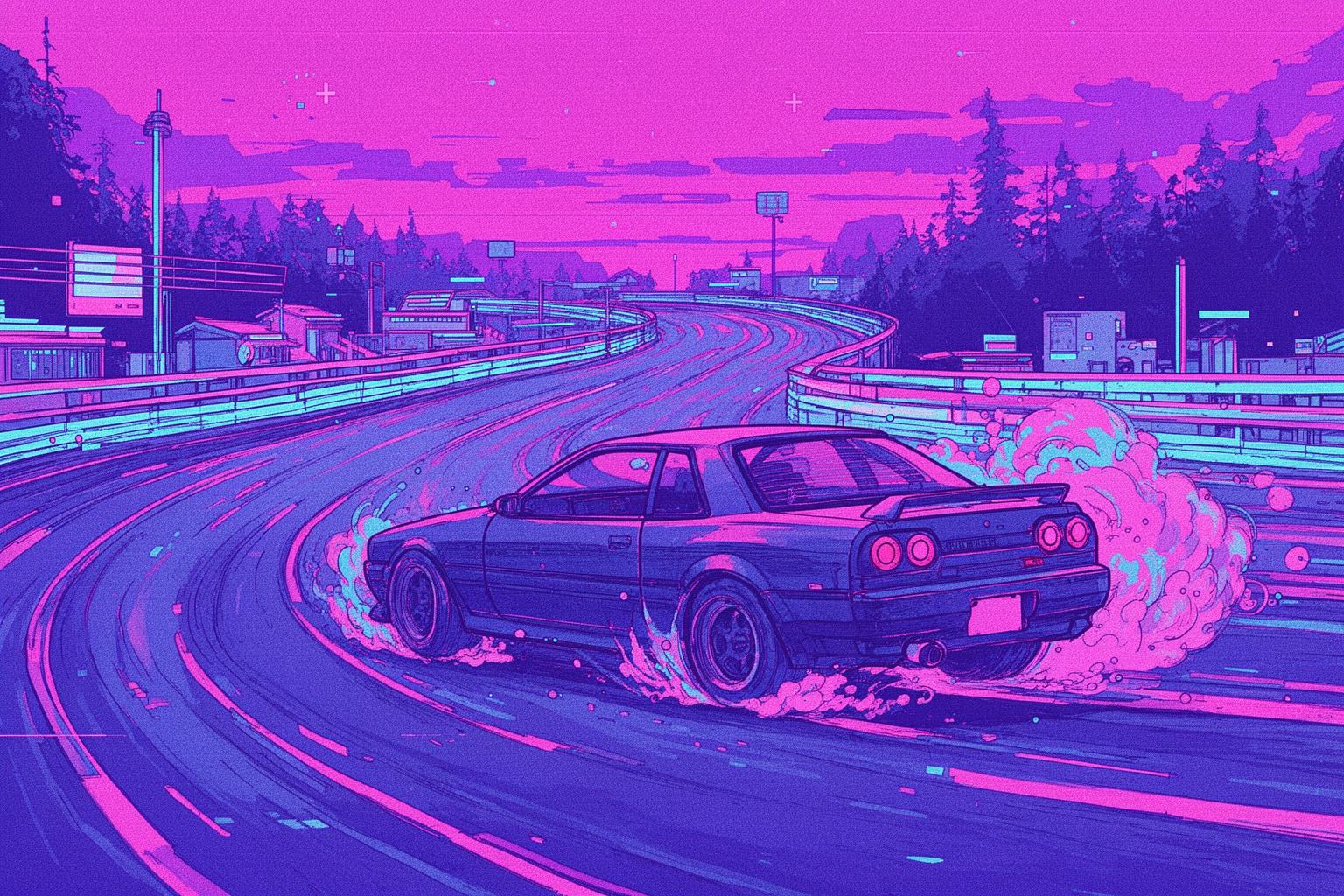
To truly immerse yourself in a misty Gunma mountain pass in 1986, you need to engage all your senses. The 80s touge experience was a visceral, overwhelming assault on the senses—a raw symphony of mechanical fury and natural beauty that cannot be duplicated. It was about more than just watching a car slide sideways; it was about feeling it in your chest, smelling it in the air, and hearing its story told through a language of fire and steel. This sensory experience lies at the heart of the analog vibe, the very essence that modern, insulated cars have engineered out. For the drivers and the few spectators lurking in the shadows, this symphony was everything.
Engine Notes and Exhaust Screams: A Mechanical Opera
Each car had its own unique voice, its distinct song. The night was never truly silent. At first, you’d catch a faint whine in the distance, a barely noticeable vibration. Then it would grow louder, echoing off the rock faces, the sound bouncing and warping until it surrounded you. An AE86 at full throttle, howling toward its 8,000 RPM redline, was a raw, metallic scream—the sound of a small engine giving every last ounce of its power. An FC RX-7 was completely different—a smooth, high-pitched buzz that swelled into a deafening roar, a noise only a spinning rotor could produce. A Nissan straight-six, like an RB20 in a Skyline, emitted a deeper, more resonant bellow, a guttural growl expressing torque and strength. Then came the punctuation marks: the sudden pop-pop-bang of unburned fuel igniting in a hot exhaust on downshift, resembling gunfire echoing through the valley; the sharp pssshhh of a blow-off valve releasing excess turbo pressure as the driver lifted off the throttle, preparing for the next corner; the chirping squeal of tires gripping desperately under hard acceleration. It was a complex, layered orchestra of mechanical sounds, and to the initiated, you could close your eyes and instantly identify which car was approaching, how aggressively it was driven, and the unfolding battle just from the sounds riding the wind.
The Scent of Battle: An Industrial Potpourri
Equally powerful as the sound was the smell. Mountain air is usually clean, crisp, and fragrant with pine and damp earth. The touge transformed that. The dominant aroma was the acrid, sharp scent of burning rubber, lingering in the air long after the cars had passed—a ghostly reminder of the commitment needed to slide a car at speed. There was also the sharp, metallic tang of overheated brake pads, a scent of pure heat and friction that revealed when a driver braked late and hard, pushing their equipment to the brink. And naturally, the sweet, chemical perfume of high-octane gasoline. A richly tuned engine, designed for maximum power, would leave a trail of this scent behind. These industrial odors mixed with the natural ones, creating a strange and unforgettable potpourri. It was the smell of competition, of machines pushed beyond their limits. It was the scent of the touge itself, a fragrance more evocative for many than any photograph.
The Feel of the Road: A High-G Conversation
For the driver, the experience was even more intense—a full-body dialogue with the car and the road. Without power steering, every imperfection in the asphalt was transmitted through your hands. The steering wheel would kick and squirm, revealing exactly what the front tires were doing. The chassis became a sensory organ. Through the thin, simple bucket seat, you could feel the rear of the car start to rotate, the subtle weight shift signaling the beginning of a drift. Your inner ear processed the intense G-forces, the relentless push and pull as the car flowed from one corner to the next. The pedals provided a direct connection to the engine and brakes. A sensitive right foot was required to modulate the throttle through a long slide, balancing the car on a knife’s edge. The left foot mastered the delicate heel-and-toe downshifting, blipping the throttle to match revs and keep the car stable under braking. It was physically and mentally grueling. Your muscles ached, your knuckles whitened, and your mind entered a state of hyper-focus, processing information at an almost impossible rate. This was the raw, unfiltered conversation between man and machine that defined the analog era—a feeling of total control while simultaneously being just one small mistake away from utter chaos.
More Than a Race: The Underground Culture and Its Unspoken Code
This wasn’t just a group of random people racing in the mountains. The 80s touge scene was a fully developed subculture with its own social hierarchies, territories, and a deeply rooted, though unwritten, code of conduct. It was a community born in the shadows, built on a shared passion that verged on obsession. The stakes were high—your car, your safety, and most importantly, your pride were at risk every single night. This human element, this feeling of belonging to a secret tribe, was just as crucial as the driving itself. It was about representing something larger than yourself, adding an extra layer of pressure and meaning to every race.
Teams, Territories, and Pride
The stickers on the cars weren’t merely decorative; they were statements of loyalty. Nearly every driver belonged to a team, and these teams were fiercely territorial. Each had a ‘home course,’ a mountain pass they knew better than anyone else. They knew every corner, every bump, every patch of slick pavement. They were the rulers of their own little domain. When a rival team arrived on your home turf, it was a serious act of disrespect, a challenge that demanded confrontation. The battles were for bragging rights, the right to claim that your team and your mountain were the best. Team names were often vivid and aggressive, names like ‘Midnight Racing’ or ‘Night Kids.’ These were more than clubs; they were brotherhoods. Teammates would help each other tune cars, serve as lookouts for police, and share information about road conditions. The pride was enormous. Losing on your home touge was the ultimate humiliation, while defending it against all challengers was the highest honor. This localism bred intense rivalries that could last for years, all driven by the desire to be the fastest on your stretch of mountain asphalt.
The Unspoken Rules of the Road
Though illegal, the touge scene was surprisingly organized and governed by a strict set of unspoken rules. It wasn’t a lawless free-for-all. There was a code of honor. Chief among these was the idea of a ‘fair fight.’ You didn’t deliberately try to crash your opponent. The aim was to out-drive them, not wreck their car. Physical contact was strictly forbidden. There were also unique battle formats with their own specific rules. One of the most famous was the ‘gumtape deathmatch.’ In this version, the driver’s right hand was taped to the steering wheel, severely limiting correction ability and forcing incredible smoothness in steering inputs. It was an extreme test of skill and car control. Another rule involved acknowledging a superior driver. If someone was obviously faster, you pulled over to let them pass. There was no shame in this; it was a mark of respect. You learned by observing faster drivers, studying their lines, and trying to understand how they achieved such speed. The most important rule of all? Don’t get caught. Everyone accepted the risks, and there was a collective responsibility to keep the scene under the radar. This code, this shared ethic, distinguished hashiriya from reckless drivers. It was a dangerous game, but one played with rules.
From Mountain Pass to Global Phenomenon: The Touge Legacy
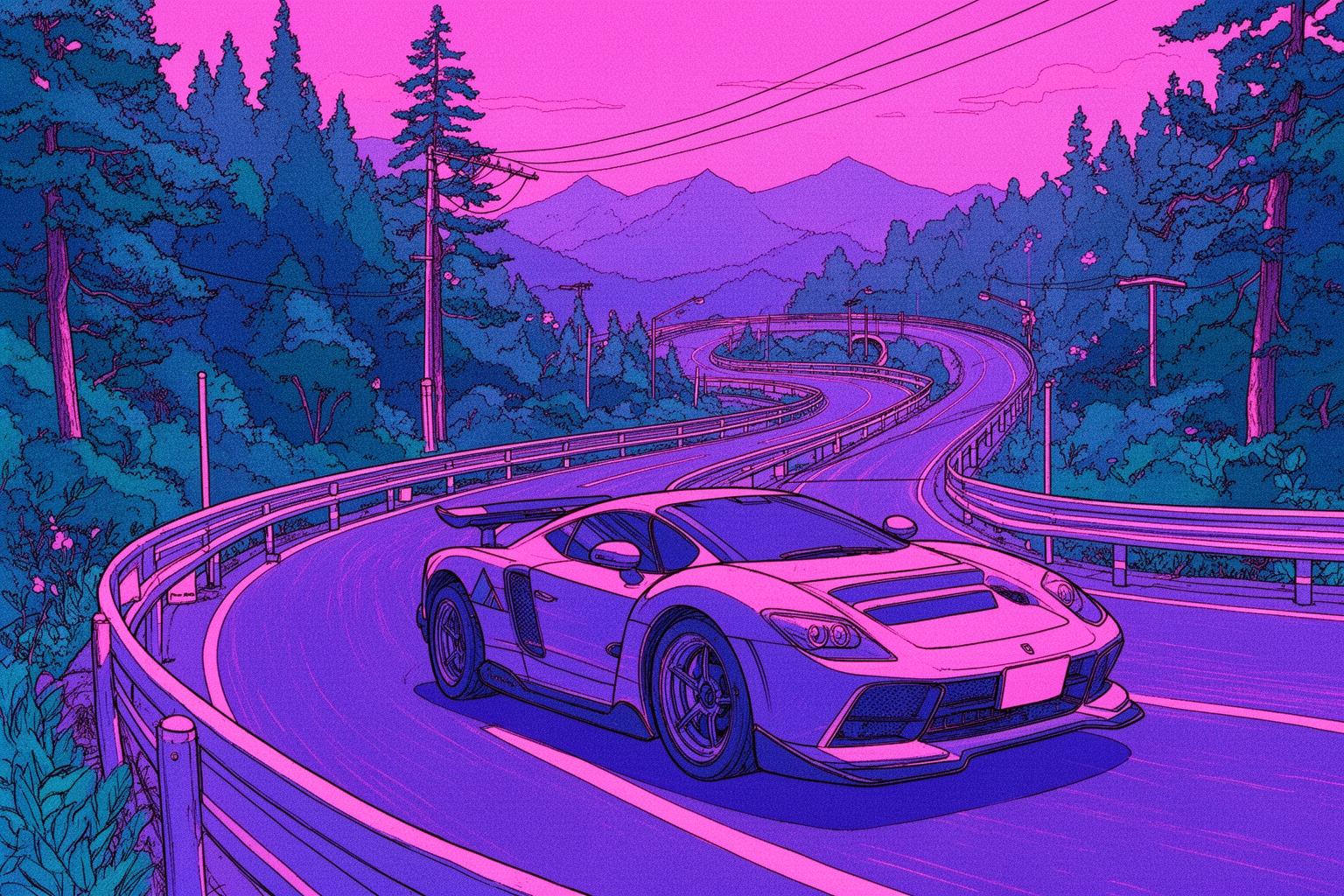
The roaring engines and screeching tires echoing through the touge passes of the 1980s have resonated far beyond Japan’s mountainous regions. What began as a secretive, hyper-local subculture has evolved into a worldwide phenomenon that has profoundly influenced modern car culture. The styles, vehicles, and spirit of the touge have been romanticized, digitized, and shared across the globe. For millions of fans who have never set foot in Japan, touge represents a revered, almost mythical place where the legends of JDM were born. This remarkable shift from an underground secret to a mainstream craze largely occurred through two powerful mediums: manga and video games.
The Initial D Phenomenon: How a Tofu Delivery Boy Changed the Game
Discussing the global impact of touge without mentioning Initial D is impossible. Simply put, it is the most influential piece of media in drifting history. Shuichi Shigeno’s manga, which debuted in 1995 and was later made into a legendary anime series, revolutionized everything. It captured the authentic culture of the 80s and early 90s touge scene and transformed it into a gripping drama. The story of Takumi Fujiwara, a seemingly uninterested high schooler who unknowingly becomes a driving prodigy by delivering tofu every morning on Mount Akina (a fictional version of Gunma’s Mount Haruna), was pure magic. The series was meticulously researched. The cars, driving techniques, team rivalries, and unspoken rules were all faithfully portrayed. It served as a love letter to the golden era. Initial D introduced the world to icons like the AE86, FC3S, R32 GT-R, and the entire pantheon of touge legends. It explained concepts such as the ‘gutter run’ and ‘inertia drift’ in a way that was as exciting as it was educational. Paired with its high-energy Eurobeat soundtrack, now inseparable from drifting, the show transformed these Japanese mountain roads into pilgrimage sites for fans worldwide. It elevated touge from a niche pastime to a heroic, almost spiritual quest. The influence of Initial D cannot be overstated; it is the reason a thirty-year-old Toyota Corolla is one of the most beloved and recognizable sports cars globally.
The Digital Drift: Mastering the Touge from the Couch
While Initial D provided the story, video games offered an interactive experience. In the 90s, racing games evolved beyond simple arcade play. Titles like Sony’s Gran Turismo for the PlayStation emphasized realism and featured an extensive lineup of Japanese domestic market cars. For the first time, players in America and Europe could virtually get behind the wheel of an AE86 or Silvia S13 and customize it to their preference. They could then race these cars on fictional circuits heavily inspired by real-life Japanese locations, including touge-style mountain passes. Other games, such as Namco’s Ridge Racer series, opted for a more arcade-style approach but were renowned for drift-heavy physics, capturing the thrill of sliding a car through long, sweeping corners. These games acted as a gateway for an entire generation. They allowed fans to experiment with the cars and techniques showcased in Initial D and early Japanese drift video magazines like Video Option. This fostered foundational knowledge and a deep appreciation for JDM car culture long before it hit the mainstream in the West. This digital exposure created a vast, passionate, and knowledgeable global fanbase, ensuring the legacy of 80s touge not only survived but flourished into the 21st century.
Chasing the Echo: Finding the Touge Spirit in Modern Japan
So, you’ve binged Initial D, devoted countless hours to mastering touge in video games, and now you find yourself in Japan. You want to connect with that raw, analog spirit of the 80s. But how? The golden era has passed, and illegal street racing is, understandably, heavily policed. But don’t worry—the ghost of the touge still lingers. The vibe remains alive; you just need to know where to look. It’s not about reckless driving; it’s about honoring the history, visiting legendary locations, and immersing yourself in the vibrant car culture born on those mountain roads. It’s about making a pilgrimage.
Pilgrimage to the Holy Roads: A Scenic Drive Through History
The iconic touge passes remain, and they’re among the most breathtaking driving roads in the world. Visiting these spots during the day is an absolute must for any fan. The key is to experience them legally, safely, and respectfully. Rent a car—preferably something fun and Japanese—and enjoy a scenic drive. Head to Gunma Prefecture, the sacred ground of Initial D. Here you can drive the real Mount Akina, Mount Haruna. The five consecutive hairpin turns still await you, and as you navigate them, you might just catch the faint echo of a 4A-GE engine. The view from the summit, overlooking Lake Haruna, is stunning. Not far off is Mount Akagi, another iconic location from the series. Further north, in Tochigi Prefecture, lies the incredible Irohazaka Pass near Nikko, famous for its one-way up and one-way down routes with a total of 48 hairpin turns. Driving it is an exhilarating experience. Or head south of Tokyo to the Hakone region, home to the renowned Hakone Turnpike, a wide, flowing toll road that feels like a real-life race track. Driving these roads isn’t about breaking speed records. It’s about feeling the rhythm of the curves, appreciating the craftsmanship it took to build them, and soaking in the atmosphere where legends were made.
The Modern Gathering Spots: A Living Car Museum at Daikoku PA
To see the cars and meet the people who embody modern Japanese car culture, there’s no better place than a major parking area, or ‘PA’, on a Friday or Saturday night. The undisputed king of these spots is Daikoku Futo PA, located on an artificial island in Yokohama, just south of Tokyo. Access can be tricky since it’s reachable only via the Shuto Expressway system, but the effort is well worth it. On any given weekend night, Daikoku transforms into one of the greatest car shows on the planet. It’s an informal, organic gathering of enthusiasts from every corner of the automotive world. You’ll see everything: pristinely restored 80s icons like Hachi-Rokus and FC RX-7s parked alongside wildly modified modern drift machines, Lamborghini and Ferrari supercars chilling next to VIP-style sedans and outrageous ‘bosozoku’ vans. It’s a place where everyone comes together to hang out, show off their rides, and share their passion. The vibe is relaxed and friendly. People are usually happy to let you take photos and will try to chat, even across language barriers. Daikoku PA is the direct descendant of the informal meetups once held at the base of touge passes. It’s the beating heart of Japan’s car scene, and visiting is an unforgettable experience.
A Taste of the Action, Legally: The Ebisu Circuit Experience
If you want to witness drifting at its absolute peak—the smoke, noise, and unbelievable skill—you need to visit a race track. This is where the spirit of the touge lives on in a safe, legal environment. The world’s most famous drift destination is Ebisu Circuit in Fukushima Prefecture. It’s not just one track; it’s a ‘drift paradise,’ a complex of multiple circuits built into the mountainside. Designed and built by a legendary drifter, it’s truly a place by drifters, for drifters. Ebisu hosts pro events like the D1 Grand Prix, but also holds ‘drift matsuri’ (drift festival) days where hundreds of drivers of all skill levels come to practice and have fun. The energy is electric. You can stand just feet from the track wall and feel the earth shake as cars fly by sideways, sometimes mere inches apart. The famous ‘Minami’ or South course even features a jump where cars go airborne mid-drift. It’s a wild sensory overload that perfectly captures the high-octane spirit of drifting. Visiting Ebisu or other circuits like Fuji Speedway or Tsukuba Circuit during a drift event is the best way to witness the extraordinary driving talent that once thrived on the touge and has now evolved into a spectacular global motorsport.