You see them before you really notice them. They’re just part of the scenery, another piece of urban furniture. But then, one night, walking down a silent residential street long after the last train has rattled away, you’ll feel it. A single, humming pool of light spills onto the pavement from an otherwise dark corner. It’s a vending machine, a jihanki, standing sentinel. In its unwavering fluorescent glow, the mundane becomes magnetic. It’s not just a box selling drinks; it’s a beacon, a tiny, self-contained oasis in the quiet vastness of the Japanese night.
For most people outside Japan, vending machines conjure images of dusty, half-empty boxes in a hospital corridor or a desolate bus station, offering stale chips and lukewarm soda. They are often graffiti-scarred, frequently broken, and exist as a last resort. To understand Japan, you have to completely discard that image. Here, the vending machine is not a peripheral convenience; it is a fundamental part of the social and architectural fabric of the country. There are millions of them—estimates hover around one for every 30 people—and their ubiquity is staggering. You’ll find them clustered in the neon canyons of Shibuya, standing alone at the top of a remote mountain trail, nestled between ancient farmhouses in the countryside, and lined up in silent, glowing rows under a highway overpass.
This article isn’t a listicle of the wacky things you can buy from them, though that list is long and fascinating. Instead, it’s an exploration of their presence. It’s about what these machines say about the space they occupy and the culture that allows them to thrive. They are monuments to a unique intersection of staggering convenience, deep-seated social trust, and a peculiar form of modern solitude. They are, in their own quiet way, the most accessible, everyday embodiment of the cyberpunk aesthetic that so many people associate with Japan—not as a dystopian fantasy, but as a lived, humming, and deeply functional reality.
Amid the neon glow and enigmatic hum of Japan’s nightscape, the evolution of everyday fixtures into urban art forms is mirrored in the dynamic world of adult gachapon culture, inviting a deeper exploration of modern Japanese ingenuity.
More Than Just a Box of Drinks
To begin to grasp the role of the jihanki (自動販売機, literally “automatic selling machine”), you must recognize its position as an utterly dependable, unquestioned part of daily life. This is not a novelty; it is infrastructure. The sheer density is the first indication. In any major city, you are seldom more than a hundred meters away from one. This saturation isn’t accidental; it results from a combination of factors that reveal much about Japanese society.
At the most fundamental level, these machines respond to a relentless pursuit of convenience. Japan is a culture that has refined convenience to an art form, best exemplified by the ubiquitous konbini (convenience store). The vending machine is the most precise expression of this drive. It breaks down convenience into its smallest form, placing it on virtually every street corner with access to electricity. It offers a nearly frictionless transaction, available 24 hours a day, 365 days a year, with no human interaction needed.
However, this system can only function because of its foundation: an extraordinary level of public safety and social trust. Consider what a vending machine is: a glass-fronted box filled with goods and cash, left unattended on a public street. In many other countries, this would invite vandalism and theft. Yet in Japan, the machines remain mostly untouched. This isn’t because they are built like fortresses; it’s because the social contract is strong enough to protect them. There is a shared, unspoken understanding that public property—and by extension, these semi-public machines—must be respected. This is the same cultural basis that allows people to leave their laptops on a café table to save a seat or for lost wallets to be routinely returned to the police with their contents intact. The vending machine thus stands as a quiet testament to a society where the default assumption is order, not chaos.
This trust fosters a virtuous cycle. Because operators know their machines are secure, they are willing to place them everywhere. And because they are ubiquitous, they become an even more integrated and dependable part of the environment, reinforcing their own necessity. They are the constant background hum of the nation, always on, always ready.
The Architecture of Solitude
Examine a vending machine not merely as a utility, but as an object occupying space. It is a piece of micro-architecture, commanding its own small domain defined by the light it emits. Especially at night, this role becomes deeply significant. In the dense, maze-like streets of Japanese cities, often dimly lit by municipal streetlights, the glow of a vending machine serves as a landmark. It acts as a point of orientation, carving out a small area of safety and visibility amidst the darkness. People use them as reference points in directions: “Turn left at the corner with the Kirin machine.” They become informal meeting places for friends, spots for delivery drivers to take brief breaks, or a comforting pause for students walking home late to feel less alone.
The interaction with the machine is itself a ritual of solitude. There is no small talk, no forced pleasantries, no judgment. It is a pure, simple, private transaction. You approach the glowing grid of choices, a silent menu of small comforts. You insert coins or tap your card, make your selection, and with a satisfying thump-clunk, your choice is delivered. For a moment, standing in that pool of light, you are the sole actor in a tiny, self-contained world. In a culture that highly values group harmony and social context, this moment of anonymous, solitary consumption offers a subtle form of release.
This is why the term “lonely glow” feels so fitting. The light is not warm or inviting like that of a tavern; it is a cool, impartial fluorescent or LED luminescence. It doesn’t invite gathering; it serves the individual. It is an ideal companion for the ohitorisama—someone who enjoys doing things alone. The machine provides for you without asking for anything in return, a silent partner in moments of thirst, fatigue, or the simple need for a pause. As a photographer, I am drawn to them for this very reason. Capturing an image of a lone person at a vending machine at night portrays a quintessentially modern Japanese scene: a quiet moment of individual existence, illuminated by technology, set against the backdrop of a sprawling, sleeping city.
A 24/7 System of Trust and Convenience
The cultural logic behind the jihanki is strengthened by strong economic and demographic factors. Japan has long dealt with high labor costs and, more recently, a declining workforce due to an aging population. Automating service is not merely a novelty; it is an economic imperative. A vending machine can perform the tasks of a shop clerk around the clock, without requiring a salary, benefits, or time off. It represents the most ruthlessly efficient retail employee imaginable. This rationale explains why these machines are often owned and maintained not by large corporations but by small local businesses or even individuals. For example, the owner of a small liquor store might place a machine outside their shop to keep selling drinks after closing hours. This approach helps maximize revenue from a small piece of personal property.
Japan’s historical reliance on cash also plays an important role. Although cashless payments have become widespread, Japan was for decades a firmly cash-based society. People were used to carrying sizable amounts of cash and, as a result, many coins. Vending machines served as ideal receptacles for this spare change. That 100-yen coin in your pocket always had a purpose. These machines became an essential part of the country’s cash circulation system. Even today, the familiar jingle of coins being accepted and change being dispensed remains a key part of their classic sensory appeal.
Moreover, the beverage companies themselves are central to this widespread phenomenon. Giants like Suntory, Kirin, Asahi, and Coca-Cola (Japan) fiercely compete for market share, with one major front being the street corner. They manage enormous networks of machines, effectively turning them into millions of small, branded storefronts. They subsidize machine costs for property owners in exchange for exclusive placement, resulting in the common sight of two or three vending machines from different brands standing side by side, each competing for your 130 yen.
Lastly, disaster preparedness is another important aspect. In a country prone to earthquakes and tsunamis, infrastructure resilience is a constant concern. Many modern vending machines are designed to switch to free-dispense mode during major emergencies. Connected to municipal alert systems, they can provide life-saving hydration to the public at no cost when activated, funded by the operating company. This elevates the humble drinks machine from a simple convenience to a vital piece of civil defense infrastructure, further embedding it into the national consciousness.
Beyond the Can: The Evolution of the Jihanki
While the classic image of a jihanki is a wall lined with canned coffee, tea, and soft drinks, the system’s adaptability has enabled remarkable diversification. One of the smartest yet simplest innovations is the dual functionality of dispensing both hot and cold drinks from the same machine. Red labels beneath the buttons indicate a hot beverage, while blue labels mean it’s chilled. In the depths of a bitterly cold January winter, being able to grab a piping hot can of sweet milk tea or corn pottage soup from a machine on a train platform feels like a small but meaningful act of kindness.
The success of this beverage model created a template for almost anything that could fit inside a box. This has led to vending machines that often captivate tourists’ attention. There are machines selling hot foods like ramen, udon, and fried chicken. Others offer fresh produce—bags of rice, bananas, or apples. You’ll find machines dispensing sake and beer (requiring age-verification cards), neckties for salarymen who’ve had an unfortunate spill before a meeting, umbrellas during sudden downpours, and even fortune slips (omikuji) outside shrines.
But viewing these as mere novelties misses the point. A machine selling something as specific as dashi (Japanese soup stock) in elegant glass bottles isn’t there just to be quirky. It exists because there is a stable, dependable market for it, and the vending machine offers the most efficient distribution method. It reflects a consumer base that values both quality and convenience equally. These specialized machines are often hyper-local, serving the particular needs of a neighborhood or demographic, demonstrating the system’s agility in catering to both mass markets and niche ones.
The technology inside these machines has evolved as well. Many now feature large digital touchscreens with animated ads. Cashless and mobile payment methods are becoming standard. Some even include facial recognition technology that suggests a drink based on the customer’s estimated age and gender. Yet despite these high-tech advances, the core experience remains unchanged: a simple, reliable transaction for a moment of personal satisfaction.
The Cyberpunk Reality
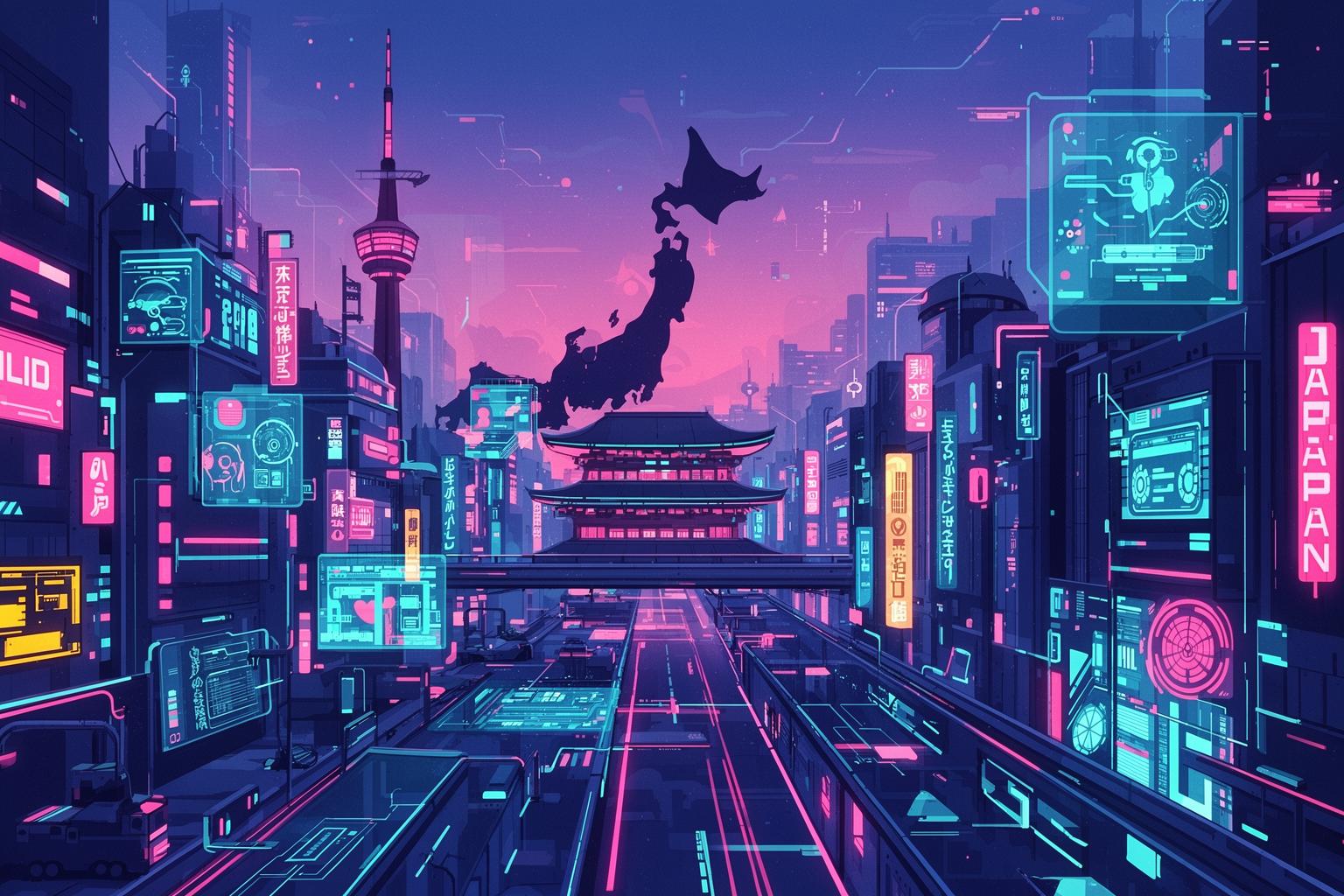
This brings us back to the cyberpunk aesthetic. The term, coined by writers such as William Gibson, often calls to mind a high-tech, low-life future: rainy, neon-lit cityscapes, powerful corporations, and blurred boundaries between humanity and technology. While Japan is far from dystopian, its urban environments strangely embody that visual language. Among these, the vending machine stands out as its most common and everyday symbol.
Picture a scene from Blade Runner or Akira. The constant backdrop is the environment: towering skyscrapers, tangled wires, and a pervasive glow from advertisements and signs against a canvas of perpetual night or rain. The jihanki fits seamlessly into this setting. It is an autonomous piece of technology, a non-human entity catering to human needs, glowing with synthetic light. It signifies the infiltration of corporate branding into the most intimate public spaces. The Coca-Cola logo or the geometric mark of Suntory Boss Coffee shines like a futuristic sigil in the darkness.
Using the machine feels subtly futuristic. The grid of backlit buttons, the quiet hum of the cooler, the precise mechanical delivery mechanism—it’s a brief interaction with a robot. A robot that serves you reliably and without complaint. This contrast between advanced automation and the most mundane human needs (a hot coffee on a cold morning) captures the very essence of the cyberpunk genre.
This isn’t a fantasy superimposed on Japan; it’s a genuine reflection of its built environment. Strolling through Shinjuku or Akihabara at night, you are surrounded by these glowing machines. They are not anomalies; they are the pixels composing the larger picture. Quiet, functional, and beautiful in their own utilitarian way, they provide ambient light for the real-life science fiction movie that is modern Japan.
So next time you find yourself in Japan, take a moment to truly observe one. Don’t just see it as a convenient way to get a drink. See it as a cultural artifact. See it as a symbol of a society built on trust and a quiet, shared understanding. See it as a tiny island of light and order, a cyberpunk sanctuary humming in the night, ready to offer a small, mechanical kindness to the next passerby. It’s more than a machine; it’s a silent narrator of the Japanese story.