
It happens to every traveler. That specific, sinking feeling when the variables of a long day abroad start to cascade into a minor crisis. Your phone battery is flashing a desperate red. You’re starting to get hungry, but not “sit down for a full meal” hungry. You’re thirsty. You realize you need cash for the small ramen shop you wanted to try, but your bank card feels like a useless piece of plastic. The sky, which was clear an hour ago, now looks suspiciously gray, and you, of course, did not pack an umbrella. You’re a little lost. A little tired. A little defeated. This is the moment in any journey where your stats are low and your morale is flagging.
And then you see it. Bathed in a fluorescent glow that cuts through the dusk like a beacon, a familiar logo comes into view: 7-Eleven, FamilyMart, or Lawson. In that moment, the store isn’t just a place to buy a drink. It’s a sanctuary. It’s a base camp. For anyone who has spent time with video games, the feeling is instantly recognizable. You’ve just stumbled upon a save point.
This isn’t just a cute analogy; it’s the most accurate way to describe the functional and emotional role the Japanese convenience store, or konbini, plays in the daily life of the country, and especially for the traveler navigating its complexities. It’s an item shop, a bank, an inn, a post office, and a quest hub all rolled into one, impeccably clean, and open 24 hours a day. The konbini is not merely a feature of the Japanese urban landscape; it is a fundamental piece of its social infrastructure, a masterclass in anticipating human needs, and the single most reliable resource you’ll find on your adventure. Understanding why it works so well is understanding a core piece of modern Japanese culture.
Just as the konbini serves as a save point for daily needs, the post-work yokocho alleys offer a different kind of sanctuary for social connection and unwinding.
The Holy Trinity: 7-Eleven, FamilyMart, and Lawson
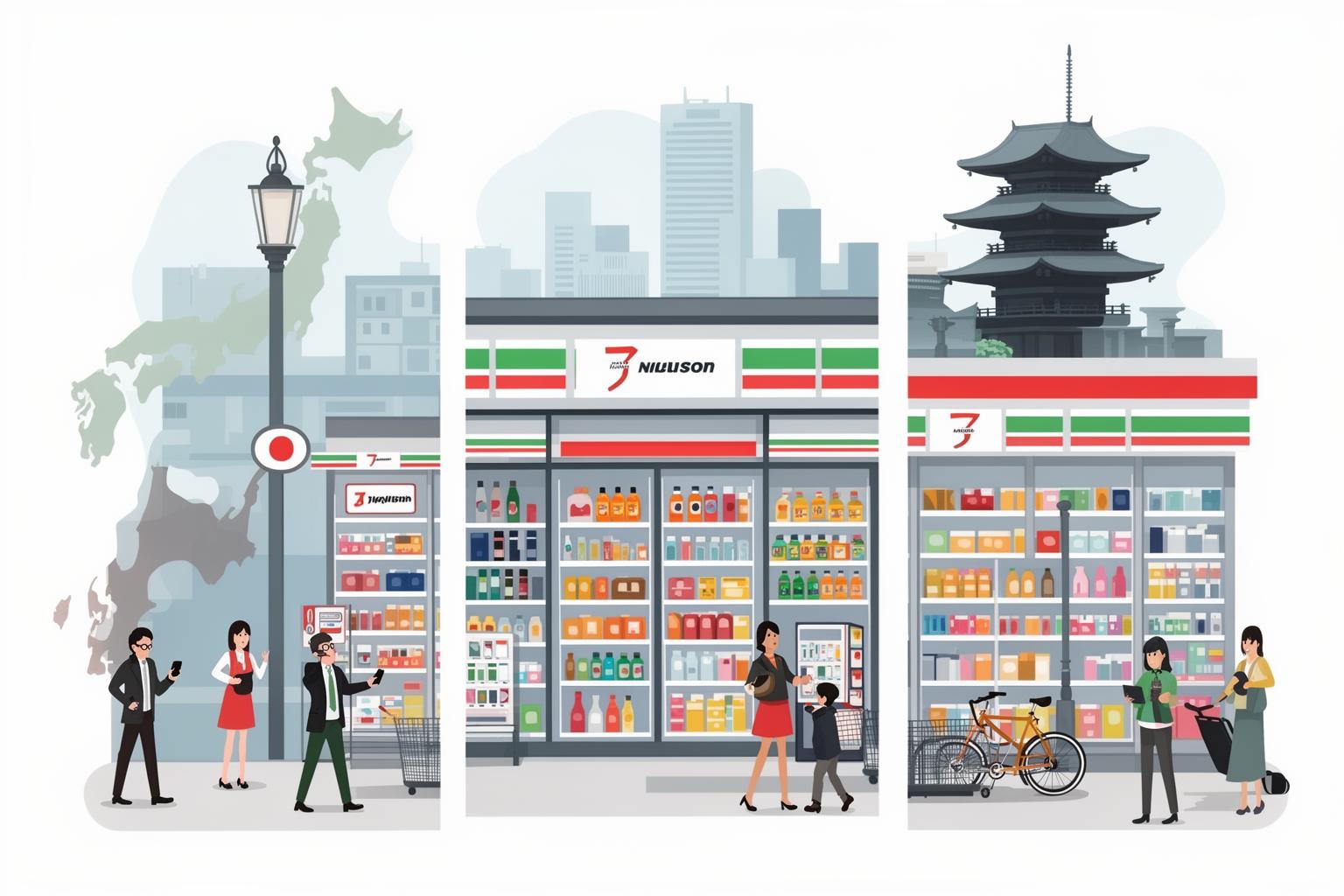
Before exploring the mechanics of this real-life game system, it’s important to appreciate the board on which it’s played. Japan’s convenience store market is dominated by three giants: 7-Eleven, FamilyMart, and Lawson. While other stores exist, these three form an omnipresent triumvirate, ensuring you are almost never more than a five-minute walk from rescue in any city, and often surprisingly close even in rural areas.
Their overwhelming density is the first foundation of the save point analogy. A save point in a game is useless if it’s located hours away from the main action. It needs to be a frequent, reliable checkpoint. With over 55,000 locations combined, these stores are embedded in the fabric of every neighborhood. You’ll find them tucked under skyscrapers, opposite ancient temples, inside train stations, and, as I’ve gratefully discovered many times, standing as a solitary beacon of light at the trailhead of a remote mountain path. This ubiquity creates a strong sense of security. No matter where you wander or how lost you become, you know a safe, clean, well-stocked base is always close by.
To the uninitiated, they might appear identical, but regulars and locals recognize subtle differences. They’re like different character classes or factions, each with its own unique strengths and specialty items. 7-Eleven, the largest, is known for its high-quality private brand, Seven Premium, offering everything from single-serving packs of simmered mackerel to surprisingly delicious frozen ramen. Lawson often feels more inventive, famous for its Kara-age Kun—bite-sized fried chicken nuggets available in various rotating flavors—and its Uchi Café line of premium sweets. FamilyMart holds its own with its signature Famichiki, a perfectly crispy, juicy piece of boneless fried chicken loved by legions of fans. Learning these nuances is part of the joy, like figuring out which in-game merchant sells the best potions versus the best armor. You develop a personal preference, a loyalty, and soon make strategic decisions about which konbini to visit based on your specific needs in the moment.
More Than a Store: The Anatomy of a Save Point
The RPG analogy resonates so well because the konbini’s role goes far beyond mere retail. It serves as a dense hub of essential services designed to address nearly any small problem a person might face. It’s a place where you don’t just purchase items; you restore and prepare.
Restoring HP and MP: The Food and Drink Arsenal
Let’s begin with the most fundamental need: sustenance. In gaming terms, this equates to restoring your Health Points (HP) and Magic Points (MP). The konbini isn’t merely vending snacks; it supplies high-quality, dependable fuel for your body and mind.
Your HP recovery stems from the astonishing variety of food available. Forget the pitiable, limited hot dogs found in Western convenience stores. Here, entire meals await. In the refrigerated section, you’ll find carefully prepared bento boxes featuring grilled fish, rice, and pickles; pasta dishes that staff will heat for you in a powerful microwave; and a wide selection of sandwiches (sando) made with perfectly crustless, fluffy bread, the egg salad variant of which has become a culinary icon. The real star, however, is the onigiri, or rice ball. These triangular pockets of seasoned rice, wrapped in crispy nori seaweed and filled with everything from salted salmon to pickled plum, serve as the perfect portable health potion. Affordable, delicious, and easy to eat with one hand while walking, they’re unbeatable. For a quick energy boost, hot cabinets near the counter offer everything from steamed buns (nikuman) to fried chicken and corn dogs.
Your MP, the energy that drives your journey, is replenished at the drink coolers. The selection is vast and unique. The iconic item here is canned coffee, available in a dizzying assortment of sweetness levels and bean varieties, sold both cold and piping hot from heated cabinets. It’s the essential mana potion for groggy mornings or afternoon slumps. Beyond coffee, there are dozens of types of green tea, oolong tea, and barley tea. Vitamin-fortified energy drinks, fruit juices, and electrolyte-replenishing sports drinks like Pocari Sweat further expand your choices. This variety allows you to tailor your energy recovery exactly to your needs.
The Item Shop: Equipping for the Journey Ahead
Once your health is restored, it’s time to check your inventory. This is where the konbini truly excels as an item shop, stocking not just what you want but what you urgently need when caught unprepared. It’s a masterclass in situational readiness.
Think of these items as temporary buffs and essential gear. Has it suddenly started raining? Every konbini will have a rack of sturdy, clear vinyl umbrellas by the entrance. Facing a brutal summer heatwave? Shelves are stocked with cooling body wipes, handheld fans, and sweat-absorbing towels. A sudden cold snap freezing you on your way home? You’ll find disposable hand warmers (kairo), thick socks, and even thermal undershirts. These aren’t merely products; they’re immediate solutions to environmental challenges.
The gear section goes even further. Is your phone dying? They sell wall chargers, portable batteries, and cables for virtually every model. Need to jot down a note? High-quality pens and notebooks are available. Emergency laundry during a stay at a coin-laundry-equipped hotel? Single-use detergent packs are on hand. You can even find dress shirts, ties, and black socks for an unexpected business meeting. The konbini operates on the principle that you should be able to rebuild a basic survival kit for modern life solely from its shelves at any hour, even three in the morning.
The Service Guild: Banking, Logistics, and Information
This layer of functionality is what transforms the konbini from a great store into a vital piece of infrastructure. It’s the service hub where you manage the meta-game of your journey.
For any foreign traveler, the most critical service is the ATM. In a country still reliant on cash, finding an ATM that accepts international cards can be challenging. However, the 7-Bank ATMs, found in every 7-Eleven, are a blessing. They are reliable, offer an English interface, and work with most foreign cards, turning every 7-Eleven into a bank where you can replenish your “gold” to continue your quest.
Next is the role of the inn or information hub. Most konbini provide free Wi-Fi, an essential resource for checking maps, train schedules, or your next destination. Many larger stores feature a small seating area where you can sit down, charge your devices, and regroup. Offering this “third space”—neither home nor work—lets you pause, save your progress, and plan your next move in a clean, safe setting.
Then there are multifunction kiosks like Loppi at Lawson or FamiPort at FamilyMart. These function as your quest boards, allowing you to book highway buses and purchase tickets for concerts, sporting events, or even museums like the Ghibli Museum (which requires advance booking). You can pay utility bills, top up transit cards, and manage a variety of administrative tasks all from these terminals, centralizing life’s errands in one convenient spot.
Perhaps the most revolutionary service for travelers is the takuhaibin, or parcel delivery service. You can bring your suitcase to nearly any konbini, fill out a form, and have it shipped ahead to your next hotel or even the airport. This allows you to travel light, free from heavy luggage, making side trips or navigating crowded train stations much easier. It’s the real-world equivalent of a magic storage chest.
The Ultimate Utility: The Immaculate Restroom
A small but profoundly important feature deserves special mention: the restroom. In many countries, using a convenience store bathroom is a last resort. In Japan, it’s never an issue. Konbini restrooms are almost always free, open to the public, and kept spotlessly clean. For a traveler spending long hours on foot, knowing a clean, safe, and private facility is always nearby offers a level of comfort and dignity that cannot be overstated. It’s a basic, fundamental need met with characteristic Japanese efficiency and care.
The Cultural Logic: Why Konbini Work This Way
This intricate system did not emerge by chance. It reflects a specific cultural mindset and a distinct set of social priorities. The konbini serves as a tangible embodiment of several fundamental principles of modern Japanese society.
The Philosophy of “Omotenashi” Miniaturized
At its core, the konbini represents omotenashi, the uniquely Japanese hospitality philosophy focused on anticipating needs before they are voiced. Every aspect of the store is centered on this idea. They stock umbrellas because they know you’ll need one when it rains, and they carry phone chargers because they understand your battery will eventually run out. This anticipation creates a seamless, frictionless experience where nearly any issue has a ready-made solution waiting. Though often busy, the staff remain consistently polite and efficient, playing a crucial role in this smooth operation.
A Pillar of Social Infrastructure
In Japan, konbini are regarded as more than private enterprises; they function as quasi-public utilities. During natural disasters such as earthquakes or typhoons, they act as critical support hubs, providing supplies and information to the community. Their resilient supply chains are often the first to be restored, turning them into lifelines during crises. This social contract builds profound public trust. People depend on them, and in return, the stores serve the community. This deep integration explains why they feel so reliable and secure. They remain a steady, unchanging presence in a world that can often seem unpredictable.
The Pursuit of Ultimate Convenience
Ultimately, the konbini epitomizes Japan’s unwavering pursuit of convenience (benri). The logistics behind these stores are a modern feat of ingenuity. Fresh foods like onigiri and bento are delivered several times daily to guarantee freshness. Product selections constantly evolve with the seasons, featuring new and limited-edition items that keep customers interested. The entire operation is fine-tuned for maximum efficiency, from the store layout to the speed of checkout. This dedication to perfecting the small details of everyday life is what makes the konbini so remarkably effective. It is a system designed to eliminate all the minor hassles from your day.
A Hiker’s Field Report: The Konbini at the Edge of the Wild
As someone who frequently spends time on Japan’s hiking trails, my appreciation for the konbini goes beyond mere theory—it’s deeply personal. I vividly recall a trip to the mountains of Nagano, where I planned to start a long traverse before sunrise. Having arrived in a small town the night before, the world was pitch black and silent when my alarm rang at 4 a.m.
In the cold, dark air, there was just one source of light across the entire valley: the familiar green and orange sign of a 7-Eleven, perched at the edge of town where the road began winding into the mountains. It felt less like a store and more like the last friendly outpost before entering a vast, untamed wilderness.
Inside, the warmth and light were a welcome surprise. I wasn’t merely grabbing a snack; I was preparing for an expedition. I bought two salmon-filled onigiri—compact and durable, ideal trail food. I grabbed a bottle of Aquarius, a sports drink rich in electrolytes, and a hot can of Boss coffee to warm my hands and awaken my mind. After a final gear check, I realized I had forgotten a lighter for my emergency stove and found one hanging by the counter. I also bought a small, jangling bear bell, a common sight on Japanese trails. This single, small store provided everything I needed for a safe and successful day in the mountains. It was my crucial save point before stepping into the “dungeon.” That experience cemented the analogy for me forever: the konbini isn’t just convenient; for adventurers, it’s mission-critical.
So when you travel to Japan, don’t dismiss the humble convenience store as merely a place for junk food. Take note of what it offers. See it as the brilliant, complex system it truly is: a safety net, a supply depot, and a quiet testament to a culture that strives to make life a little easier, safer, and better prepared for whatever challenges the day may bring. When you see that glowing sign, feel the relief—you’ve reached a save point. Your progress is secure. Now, grab a hot coffee and an onigiri, and gear up for the next level.