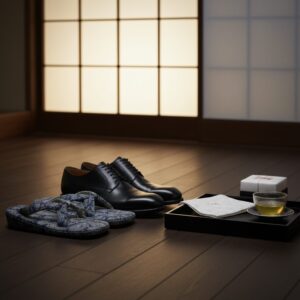
You’ve probably seen it, even if you didn’t know what to call it. It’s the old man in a tiny, ten-seat Tokyo bar who spends a full minute polishing a single glass until it’s impossibly clear. It’s the woman at a flea market who has dedicated her life to collecting and restoring a specific type of Showa-era glassware, and can tell you the manufacturing history of each piece. It’s the young barista who discusses the tasting notes of a single-origin coffee bean with the intensity of a sommelier describing a vintage wine. This isn’t just being “picky” or “a perfectionist.” It’s something deeper, a cultural mindset woven into the fabric of Japanese life called kodawari (こだわり).
Translating kodawari directly into English is notoriously difficult. Dictionaries might offer words like “fastidiousness,” “scrupulousness,” or “obsession,” but they all fall short. They carry a slightly negative, fussy connotation, as if it’s a character flaw. But in Japan, kodawari is a badge of honor. It represents a personal, internal standard of excellence that you refuse to compromise on. It’s the relentless pursuit of an ideal, not for fame or money, but for its own sake. It’s the deep, soul-satisfying belief that there is a “right way” to do something, and you will dedicate yourself to finding and mastering it, down to the most microscopic detail.
This is the invisible engine that elevates what might be a casual pastime elsewhere into a profound, almost spiritual practice in Japan. It’s why a simple hobby can become a lifelong path of learning and refinement. It’s the difference between just doing something and pursuing it as a craft. Understanding kodawari is key to understanding why so many experiences in Japan, from drinking a cup of tea to buying a pair of jeans, feel so incredibly intentional and meticulously executed. It’s a philosophy of engagement, a way of finding meaning not in the final product, but in the painstaking, beautiful, and often obsessive process of getting there.
This relentless commitment to precision is echoed in the practice of kuuki wo yomu, which reveals how attuned Japanese culture is to unspoken social cues.
Beyond “Perfectionism”: Decoding the Spirit of Kodawari
It’s easy to confuse kodawari with the kind of perfectionism common in the West, which is often linked to anxiety, competition, and seeking external approval. However, the two are fundamentally distinct. Western perfectionism tends to focus on being the best in the room—achieving the promotion, winning the award, or earning the highest score. In contrast, kodawari centers on being your best, measured against an internal, ever-moving horizon of what’s possible. It is a deeply personal and introspective journey.
It’s Not About Being the Best, It’s About Being Your Best
Someone with kodawari isn’t necessarily aiming to impress others; in fact, they might be completely indifferent to outside opinions. Their audience is themselves and the craft itself. Their internal dialogue isn’t, “Will people like this?” but rather, “Is this the absolute best I can do? Does this honor the materials? Have I respected the process?” Satisfaction comes from gradually closing the gap, millimeter by millimeter, between their current work and the perfect ideal they envision.
Consider a sushi chef. For a chef driven by Western perfectionism, the ultimate goal might be three Michelin stars—a clear, external symbol of success. However, the chef guided by kodawari might be just as content, if not more so, running a small six-seat counter in a quiet neighborhood, focusing on perfecting their personal technique for aging fish or seasoning rice. For them, the Michelin star is a byproduct, not the objective. The true goal is the pursuit itself. This inward focus removes ego and replaces it with humble, almost reverent dedication.
The Process is the Prize
This brings us to the second key distinction: kodawari finds its deepest meaning in the process rather than the outcome. The final result matters, naturally, but it’s regarded as the natural consequence of a flawlessly executed process. True joy lies in the details—the daily rituals, tool maintenance, and relentless practice of technique.
A guitarist with kodawari doesn’t simply practice songs; they obsess over the humidity of the room where their instrument is stored, the specific brand of strings that yield the perfect tone, and the exact angle of their pick against the strings. A knitter with kodawari might travel far to find a specific type of yarn spun from a rare breed of sheep, treasuring the texture and feel of the raw material long before it becomes a sweater. This is where a hobby transforms into an entire world. It’s not just a way to fill time; it becomes an endless field of exploration. Every detail, no matter how small, offers a chance for learning, refinement, and deeper engagement. This intense focus on the “how” is what lends Japanese hobbies their remarkable depth and richness.
Kodawari in Action: From Coffee to Camping
Once you recognize what to look for, kodawari becomes visible everywhere in Japan. It drives countless small businesses and inspires devoted hobbyists. It reveals itself in the quiet confidence of someone who has dedicated ten thousand hours to their passion.
The Coffee Ritual: A Masterclass in Micro-Details
Forget the quick, automated espresso shot. A traditional Japanese kissaten (coffee shop) is a sanctuary of kodawari. Typically run by a single master who has focused on this craft for decades, their dedication is unwavering. The kodawari starts with the beans, often sourced from a particular farm and roasted on-site in small batches for optimal freshness. The master crafts a unique roasting profile for each bean type, honed through years of experimentation.
When you order, the process unfolds as a slow, intentional performance. The beans are ground solely for your cup. The water is heated to an exact temperature, frequently checked with a thermometer. The master employs a special long-spouted kettle, pouring water in a slow, controlled spiral over the grounds. Even the tools—the hand-cranked grinder, the copper kettle, the porcelain dripper—are objects of care. The final element is the cup itself, often a fine piece of pottery selected for its shape and thickness to best showcase the coffee’s aroma and flavor. The five to ten minutes spent preparing your coffee is not a delay, but the experience itself. You’re not just buying a drink; you’re witnessing the culmination of a lifelong devotion.
The Audiophile’s Sanctuary: Pursuit of Sonic Purity
Another captivating example lies in the realm of Japanese audiophiles and the jazz kissa or vinyl listening bars they frequent. Here, kodawari is focused on a single, seemingly impossible aim: reproducing recorded music with perfect fidelity. The owners are not casual music enthusiasts; they are sonic purists on a sacred quest.
Step into one of these bars, and you’ll find a sound system that could belong in a science fiction movie. Towering, often custom-built speakers flank gleaming turntables and glowing vacuum tube amplifiers with an orange hue. The owner’s kodawari is clear in every detail. They may use silver wiring believing it transmits a clearer signal. Different turntable cartridges might be chosen specifically for jazz or classical music. The entire space is acoustically tuned with panels to eliminate unwanted echoes. Patrons often remain silent, nursing a single drink for an hour, speaking little, simply listening. The owner’s obsession creates a sanctuary where music is the sole focus—a shared experience of profound listening, enabled by one individual’s refusal to compromise on sound quality.
My Own Obsession: Ultralight Hiking and the Grammar of Gear
As someone who spends much time in the mountains, I have witnessed this mindset firsthand within the Japanese hiking and mountaineering community. While a love of nature is universal, the Japanese approach often carries a distinct flavor of kodawari. This is especially evident in the ultralight (UL) hiking subculture, which emphasizes minimizing pack weight to travel farther and faster with less effort.
In the West, UL hiking often centers on pragmatism. In Japan, it is elevated to an art. The kodawari extends not only to gear weight but also to design, multi-functionality, and aesthetic grace. Hikers create detailed spreadsheets cataloging every item’s weight down to the gram—the tent, sleeping bag, stove, even the toothbrush (sometimes cut in half to save weight). They spend hours researching and debating materials like Dyneema Composite Fabric versus Silnylon. Japanese outdoor brands such as Montbell and Snow Peak are celebrated for their meticulous design and superior craftsmanship. The hobby goes beyond mountain walking; it is an intellectual pursuit, a complex optimization balancing safety, comfort, and weight. The perfectly packed sub-5-kilogram backpack is a source of immense pride, embodying months of refinement. It is the tangible expression of kodawari.
The Cultural Roots: Why Does Kodawari Thrive in Japan?
This intense dedication does not arise in isolation. It is cultivated by centuries of cultural and historical background. Several fundamental concepts within Japanese society have fostered an environment where kodawari has become a widely embraced value, shaping both professional artisans and passionate amateurs alike.
The Heritage of the Shokunin (Artisan)
The most direct predecessor of kodawari is the spirit of the shokunin (職人), or master craftsman. For centuries, Japanese society has deeply respected its master artisans—whether swordsmiths, potters, woodworkers, or lacquerware specialists. The shokunin ethos is characterized by a profound sense of social and spiritual duty toward one’s craft. A shokunin does more than just work; they commit their entire being to perfecting their skill. They take great pride in their work, striving not only to master their craft but also to elevate it.
This ideal has carried over from professional craftsmanship into personal hobbies. An enthusiast may embrace the shokunin mindset, approaching their passion with the same seriousness and dedication as a master artisan. The amateur photographer who studies lens optics with scholarly rigor or the home cook who makes soba noodles from scratch are embodying this spirit. They accept the responsibility to do something as well as it possibly can be done.
The Importance of “Kata” (Form and Pattern)
Another foundational element is the concept of kata (型), meaning “form” or “pattern.” Kata represent the basic movements and prescribed sequences found in everything from martial arts (karate, judo) and performing arts (kabuki, noh) to cultural rituals (tea ceremony, flower arranging). In Japan, learning a new skill often begins with the careful repetition of kata. You practice the fundamental forms repeatedly until they become second nature. Originality and improvisation are discouraged until the basics are fully and flawlessly internalized.
This disciplined approach fosters deep respect for the process and a strong grasp of fundamentals. It teaches patience and focus. When you spend years perfecting a single precise motion for pouring tea or a specific technique for cutting vegetables, you develop an appreciation for detail that naturally leads to kodawari. The pursuit becomes about refining the kata, a journey without end. There is always a deeper level of mastery to attain.
The Appreciation of the Small and Subtle
Lastly, Japanese aesthetics have long valued subtlety, simplicity, and meticulous attention to detail over grand, extravagant displays. Consider the intricate design of a Japanese sweet, intended to be savored in a single bite, or the quiet elegance of a single flower in a vase. There is a cultural inclination to find beauty in the small, the overlooked, and the carefully crafted.
This cultural lens inspires people to look more closely and apply greater care to everything they do. If society celebrates the careful arrangement of a bento box as an art form, it naturally encourages individuals to bring that same artistic devotion to their own pursuits. This creates a positive cycle: society esteems detail, individuals strive for it in their hobbies, which in turn reinforces the cultural value of meticulousness. Kodawari is the active manifestation of this aesthetic principle.
The Double-Edged Sword: When Passion Becomes Pressure
For all its merits, it’s important to recognize that kodawari also has its drawbacks. Like any intense philosophy, it can be pushed to extremes, resulting in rigidity, exclusion, and a loss of the original joy that inspired the passion initially.
The Barrier to Entry
For beginners, a community centered around kodawari can feel overwhelmingly intimidating. When everyone around you is an expert functioning at nearly a professional level, it can be discouraging to even get started. The pressure to “do it right” from the outset can be immobilizing. There is often an unspoken expectation to demonstrate a certain level of seriousness and respect for the established methods.
This can lead to a subtle form of gatekeeping. The seasoned expert at the coffee shop may appear distant and unapproachable. Veteran hikers might look down on newcomers with brand-new, unoptimized gear. Though not always intentional, this intense environment can make it difficult for novices to feel welcome, turning a potential hobby into a source of stress rather than enjoyment. The fear of doing it “wrong” might stop people from trying altogether.
Losing the Forest for the Trees
Another major risk of kodawari is becoming so absorbed in the process and equipment that one loses sight of the primary purpose. The quest for perfection can become an end in itself, detached from the experience it was meant to enrich.
This is the audiophile who spends all their time scrutinizing sound frequencies on a computer instead of simply enjoying the music. It’s the photographer with thousands of dollars worth of camera gear who gets too caught up in adjusting settings to appreciate the stunning sunset they are meant to capture. It’s the ultralight hiker so fixated on their pack weight spreadsheet that they forget to look up and enjoy the mountain views. When tools and techniques overshadow the experience, kodawari turns into a counterproductive obsession. It’s a delicate balance, and it’s easy to become lost in the details.
Ultimately, kodawari is a powerful and distinctly Japanese way of engaging with the world. It’s a philosophy that challenges our modern culture of disposability, instant gratification, and settling for “good enough.” It asserts that immense value and deep satisfaction lie in choosing one thing—no matter how small or seemingly insignificant—and committing yourself to mastering it. It transforms a simple hobby into a meaningful practice, a way of life.
It’s about discovering a small corner of the universe—whether in the flavor notes of a coffee bean, the perfect sound wave, the grain of wood, or the efficiency of a backpack—and deciding to make it uniquely yours. It’s a statement that what we do matters, and how we do it matters even more. In a world filled with endless distractions, the deliberate, focused pursuit of excellence might be one of the most rewarding journeys we can embark upon.