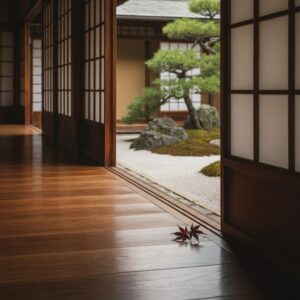
Yo, what’s up? Keiko here. Let’s get real for a sec. You’ve probably seen it on your feed—that picture-perfect shot of a Japanese garden. But it’s not the one with the vibrant cherry blossoms or the fiery red maple leaves. It’s the other one. The one that’s just… gravel and some rocks. You zoom in. Yep, still just gravel and rocks. The caption is probably something deep like “finding my zen 🙏” or whatever, and you’re just sitting there thinking, “For real? Is this it?” It’s a vibe that feels low-key empty, and you’re left wondering if you’re missing the punchline. Is this one of those high-art things that’s designed to go over everyone’s head? A cultural inside joke you’re not privy to? The short answer is kinda, but not in the way you think. This isn’t about being artsy or exclusive; it’s about a fundamental shift in how you look at the world, at space, and at your own thoughts. That expanse of meticulously raked gravel and a few strategically placed stones is called a karesansui (枯山水), or a dry landscape garden. It’s not a garden in the Western sense of growing things. It’s a canvas. It’s a cosmic mood board. It’s basically a full-on philosophical statement pretending to be landscaping. The whole point isn’t to show you a pretty scene, but to give your brain a place to chill, to wander, to project its own blockbuster movie onto the most minimalist set imaginable. It’s less about what you’re seeing and more about what’s happening in your head while you’re seeing it. Before we dive deep into this universe of chill, let’s get you grounded in a real-world spot—the absolute icon of karesansui, Ryoan-ji Temple in Kyoto. Peep the map below.
If you’re digging this minimalist, contemplative vibe, you might also appreciate the quiet focus found in Japan’s minimalist whisky tasting rooms.
Deconstructing the Vibe: The “Why” Behind the Rocks
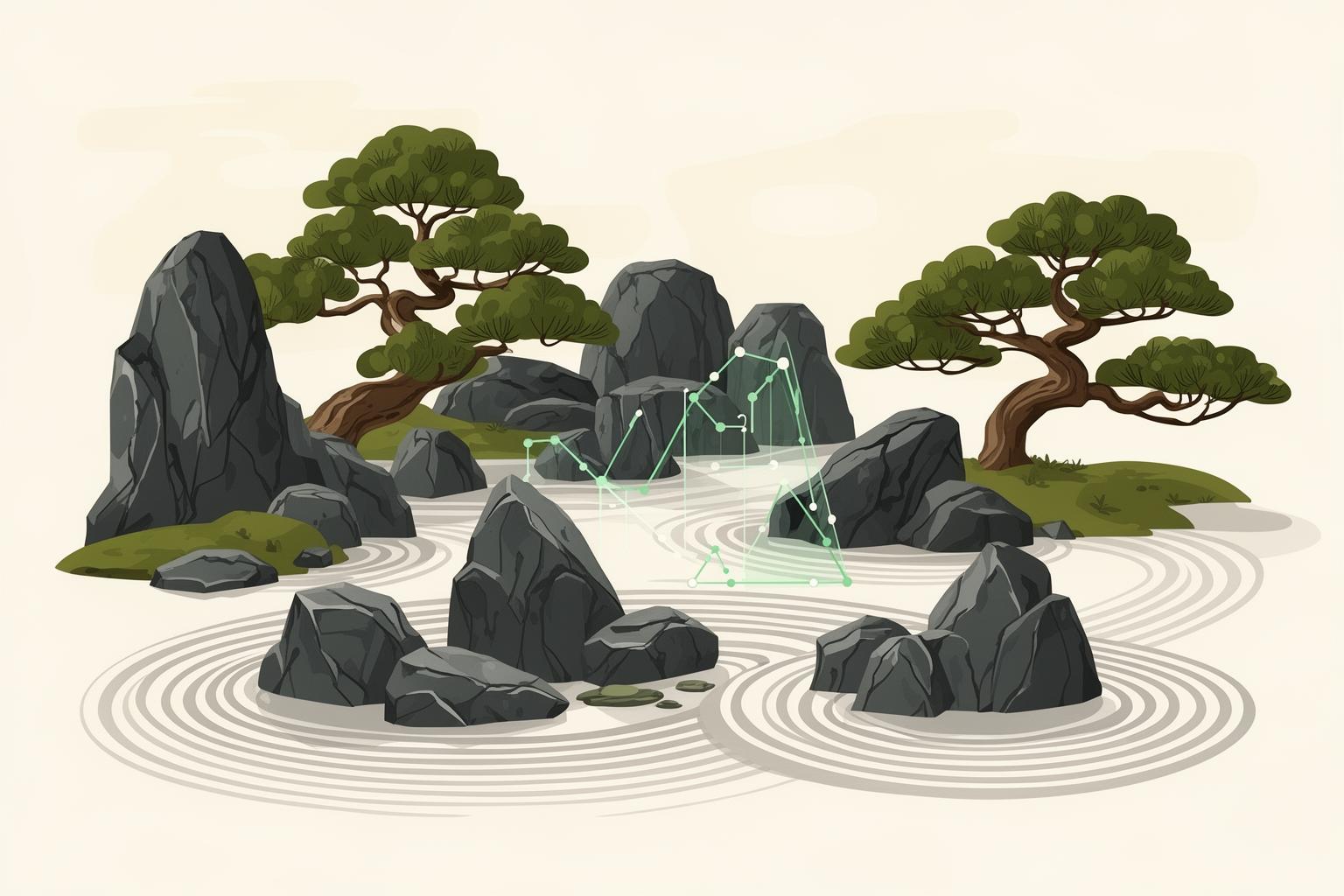
So, you find yourself sitting on the veranda of a temple, gazing out at a field of white gravel. Your brain, trained by a world saturated with constant content, might first try to categorize it. Is it a beach? A desert? A construction site? The answer is both yes and no. The brilliance of karesansui lies in its removal of all the typical markers of a “garden” – the colors, scents, and life cycles of plants – leaving you with the bare essentials: form, space, and texture. This isn’t about replicating nature in miniature. It’s about distilling its very essence, its ki (気) or life force, into a highly abstract form. It’s art, but its medium is the earth, and its purpose is contemplation.
It’s Not a Garden, It’s a Canvas
The most crucial shift in perspective you need to make is this: a karesansui is not a space you walk into. It’s a scene to be observed. You’re not meant to tread through the raked gravel and disturb the pristine lines. You are the audience, and the garden is the stage. This design philosophy is deeply influenced by Zen Buddhism, which flourished in Japan during the Kamakura and Muromachi periods (roughly 12th to 16th centuries). Zen teaches finding enlightenment (satori) from within through meditation (zazen) and strict self-discipline. It advocates letting go of worldly attachments and realizing that reality is transient and ultimately empty (ku, 空).
So, how does a garden fit within that worldview? A traditional, lush garden full of flowers and fragrant trees is undoubtedly beautiful. Yet, from a strict Zen viewpoint, it can be a distraction—an overload of sensory experiences that feed worldly desires. A karesansui garden reverses this. By removing distractions, it creates an emptiness. That broad stretch of white gravel, known as shirakawa-suna (白川砂), is more than just sand; it symbolizes water, the ocean, or even the cosmic void. The carefully raked patterns called samon (砂紋) represent ripples on the water’s surface, a visual metaphor for the universe’s endless flow. The raking itself is a form of active meditation for monks—a repetitive, focused act that clears the mind. The lines they draw testify to discipline but are also fleeting; a single rain can erase them, perfectly illustrating Zen’s impermanence.
The Rocks Steal the Spotlight
If the gravel is the canvas, the rocks are the main characters in this stone tableau. They are never placed randomly. Each rock is meticulously selected for its shape, color, texture, and even its perceived spirit. Often sourced from mountains and rivers, these stones carry the essence of their origins. Far from inert objects, in karesansui they are living entities with personalities and roles. Their placement is a sophisticated art governed by aesthetic principles honed over centuries.
They can symbolize a vast range of ideas. Sometimes they directly represent landscapes; a tall, upright stone might signify a mountain, often the mythical Mount Horai or Mount Meru, central to Buddhist cosmology. A cluster of smaller stones could depict islands floating in the gravel sea. A famous interpretation at Ryoan-ji suggests the rocks portray a tigress leading her cubs across a river. Yet often the meaning is far more abstract. The rocks might embody constellations, philosophical concepts, or simply serve as a study in pure form and balance.
The garden’s quiet power comes from its core principles. One is fukinsei (不均斉), or asymmetry. Unlike the perfect symmetry prized in Western classical art, Japanese aesthetics find beauty in imbalance and irregularity, believing it more natural and dynamic. Another is kanso (簡素), or simplicity, where the design is stripped down to only what’s essential. Then shizen (自然), or naturalness, ensures the arrangement feels unforced and organic, despite intense artistic planning, as if the rocks have always been there. Perhaps the most vital concept is ma (間), the space between—the negative space. In karesansui, the emptiness—the gravel—is as important, if not more so, than the rocks. The void defines the forms, gives them room to breathe, and invites imagination to complete the picture. This aligns with the aesthetic of yohaku-no-bi (余白の美), the beauty of empty space, a fundamental aspect of Japanese art, from ink painting to ikebana.
The Historical Glow-Up: From China to Kyoto’s Finest
This aesthetic didn’t simply emerge out of nowhere. Like many aspects of Japanese culture, its roots can be traced back to China, but it was subsequently adapted, refined, and transformed into something distinctly Japanese. The karesansui serves as a perfect example of this process of cultural assimilation and reinterpretation. It tells the story of how a painting style evolved into a three-dimensional spiritual instrument, becoming the ultimate expression of a new and influential school of thought.
The Original Influence: Chinese Landscape Painting
The direct predecessor of the karesansui garden is the Chinese landscape painting from the Song Dynasty (960–1279). These works, called sansui-ga (山水画) in Japan, were typically monochrome ink paintings depicting vast, misty mountain scenes. The artists were not trying to create photorealistic depictions of specific locations. Instead, they aimed to capture the spiritual essence of nature, its fundamental rhythm and energy. A key technique involved the skillful use of empty space. Blank areas on the scroll were not just unpainted silk but represented mist, clouds, or boundless sky, creating a sense of immense depth and scale. When Zen Buddhism was introduced from China to Japan, these paintings accompanied it and profoundly influenced Japanese monks.
They recognized a parallel between the philosophy behind the paintings and their own Zen practice. The monochrome palette reflected Zen’s rejection of worldly color and extravagance. The focus on capturing the essence rather than superficial appearance aligned with the pursuit of inner truth. The karesansui garden can be seen as a direct, three-dimensional translation of these paintings. The gravel symbolizes the empty space on the scroll, the rocks represent bold, calligraphic brushstrokes defining the mountains, and the viewer’s eye moves through the composition just as it does across a painting. This was a revolutionary concept: creating a permanent, living version of a sansui-ga that served as a constant aid to meditation.
Zen Buddhism Takes Center Stage
While the artistic origins came from China, it was the Zen monks of Japan’s Muromachi period (1336–1573) who truly mastered the karesansui form. This era was marked by political unrest and nearly continuous warfare, during which the samurai class, who held power, were attracted to Zen’s emphasis on discipline, self-control, and mental resilience. They became the main patrons of the great Zen temples in Kyoto, providing both the funds and land to establish these remarkable complexes. The monks, in turn, emerged as leading cultural innovators in everything from the tea ceremony to garden design. For a Zen monk, the garden was not merely a hobby; it was a vital part of their spiritual practice.
Designing the garden was a profound philosophical exercise. Maintaining it, particularly the daily, ritualistic raking of gravel, was a form of samu (作務)—physical labor viewed as meditation. Drawing those perfectly straight or swirling lines demanded intense concentration. It helped to focus the mind, bringing order to one’s inner world by creating order in the outer world. The garden became a physical embodiment of Zen principles. It was a place to train the mind, confront concepts of emptiness and impermanence, and find moments of profound stillness amid chaos. The most renowned karesansui gardens were crafted by legendary monks and masters like Muso Soseki, whose works were regarded not just as beautiful landscapes but as powerful tools for attaining enlightenment.
Famous Gardens: More Than Just a Showcase, But a Lesson
To fully appreciate the karesansui aesthetic, one must study the masterpieces. These gardens are not merely tourist attractions; they are historical and philosophical texts, each imparting a different lesson in the art of stillness. The two most iconic examples, both located in Kyoto, demonstrate the remarkable range of the form, from pure abstraction to intricate narrative.
Ryoan-ji: The Ultimate Puzzle
Ryoan-ji is the garden that immediately comes to mind when people think of karesansui. It represents the pinnacle of minimalist, abstract Zen design. The composition appears deceptively simple: a rectangular plot of white gravel, roughly the size of a tennis court, with fifteen rocks of varying sizes arranged in five groups. That’s all. There is no water, no trees, and no plants within the garden itself—just some moss around the rocks’ bases. The entire garden is enclosed by a low, earthen-colored wall.
The true genius of Ryoan-ji, what has intrigued and baffled visitors for over 500 years, lies in the arrangement of the rocks. From any vantage point on the viewing veranda, you can only see fourteen of the fifteen rocks at once. One stone is always concealed. The meaning behind this remains widely debated. Does it suggest that perfection is unattainable in this world? That true enlightenment comes only when one can perceive the ‘complete picture’? Or is it simply a clever trick of perspective? No definitive answer exists, and this mystery contributes greatly to its power. The garden offers no solutions; it poses a profound question. It compels you to pause, observe, move, and reflect on the nature of perception itself. It is the ultimate reality check for the checklist tourist—you cannot just snap a photo and claim to have ‘done’ Ryoan-ji. The experience is internal, a quiet dialogue that unfolds between you, the rocks, and the silence.
Daisen-in: A Stone-Bound Narrative
If Ryoan-ji is an abstract poem, the garden at Daisen-in, a sub-temple of Daitoku-ji, is an epic novel told through stone and sand. It occupies a smaller, more intimate space surrounding the temple building, yet it is rich with symbolic narrative. This garden is a shukkei-en (縮景園), a miniature landscape that tells a story. It represents the journey of life using the visual language characteristic of Chinese landscape painting.
The narrative begins with two tall, upright rocks positioned in one corner, symbolizing a great mountain waterfall, the source of life. The gravel flowing from it represents a rushing mountain stream. As this ‘river’ winds through the narrow garden, it encounters other rocks symbolizing life’s obstacles and challenges—a turtle struggling upstream, a treasure boat. The river then widens, flowing into a large expanse of white gravel representing the vast ocean, the void, or nirvana, where the journey concludes. Experiencing Daisen-in is like reading a narrative scroll; you follow the flow of the water, contemplating each scene and its allegorical meaning. This shows that karesansui is not a uniform style—it can be deeply personal and narrative-driven, using its minimalist elements to tell stories as complex and emotional as any painting or poem. It stands as a testament to the versatility and expressive power of just a few simple components.
The Psychology of Stillness: Why It Hits Different in the 2020s
Alright, we’ve gone over the history and art theory, but let’s get to the real question: why does this ancient aesthetic still resonate so strongly today? In a world that’s louder, faster, and more visually overwhelming than ever, the radical emptiness of a karesansui garden feels less like a void and more like an essential remedy. It provides a space for a different kind of engagement—one that pushes back against the hectic energy of modern life and appeals to a deeper, more universal human need for quiet and reflection.
Escaping the Doomscroll: Karesansui as a Digital Detox
Consider your daily media consumption. Your phone is a firehose of notifications, trending topics, hot takes, and algorithmically curated content designed to keep you glued and hooked. Every moment is engineered for engagement. A karesansui garden stands as the philosophical opposite of your Instagram feed. It is deliberately, unapologetically unengaging by modern standards. There are no bright colors to draw your eye, no movement to follow, no sounds to process, no information to absorb. It doesn’t demand your attention; it simply offers you space. For a mind trained to constantly seek the next stimulus, this can feel jarring or even boring at first. But if you persist, something remarkable happens. Your mind, released from the compulsion to react and process, finally has the opportunity to just… be. The silence allows your own thoughts to arise. It’s the ultimate digital detox, a forced “touch grass” moment reminding you there is a world beyond the screen. It’s a workout for your attention span, training you to find fascination in subtlety and peace in stillness.
Wabi-Sabi: The Aesthetic of “It’s Complicated”
To fully grasp the psychological effect of a karesansui garden, you need to understand the essential Japanese aesthetic of wabi-sabi (侘寂). This is a notoriously difficult concept to translate, but it essentially represents a worldview centered on embracing transience and imperfection. It celebrates the beauty of things that are imperfect, impermanent, and incomplete. Wabi refers to a rustic simplicity, a quiet beauty found in natural, unpretentious things. Sabi refers to the charm that comes with age—the patina of time, the visible wear that tells a story. A karesansui garden perfectly embodies wabi-sabi. The rocks aren’t polished spheres; they are weathered, asymmetrical, often moss-covered, bearing the marks of time and nature. The raked gravel patterns are flawless only momentarily—their beauty lies in their ephemeral nature, as they will be reshaped repeatedly. The enclosing walls are aged and stained, celebrated for their imperfections rather than despite them. This presents a profound contrast to the dominant Western aesthetic, which often pursues perfection, symmetry, and permanence. Wabi-sabi suggests there is profound beauty and peace in accepting things as they are, flaws included. It’s an aesthetic that embraces complexity, melancholy, and the inevitability of decay. In a world obsessed with anti-aging filters and flawless branding, the wabi-sabi of a Zen garden feels like a radical act of acceptance.
Your Brain on Zen: The Art of Seeing What Isn’t There
The last piece of the psychological puzzle is the active role the garden invites you to take. This is not a passive viewing experience; it’s a collaboration. The garden acts as a prompt, a set of clues, with your imagination expected to fill in the rest. This ties to the artistic concept of mitate (見立て), the act of seeing one thing as a metaphor for another. You see a flat expanse of gravel, but your mind envisions a vast ocean. You see a rugged stone, but you imagine a sacred mountain or a mythical creature. The garden is deliberately abstract and open to interpretation. Its meaning isn’t fixed; it’s co-created within the mind of each viewer. That’s why two people can look at the same garden and have wildly different experiences. One might find it peaceful and meditative; another might perceive intense drama and movement in the rock arrangement. The garden serves as a mirror, reflecting your inner state. By engaging your imagination and actively participating in creating meaning, you move from a passive consumer mindset to a state of active contemplation. You’re not just viewing a scene; you’re constructing a universe in your mind, using the rocks and sand as your raw materials. This is the ultimate “Chill & Zen”—not a state handed to you, but one you help bring into being yourself.
How to Vibe With a Rock Garden: A User’s Guide
So you’ve arrived at a Zen temple, ready for a profound, culture-shifting experience. But when you sit down, gaze at the rocks, and… nothing. They still just look like rocks. Don’t worry—that’s completely normal. Engaging with a karesansui garden is a skill and goes against most of our modern instincts. It’s not about “getting it” right away. Instead, it’s about creating the right conditions for the experience to unfold. Here’s a short guide to help you tune in.
Drop the Checklist Mindset
The biggest mistake visitors make is treating a karesansui garden like just another stop on their travel list. They arrive, snap the obligatory photo from the usual angle, linger for a few minutes, and then move on. You can’t rush Zen. The whole purpose of the garden is to slow you down. So, find a spot on the veranda (en), sit (don’t just stand), and put your camera away for a while. Plan to spend at least fifteen to twenty minutes there, even if at first it feels painfully slow. The initial boredom is part of the process—it’s your brain detoxing from its usual speed. Soften your gaze and take in the entire scene without trying to analyze it. Simply be present in the space for a bit.
Appreciate the Small Details
Once you’re settled, begin to focus on the finer details. This is where the garden’s richness emerges. Observe the texture of a single rock—is it rough or smooth? What colors do you notice? See the tiny patches of moss growing on its side, a small ecosystem in itself. Follow the lines raked into the gravel and admire the incredible precision and focus needed to create them. Notice the changing light—the way the sun hits the rocks and casts long, dramatic shadows varies from morning to afternoon. Listen to the sounds around you—the rustling leaves outside the wall, a bird’s chirp, the distant temple bell. By tuning into these small sensory details, you ground yourself in the present moment. You stop trying to interpret what the garden means and start experiencing what it is. The immense craft and care involved in maintaining this seemingly simple space are profound, and appreciating that craftsmanship is a key to appreciating the garden itself.
It’s Okay Not to Feel It
Finally, and most importantly, it’s completely fine if you don’t have a life-changing spiritual experience. Some people connect deeply with the aesthetics and philosophy of karesansui, while others see only a meticulously arranged rock collection. And that’s perfectly okay. There’s no right or wrong way to feel. The value isn’t in forcing yourself to feel “zen.” The value lies in understanding what the garden represents: a centuries-old tradition, a powerful philosophical tool, and a cultural approach to art and nature that contrasts with many others worldwide. Even if you simply walk away thinking, “Ah, so that’s Japanese minimalism,” you’ve still gained valuable insight. Karesansui is a cultural text. You don’t have to love every book you read, but reading it—trying to understand its language and context—broadens your world. So give it time, give it a chance, and be open to whatever arises—even if it’s just a quiet appreciation for some very thoughtfully placed rocks.