Yo, what’s the deal? You’ve seen it, right? Scrolling through your feed, you see these pics from Japan. Sandwiched between gleaming skyscrapers and futuristic tech hubs, there’s this… street. Faded awnings, handwritten signs, an old lady selling fried things on a stick. It looks like a movie set for a post-war drama, but people are just… living there. It’s a total vibe, kinda like when you first boot up Animal Crossing. You’re dropped into this cozy little neighborhood where everyone knows each other, the pace is chill, and community is everything. These Japanese streets, called `shotengai` (商店街), feel like the real-deal version of that. But for real, in a country that’s all about bullet trains and efficiency, why are these low-key, analog, slightly dilapidated shopping arcades still a thing? Is it just for the retro aesthetic, a tourist trap for the ‘gram? Or is there something deeper going on? The truth is, these streets are less about shopping and more about the invisible social code that holds Japanese society together. They’re a living, breathing museum of a different set of rules, a different way of relating to people. It’s a system that can be super wholesome but also kinda intense, and understanding it is key to getting why Japan is the way it is. So let’s ditch the tourist map and take a deep dive into the cultural software running behind the charming, nostalgic hardware of the shotengai. It’s way more than just a place to buy groceries; it’s the heart of a community, running on a logic that a globalized, hyper-efficient world forgot. It’s the analog soul of Japan, and it’s complicated.
To truly understand this analog soul, one must also explore the role of communal bathhouses as Japan’s original social network.
The Shotengai Isn’t Just a Place, It’s a Vibe: The Anatomy of “Natsukashii”
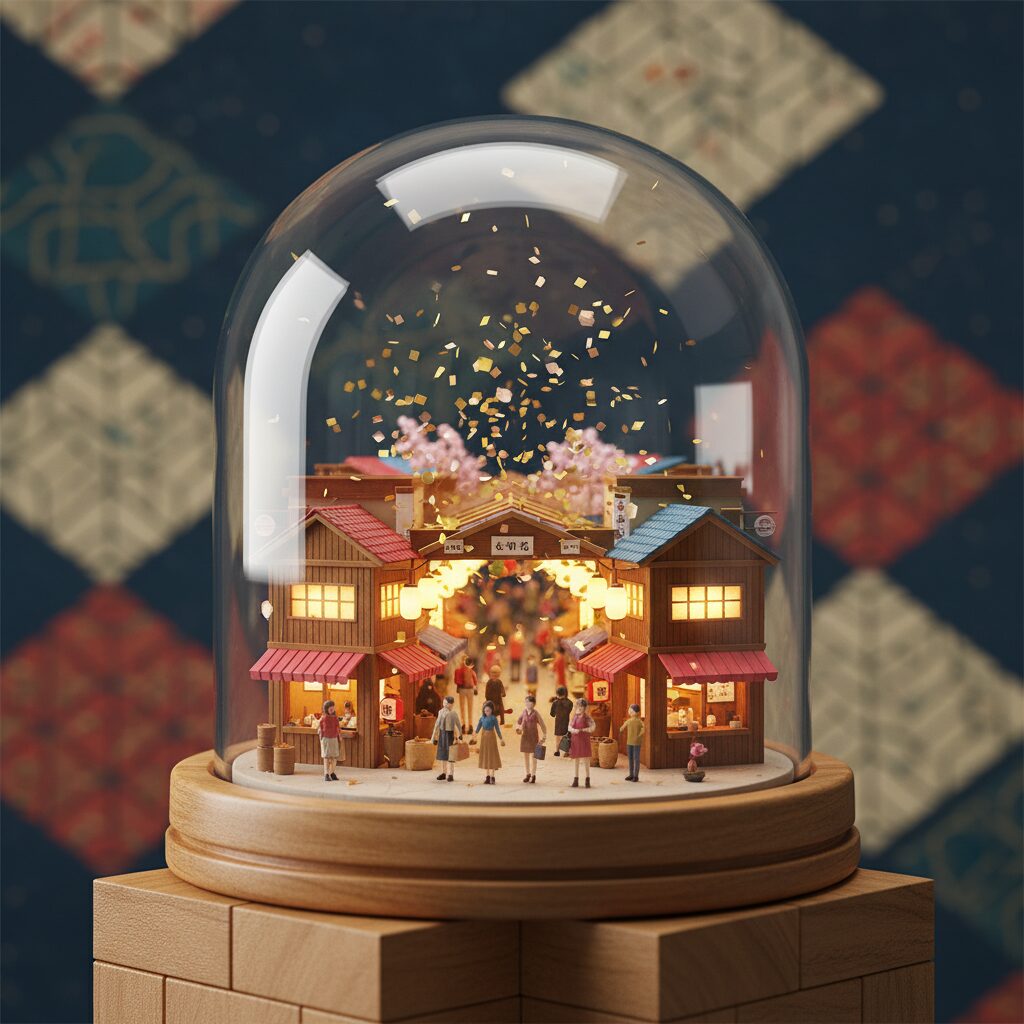
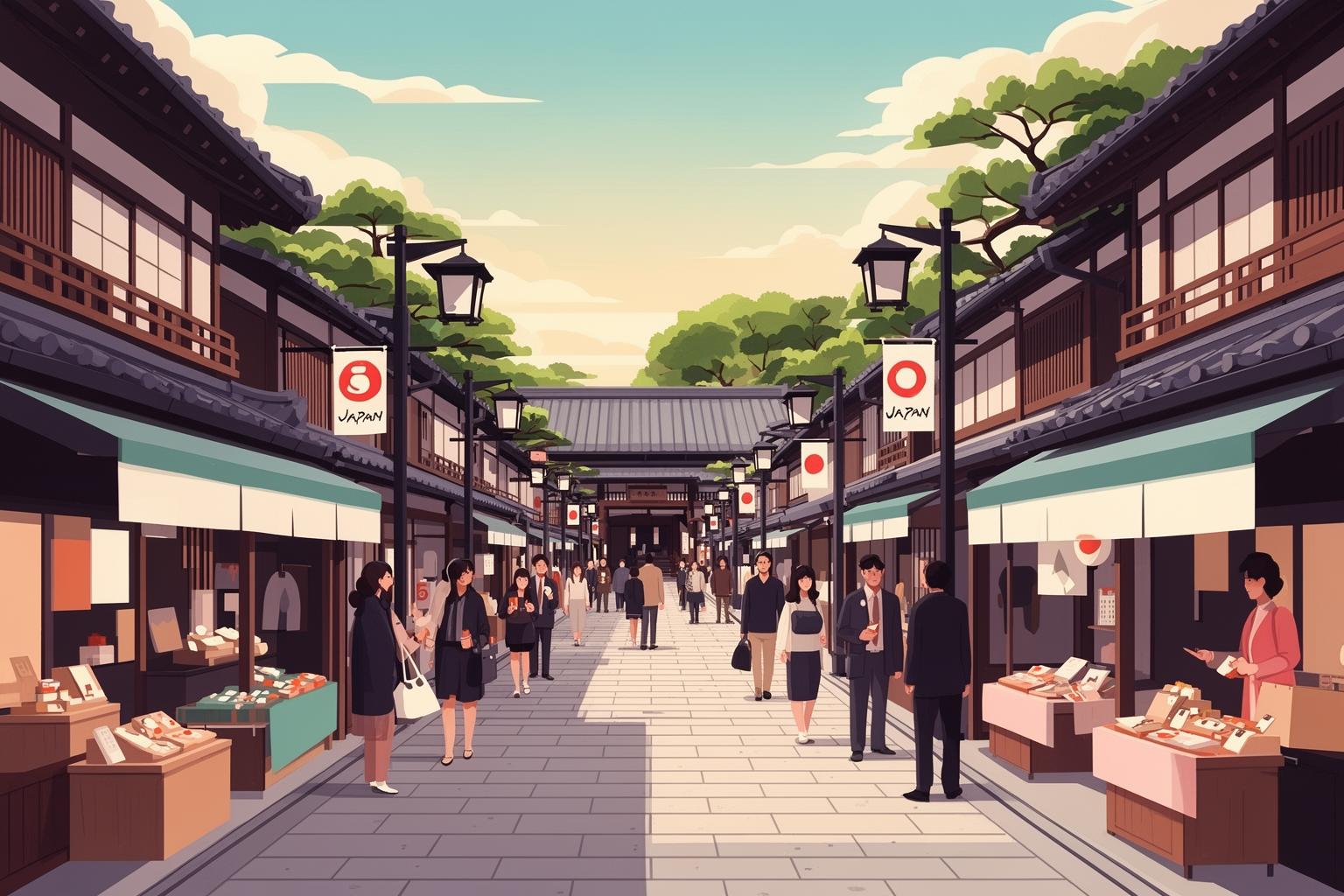
When you step into a shotengai, the sensation hits you immediately. It’s not merely that it appears old; it’s a full sensory immersion that makes you feel as though you’ve stepped back in time. The air carries a different aroma—a blend of soy sauce simmering in a pot of oden, sweet bean paste wafting from a mochi shop, and the savory sizzle of a butcher frying up menchi-katsu. The sounds form a low-fi symphony: the clatter of a metal shutter rolling open, a cheerful yet slightly distorted music box tune playing through the speakers, and the rhythmic chop-chop-chop of a fishmonger scaling the day’s catch. This entire atmosphere embodies what the Japanese call natsukashii (懐かしい), one of the most essential emotional concepts to grasp to truly understand the national psyche. It goes beyond simple nostalgia for one’s personal past—it’s a collective, cultural yearning for an idealized shared history, even one you never lived through. The shotengai is the ultimate physical embodiment of natsukashii: a thoughtfully preserved, though somewhat weathered, diorama of the Showa Era (1926–1989), particularly its post-war boom years. This era was no ordinary period; it was the crucible in which modern Japan was shaped. It was a time of great hardship, followed by rapid economic growth and the rise of a national identity. These streets were the epicenter of that energy, the vibrant heart of every neighborhood before large supermarkets and soulless shopping malls took over. This is where life truly happened.
Deconstructing the “Showa Retro” Aesthetic
Let’s dissect the aesthetic now popularized as “Showa Retro” (昭和レトロ). It’s a distinct visual language. The architecture is utilitarian, often a hodgepodge of concrete, tile, and corrugated metal, built for function rather than style. Storefronts open directly onto the street, blending public and private spaces seamlessly—a sharp contrast to the enclosed, air-conditioned boxes of contemporary retail. Signage is a major part of the charm. Forget sleek, minimalist logos; here you find hand-painted kanji, sometimes faded and peeling, on wooden boards. Iconic plastic food models (shokuhin sanpuru) sit in glass cases, showcasing dishes with an analog glow that’s vibrantly tacky. Outside barbershops, spinning red, white, and blue poles remain, universally recognized, having endured decades of shifting trends. The color palette is earthy and muted—browns, greens, and creams—punctuated by bright primary hues in plastic buckets, banners, and packaging from a bygone era. Even the technology is retro: old-fashioned cash registers chiming cha-ching, flickering fluorescent lights, and occasionally a rotary phone tucked away in the back of a shop. This isn’t a manufactured aesthetic like a theme park; it’s genuine decay shaped by decades of use, improvisation, repair, and adaptation. Every crack in the pavement, every rust stain on a shutter, narrates a story of community resilience. It speaks to an era when things were built to last and life was lived at a human scale. This visual clutter combined with organized chaos stands as a direct defiance of the sterile, hyper-curated perfection seen in modern Japanese design. It’s messy and human, which is exactly why it feels so comforting and authentic.
“Natsukashii” – More Than Just Nostalgia
Grasping natsukashii is key here. In the West, nostalgia sometimes carries a negative edge—a sentimental, unrealistic longing that can hinder progress. In Japan, natsukashii is a warmer, more communal feeling. It’s a cozy, slightly bittersweet emotion that brings comfort, much like the feeling of being wrapped in a weighted blanket. Crucially, natsukashii can be felt for experiences you’ve never personally had. A Tokyo teenager might walk through a shotengai and feel a profound natsukashii for the Showa era, a time known only through movies, manga, or grandparents’ stories. Why? Because the Showa era, despite its hardships, is culturally framed as a period of simplicity, strong community ties, and shared purpose. It was a time when neighbors knew each other, children played safely in the streets, and life—though harder—felt clearer. The shotengai serves as a trigger for this collective memory. When someone smells fried croquettes, it doesn’t just evoke childhood snacks; it connects them to a broader narrative of post-war recovery and simple pleasures. This emotional anchor is powerful amid a rapidly changing world. Its impact is so strong that it fuels marketing itself: products are released in “Showa-style” packaging, and movies and anime set in that era remain perennial favorites. The shotengai requires no marketing team; its very existence masters selling this comforting, shared sensation of a past that often feels more authentic than the present.
The Social Glue: Why Shotengai Feel Like Tom Nook’s Neighborhood
Alright, so the vibe is absolutely perfect. But a vibe alone doesn’t pay the bills. The true reason these shotengai endure, despite fierce competition from convenience stores and online giants, is because they function within a completely different social and economic framework. If a modern supermarket is a transactional space, then the shotengai is a relational one. It’s not about securing the lowest price or the most efficient service. It’s about nurturing the delicate, intricate network of human relationships that form the foundation of a community. This is where the essence of Japan shines through. The interactions follow unwritten rules and deep-rooted cultural values that emphasize the group over the individual and long-term stability over short-term profit. It’s like a real-life version of the Animal Crossing ecosystem, where you don’t just buy turnips from Daisy Mae—you build a relationship with her over time. This social infrastructure is far more significant than the buildings themselves.
The “Gaman” and “Giri” of Local Commerce
Two essential terms to understand here are `gaman` (我慢) and `giri` (義理). `Gaman` is often translated as “endurance” or “perseverance,” but it goes beyond that. It means stoically enduring hardships for the greater good without complaint. The shopkeepers in shotengai are experts in `gaman`. They withstand long hours, slim profit margins, and the constant threat of becoming obsolete. They keep their shops open not just as businesses, but out of a sense of duty to the neighborhood. Their parents and grandparents ran the same establishment, and closing it would feel like betraying that legacy and disrupting the community’s rhythm.
Then there’s `giri`, which is even more nuanced. It’s a sense of social obligation or duty. It’s why you feel compelled to give a gift in return for one or to help a neighbor. In a shotengai, `giri` acts as an invisible currency. A local might keep buying vegetables from the elderly grocer, even though the supermarket down the street is cheaper and offers more variety. Why? Because of `giri`. Their family has shopped there for generations. The grocer’s family has served their family for just as long. This is a relationship, a bond of mutual responsibility. The customer supports the local shop, and in return, the shopkeeper provides a personal touch—perhaps throwing in an extra onion, inquiring about a sick family member, or delivering groceries when needed. It’s a system of reciprocal care. This is a fundamentally different economic logic. It’s not driven by impersonal capitalism but by a commitment to preserving the social harmony (`wa`, 和) of the community. Breaking this `giri` chain by suddenly switching to the supermarket would be seen as selfish—a small tear in the social fabric. This powerful, invisible force keeps many small businesses afloat.
The “Osekkai” Factor: Everyone Knows Your Business (and That’s Mostly a Good Thing)
This deeply rooted community also brings with it another distinctly Japanese trait: `osekkai` (おせっかい). The direct translation is something like “meddlesome” or “nosy,” which sounds negative. But within the context of a shotengai, it’s often a form of proactive, well-meaning care. It’s the butcher wondering why a young woman is buying ingredients for one and trying to set her up with his nephew. It’s the fishmonger scolding a kid for riding his bike too fast. It’s the bakery owner offering unsolicited advice on your life choices while bagging your bread. In the hyper-individualistic West, this would be considered a major invasion of privacy. And to be fair, many younger, urban Japanese also find it stifling. That’s the “mostly” part.
However, in a society facing a rapidly aging population and growing social isolation, `osekkai` also serves as a powerful, informal social safety net. The shopkeepers in the shotengai are the neighborhood’s eyes and ears. They’re the first to notice when an elderly regular, like Suzuki-san, hasn’t stopped by for their daily daikon radish. This isn’t just passive observation—they act on it. They might call Suzuki-san or ask another nearby regular to check in. These small acts of `osekkai` literally save lives. It’s a system of ambient surveillance born from genuine care. It offers a sense of security no private firm or government program can replicate. You’re not an anonymous consumer—you’re a recognized member of a community. This stands in stark contrast to the lonely, anonymous existence that city life in Tokyo or Osaka can bring. The shotengai is an antidote to that anonymity. It’s a place where you’re seen, your presence is valued, and people will notice if you disappear. For many, that sense of belonging is worth a little meddling.
The Struggle is Real: Shotengai vs. The Modern World
Now, let’s pause the warm, fuzzy feelings for a moment. It’s not all about `natsukashii` vibes and community spirit. The reality on the ground is harsh, and many shotengai are fighting for their very survival. The romantic ideal we’ve discussed faces constant, relentless pressure from the forces of modern life. For every vibrant, bustling shotengai featured on a travel blogger’s feed, dozens more are slowly fading away, their shutters permanently closed. This is the other side of the story—one that exposes the deep challenges rural and suburban Japan confronts and the limits of a community-based economic model in a globalized world. The struggle is real, and the future remains uncertain.
The “Shutter-gai” Phenomenon
There’s a poignant term in Japanese for a dying shotengai: `shattā-gai` (シャッター街), or “shutter street.” It evokes a stark image of a once-lively street where most storefronts are now covered by cold, gray metal shutters. This sight is common in regional cities and depopulated rural towns across Japan. The causes of this decline stem from a complex mix of the country’s major societal problems. First, there’s the demographic crisis. Japan’s population is aging and shrinking. Young people leave their small hometowns seeking jobs and excitement in major cities like Tokyo, leaving behind an aging community. This results in fewer customers and, critically, no successors to take over family businesses.
This brings us to the `kōkeisha mondai` (後継者問題), or successor problem. That tofu shop, in the family for three generations, is now run by its 75-year-old owner whose children have become accountants and software engineers in the city. They have no interest in the demanding, low-margin work of making tofu at 4 AM every day. When the owner retires or passes on, the shop closes for good. The shutter comes down, taking another piece of the community’s soul with it. And of course, there’s fierce economic competition. Massive, American-style suburban malls anchored by huge Aeon supermarkets have sprung up nationwide. Offering one-stop shopping, ample free parking, air conditioning, and competitive prices, they are tough for small, independent shotengai shops to compete against. Add the rise of online retail, and pressure mounts even more. The `giri`-based loyalty system can only withstand the overwhelming tide of convenience and price for so long.
The Modern Remix: How Shotengai are Fighting Back
But this isn’t just a story of decline; it’s also one of adaptation and resilience. The shotengai that survive—and even thrive—are those that have learned to evolve. They recognize they can no longer compete with malls on price or convenience. Instead, they’re offering something different: an experience. Embracing their “Showa Retro” identity, they turn it into their greatest asset. Streets like Tokyo’s Yanaka Ginza or Kyoto’s Teramachi Arcade have become major tourist draws. They actively promote their nostalgic charm, attracting international visitors and young Japanese alike, all seeking authenticity and Instagram-worthy moments. Their value now lies not just in providing daily necessities but in offering a connection to cultural history.
This transformation is also driven by a new generation. Young entrepreneurs, disillusioned with corporate life and yearning for more meaningful work, are moving into these aging shotengai. They take over vacant storefronts, launching businesses that blend old and new. You might spot a third-wave coffee shop with minimalist decor right beside a century-old seaweed store. A craft beer bar could open in a former fishmonger’s stall. A modern art gallery might appear in an old pharmacy. This fusion generates fresh energy, preserving historic architecture and the street’s community feel while injecting new ideas and drawing younger crowds. These revitalized shotengai also double down on their role as community hubs, hosting seasonal `matsuri` festivals, flea markets, and local events that bring neighbors together. They don’t just wait for customers; they actively create reasons for people to gather, connect, and share a sense of identity. They are transforming from mere commercial spaces into vital cultural centers.
Your Real-Life Animal Crossing Quest: How to Vibe with a Shotengai
So you’re convinced. You want to experience this firsthand. How do you approach a shotengai not as a typical tourist, but as someone who understands the deeper cultural context? The key is to change your mindset. You’re not there to tick off a list of must-see spots or hunt for bargains. You’re there to observe, participate in a small way, and absorb the atmosphere. It’s a quest to grasp the rhythm of local life. Think of it less as a shopping trip and more as an anthropological field study, but with much better snacks. Your aim is to catch a glimpse of the invisible social dynamics at play. This takes patience and a willingness to engage with your surroundings on a genuinely human level.
It’s Not About Shopping, It’s About “Tabe-aruki”
The best way to break the ice and truly experience a shotengai is through its food. This is the idea behind `tabe-aruki` (食べ歩き), which literally means “eating while walking.” Many shotengai are known for their cheap, delicious, and portable street food sold at the fronts of small shops. This is the main activity. Forget sit-down meals; this is about grazing your way along the street. Taking part in `tabe-aruki` is your ticket into the local scene. Begin with the classics. Look for a butcher shop with a sizzling deep-fryer out front. There you’ll find the holy trinity: `korokke` (コロッケ), a simple potato and meat croquette; `menchi-katsu` (メンチカツ), a juicy minced meat cutlet; and `hamu-katsu` (ハムカツ), a breaded and fried slice of ham. They generally cost a dollar or two, come wrapped in a small piece of wax paper, and taste absolutely divine. Then seek out a `yakitori` (焼き鳥) stand, grilling chicken skewers over charcoal. Or a `senbei` (煎餅) shop where rice crackers are toasted by hand. Or a `wagashi` (和菓子) shop offering seasonal mochi treats, like `ichigo daifuku` (strawberry and red bean mochi). Buying these small items creates easy, low-pressure interactions with the vendors. You point, pay, say “arigatou gozaimasu,” and receive a smile in return. It’s a brief but authentic connection to the community and the most genuine way to engage.
Reading the Air (And the Storefronts)
As you explore, keep in mind the golden rule of Japanese society: `kūki o yomu` (空気を読む), or “read the air.” This means being sensitive to your surroundings and unspoken social cues. A shotengai is not a tourist site; it’s a living, working community. People are going about their daily routines. Be respectful of that. Don’t block the narrow street with a large group. Keep your voice down. The atmosphere is relaxed and low-key, so mirror that energy. When it comes to photography, be considerate. Taking broad shots of the street is usually fine, but avoid aiming your camera directly into shops or at people’s faces without asking. A simple gesture with your camera and a questioning look often earns a nod of approval. These are people’s workplaces and, quite often, their homes (families frequently live above the shops). Treat them with the respect you’d want in your own neighborhood. Your true goal is to observe the interactions. Watch how shopkeepers chat with regular customers. Notice the `osekkai` in action. Observe the small acts of `giri`. Here you’ll find the soul of the place. Don’t stress about discovering a “hidden gem” unknown to others. The real treasure is the everyday, ordinary, beautiful reality of the community itself, hiding in plain sight.
The Analog Heart in a Digital World
So, why do these traditional streets still endure? When you distill it down, the shotengai persists because it provides a powerful remedy to the core anxieties of modern life: loneliness, anonymity, and the absence of genuine connection. It stands as a defiance against the cold efficiency of algorithms and the sterile uniformity of the globalized marketplace. It is a physical space devoted to the messy, inefficient, and deeply essential act of being human together. It embodies a different set of values, one that prioritizes relationships over transactions, community over individuality, and the long-term over the immediate. These streets serve as a tangible link to collective memory, a source of the comforting warmth of natsukashii that helps ground people in a rapidly changing world.
Of course, they are far from perfect. They can be resistant to change, insular, and economically vulnerable. The giri that binds the community can also become a chain that restricts people from making decisions that suit them individually. The osekkai that offers a safety net can sometimes feel stifling. Yet their endurance, even in their faded and deteriorating condition, reveals something deeply important about what Japanese society quietly cherishes, and what it fears losing. It is the fear of a future where every interaction is filtered through a screen, where every neighborhood looks identical, and where no one knows their neighbor’s name. The shotengai, in its own persistent, analog manner, declares that there is another way to live. It is not a relic to be pitied but a living blueprint for a more connected future. It is the genuine, vibrant, and wholly authentic heart of Japan.