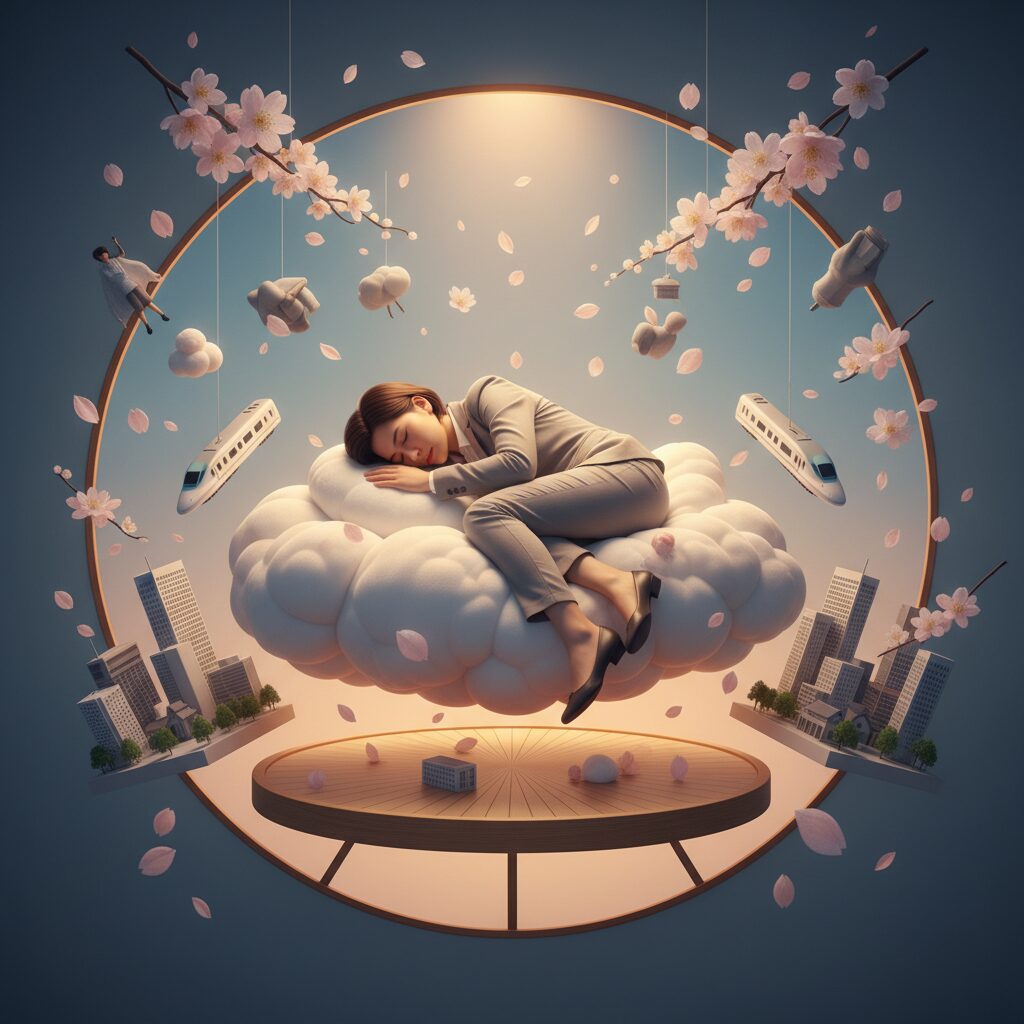
Yo, what’s the deal with Japan? You scroll through your feed and see this wild mix of ancient temples, neon-drenched cityscapes, and just… a whole lot of people sleeping. Not in their beds. We’re talking crisp suits, heads lolling back on a packed morning train. We’re talking office workers, face down on their desks in the middle of the afternoon. You might have even seen it IRL on a trip to Tokyo, peeking into a meeting room and seeing someone just completely checked out, eyes closed, while a presentation drones on. Your first thought is probably, “Are they okay? Are they about to get fired?” In most places, public napping, especially at your desk, is a one-way ticket to a talking-to from HR. But here? It’s a whole different story. This isn’t about laziness or being rude. It’s a deeply ingrained cultural phenomenon called `Inemuri` (居眠り), and honestly, it’s one of the most fascinating and confusing keys to understanding the Japanese psyche, especially when it comes to work, dedication, and the unspoken rules of society. So, let’s get into it. Let’s spill the tea on why falling asleep in public isn’t just acceptable in Japan—it can sometimes be seen as a badge of honor. It’s a vibe that says more about the country’s hustle culture, its insane public safety, and its collective exhaustion than any textbook ever could. This is the lowdown on Inemuri, the art of being present while sleeping.
The Unspoken Rules of Inemuri: It’s Not Just a Nap
First, let’s clarify one thing: Inemuri is not simply taking a nap. It’s much more nuanced, and the word itself provides the first important hint. The term combines two Japanese words: `i` (居), from the verb `iru`, meaning “to be present,” and `nemuri` (眠り), which means “sleep.” So, it literally means “sleeping while present.” This difference is crucial. It’s the philosophical loophole that makes the practice socially acceptable. You’re not abandoning your position or clocking out. You’re still technically there, participating in the meeting, sitting at your desk, or riding the train. You’re just temporarily resting to conserve energy. This idea implies that you remain ready to wake up instantly and resume your duties if needed. If asked a question during a meeting, the expectation is that you can snap awake, gather your thoughts, and respond coherently. It’s a delicate balance of being both absent and available. This is fundamentally different from `hirune` (昼寝), which refers to a planned midday nap. A `hirune` is intentional—you might go to a break room, rest your head for a scheduled twenty minutes, or find a park bench on your lunch break. It’s purposeful rest. Inemuri, however, is presented as an unintentional surrender to sheer exhaustion. It happens when you’ve pushed your body and mind beyond their limits. You didn’t mean to fall asleep; it just happened because you couldn’t stay awake any longer. This distinction is vital because it shifts the perspective from leisure to a sign of extreme diligence.
“I-ru” (To Be Present) + “Nemuri” (To Sleep)
Let’s explore this “sleeping while present” idea further, as it underpins the entire Inemuri philosophy. The key lies in `i` (居), which implies a state of being, a continuous presence within a social setting. At your desk, you fulfill your role as an employee. On the train, you’re a commuter. In class, you’re a student. Inemuri lets you sleep without relinquishing that social role. Your body remains physically present, occupying the space and minimally demonstrating your presence. Think of it like a computer in sleep mode: all programs remain open, the system runs, but the screen dims to conserve energy. You haven’t completely shut down—you’re just in a low-power state, ready to reactivate instantly. This cultural understanding distinguishes Inemuri from what many other cultures might see as neglect of duty. It’s a subtle social contract. As long as your sleeping doesn’t disrupt others—no loud snoring, sprawling across seats, or missing your stop—you’re generally excused. You’re perceived as someone so dedicated to their responsibilities (work, school) that they have to take advantage of these brief moments to recharge. The tacit agreement is that while your mind may be offline, your social self remains logged in. That’s why posture matters so much. The ideal Inemuri position is upright, perhaps with your head nodding forward or resting against a train window. You stay contained, don’t invade others’ space, and maintain the outward semblance of your social role, even as you dream inwardly. It’s a captivating blend of social compliance and personal need, all wrapped in a quiet, sleepy gesture.
The Performance of Exhaustion
Here’s the thing: Inemuri isn’t just about dozing off. It’s a subtle performance. It’s like a silent public declaration: “I am so devoted, so committed, so essential to my team that I have sacrificed personal sleep for the company’s sake.” It’s a humble flex. In a culture where open self-promotion is often frowned upon and group harmony is valued over individual showmanship, Inemuri becomes an intricate way to convey one’s worth. You don’t step up to your boss and say, “I stayed up until 3 AM finishing Tanaka-san’s proposal.” That would be seen as boastful and inappropriate. Instead, you simply nod off during the 10 AM meeting. The message transmits silently. Your boss notices, colleagues see it, and everyone silently acknowledges, “Sato-san is committed. They’re putting in the effort.” This turns an act often punishable in Western workplaces into a badge of honor for diligence, or `kinben` (勤勉). It physically embodies the `gambaru` (頑張る) spirit—the cultural mandate to always try your best, persevere, and push onward. So when you see that salaryman, head nodding, eyes closed, he’s not merely sleeping; he’s engaging in a nuanced social ritual that reinforces his identity as a hardworking, loyal, indispensable member of the corporate community. It may seem odd, but once you grasp the logic, it makes a kind of twisted sense. This performative aspect also explains why Inemuri is more common in some situations than others. Dozing off in a long, dull internal meeting? That’s prime Inemuri territory. It quietly signals that you had more pressing concerns that kept you awake all night. But falling asleep during a major client’s presentation? Absolutely not. That crosses from diligence into disrespect. The unspoken rules revolve around context, and the performance must suit the audience and the stakes at hand.
Where Does This Vibe Come From? The Historical and Social Sitch
The whole Inemuri vibe didn’t simply emerge out of nowhere. It’s deeply embedded in Japan’s modern history and the social frameworks developed over decades. To truly understand why a society would collectively accept sleeping at work, you need to consider the forces that shaped the Japanese workplace and the everyday lives of its people. It’s a story of economic ambition, grueling commutes, and a national sleep deficit building up over generations. This isn’t just about people being tired; it concerns the very essence of what it means to be a contributing member of Japanese society. The expectation to work, the physical reality of commuting, and the cultural acceptance of exhaustion are all intertwined. Grasping this background is like obtaining a cheat code to Japanese culture, revealing how a behavior that seems odd on the surface is actually a rational, if extreme, adaptation to a unique set of historical and social pressures. It’s a kind of solution to a problem Japan created for itself in its relentless pursuit of progress. Let’s delve into the three main pillars underpinning the institution of Inemuri: the post-war hustle, the soul-crushing commute, and the simple fact that nearly everyone is running on empty.
The Post-War Economic Boom: Hustle Culture Amplified
To comprehend modern Japan’s work ethic, you have to travel back to the post-World War II period. The country was devastated, but what followed was one of the most intense periods of economic rebuilding and growth the world has ever seen. This wasn’t just about reconstruction; it was about forging a new national identity centered on economic power. A generation of workers, famously known as “corporate warriors” or `shakaijin`, devoted their entire lives to their companies. The arrangement was straightforward: you offer your unwavering loyalty and waking hours, and we provide lifetime employment, security, and a sense of purpose. Companies became like families, and work wasn’t just a job; it was a core part of one’s identity. This era created a culture where long hours were not merely expected—they were a moral obligation. Leaving the office before your boss was unthinkable. Declining after-work drinks with colleagues was considered antisocial. This relentless hustle culture drove the Japanese economic miracle but came at a steep price: personal time and sleep. Within this environment, exhaustion wasn’t seen as weakness; it was proof of contribution—a visible symbol of sacrifice for the company and, by extension, the nation. Inemuri emerged from this context. When expected to work 12-hour days and socialize late into the night, falling asleep during the day became inevitable. Rather than being reprimanded, it was quietly accepted as a natural consequence of the extreme diligence fueling the country’s success. It became a silent badge of honor. A manager seeing a young employee dozing at their desk might not view them as lazy, but as reflecting their own early dedication—a sign that the company’s work ethic was being passed down. The dark side, of course, is `karoshi` (過労死), or death from overwork, a tragic term that entered the global lexicon from Japan. Inemuri is the more benign, everyday manifestation of the same root cause: a work culture historically prioritizing corporate needs over individual well-being.
The Commute Grind is Real
The daunting logistics of the daily commute in Japan, especially in vast urban areas like the Greater Tokyo Area, is another major factor making Inemuri essential. Millions live in suburbs and commute into city centers for work or school every day. A one-way trip of an hour and a half, or even two hours, is common, meaning three to four hours daily spent just traveling. This time is a sort of limbo—it’s neither personal time usable at home nor productive time at work. It’s simply transit. The trains are famously punctual and efficient but often extremely crowded during rush hours. You’re packed so tightly you can’t read a book or even look at your phone. So, what else is there to do? For a chronically sleep-deprived population, this enforced downtime offers a perfect chance for a power nap. The gentle rocking of the train and the low hum of the engine create an ideal environment for drifting off. Here, another vital element comes into play: Japan’s extraordinary public safety. Tourists and newcomers are often amazed that you can fall asleep on a crowded train with your phone in hand or bag on your lap and wake up with all your belongings still intact. A strong social trust and low petty crime rate enable this security. This safety allows people to let their guard down and close their eyes without fear of theft. It transforms the train from a stressful, crowded space into a sort of communal bedroom—a semi-private bubble where precious moments of rest can be reclaimed before or after the workday. The commute nap isn’t merely a choice; it’s a survival strategy for enduring the daily urban grind in Japan.
Sleep Deprivation Nation
Let’s be clear: the Japanese are a nation struggling with severe sleep deprivation. Study after study confirms this. Whether through OECD data or health surveys, Japan consistently ranks among developed countries with the shortest average sleep durations. The reasons are a mix of everything mentioned: long work hours, lengthy commutes, plus intense academic pressure on students who often attend `juku` (cram schools) late into the evening. There’s a prevailing societal push for constant productivity. Free time is often filled with self-improvement, hobbies, or social obligations, rather than rest. Sleep is usually the first casualty. When burning the candle at both ends, the body eventually demands repayment. Inemuri is that repayment, taken in small doses throughout the day. It’s a biological necessity expressed within a specific cultural context. Rather than resisting exhaustion or feeling ashamed of it, the culture has fashioned an outlet for it. Inemuri tacitly acknowledges that the demands of modern Japanese life often make a full eight hours of sleep unattainable for many. It’s a coping mechanism normalized across all demographics: the high school girl in her uniform, head against the train window, drained from a long day of classes and club activities; the young office worker in a suit, nodding off at his desk after overnight overtime; even elderly people dozing on a park bench. It’s a shared public experience. This collective tiredness fosters an unspoken solidarity. No one bats an eye at someone sleeping on the train because everyone understands—they are tired, too. Inemuri quietly reveals a nation working, studying, and commuting itself into a constant state of fatigue.
Inemuri in Action: The Dos and Don’ts
So you might be thinking, “Great, if I’m in Japan, I can just fall asleep anywhere, right?” Not quite. While Inemuri is broadly accepted, it isn’t a free-for-all. Like many things in Japan, it’s guided by a complex network of unwritten rules, social signals, and situational awareness. There’s a right way to do it and a wrong way. Mastering Inemuri involves understanding the subtle etiquette that transforms it from a careless act into a respectful expression of exhaustion. It’s about hierarchy, posture, and context. These rules aren’t found in any employee handbook, but they’re universally understood. For non-Japanese individuals, these nuances can be challenging, yet they illuminate how social harmony, respect for authority, and consideration for others play out in daily life. Ignoring these unspoken rules can quickly turn an acceptable behavior into a social misstep. So, before you decide to catch some z’s during a meeting, let’s explore the Inemuri playbook: who is allowed to do it, how it should be done, and when it’s absolutely inappropriate. This is the insider’s guide to the delicate choreography of public napping.
The Hierarchy Factor: Who Can Do It?
This is probably the most crucial and least obvious rule of Inemuri in a professional context: it’s all about status. In Japan’s traditionally hierarchical corporate world, earning the privilege to practice Inemuri takes time. A senior manager—a `bucho` or a `kacho` with twenty or thirty years at the company—can doze off in a meeting, and it will likely be seen as a sign of their heavy workload and wisdom. They’ve earned their place, demonstrated loyalty, and their exhaustion reflects their significant responsibilities. They are like seasoned warriors resting between battles. Their Inemuri nearly acts as a badge of honor. Conversely, a `shinnyu shain`, a newly hired employee fresh out of college, would make a serious mistake falling asleep in the same meeting. For a junior employee, sleeping is not viewed as hard work but as disrespect, a lack of discipline, or a failure to take the job seriously. They haven’t yet earned the social capital to have their tiredness excused. Their job is to stay alert, absorb information, show enthusiasm, and prove their value. Inemuri is a privilege that comes with age and rank. It’s a clear reminder that in Japan, your position within the group often determines which rules apply and how your behavior is perceived. The general rule: the higher you are in the hierarchy, the more socially acceptable your public naps become. It reflects a system where respect for seniority is paramount—even when it comes to simply falling asleep.
The Posture Police: Look Like You’re Trying
How you sleep matters just as much as who you are. The physical manner of Inemuri is key to its social acceptance. The idea is to appear as if you’re fighting sleep and losing, not that you’ve happily surrendered. This means maintaining a posture that signals you’re, in theory, still on duty. The classic Inemuri position at a desk is sitting upright, with your head slowly nodding forward until your chin rests on your chest. Or you might lean forward slightly, resting your forehead on your hand as if you’re deep in thought. What you must absolutely avoid is reclining in your chair with your feet up. Don’t slump sideways, taking up extra space. Don’t bring a pillow from home. And under no circumstances should you be visibly drooling or—worst of all—snoring. Any loud noises are a major violation of the Inemuri code. The essence of proper form is to stay as contained and unobtrusive as possible. On a train, this means remaining within your seat’s boundaries. Leaning on a stranger’s shoulder is a big no-no, though it occasionally happens by accident and usually results in uncomfortable silence rather than confrontation. The ideal move is to sit by the window and lean your head against the glass. The point is to show consideration for others. Your tiredness should not become a burden or annoyance to those around you. By keeping a controlled, upright posture, you signal that even in sleep, you respect social harmony. You show you’re trying to stay present, even if your mind has momentarily checked out. It’s a performance of effort—a physical statement that you haven’t completely abandoned your social duties.
Context is Everything: Meetings vs. Presentations
Finally, whether Inemuri is acceptable depends heavily on the social context. You need to read the room. The stakes of the situation determine if dozing off is a minor slip or a serious offense. A long, weekly internal team meeting where the same points are repeated? This is often seen as low stakes. It’s not uncommon to find a few people subtly practicing Inemuri. It’s almost an unspoken acknowledgment that the meeting isn’t the most critical part of their day. However, if you’re in a meeting with an important client or if the CEO is delivering a major speech, falling asleep is absolutely off-limits. Doing so would be deeply disrespectful to the guest or leader and bring shame not only on you but on your entire team and company. The hierarchy of attention is essential. You must be awake and engaged for those senior to you or external stakeholders. Likewise, if you’re the one presenting, sleeping is obviously out of the question. And nodding off while a direct subordinate presents to you is extremely rude, as it undermines their effort. The general rule: the more your attention is required as a mark of respect, the less acceptable Inemuri becomes. It’s an ongoing calculation of social dynamics. You assess the event’s importance, the people involved, and your role in the proceedings. This is why Inemuri rarely occurs during active, dynamic conversations. It happens mostly during passive listening situations—the lecture, the long briefing, the monotonous train ride—where your physical presence is needed, but your active mental engagement can briefly lapse.
Is the Inemuri Vibe Changing? The New Gen POV
The Japan of the post-war corporate warrior era is not the Japan of today. Change is happening, gradually but steadily. A new generation of workers, raised with the internet and a broader global outlook, is beginning to question traditional practices. The cultural glorification of overwork and exhaustion is starting to feel… somewhat cringe-worthy. The notion that one must physically exhaust themselves to prove their value is losing its charm. This shift in mentality is directly affecting work culture and, consequently, the practice of Inemuri. The rise of ideas like “work-life balance,” government efforts to reform working styles, and the unprecedented disruption caused by the pandemic are all reshaping the landscape. The old rationale behind Inemuri—that it symbolizes honor for a devoted corporate soldier—is now being contested. For many young people, constant tiredness is not a badge of pride but rather a sign of poor time management or a toxic work environment. So, what lies ahead for Inemuri? Is this iconic aspect of Japanese daily life fading away, or is it simply evolving? Let’s explore the forces challenging the culture of exhaustion and what they might mean for the future of napping on the job.
Work-Life Balance is Finally Gaining Ground
For decades, the idea of “work-life balance” was mostly foreign in Japan—work was life. But that is shifting significantly. Younger generations, especially Millennials and Gen Z, have witnessed their parents sacrifice everything for their companies, often with little reward after years of economic stagnation during the “Lost Decades.” They are far less inclined to follow the same path. A growing movement now prioritizes personal time, hobbies, and family over blind corporate loyalty. This momentum is supported by government campaigns like “Hataraki-kata Kaikaku” (Work-Style Reform), which aims to reduce long working hours, promote flexible schedules, and encourage employees to use their paid vacation days. Companies face increasing pressure to limit overtime and avoid overburdening staff. In this new environment, the “performance of exhaustion” that Inemuri represents is losing its significance. When the objective is to be efficient and productive within contracted hours in order to leave work on time, falling asleep at your desk from fatigue no longer signals dedication—it signals inefficiency. Many startups and modern companies actively discourage old habits, fostering a culture where being well-rested and energized is prized over appearing visibly worn out. The flex is no longer about staying late at the office, but about how effectively you complete your work and then sign off. This fundamental shift strikes at the core of the culture that sustained Inemuri, suggesting its status as a respected workplace practice may be waning.
Remote Work and the End of the Commute Nap
The COVID-19 pandemic served as a massive catalyst for change in Japan’s traditionally rigid work culture. Suddenly, companies that had insisted for decades that work must be done in the office were pushed to embrace remote work and telecommuting. While Japan hasn’t adopted remote work as fully as some other countries, the shift has had a significant impact. Most notably, it eliminated the grueling daily commute for millions of workers. Without the three-to-four-hour travel time, people gained more hours each day—time for sleep, family, or leisure. The train, once a prime venue for Inemuri, ceased to be a daily necessity for many. Moreover, working from home changes the dynamic of exhaustion; if you feel tired while working in your living room, you needn’t perform Inemuri—you can simply take a real nap. You can close your laptop for 15 minutes, lie down on your couch, and properly rest without any social performance. The need to demonstrate diligence by dozing off in front of colleagues disappears with physical separation. The rise of remote and hybrid work fundamentally disrupts the two main environments where Inemuri flourished: the office and the commuter train. As flexible working arrangements become more common, these traditional spaces for public napping may lose their central role in daily life, potentially leading to a natural decline in the practice.
So, Is It Still Cool?
Is Inemuri dead? Far from it. It remains a very common sight, especially on trains and buses. The nation’s chronic sleep deficit hasn’t magically vanished, and students still face enormous pressure. The daily commute struggle continues for millions still going to the office. However, the meaning of Inemuri is shifting. In the workplace, it’s becoming less of a respected badge of honor and more of a somewhat embarrassing sign of being overworked in a system attempting to move beyond that. Its social prestige is fading rapidly among younger generations. But in public spaces like trains, Inemuri is likely here to stay. It has become less about performing dedication and more about what it truly is: a practical response to tiredness in a safe, convenient setting. It’s a very human moment. For visitors to Japan, seeing someone practicing Inemuri remains one of those quintessentially Japanese experiences—an ideal visual metaphor for the country itself: disciplined, orderly, and considerate on the surface, yet deeply, profoundly fatigued underneath. It reflects a nation caught between a past defined by relentless collective effort and a future striving to make more space for individual well-being. The salaryman sleeping on the Yamanote Line is no longer just a corporate warrior; he’s a person in transition, dreaming of a future where perhaps, just maybe, he can get a bit more rest.