For the seasoned traveller, the one who has already walked the well-trodden paths of Kyoto’s temples and felt the electric pulse of Shibuya Crossing, Japan begins to reveal its deeper, more nuanced layers. These are the cultural experiences that don’t always feature in glossy travel brochures but are woven into the very fabric of daily life. They are the rituals, the pastimes, the shared moments that define a generation and offer a vibrant, unfiltered glimpse into the nation’s soul. Among these, perhaps none is as dazzlingly bright, as technologically bewildering, and as quintessentially Japanese as Purikura. This isn’t merely a photo booth; it’s a cultural phenomenon, a digital beauty parlour, a social bonding ritual, and a souvenir factory all crammed into a space the size of a small closet. It’s a place where reality is artfully suspended and a hyper-idealised, impossibly cute version of yourself is born. For the repeat visitor seeking that authentic Japanese ‘vibe’, stepping into the world of Purikura is less about taking a picture and more about participating in a living, breathing piece of modern Japanese culture. It is a riot of sound, light, and frantic creativity that promises a tangible, shareable memory far more personal than any postcard. It’s a totally lit experience that captures the essence of Japan’s obsession with technology, aesthetics, and ephemeral fun.
For a taste of another uniquely Japanese retro delight, explore the world of Japanese cream soda.
From Print Club to Cultural Icon: The Genesis of a Phenomenon

To fully appreciate the flashing, beeping spectacle of a modern Purikura booth, one must rewind to the mid-1990s. Japan was on the brink of a technological revolution, a time when the foundations of today’s hyper-connected society were being laid. In 1995, two companies, Atlus and Sega, introduced a machine to Japanese arcades that would transform youth culture forever. It was called “Print Club” (プリント倶楽部, Purinto Kurabu), and its concept was deceptively simple: take a photo with a friend and have it printed on a sheet of small stickers. The name itself, soon shortened to “Purikura,” became the generic term for the entire industry, much like Hoover for vacuum cleaners or Xerox for photocopiers. The initial machines were basic by today’s standards, offering only a few whimsical frames and simple backgrounds. Yet, they tapped into something profound. For Japanese high school girls, the main users of this technology, it was revolutionary. It provided a way to create and control their own image, sharing a piece of themselves with friends in a tangible, collectible form. These tiny, low-resolution sticker photos became a kind of social currency. They were traded, carefully kept in special Purikura albums (puri-chō), and used to decorate everything from pencil cases to the early mobile phones of the time. This was more than just a photograph; it was a token of friendship, a snapshot of a shared moment, sealed in adhesive plastic. The historical context is essential; this boom coincided with the rise of kogyaru culture, the fashion-conscious high school girls of Shibuya, who set the trends for cool. Their endorsement propelled Purikura from a novelty arcade machine into a vital part of teenage social life. The booths became sacred spaces for self-expression and community—a place to capture changing hairstyles, school uniforms, and the complex bonds of adolescent friendship.
The Technological Arms Race: A Journey into the Uncanny Valley
The evolution of Purikura from the 90s to today serves as a captivating example of rapid technological progress, fueled by an unwavering quest for the perfect—or rather, the perfectly idealized—image. The initial triumph of Print Club ignited a competitive arms race among manufacturers such as FuRyu, Taito, and MakeupSoftware. What began as a simple portrait booth quickly transformed into a sophisticated digital studio. Cameras advanced, producing sharper images, while lighting systems grew more complex, designed to replicate professional studio setups that could eliminate shadows and enhance any complexion. The concept of bihaku (beautifully white) skin became a digital standard, with filters automatically lightening and smoothing skin tones to achieve an ethereal perfection. Then emerged the era of dekame (big eyes), a feature that digitally enlarges irises to almost doe-like proportions, echoing aesthetics popularized by manga and anime. This marked a turning point, as Purikura shifted from simple photography to digital transformation. The goal was no longer merely to capture reality but to enhance it, crafting a fantastical version of oneself. Editing suites, once limited to a handful of stamps and frames, expanded dramatically with a wide array of options. Infrared communication was introduced, enabling users to send a single selected image to their flip phones—a precursor to the instant digital sharing we recognize today. The booths themselves grew larger and more elaborate. Full-length machines appeared, capable of capturing entire outfits and, through clever digital manipulation, elongating legs to supermodel-like proportions. The adoption of green screen technology unlocked endless background options, allowing users to pose in front of landmarks in Paris, beneath showers of cherry blossoms, or alongside their favorite anime characters. Today’s machines represent the peak of this evolution. Powered by sophisticated software, sometimes integrated with AI, they analyze facial features and apply a range of beautifying effects with remarkable precision. Users can adjust the size of their eyes, the shape of their face, the shade of their lipstick, and the smoothness of their skin. Some even offer video snippets, producing short, looping clips ideal for social media. This ongoing innovation has kept Purikura relevant, enabling it to compete even in an era where powerful photo editing apps are available on every smartphone. The experience it provides is simply more intense, more collaborative, and, in its own distinctive way, more authentic in its artifice.
The Sanctuary of Sound and Light: The Purikura Corner Vibe
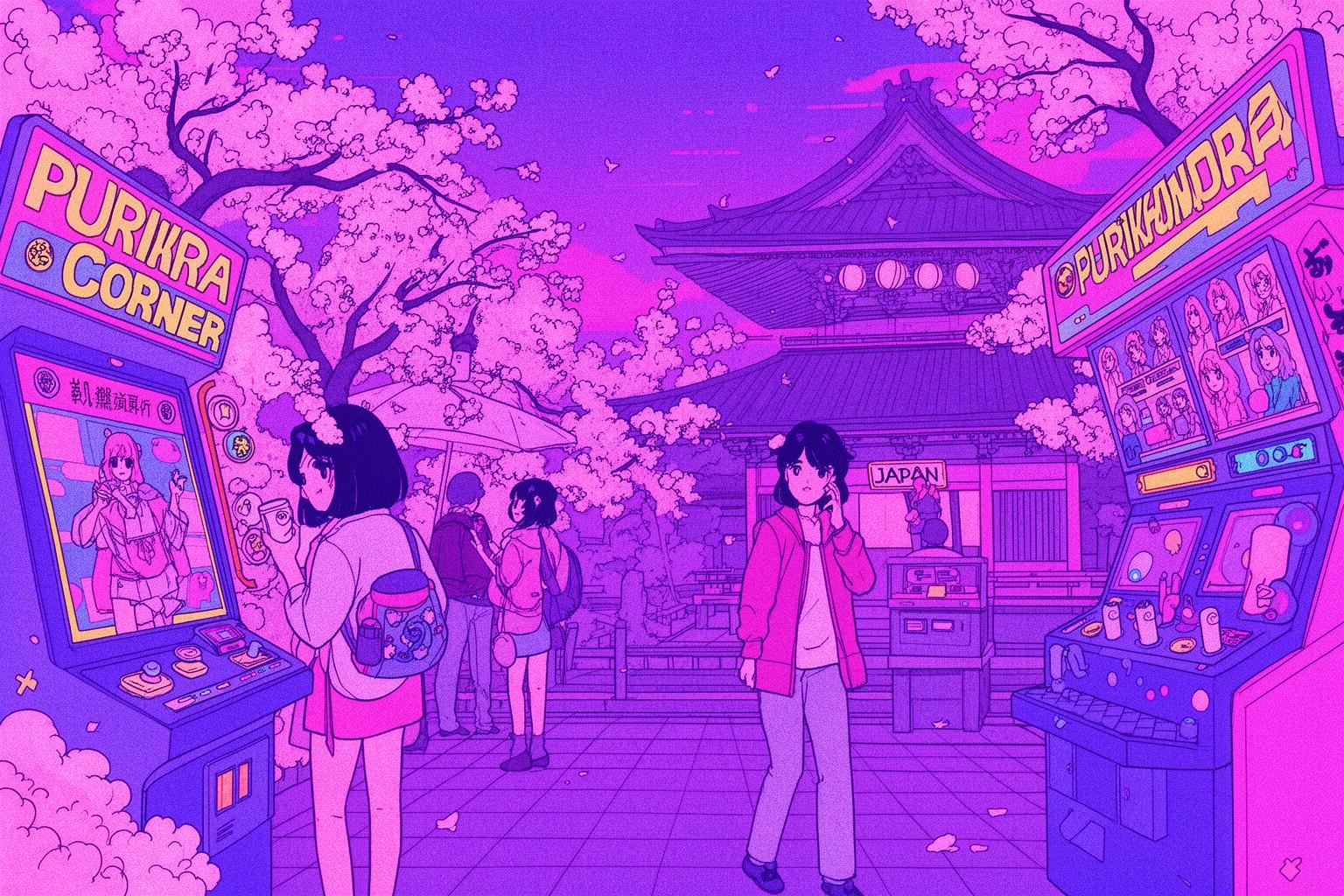
To find Purikura, you generally need to dive into the chaotic, lively core of a Japanese game center, or gesen. These multi-level venues provide a sensory overload in the best way possible. The ground floor often becomes a battleground of UFO catchers, with their mechanical claws teasingly hovering over plush toys and prizes. On the upper floors, the sounds of rhythm games fill the air—the pounding beats of Taiko no Tatsujin drums blending with the electronic tunes of fighting games and the roar of racing simulators. Within this joyful chaos, the Purikura section usually stands as a distinct, separate sanctuary. The lighting is brighter, the music consistently upbeat J-pop, and the crowd predominantly female. It feels like a backstage dressing room for the digital era. This is where the ritual truly starts, long before any coins are inserted into a machine. Most Purikura areas include dedicated ‘beauty corners’ or ‘powder rooms.’ These spots come equipped with large, well-lit mirrors, shelves for bags and belongings, and sometimes even complimentary hair straighteners or curling irons. Here, groups of friends bustle about, perfecting their hair, touching up makeup, and coordinating poses. The mood is one of eager anticipation, a shared energy of preparation for the main event. It’s a space for transformation, both literal and social, as friends laugh, chat, and help one another get ready for their close-up. The sheer variety of machines can be daunting. Each booth is a towering display of colorful branding, adorned with Japanese characters and photos of models showcasing the machine’s unique ‘style.’ Names like ‘Melulu,’ ‘Choupi,’ or ‘97%’ suggest the aesthetic offered—from soft and dreamy (fuwafuwa) to chic and glamorous (oshare) or even a nostalgic 90s feel. Selecting the right machine is a crucial step, often decided by consensus after carefully examining the sample images. This pre-game ritual is fundamental to the Purikura experience. It illustrates that this is not a spontaneous or casual act but a planned outing, an activity given time and thought. It highlights the cultural emphasis on presentation and the shared happiness of creating something beautiful, or at least beautifully cute, together.
A Step-by-Step Guide to Digital Metamorphosis
For those unfamiliar, approaching a Purikura machine can feel like attempting to pilot a spaceship. A dazzling array of buttons, screens, and Japanese instructions may appear incomprehensible. But don’t worry—the process is surprisingly intuitive, largely guided by visual cues and an enthusiastic pre-recorded female voice that encourages you at every step. The first step is providing currency. These machines do not accept credit cards or digital payments; they demand cold, hard cash. Most sessions cost between 400 and 500 yen, so having a wallet full of 100-yen coins is essential. After selecting your machine and inserting the coins, the real fun begins. You’ll be prompted to choose various settings on an external touchscreen, including the number of shots, the layout of the final sticker sheet, and the background color or theme. Don’t linger too long, as a timer is always counting down. Once your selections are made, you’ll be instructed to enter the booth itself. The interior is surprisingly compact, dominated by a large camera lens, studio-style lighting, and a screen displaying your poses in real time. A voice will start a countdown for the first shot—this is when you need to be ready. The pace is relentless. You’ll be guided through six to eight poses, with only a few seconds between counts to compose yourself. The screen often suggests poses—a peace sign, a heart shape with your hands, the ‘toothache’ pose with a hand on your cheek—and it’s best to have a few ideas ready to avoid freezing up. The camera captures everything, usually with a flattering high-angle shot that enhances the ‘small face’ aesthetic. The bright lights flash, the voice exclaims ‘Kawaii!’, and before you know it, the photography session is over. But the experience is only halfway complete. The frantic second act is about to begin: decoration. You’ll be directed to a nearby station, usually next to the booth, featuring one or two large touchscreens and styluses. This is the rakugaki (doodling or graffiti) corner. A timer, typically a heart-stoppingly brief 100 to 180 seconds, appears on the screen. Now, the real creative chaos unfolds. Your photos will be displayed, already transformed with smoother skin and larger eyes. Your mission is to embellish them with a dizzying array of digital decorations. You can draw freely with pens of various colors and textures, add pre-designed stamps ranging from sparkling hearts and stars to cute animals and trendy phrases. You can type text, apply makeup filters to add blush or change your hair color, and further refine your facial features. It’s a high-pressure, collaborative flurry of activity. Friends often shout suggestions, each grabbing a stylus to decorate a different photo simultaneously. Time management is crucial. It’s impossible to perfect every image, so the goal is to add as much flair as possible before the timer hits zero. When time runs out, the machine processes your masterpiece. You select your favorite image to send to your phone (usually via a QR code and a dedicated app or website), then wait patiently at the retrieval slot. Within a minute or two, a warm, glossy sheet of stickers emerges. The final part of the ritual takes place at a small, shared table equipped with scissors. Here, you carefully cut the sheet, dividing the photos among the members of your group. This act of cutting and sharing is the concluding communal step, cementing the shared memory you’ve just created. It’s a process that is both technologically advanced and wonderfully analogue in its conclusion.
Reading the Code: Purikura and the Language of Kawaii
To dismiss Purikura as merely simple, narcissistic fun is to overlook its profound connection to deeper currents within Japanese culture, especially the all-encompassing aesthetic of kawaii (cuteness). At its core, Purikura is a kawaii machine. It transforms the raw material of reality through a set of culturally recognized filters to produce an output that perfectly aligns with the ideals of cuteness. The enlarged eyes, flawless skin, and slender physique are not random beautifying effects; they directly reflect the visual language found in Japan’s most popular media forms. The doe-eyed heroines of shōjo manga, the charmingly stylized characters of anime, and the carefully curated images of J-pop idols all contribute to this aesthetic ideal. Purikura allows ordinary people to step briefly into this idealized world. It offers a playful escape from the mundane and a chance to view oneself through a fantasy lens. This transformation is not necessarily rooted in dissatisfaction with one’s real appearance. Rather, it can be seen as a form of creative expression, similar to cosplay or designing an avatar in a video game—an act of playing with identity. The user is both subject and artist, consciously choosing how to present themselves. The stamps and text added during the rakugaki phase reinforce this; phrases like ‘zッ友’ (zuttomo, ‘friends forever’) or ‘なかよし’ (nakayoshi, ‘good friends’) are not mere decorations but declarations framing the photo within a narrative of friendship and belonging. The date is almost always included, turning the sticker into a time capsule of a specific moment. Viewed through this lens, a Purikura sticker is more than just a picture. It is a highly coded cultural artifact full of meaning. It highlights the importance of the group over the individual, the joy of shared experience, and the pervasive influence of a highly refined aesthetic of cuteness that stands as one of Japan’s most significant cultural exports. It serves as a form of visual communication instantly understood within the culture—a shorthand for a particular kind of fun, friendship, and youthful exuberance.
Practical Advice for the Aspiring Purikura Artist
For a first-time visitor, the world of Purikura is an adventure ready to unfold. To ensure the experience goes smoothly and is as enjoyable as possible, a few practical tips can be extremely helpful. First and foremost, approach the experience with an open mind and a good sense of humor. The aim isn’t to capture a realistic passport-style photo; it’s to have fun and create an outrageously fun souvenir. Don’t hesitate to strike bold poses—the machines encourage expressive, even silly, gestures. Flash a peace sign, make a heart with your hands, or try the popular ‘crying’ pose. The more you commit to the performance, the more enjoyable it becomes. As mentioned, having 100-yen coins on hand is essential. While some arcades provide change machines, it’s always easier to come prepared. When selecting a machine, feel free to judge it by its cover. The sample photos displayed outside provide a great indication of the type of aesthetic transformation it delivers. Some machines offer a more ‘natural’ look (by Purikura standards, at least), while others fully embrace glamorous, doll-like effects. During the rakugaki decoration phase, speed matters. It’s smart to have one person write the date and a simple message while others decorate with stamps and drawings. Don’t aim for perfection—embrace the delightful chaos. The slightly messy, “extra” style is part of the charm. Finally, think about how to use your creations. The sticker format is incredibly versatile: they can be stuck to the back of your phone, used to embellish a travel journal, or act as unique bookmarks. Exchanging stickers with friends you shared the experience with is a must, as this final act of sharing cements both the memory and the bond. For repeat visitors, trying different machines at various locations can become a fun ongoing adventure. The Purikura booths in Harajuku might showcase the latest, most fashion-forward trends, while those in Akihabara may feature limited-edition collaborations with popular anime series. Each experience is slightly different, adding a new chapter to your exploration of Japanese pop culture.
More Than a Photo: The Enduring Allure of the Booth
In an age dominated by smartphones and social media filters, it might seem natural for a physical photo booth to vanish into obscurity. Yet, Purikura persists. It has endured and evolved precisely because it offers something a smartphone app cannot fully replicate: a dedicated, physical, and deeply social experience. The act of gathering with friends, selecting a booth, coordinating poses in a small space, and eagerly decorating the results together is a powerful bonding ritual. It is a shared journey from start to finish. The physical keepsake you receive at the end—the tangible sheet of stickers—is also a crucial part of its charm. In a world of fleeting digital images lost in the endless scroll of social media feeds, a Purikura sticker serves as a concrete memento. It is proof that says, “We were here, we did this, we had fun together.” It’s a low-cost, high-impact souvenir far more personal than a keychain or magnet. For travelers wanting to connect with Japan on a deeper level, engaging with Purikura is participating in a cultural dialogue. It offers a chance to understand the aesthetics driving youth trends, to experience the unique mix of technology and playfulness that defines modern Japan, and to create a memory that is vibrant, joyful, and truly unforgettable. So next time you find yourself wandering through a Japanese city, hearing the siren song of J-pop spilling from a brightly lit arcade, don’t just pass by. Gather your friends, arm yourself with some coins, and step inside the booth. Embrace the filters, strike a pose, and prepare to meet a newer, cuter, and infinitely more sparkly version of yourself. You won’t just walk away with a photo; you’ll leave with a story.