Ever been scrolling through social media and stumbled upon a clip from a Japanese idol concert? You see it, right? The sea of thousands of fans, each one holding a glowing light stick, moving in perfect, hypnotic synchronization. The fanchants are crisp, timed to the millisecond, a collective roar that’s more like a well-rehearsed choir than a chaotic crowd. But then you notice something… off. Between the songs, there’s an almost unnerving quiet. There’s no random screaming, no one yelling “I love you!” at the stage, no desperate attempts to get noticed. The energy is massive, no cap, but it’s channeled, controlled, and almost… reverent. It’s a vibe that can feel totally alien if you’re used to the explosive, individualistic fan cultures of the West, where the goal is often to be the loudest, most visible supporter. You’re left wondering, “Do they even… like this? Are they having fun?” The passion is clearly there—the merch sales and stadium tours don’t lie—but the expression of it is so different it begs the question: what’s the logic here? Why is Japanese fan culture, or Oshi-katsu, so often a silent, coordinated affair? The answer, fam, isn’t about a lack of passion. It’s about a completely different philosophy of support, one that’s less about being seen and more about becoming an unseen, benevolent force. It’s about embodying the spirit of a Zashiki-warashi—a household guardian ghost that brings fortune to the ones it protects, all while staying in the shadows. This is the world of Silent Oshi-katsu, where the ultimate flex is not getting your fave to notice you, but to quietly, invisibly, will them to success.
This philosophy of becoming an unseen, benevolent force shares a surprising resonance with the concept of Japan’s sacred Power Spots, where the focus is on channeling energy rather than demanding attention.
What in the World is “Oshi-katsu”? The Art of Stan Culture, Japan-Style
Before we jump in fully, let’s clarify the terminology. You’ve likely heard the word “stan,” which evolved from an Eminem song into a global term for intense fandom. Japan’s counterpart is Oshi-katsu (推し活). Let’s unpack it. Oshi (推し) derives from the verb osu, meaning “to push” or “to endorse.” Your Oshi is the one you support, champion, your bias, your favorite. This could be an idol, an anime character, a voice actor, a stage performer, or even a historical figure. Katsu (活) is short for katsudō (活動), meaning “activities.” So, Oshi-katsu literally means “activities to support your favorite.” It encompasses the entire fan experience. And when I say experience, I mean it—not just streaming a song or posting a kind comment. Oshi-katsu is a lifestyle, a hobby, and for some, an almost full-time commitment that requires financial investment. The activities are extensive and carefully organized. They include buying every version of a new CD single, not merely for the music (which, let’s be honest, is already available on streaming platforms), but for the different cover art, exclusive B-sides, and, most importantly, the lottery tickets for event access or the randomly inserted collectible photo cards. It involves creating elaborate shrines in your room, known as matsuri-dan (festival altars), displaying rows of identical keychains and acrylic stands of your Oshi. It means visiting themed cafés where your Oshi’s face is printed on the latte foam. It includes mastering complex, synchronized dance moves called otagei performed during specific song bridges at concerts. It’s a consumer-driven culture where spending money is a clear, measurable expression of your love and dedication. In the West, fans might show their loyalty by running popular update accounts or making viral memes. In Japan, the evidence is often in the receipts. It’s a tangible, almost ritualistic practice of support that goes far beyond passive consumption. It’s an active, ongoing effort to ensure your Oshi’s continued success and visibility in a fiercely competitive entertainment landscape.
The Rise of the “Silent Oshi”: Why So Quiet?
Alright, we’ve confirmed that the dedication is extraordinary. Money is being spent, concerts are sold out, and the passion is genuine. So we return to the central puzzle: why the subdued, almost eerie quietness among the crowd? Why the strong emphasis on conformity rather than individual expression? This isn’t accidental; it stems from powerful, deeply embedded cultural norms operating in the background. It boils down to a few key principles that guide Japanese society as a whole, which become intensified within the closed loop of fandom.
The “Meiwaku” Factor: Don’t Disturb the Oshi
If you learn only one Japanese social concept, make it meiwaku (迷惑). It roughly means “nuisance,” “trouble,” or “bother,” but those words don’t fully convey its significance. Meiwaku stands as the cardinal sin in Japanese social etiquette. The foremost rule is to avoid causing trouble or inconvenience to others—whether that’s talking loudly on a train, being late, or making complicated requests. Every action is constantly measured against its potential impact on the group and public harmony. Now, apply this to fandom. From a Western viewpoint, shouting an idol’s name expresses affection. But from a meiwaku-aware perspective, it might be seen as highly selfish. It could interrupt the idol’s planned speech (the MC segment), or spoil the listening experience for the hundreds around you. In essence, you are making the moment about yourself rather than the performer and the collective audience. This extends to all fan interactions. The strict rules around fan letters and the frequent ban on gifts exist to avoid burdening the Oshi. What are they supposed to do with thousands of presents? It becomes a logistical headache for management. Within this framework, a true fan aims to be a source of support, not stress—a force that fuels their Oshi’s career, not another administrative hassle. Consequently, the fandom culture values respectful distance. Love is demonstrated through quiet, coordinated support, not noisy, individual demands for attention. It completely inverts the typical “Notice me, senpai!” trope.
Fandom as a Collective, Not an Individual Display
Closely linked to meiwaku is the idea of wa (和), or group harmony. Japanese society has traditionally prioritized smooth group functioning over individual desires. This principle shows itself visually and audibly at concerts. The sea of light sticks, or penlights, isn’t a random scatter of lights—fans usually purchase the official concert light stick, which can be centrally controlled by the production team to change colors and flash in synchronization with the music, creating stunningly complex visual effects throughout the stadium. Even without central control, fans know which color to switch to for each member or song. It’s a collective effort to craft a beautiful atmosphere—the kūki (air or atmosphere)—for the Oshi’s performance. The fanchants likewise aren’t random outbursts; they’re pre-arranged calls and responses the fandom learns and rehearses. These add a layer to the performance, turning fans into part of the orchestra rather than hecklers in the crowd. The individual is subsumed into the whole. As a fan, your role is to be a perfect pixel in a larger, more beautiful picture. Standing out, doing your own thing, or seeking a personal moment with the idol during a collective event disrupts this harmony. It’s simply not the vibe. The collective thrill of flawlessly executing a fanchant alongside 50,000 others is the reward—a shared experience of unity and purpose that strengthens the bonds of fandom and their common love for the Oshi.
The Digital Panopticon: Fear of “Tokutei”
There’s a darker, more modern reason for the silence: fear. Specifically, the fear of tokutei (特定), meaning “to identify” or “to specify.” Within the internet and fandom context, it’s the terrifying possibility of being doxxed. Japanese fandoms can be highly insular with strict unspoken rules. If you break one—such as acting disrespectfully at a concert or posting a controversial opinion about the Oshi—other fans with spare time might make it their mission to discover your identity. They’ll dig through social media, cross-reference photos, and use clues to find your real name, school, or workplace. This fan-led vigilantism is a potent mechanism enforcing conformity. Being “outed” as a “bad fan” can lead to harsh online harassment and social exclusion. The risk is so severe that many fans maintain intense self-surveillance. They keep fan accounts anonymous and separate from their personal lives, carefully monitoring their speech and behavior at events, since they never know who might be recording. This digital panopticon exerts immense pressure to be the “perfect fan” who never crosses the line. It’s simpler and safer to stay quiet, follow the rules, and blend into the crowd. Thus, the silence is not just about respect for the Oshi; it’s also a defensive posture, a way to engage in fandom without becoming a target for its harsher elements.
Enter the Zashiki-warashi: The Perfect Metaphor for the Silent Fan
We have cultivated a culture of quiet, collective, and financially powerful support, motivated by a desire to avoid being a nuisance and a fear of standing out. This is where everything aligns with a piece of classic Japanese folklore: the Zashiki-warashi (座敷童子). Understanding this friendly spirit is key to grasping the essence of the silent fan.
Who Are These Spirit Kids, Anyway?
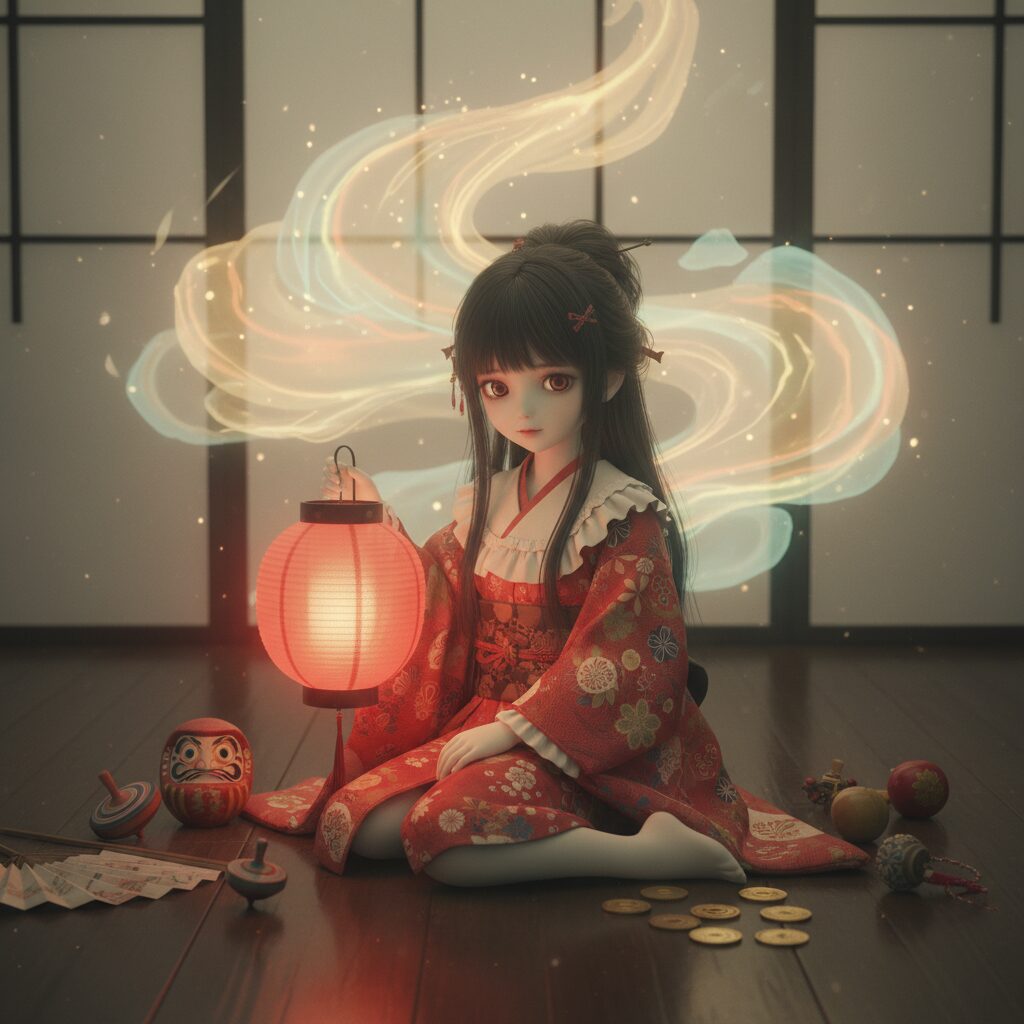
A Zashiki-warashi, meaning “guestroom child,” is a type of yōkai or spirit from Japanese folklore, mainly found in the Tōhoku region. They appear as small children, often with red faces and a traditional bob haircut, and they reside in old, well-kept houses. Essentially, they are spirit roommates. If you’re imagining a horror story, think again. Unlike many other yōkai, Zashiki-warashi are regarded as bringers of good fortune. When one inhabits a home, the family experiences prosperity and success. They bring positive energy, big time. However, they are extremely shy and mostly invisible. You might catch a brief glimpse from the corner of your eye or hear faint footsteps or childish laughter when no one is present. They might play small, harmless pranks, like leaving tiny footprints in the ashes or making rustling noises at night. They don’t require offerings or worship. They simply exist. Their presence alone is a blessing. But if the family mistreats them or the house falls into neglect, the Zashiki-warashi will leave. When they depart, the family’s luck declines sharply and their fortune crumbles. The lesson is clear: maintain a warm, welcoming home, and the spirit will bless you with its unseen presence. Neglect it, and you lose everything.
The Zashiki-warashi Vibe in Fandom
Honestly, this is the perfect metaphor for the silent Oshi-katsu practitioner. They are the modern Zashiki-warashi for their chosen idol. Consider this: their main goal is the prosperity of their Oshi. They want them to have a long, successful career, to fill arenas, to be happy and healthy. And they achieve this not through loud visibility, but by quietly being a background force of good luck. They stream music on repeat across multiple devices, boosting chart positions invisibly to the public but crucial for industry metrics. This is the Zashiki-warashi’s unseen presence bringing fortune. They practice tsumu (積む), meaning “to stack up.” They purchase dozens, sometimes hundreds, of the same CD—not to showcase their collection on social media, but to obtain handshake event tickets or voting slips inside. This significant financial support directly funds the Oshi’s projects and demonstrates their commercial value to the company. They quietly ensure the “house” (the idol’s career) remains prosperous. At concerts, they contribute to the perfectly synchronized sea of light sticks and flawless fan chants. They are one of thousands of invisible spirits whose collective energy crafts a magical atmosphere that helps the Oshi shine. Their reward isn’t a personal shout-out; it’s the continuation of the Oshi’s success. They find fulfillment in seeing their favorite thrive, knowing they are a small, unseen part of why. And just as the folklore warns, if the Oshi becomes embroiled in scandal or management mistreats the fans—if the “house” becomes unwelcoming—these silent supporters may quietly withdraw, taking their considerable financial and spiritual support with them, often causing a noticeable decline in the idol’s popularity. They are the silent kingmakers.
The Economics of Silent Support
This Zashiki-warashi model is, frankly, a stroke of business genius. The Japanese entertainment industry has perfected the art of monetizing this quiet devotion. The entire system is designed to encourage mass consumption as the primary form of support. The most famous example is the AKB48 “Senbatsu General Election,” where fans vote for their favorite members to determine their rank and visibility for the next single. The catch? Each ballot is inside a CD. To cast 100 votes, you must buy 100 CDs. This transforms fandom from passive appreciation into a high-stakes political campaign funded by the fans themselves. Likewise, handshake events (akushu-kai) require tickets that, you guessed it, are included inside CDs. Want to meet your Oshi for ten seconds? Buy a CD. Want a longer chat? Buy six. It’s a system of micro-transactions that add up to massive sales figures. The randomness of trading cards (trekkas) also fuels this. To get a specific card of your Oshi, you may have to buy dozens of packs or engage in a complex trading economy with other fans. All these mechanics tap into the Zashiki-warashi mindset. The fan isn’t just buying a product; they’re performing a ritual of support. Each purchase is a prayer for their Oshi’s success, a small contribution to the good fortune they hope to foster. It’s a system that transforms quiet passion into cold, hard, and remarkably predictable revenue.
Is This Vibe Healthy? The Flip Side of Silent Devotion
It’s easy to romanticize the idea of the devoted, selfless fan, but the reality of this system has a darker side that isn’t always pleasant. The immense pressure to be the “perfect” silent supporter fosters a culture of conformity that can feel both suffocating and exclusionary.
The Pressure to Be the “Perfect” Fan
When there’s an unspoken consensus about the “correct” way to be a fan, any deviation is quickly noticed and often harshly judged. An unwritten rulebook dictates everything—from which merchandise to buy, to how to act at events, to what is and isn’t acceptable to post online. This creates a high-stress environment where fans constantly monitor themselves and each other. For newcomers, it can be intimidating, as one misstep may label them an amateur or, worse, a disrespectful fan. The focus on financial support can be particularly toxic. Fans often feel compelled to spend beyond their means to “prove” their devotion, which can cause financial strain. If you can’t buy 50 copies of a CD, does that make you less of a fan? To some, the answer is yes. This creates a painful hierarchy within the fandom, where the highest spenders—the “whales”—are seen as the most dedicated, while those who spend less are looked down upon. The fandom’s silent, collective nature can sometimes devolve into a mob mentality, quick to shame and exclude anyone who doesn’t perfectly conform to the group’s standards.
Parasocial Overdrive?
At its core, fandom is rooted in parasocial relationships—the one-sided emotional bonds we form with people we don’t actually know. The Silent Oshi-katsu model arguably pushes this to an extreme. It’s a relationship characterized by immense giving—time, money, emotional energy—with no expectation of personal recognition in return. While this can be viewed as pure, altruistic support, it also creates a dynamic that can be easily manipulated. It fosters emotional dependency, where a fan’s self-worth becomes tied to the Oshi’s success or failure. An idol’s graduation, retirement, or dating scandal can feel like a deeply personal betrayal, as fans have invested so much of their identity in being that silent, spiritual guardian. Critics argue that this system conditions fans to be perfect, quiet consumers who demand nothing in return for their unlimited support. It’s a delicate balance between beautiful, selfless devotion and a potentially unhealthy, one-sided obsession that ultimately serves the industry’s bottom line above all else.
So, When You See Those Quiet Crowds…
The next time you watch a video of a Japanese concert and marvel at the quiet, orderly crowd, you’ll understand. You’ll realize that it’s not a lack of passion you’re witnessing. Instead, you’re seeing a different cultural operating system for fandom, one rooted in foundational social principles like avoiding meiwaku and maintaining wa. You’re observing thousands of people who have chosen to show their love not through individual noise, but through collective, synchronized action. They are there to create a perfect, supportive environment for their Oshi to flourish. You’re looking at a stadium full of modern-day Zashiki-warashi, each a silent, invisible guardian spirit, investing their money, time, and energy into one goal: ensuring the success of the person on stage. It’s a fascinating, complex, and sometimes unsettling system that is deeply rooted in Japanese tradition and perfectly suited for the digital age of hyper-capitalist fandom. It’s not about being noticed; it’s about being felt. It’s the quiet power of a thousand unseen helping hands, lifting their favorite star ever higher. And in a world constantly shouting for attention, there’s something profoundly moving about that kind of silent, unwavering devotion. Bet.