You see it everywhere, a ghost in the machine of the Japanese urban landscape. It’s a scene replayed a million times a day, from the quiet suburbs of Saitama to the bustling backstreets of Osaka. A mother, impossibly elegant and fiercely determined, glides past. She’s piloting a bicycle that seems to defy physics. On the front, a toddler sits nestled in a custom-built seat, babbling at the passing world. On the back, another child, a little older, clings on, their school cap a bright splash of color. The front basket is overflowing with groceries—a daikon radish juts out at a jaunished angle, a bag of rice rests heavy at the bottom. She navigates a narrow sidewalk crowded with pedestrians, makes a tight turn without a wobble, and disappears down an alleyway you’d never noticed before. To the uninitiated eye, it looks like a circus act, a beautiful, high-wire performance of domesticity. You’re left wondering, “What did I just see? How is that even legal? And why, for the love of all that is holy, does everyone seem to have one of these bikes?”
What you’ve witnessed isn’t just a bicycle. It’s a cultural phenomenon, an icon of daily life, and the undisputed, low-key MVP of Japanese city navigation. It’s the Mamachari (ママチャリ), a portmanteau of mama (mom) and chari (a slang term for bicycle, from ‘chariot’). But don’t let the name fool you. This isn’t just for moms. The mamachari is the default setting for two-wheeled transport in Japan, ridden by students, office workers, grandfathers, and everyone in between. It’s a masterpiece of utilitarian design, a vehicle born from the unique pressures and priorities of Japanese urban living. It’s not about speed, it’s not about sport, it’s not about looking cool. It’s about getting life done, efficiently and without fuss. To understand the mamachari is to understand the rhythm of Japan itself—the quiet practicality, the community focus, and the art of finding freedom in the mundane. This bike isn’t just a mode of transport; it’s a vibe, a whole entire mood. And if you know, you know. It’s time to unpack the legend.
While the mamachari is the undisputed king of urban utility, for a different kind of two-wheeled escape, consider exploring Japan’s unique lunchtime cycling workation culture.
The Anatomy of a Legend: What Makes a Mamachari, a Mamachari?

At first glance, a mamachari appears to be a simple, almost nostalgic bicycle—the kind you might spot in an old photograph. Yet, this apparent simplicity is misleading. Every single part of a mamachari has been meticulously optimized for its specific role: to serve as the ultimate urban workhorse. It’s the result of decades of incremental enhancements, a prime example of Japanese kaizen applied to everyday living. Rather than being defined by one standout feature, it’s the harmonious integration of all its components that sets it apart. Let’s explore the core elements that have earned this bike its legendary reputation.
It’s All About the Frame: The Step-Through Innovation
The most distinctive visual trait of a mamachari is its deep, flowing step-through frame—often called a U-frame or low-step frame—which forms the very foundation of its design ethos. In Western contexts, bike frames typically follow the classic diamond shape seen on road or mountain bikes, emphasizing structural strength and power transfer. The mamachari disregards this approach. Its focus isn’t on performance—it’s on accessibility. The low frame allows riders to mount and dismount effortlessly without having to swing a leg high over the back, which is a game-changer when wearing skirts, business attire, or traditional kimonos. It’s especially important when the bike is loaded with a child or groceries. Attempting a high-kick mount with a toddler and a bag of onions aboard is asking for trouble. The step-through design eliminates this hurdle entirely, making hopping on for a quick convenience store run as effortless as slipping into a pair of shoes. This design clearly signals the bike’s purpose: not for athletes, but for everyday life.
Built to Carry: The Basket, the Rack, and Child Seats
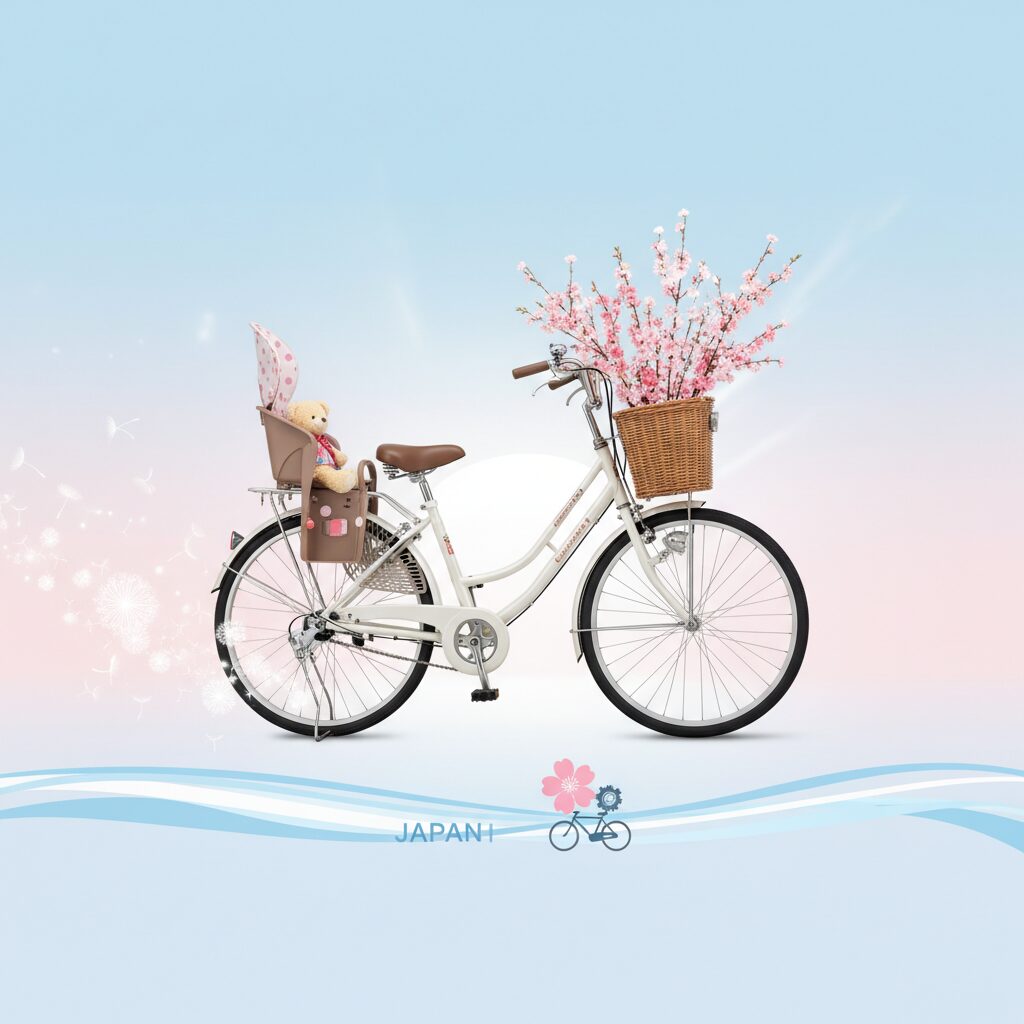
If the frame is the mamachari’s skeleton, its carrying capacity is its heart. These bikes are Japan’s unsung cargo champions. The front basket isn’t just an optional add-on—it’s an essential, standard feature. And we’re not talking about a delicate wicker basket for flowers; the mamachari’s basket is a large, sturdy wire mesh container, often vinyl-coated for durability. It’s designed to carry a heavy purse, a student’s bulky randoseru, and multiple grocery bags. Positioned over the front wheel, it’s easy to keep an eye on your belongings.
Then there’s the rear rack. Firmly bolted to the frame, this isn’t the lightweight aluminum rack commonly seen on Western bikes. It’s a robust steel platform engineered to bear substantial weight. Its primary role is to serve as the mount for a certified child seat, transforming the humble bicycle into a family transport vehicle. The combination of front basket and rear rack allows a mamachari to easily accommodate a significant grocery haul. The child seats themselves are marvels of specialized design, coming in two main varieties: a smaller, open-style seat mounted on the handlebars for toddlers, and a larger, high-backed seat with footrests and harnesses attached to the rear rack. Japanese regulations specify strict standards for these seats, requiring an “SG” (Safety Goods) certification. Seeing a bike equipped with both front and rear seats signifies a family with two young children. This setup, often humorously called the “three-seater” (san-nin nori), epitomizes the logistics of parenting in Japan.
The Hidden Tech: Everyday Engineering That Delivers
Beyond its obvious frame and cargo features, the mamachari packs subtle yet brilliant engineering solutions that make it remarkably reliable and low-maintenance. This is where the Japanese emphasis on practical, user-centered design truly shines. No exaggeration—the technology is impressive.
Internal Hub Gears
Most bikes in North America or Europe use derailleur systems—those complex assemblies of cogs and chains hanging off the back wheel—to shift gears. While effective for performance biking, derailleurs are fragile, need regular upkeep, and easily accumulate grease and dirt. The mamachari chooses a far more elegant approach: an internal hub gear. All gearing mechanisms are sealed within the rear wheel hub, shielded from rain, dust, and grime. Typically, a mamachari features a three-speed Shimano hub operated by a simple twist grip on the handlebar. You can even shift gears while stopped—a huge advantage at traffic lights. Does it offer a wide gear range? No, but it provides exactly what’s needed: one gear for starting out, one for cruising flat terrain, and one for gentle inclines. It’s durable, clean, and requires almost no maintenance. It simply works.
Dynamo Hub Lights
Another understated but ingenious feature is the lighting system. Instead of relying on battery-powered lights that need recharging or replacement, most mamacharis come equipped with a dynamo hub on the front wheel. As the wheel turns, the hub generates electricity that powers the front lamp, so the light automatically switches on when riding in low-light conditions. You never have to remember to turn it on. It’s simple, sustainable, and enhances safety. Although early dynamo hubs caused noticeable drag, modern versions are so efficient you barely feel them. It’s the essence of “set it and forget it” design.
The Ultimate Kickstand
A seemingly minor yet revolutionary feature is the mamachari’s kickstand. Western bikes typically have a single-sided kickstand that tilts the bike to one side, which works fine when empty but becomes unstable when loading a squirming child or heavy bags. The mamachari sports a sturdy, center-mounted, double-legged stand that, when engaged, lifts the rear wheel off the ground by slightly pulling the bike backward. The bike stands perfectly upright and is extremely stable, letting you use both hands to load or unload without worrying about tipping over. This small detail significantly enhances everyday usability—it’s definitely a flex.
The O-Lock
Lastly, there’s the built-in O-lock or ring lock. Attached to the frame over the rear wheel, this simple lock slides a metal bolt through the spokes to immobilize the wheel. It’s operated by a small key. While not a high-security deterrent against a determined thief with bolt cutters, it perfectly suits Japan’s social context. It prevents casual theft when popping into a store for a few minutes. Its convenience is unmatched—you don’t need to carry a separate bulky U-lock or chain. The lock is permanently on the bike, ready to use in seconds. It exemplifies and depends on Japan’s relatively low-crime, high-trust environment.
The “Why” Behind the Wheels: A Cultural and Systemic Deep Dive
Alright, so the mamachari is an ingeniously designed piece of equipment. But why did it become so widespread? Why this particular solution for a problem that every country faces? The answer lies not only in the bike itself but in the distinctive blend of urban planning, social structures, and economic realities that define modern Japan. The mamachari isn’t just popular; it is a necessary adaptation to its environment.
The Urban Jungle Gym: How Japanese Cities Shaped the Mamachari
To truly understand the mamachari, you need to understand Japanese cities. While images of Tokyo often highlight towering skyscrapers and multi-lane highways, the majority of the city—and indeed any Japanese city—is a dense, sprawling web of residential neighborhoods. These areas feature incredibly narrow streets, known as roji (路地). Many of these streets are too narrow for two cars to pass side by side and are often designated pedestrian-only or have strict speed limits. Navigating these maze-like neighborhoods by car is a nightmare—slow, stressful, and frequently impossible. In contrast, the mamachari is perfectly suited for this environment. It can zip down the narrowest alleys, take shortcuts inaccessible to cars, and be parked right at the doorstep of a small shop or home. It is the ultimate tool for mastering the intricate, human-scale geography of Japanese residential areas.
This ties directly into the concept of the “last mile.” Japan’s public transportation system is arguably one of the best in the world. Its train and subway networks are dense, punctual, and efficient. However, they cannot get you from your exact front door to your precise destination. There is always a gap—the walk from your apartment to the station, the trip from the station to the grocery store, or the journey to the local post office. The mamachari flawlessly fills this gap, turning a 15-minute walk into a 5-minute ride. It lets you carry a week’s worth of groceries home from the supermarket near the station without breaking a sweat. It effectively extends the reach of public transport, making a car-free lifestyle not only feasible but preferable for millions.
Then there is the harsh reality of car ownership. Owning a car in a major Japanese city is prohibitively expensive and complicated. First, in most cities, you are legally required to prove you have a dedicated off-street parking space before you can register a vehicle—known as the shako shomeisho (車庫証明書), or “garage certificate.” With urban real estate prices, renting a parking spot can cost hundreds of dollars monthly. Add to that mandatory inspections (shaken), costly expressway tolls, and expensive gasoline, and the financial burden becomes enormous. The mamachari neatly sidesteps this entire system. While designated bicycle parking is becoming more common and sometimes comes with a small fee, it is a fraction of the cost of car parking. Thus, the mamachari symbolizes profound economic freedom from the burdens of car culture.
A Society in Motion: The Mamachari and Daily Rhythms
The mamachari is closely woven into Japan’s social fabric, particularly the roles and routines shaping family life. Its very name points to its origin as the primary vehicle for the dedicated housewife, or shufu (主婦). During the post-war economic boom, the standard family structure consisted of a salaryman husband who commuted long hours to a central business district, and a wife who managed the household and children. The mamachari became her chariot, giving her the mobility to carry out her daily duties within the local community. It was her tool for okaimono (shopping), omukae (picking up children from school), and all the countless errands that constitute the invisible labor of domestic management. It provided a sphere of autonomy and competence within a five-kilometer radius of her home.
One of the most important daily rituals enabled by the mamachari is the school run. In Japan, many children attend local preschools (yochien, 幼稚園) or daycare centers (hoikuen, 保育園). These locations are often too far to walk but too close to justify taking a train. The mamachari is the perfect solution. Every morning and afternoon, the streets around these schools fill with parents on their mamacharis, dropping off and picking up their children. It serves as a social scene, a moment for parents to connect and exchange information. The bike is not merely a mode of transport; it facilitates community.
Of course, the bike’s use has long extended beyond its original demographic. While the name remains, the user base is universal. University students use them to commute from inexpensive apartments to campus. Elderly residents ride them to visit clinics or community centers. Even salarymen, in their crisp suits, can be seen riding a mamachari for the short trip from home to the train station, parking it in large, multi-story bicycle garages. It has become a classless, ageless symbol of practical mobility—a great equalizer on Japanese streets.
The Legal and Systemic Framework: Rules of the Road
Navigating Japan by bicycle also means navigating a sometimes confusing set of rules. Officially, bicycles are classified as “light vehicles” and should be ridden on the left side of the road, following traffic flow. However, in practice, this exemplifies the Japanese cultural distinction between tatemae (the official stance) and honne (the actual reality). Sidewalks are often marked with lanes for shared pedestrian and bicycle use. Even when not marked, sidewalk riding is widespread and largely tolerated by police, provided riders are not reckless. This is born of necessity since many Japanese roads are narrow and congested with heavy car traffic, making cycling feel unsafe. The result is a delicate, unspoken dance between pedestrians and cyclists on sidewalks—a system that may appear chaotic to outsiders but generally operates through mutual awareness and caution.
In recent years, there have been efforts to improve safety. For example, a law was revised to make wearing bicycle helmets a “recommended effort” for all riders, though there are currently no fines for adults who do not comply. This gentle approach reflects typical Japanese regulation, favoring guidance and social pressure over strict enforcement. Another important part of the system is mandatory bicycle registration, called bohan toroku (防犯登録). When purchasing a new bicycle, the shop registers it with the local police department for a small fee. You receive a sticker with a registration number to place on your bike. This system mainly aims to prevent theft and aid in recovery. It is common for police to conduct random checks to ensure the bike is not stolen. This registration represents a small but meaningful aspect of the social contract, reinforcing the idea that a bicycle is property to be tracked and respected.
The Mamachari Vibe: More Than Just a Bike, It’s a Lifestyle
To truly understand the mamachari, you need to look beyond its mechanical purpose and appreciate its cultural significance. It isn’t an object of desire or a status symbol in the usual sense. Rather, it represents a set of values and an aesthetic that is deeply rooted in Japanese culture. It’s about valuing practicality, discovering beauty in everyday life, and navigating the world with quiet, unassuming confidence. This is the essence of the Mamachari Vibe.
The Aesthetic of Practicality: Simple, Functional, and Unadorned
The mamachari stands in stark contrast to what Western bike culture deems “cool.” It’s neither a sleek, carbon-fiber road bike nor a rugged, full-suspension mountain bike. It cares little for trends. Its design speaks purely of utility. The colors tend to be muted: silver, black, navy blue, beige, perhaps a deep maroon or forest green. Flashy graphics and neon accents are absent. The intention is to blend seamlessly into the urban environment, not to demand attention. This restrained aesthetic is a hallmark of Japanese design, seen from Muji’s minimalism to the understated grace of a traditional tea room. The mamachari’s charm lies not in its looks but in its flawless execution of purpose. Its coolness is a quiet assurance that it requires no outside approval. It knows its identity—and that identity is essential.
There is also a sensory layer to the mamachari vibe. The soundscape of a residential Japanese neighborhood features these bikes prominently. There’s the soft whirr of a dynamo hub engaging at dusk, the distinctive metallic click-click-click of a Shimano 3-speed shifter, and the gentle squeak of brake pads that could surely use some oil. These sounds form the ambient soundtrack to daily life, as integral to the environment as the evening chimes from community speakers or the winter call of the roasted sweet potato vendor.
The Electric Evolution: The Emergence of the E-Mamachari
For decades, the classic mamachari reigned without rival. But recently, a powerful new entrant has changed the landscape: the electric-assist mamachari, or Denki Asisuto Jitensha (電動アシスト自転車). It’s important to clarify that these are not electric mopeds or scooters—the motor doesn’t propel the bike independently. Instead, it provides pedal assistance up to a legally mandated speed of 24 km/h. The difference is transformative. Hills that once posed a difficult challenge with two children aboard feel flat. Starting from a standstill at traffic lights becomes effortless. The e-mamachari has broadened access to cycling, welcoming older riders, those with physical limitations, and parents tasked with transporting heavier loads over longer distances.
Leading this innovation are Japan’s electronics giants—Panasonic, Yamaha, and Bridgestone—who have invested heavily in R&D to create advanced systems featuring durable batteries, powerful motors, and user-friendly controls. These e-bikes represent a significant financial outlay, often costing three to four times more than a standard mamachari. Yet for many families, this cost is easily justified. They remain far cheaper than a car while dramatically enhancing mobility and convenience. The electric mamachari is now a common sight in suburban neighborhoods and serves as a kind of middle-class status symbol—a mark of having invested in the finest tool to manage family life. In many ways, they are the Teslas of the sidewalk.
The Counter-Narrative: Could the Mamachari Actually Be… Dangerous?
It would be misleading to portray the mamachari solely in an idealized light. For many visitors to Japan, and even some locals, watching a parent navigate a crowded sidewalk with two children on board can be genuinely unsettling. The term “kamikaze mamachari” sometimes describes riders who dart into traffic, run red lights, or push through pedestrians with a sense of entitlement. This criticism is not entirely unfounded. Poor riding etiquette exists, and accidents do occur. The complex and often contradictory regulations on sidewalk riding create a gray area where conflict between cyclists and pedestrians becomes unavoidable.
However, this behavior must be seen in context. Generally, mamachari riders are highly skilled, possessing sharp situational awareness developed through years of daily riding. The “dangerous” weaving is often a series of careful micro-adjustments to navigate dense crowds. Moreover, such behavior is often a rational response to flawed infrastructure. When roads feel unsafe because of heavy car traffic and the lack of dedicated bike lanes, sidewalks become the default, albeit imperfect, alternative. The problem is less about “bad riders” and more about the systemic challenge of balancing limited urban space among cars, bikes, and pedestrians. The mamachari rider is simply making the most sensible choice within those constraints.
Experiencing the Vibe for Yourself: Renting and Riding
Reading about the mamachari is one thing, but to truly grasp its charm, you need to ride one. It’s an experience that connects you to the rhythm of Japanese life in a way that taking a train or taxi simply cannot. It encourages you to slow down, notice the small details, and feel like an active participant in the city rather than just a bystander.
How to Get Your Own (Temporarily)
While tourist-focused rental shops might offer mountain bikes or sleek hybrid models, the best way to get an authentic experience is through one of the community bike-share programs. Services like Docomo Bike Share in Tokyo or Pippa in other cities provide fleets of electric-assist mamachari-style bikes. These are easily identified by their sturdy frames, front baskets, and signature red or green colors. To use them, you typically download an app, register a credit card, then locate a docking station. You can unlock a bike using your phone or a passcode and return it at any other station in the network. These bikes offer a fantastic way to explore neighborhoods at your own pace.
A Rider’s Etiquette: Don’t Be That Guy
When you hop on, it’s important to observe local etiquette to avoid being that tourist. First, remember that Japan drives on the left—and this applies to bikes too. When cycling on the road, keep to the left side. Bells are reserved for emergencies only; using one to urge pedestrians aside is seen as very rude. The most crucial rule concerns parking. You cannot simply leave your bike anywhere. Illegally parked bicycles, especially near train stations, are a significant social problem. Local authorities often send trucks to collect and impound these bikes. Retrieving an impounded bike means a trip to a distant depot and a fine. Always look for designated bicycle parking areas (chūrinjō 駐輪場) and park your bike there.
A Recommended Ride: A Taste of the Real Japan
For the ultimate mamachari experience, avoid major tourist routes and explore a residential neighborhood instead. Pick an area known for its laid-back atmosphere and charming backstreets, such as Yanaka in Tokyo, with its old temples and traditional shops, or the trendy yet livable neighborhoods of Kichijōji or Shimokitazawa. Turn off your Google Maps for a while and just ride. Glide through quiet alleys, past carefully tended miniature gardens and laundry fluttering on balconies. Peek into the windows of a local tofu shop or a family-run stationery store. Listen to a piano lesson drifting from an open window. Watch kids playing in a small, immaculately clean park. This is the Japan that exists beyond the famous landmarks. The mamachari is your key to unlocking this world, offering access to the seikatsukan (生活感)—the real, tangible feeling of everyday life.
The Final Word: The Mamachari as a Cultural Mirror
The mamachari is far more than just a mom’s bike. It serves as a reflection of the realities within Japanese society. It is a product shaped by dense urban planning and world-class public transportation. It stands as a symbol of the resilience and creativity of parents raising children in such an environment. It exemplifies cultural values like practicality over flashiness, community harmony over individual expression, and the quiet dignity of a well-crafted tool that performs its function flawlessly. It signifies a particular kind of freedom—not the freedom of the open road, but the freedom to efficiently and affordably maneuver through your own community, stay connected, and accomplish tasks.
So, the next time you find yourself in Japan and see a parent skillfully guiding a fully loaded mamachari through a bustling street, pause to appreciate what you’re witnessing. It’s not chaos; it’s a symphony of balance, a mastery of logistics, and a living, breathing reflection of a culture that has perfected the art of everyday living. The Mamachari Vibe is the true pulse of the city. Subtly iconic. No fanfare needed.