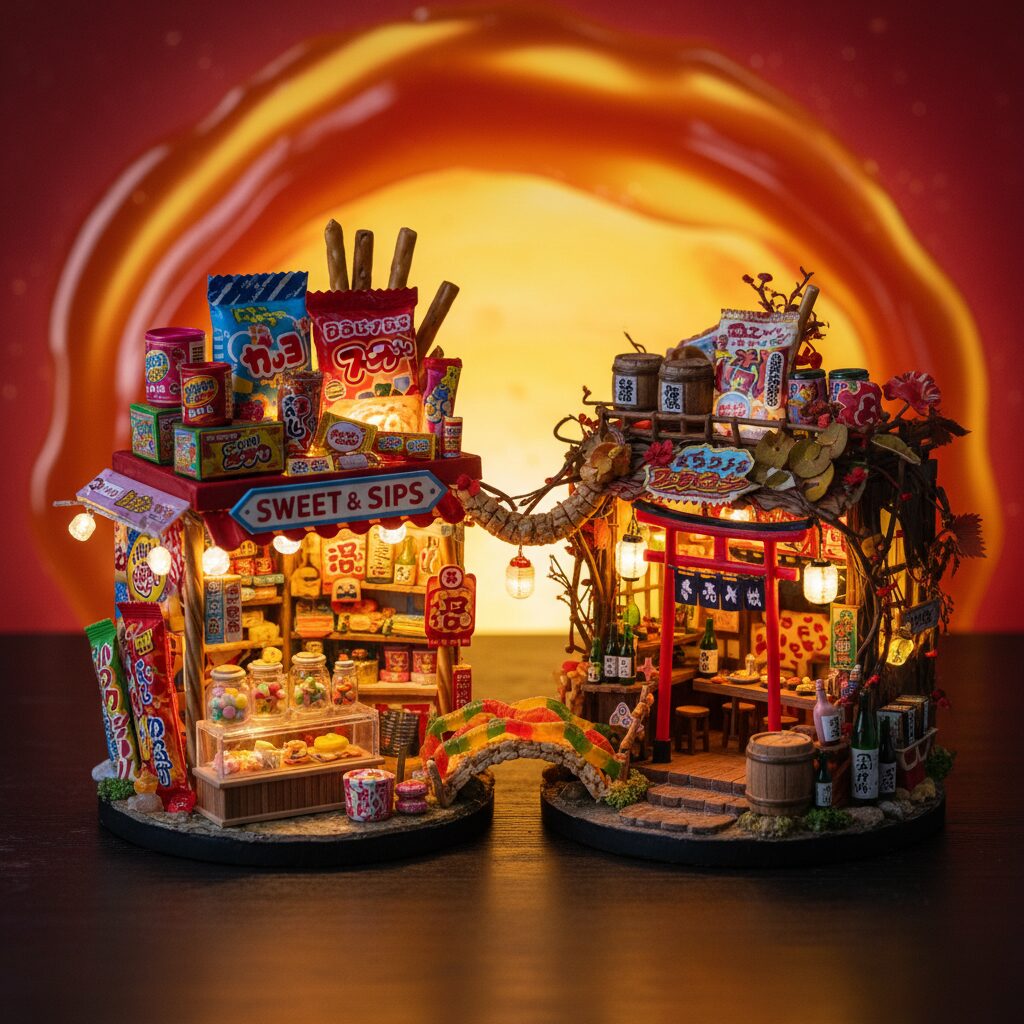
Yo, what’s up. Shun Ogawa here. Let’s get real for a sec. You’ve seen it, right? You boot up a classic JRPG, maybe an old Dragon Quest or Final Fantasy. The first thing you do? You walk your pixelated hero into the town’s tavern. The music shifts to a chill, folksy tune. A grizzled dude in the corner gives you a cryptic tip, the bartender serves you a drink, and some traveler asks to join your party. It’s the hub. It’s the information exchange. It’s where the adventure really starts to take shape. It’s a place of low-stakes community building before you go out and face the high-stakes world boss. We all know this trope. It’s practically baked into the DNA of gaming.
But what if I told you Japan had a real-life, honest-to-goodness version of this? Not for buff adventurers with giant swords, but for us—the kids of the 80s and 90s, with scraped knees, pockets full of 10-yen coins, and a burning need to know how to find the secret warp whistle in Super Mario Bros. 3. These places weren’t fantasy taverns. They were dagashiya—humble, often rundown, little corner stores selling cheap candy and snacks. And they were, without a doubt, the most important social institutions of our entire childhood.
This isn’t just some cutesy nostalgic trip. To understand the dagashiya, you have to understand the soul of a Japan that’s rapidly vanishing. It’s the key to understanding why my generation is so obsessed with retro games, how we learned to socialize before the internet took over, and what we lost when the gleaming, 24/7 convenience store, the konbini, conquered every street corner. The dagashiya wasn’t just a place to buy cheap chocolate; it was the server lobby for real life. It was our guild hall, our information broker, and our save point. It was the analog, real-world social network where the quests of our youth were born. And honestly? It was way more lit than any online forum today. So grab a ramune, settle in, and let me tell you about the world we used to own for a hundred yen.
This deep-seated nostalgia for a simpler, more communal era is a key driver behind Japan’s current cultural fascination with the isekai genre and the dream of a JRPG rebirth.
The 100-Yen Kingdom: What a Dagashiya Actually Was
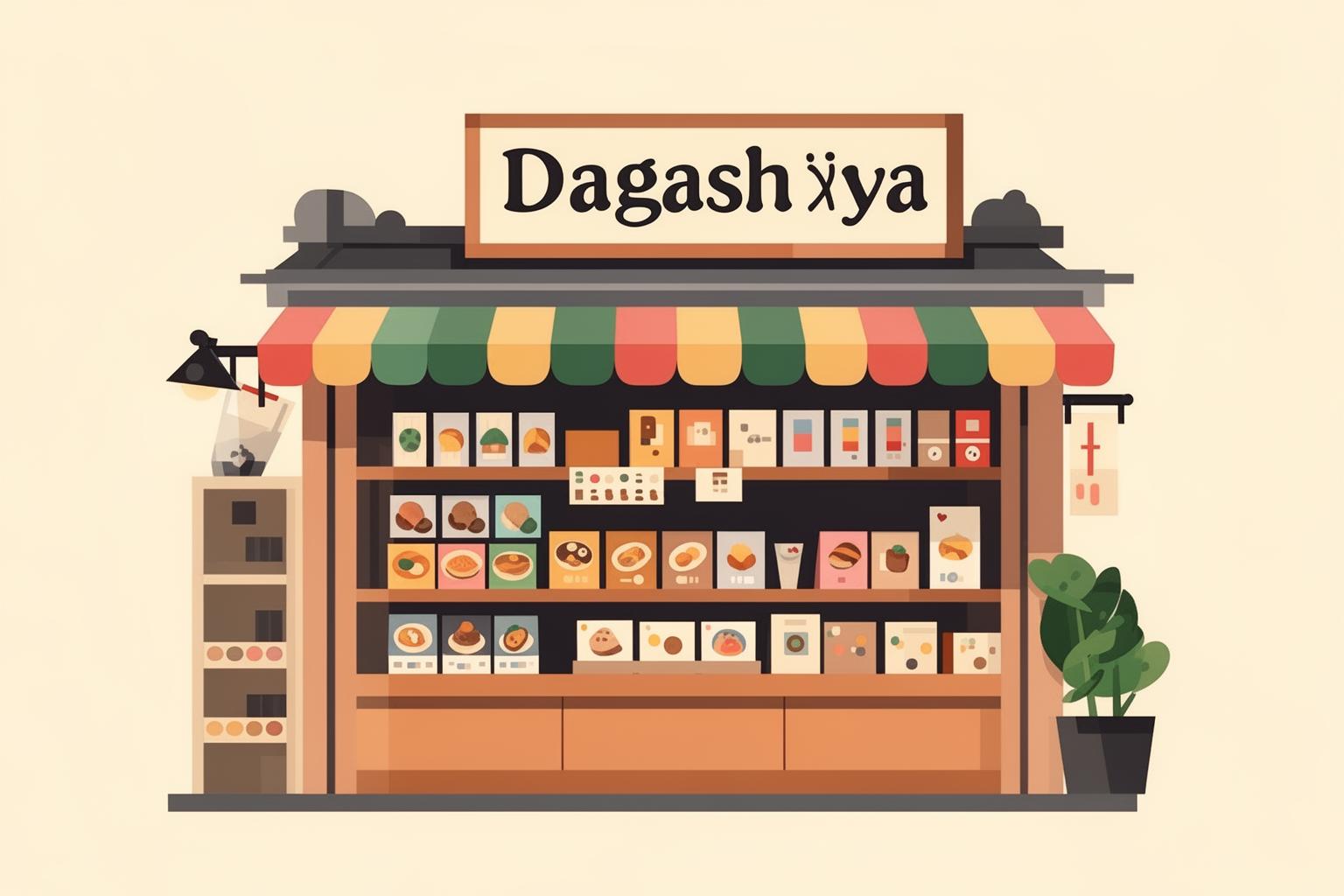
To truly capture the vibe, you need to clear from your mind the modern image of a Japanese store. Forget the pristine, brightly-lit, minimalist look of a MUJI or the clinical efficiency of a 7-Eleven. A dagashiya was the complete opposite. It was a chaotic, cramped, and utterly magical pocket of the universe, operated on a currency adults had long since forgotten: the 10-yen coin. The entire business model revolved around what a seven-year-old could afford with their weekly allowance. One hundred yen didn’t just buy you a drink; it made you a king for ten minutes.
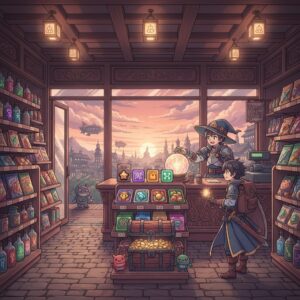
Entering a dagashiya was a full-sensory onslaught. The air was thick with a distinctive scent—a blend of sweet artificial flavors, cheap chocolate, the faint tang of vinegar from pickled squid snacks, and the dusty aroma of old cardboard boxes. Sunlight struggled to penetrate the clutter of product displays taped to the windows. The space was incredibly tight, a narrow corridor lined with shelves bulging under the weight of a thousand colorful packages, all vying for your attention. There was no sense of personal space; you’d be bumping shoulders with other kids, all jostling for the best spot in front of the most popular snacks. It was a place that operated on the logic of a child’s imagination, not an adult’s sense of order. Everything was at eye level for a ten-year-old, a deliberate design choice that made you feel this world was built just for you—because it was.
More Than Just Candy: The Arsenal of a Showa Kid
The word dagashi (駄菓子) says it all. ‘Da’ (駄) means ‘futile’ or ‘negligible,’ and ‘kashi’ (菓子) means ‘sweets.’ These were literally ‘worthless sweets.’ They were the cheap, low-quality snacks that stood in contrast to the proper, expensive sweets (jogashi) bought at department stores. But to us, they were anything but worthless. They were the lifeblood of our after-school economy. You had iconic staples like Umaibo (うまい棒), a puffed corn stick in dozens of flavors costing just 10 yen. It was the foundational currency of childhood. You could buy ten of them and have a feast, or trade them for other goods. There was Butamen, a miniature cup of instant ramen eaten dry, shaking the seasoning packet inside and crunching on it like chips. There were tiny plastic containers of Yogurt that wasn’t really yogurt but a sweet, chalky candy. Soft drinks like ramune, famous for the marble you had to pop into the bottle—a mini-game before you even got to the drink.
But the true genius of the dagashiya was in its interactive snacks. Many items had a lottery element, a built-in gambling system called kuji (くじ). You might buy a chocolate bar that, once unwrapped, revealed if you won another one for free. Or you’d pull a string from a board, hoping for the one tied to the biggest prize. This was our first encounter with probability and crushing disappointment—a low-stakes lesson in the harsh realities of chance. It taught you to budget your 100 yen. Do you pick a sure thing, like ten Umaibo? Or risk 50 yen on a lottery snack for a shot at a bigger prize? These were serious economic decisions for an eight-year-old.
Beyond candy, the dagashiya was the neighborhood’s armory. It sold everything a kid needed for daily adventures. In summer, you’d find cheap fireworks: sparklers, smoke bombs, and little poppers to throw on the ground. You could buy rolls of red paper caps for toy guns, bouncy super balls you’d inevitably lose on a roof, and menko cards—thick cardboard discs flipped over by slamming your own card down beside them. This wasn’t just a store; it was the equipment shop where you stocked up before heading out on a quest to the local park or vacant lot. And if you were lucky, tucked away in a dusty corner was the ultimate prize: a battered arcade machine. It might be a vintage table-top Space Invaders or a somewhat newer Street Fighter II cabinet. This machine was the digital heart of the place. The kid with the high score was a local legend. It was a training ground where you honed your skills, watching older kids to learn combos, while waiting your turn to challenge the reigning champ. The line between the game’s digital world and the real world of the dagashiya was incredibly thin.
The Shopkeeper: The NPC Who Knew Everything
Overseeing this chaotic kingdom was the shopkeeper, usually an elderly woman or man—the local obaa-chan (grandma) or ojii-san (grandpa). They were the ultimate NPC—the non-player character central to the entire game. They weren’t a smiling, uniformed cashier trained in corporate jargon. Often gruff and a little weary, they sat on a stool behind a simple wooden counter, watching everything with a practiced eye. They might be reading a newspaper or watching a fuzzy TV, but they missed nothing.
Their role extended beyond making change. They were the neighborhood children’s unofficial guardians. They knew every kid’s name, their friends, and current feuds. If a fight broke out, the obaa-chan would shuffle out to yell at everyone to knock it off. If a child came in sad after a bad day at school, she might slip them an extra piece of candy, no questions asked. They acted as a bank, sometimes letting regulars buy on credit—’tsuke’—with a promise to pay back later. This was a relationship based on trust, unthinkable in today’s automated, impersonal retail world.
They were also the hub of local information, the town crier for the kid community. They knew which kids had moved away, who got a new bike for their birthday, and who was in trouble with their parents. They provided a subtle layer of safety and supervision in a time when children enjoyed a level of freedom that seems radical today. Parents knew that even when their children were out of sight, they remained under the watchful, if distant, eye of the dagashiya owner. This person wasn’t just a shopkeeper—they were a community fixture, a living landmark, the keeper of stories, and the silent quest-giver in the great adventure of growing up. Their presence transformed a simple store into a true social institution—a safe haven where rules were simpler and the stakes measured in 10-yen coins.
The Unofficial Guild Hall: How Dagashiya Became JRPG Taverns
Alright, so we’ve set the scene: a small shop packed with inexpensive candy, run by a local elder. But how does this relate to being a JRPG tavern? It comes down to function. In a game, the tavern isn’t merely a spot to rest; it’s where you pick up rumors, gather clues, and meet fellow adventurers. It serves as a hub of information and social interaction. The dagashiya fulfilled exactly this role in the analog world. It was the physical place where the social and informational threads of our childhood were woven together. It was our unofficial guild hall, a sanctuary wholly ours, operating outside the formal realms of school and home.
This was our ‘third place,’ a term sociologists use—a setting separate from the two primary social spaces of home (the first place) and work, or in our case, school (the second place). These third places are vital for nurturing community. For adults, it might be a café, a bar, or a public library. For us, it was the dagashiya. It was neutral ground. Your parents weren’t there to supervise, and your teachers weren’t present to impose rules. The only authority was the obaa-chan, whose rules were straightforward: don’t steal, don’t make a huge mess, and take your fights outside. Within those broad limits, we were free to be ourselves and to shape our own social world.
The Information Brokerage: Trading Cheats for Ramune
This is the heart of the analogy. Before Google, before GameFAQs, before YouTube walkthroughs, game knowledge was rare and precious. The dagashiya was the main marketplace where this knowledge was exchanged. Think about it: JRPGs of the ’80s and ’90s, especially games like Dragon Quest and Final Fantasy, were intentionally cryptic. They were designed as communal challenges, encouraging players to interact. How do you defeat that insanely tough boss? Where is the legendary sword hidden? What’s the answer to this incredibly obscure puzzle?
This knowledge wasn’t online. It spread orally, like folklore. The dagashiya was the center of this oral tradition. You’d go in to buy an Umaibo and overhear an older kid, a respected senpai, describing how he finally beat the final boss in Final Fantasy IV. This was pure gold. You’d listen in, pretending to be focused on picking candy flavors, soaking up hidden tips. Sometimes you had to trade for it: “I’ll tell you where the secret treasure is in The Legend of Zelda if you trade me your rare menko card.” Information was currency, just as valuable as the yen in your pocket.
This created a living, dynamic social network. Rumors—both true and false—traveled through the dagashiya world. “My cousin’s friend said if you press A and B a hundred times in Pokémon, you can catch Mew.” Most of it was nonsense, but the excitement of possibility, of sharing these urban myths, was a big part of the fun. It fostered a culture of cooperation and conversation. We were all adventurers on the same quest, even if playing separate consoles at home. The dagashiya was where we met to compare notes, share hand-drawn maps, and collectively solve the games that captivated us. It was a decentralized intelligence network fueled by candy and shared passion.
Forming Your Party: The Social Dynamics of a Cramped Shop
Beyond just swapping game secrets, the dagashiya was the main stage for all childhood social drama. It was where you assembled your ‘party’ for afternoon adventures. Friendships formed over shared love of a snack or mutual battles against video game bosses. You’d gather your group at the dagashiya, stock up on supplies, then set out on the day’s quest. “Okay, we’ve got enough juice and chips. Let’s go to the creek and try to catch crayfish,” or “Let’s all go to Tanaka’s house—he just got the new Street Fighter game.” The dagashiya was the launchpad.
It was also a miniature society where you learned crucial unwritten social rules. You picked up how to navigate social ranks. The kid who could afford the most snacks often became the center of attention. The unbeatable arcade champ earned special respect. You learned to negotiate, share, and belong to a group. You practiced pooling money for bigger snacks to share with everyone. This was where you rehearsed being a person, in a low-stakes setting. Social missteps had minor consequences—maybe you didn’t get invited to play at the park that day—but the lessons were invaluable.
It taught you about economics in a concrete way. Your 100-yen allowance became a lesson in budgeting. You had to make choices with immediate effects. You learned money’s value and felt buyer’s remorse when a toy broke after five minutes. You also understood social capital. Being the kid with the coolest secrets or the one who shared snacks earned status money couldn’t buy. The dagashiya was a social laboratory, a place for countless experiments in friendship, status, and community, all without adult instruction. We built our own society from the ground up, one 10-yen purchase at a time.
The Great Famicom Boom and the Golden Age of the Tavern
The connection between the dagashiya and gaming culture was more than mere coincidence; it was a powerful symbiosis. The emergence of the Nintendo Famicom (the Japanese version of the NES) in 1983 completely transformed childhood. It shifted adventures from neighborhood parks and empty lots directly into our living rooms. This dramatic change didn’t render the dagashiya obsolete; it made it more vital than ever. The Famicom generated a new, vast, and urgent demand for what the dagashiya excelled at providing: information and community.
The golden era of the dagashiya as a social hub aligns perfectly with the golden age of 8-bit and 16-bit JRPGs. These two cultural phenomena were deeply connected, each fueling the other in a perfect feedback loop. As the games grew more popular and complex, the role of the dagashiya as the central information hub became increasingly important. It became the tangible embodiment of the game’s virtual world—the place where digital and analog worlds intersected.
The Quest in the Living Room
The launch of Dragon Quest by Enix in 1986 marked a turning point. It wasn’t just a game; it was a national sensation. Children would skip school to buy it on release day, a trend so widespread that the company eventually began releasing new titles only on weekends. Dragon Quest and its successors, along with the Final Fantasy series, were not games easily completed alone. They were designed with communal discovery in mind. Manuals were sparse, in-game hints were cryptic, and the worlds were vast and unforgiving. There were no mini-maps, no glowing quest markers, no online guides to rely on.
This design created an information vacuum that had to be filled. How do you find the key to open the sealed door? What is the enemy’s weakness? Where is the next town? Answers to these questions became playground currency and, by extension, the currency of the dagashiya. The store transformed into a dedicated strategy hub. Kids would huddle in corners—one holding a hand-drawn map, another sharing a rumor heard from an older sibling. “You have to walk around the desert’s edge for five minutes, and a hidden shrine will appear.” It was a collaborative effort to solve a massive nationwide puzzle.
This dynamic fundamentally altered how we engaged with media. The game was not just what appeared on the screen; it was the conversations, rumors, and shared challenges. The experience was half playing the game and half discussing it at the dagashiya. It fostered a distinctive form of collective problem-solving—a key cultural context for understanding Japan’s enduring affinity for collaborative gameplay and information sharing, even today, via online wikis and Discord servers. It all began here, in these dusty little shops, with kids trying to discover how to obtain the Rainbow Drop.
Bikkuriman-Choco: The Real-World Gacha System
If the Famicom supplied the software for the dagashiya’s golden age, a particular snack provided the hardware for its social economy: Bikkuriman-Choco. Released by Lotte, this simple chocolate wafer snack included a collectible sticker. It sounds straightforward, but it sparked a nationwide craze in the mid-to-late 1980s that is difficult to exaggerate. In essence, it was the world’s first mainstream physical gacha game—a loot-box system you could hold in your hands.
Kids weren’t buying it for the chocolate; in fact, the wafers were often discarded. They wanted the sticker inside. Hundreds of different stickers featured angels, demons, and guardians, each with varying rarity. Finding a rare holographic “head” sticker was like hitting the jackpot, granting instant playground prestige. The dagashiya was ground zero for this craze. It became the de facto stock exchange for Bikkuriman stickers. Children bought packs, tore them open on the spot, and began trading immediately. “I’ll trade you three demon stickers for your angel sticker!” “No way, that one is way rarer!”
This sparked a lively, intricate, child-run economy. We learned about supply and demand, rarity, and the tough art of negotiation. The shop floor buzzed with activity—kids flaunting their collections kept in special binders and hustling for the final sticker needed to complete a set. The obaa-chan behind the counter often had to shoo kids away for blocking the aisles but also recognized that the Bikkuriman craze was excellent for business. It perfectly mirrored the JRPG grind loop—buying snacks for rare loot (stickers) and then showing off your gear (collection) at the tavern (the dagashiya). It was a meta-game happening in the real world, solidifying the dagashiya as the irreplaceable center of our universe.
The Fading Light: Why the Taverns Are Closing
Every golden age must eventually end. The JRPG tavern, once a staple in every Japanese neighborhood, has now become critically endangered. Strolling through most parts of Tokyo or any other major city today, it’s increasingly difficult to find a traditional, family-run dagashiya. They survive mainly as nostalgic relics or as themed sections inside larger stores. The lively, disorderly, kid-operated institutions that shaped a generation have nearly disappeared. So, what happened? It wasn’t a single event but a gradual obsolescence—a death by a thousand cuts wrought by the forces of modernity. The world evolved, and the humble dagashiya was unable to keep pace.
Understanding their decline is crucial to grasping the profound changes in Japanese society over the past three decades. This is a story about convenience, technology, changing family structures, and the inevitable passage of time. The closure of these taverns marked not only the end of a business model but also the disappearance of a particular lifestyle and childhood form that has become almost unrecognizable.
The Four Horsemen of the Dagashiya Apocalypse
Four key factors combined to create a perfect storm of social and economic change that rendered the dagashiya unsustainable.
1. The Rise of the Convenience Store (Konbini): The main antagonist, the ultimate adversary. The konbini—such as 7-Eleven, FamilyMart, and Lawson—is a marvel of modern retail: open 24/7, spotless, brightly lit, offering a vast and ever-changing selection of products. For a kid with 100 yen, a konbini provides tastier snacks, colder drinks, and even hot foods like fried chicken or steamed buns. On every measurable front, the konbini outperforms the dagashiya. But it’s also sterile, lacking soul. The staff are part-time employees following corporate scripts. It’s not a place to hang out, nor does it foster community. It’s a site of transactions, not interactions. The konbini slew the dagashiya through sheer, overwhelming convenience, replacing the quirky, personalized tavern with a ruthlessly efficient but impersonal vending machine.
2. The Digital Revolution: The very phenomenon that energized the dagashiya’s heyday ultimately caused its demise. The internet rendered the shop’s key role as an information hub obsolete. Why linger in a dusty corner shop hoping to catch a game cheat code when you can instantly access a complete walkthrough with video tutorials on your phone? The guild hall moved from the street corner into the cloud, and socializing followed. Kids began congregating online—in forums, message boards, and eventually on social media platforms and Discord servers. The gaming community didn’t vanish; it transformed into a global, digital entity, severing its physical neighborhood roots.
3. Changing Urban Landscapes & Falling Birth Rates: The math is straightforward: fewer kids means fewer customers. Japan’s steeply declining birth rate steadily shrank the dagashiya’s clientele. Parental attitudes also shifted: heightened concerns over safety, traffic, and ‘stranger danger’ caused the once-common culture of kids freely roaming their neighborhoods after school to fade. Childhood became more structured and supervised. The precious after-school hours, once for unstructured play and dagashiya visits, increasingly became filled with juku (cram school), sports clubs, and music lessons. The free-roaming children—the dagashiya’s core customers—were disappearing.
4. Aging Shopkeepers: The final blow was a simple human factor. The obaa-chan and ojii-san running these shops grew old. Margins on 10-yen candy are razor-thin; it was a labor of love, not a lucrative livelihood. Their children, raised in a more prosperous and educated Japan, had little interest in inheriting the family business. They pursued careers as salarymen, doctors, and engineers. So when the elder shopkeeper retired or passed away, no successor stepped forward. The lights went off, the doors shuttered, and another neighborhood fixture closed forever, taking a piece of the community’s soul with it.
What Was Lost? The Social Cost of Convenience
The disappearance of the dagashiya signifies a profound loss—often felt but rarely put into words. What vanished wasn’t just the candy or inexpensive toys. It was a critical social training ground. We lost a ‘third place’ built by and for children, a space where kids could develop autonomy away from constant adult supervision. The lessons learned in the dagashiya—how to manage a small budget, share, resolve conflicts, and interact across generations—cannot be readily duplicated within today’s structured childhood environments.
Children today connect online, forming communities around shared interests just as before. But these digital taverns, while valuable, lack the face-to-face, physical interactions that made the dagashiya experience unique. Real-world interaction carries textures, nuances of body language, and tone of voice that text or voice chat cannot replicate. The dagashiya was a crucible that forced us to learn those skills. Its disappearance marks a broader shift toward a more convenient, efficient, yet also more isolated and less community-oriented way of living. We traded our chaotic, messy, vibrant guild halls for the clean, cold efficiency of the digital age.
The Quest for Nostalgia: Can You Still Find a Dagashiya?
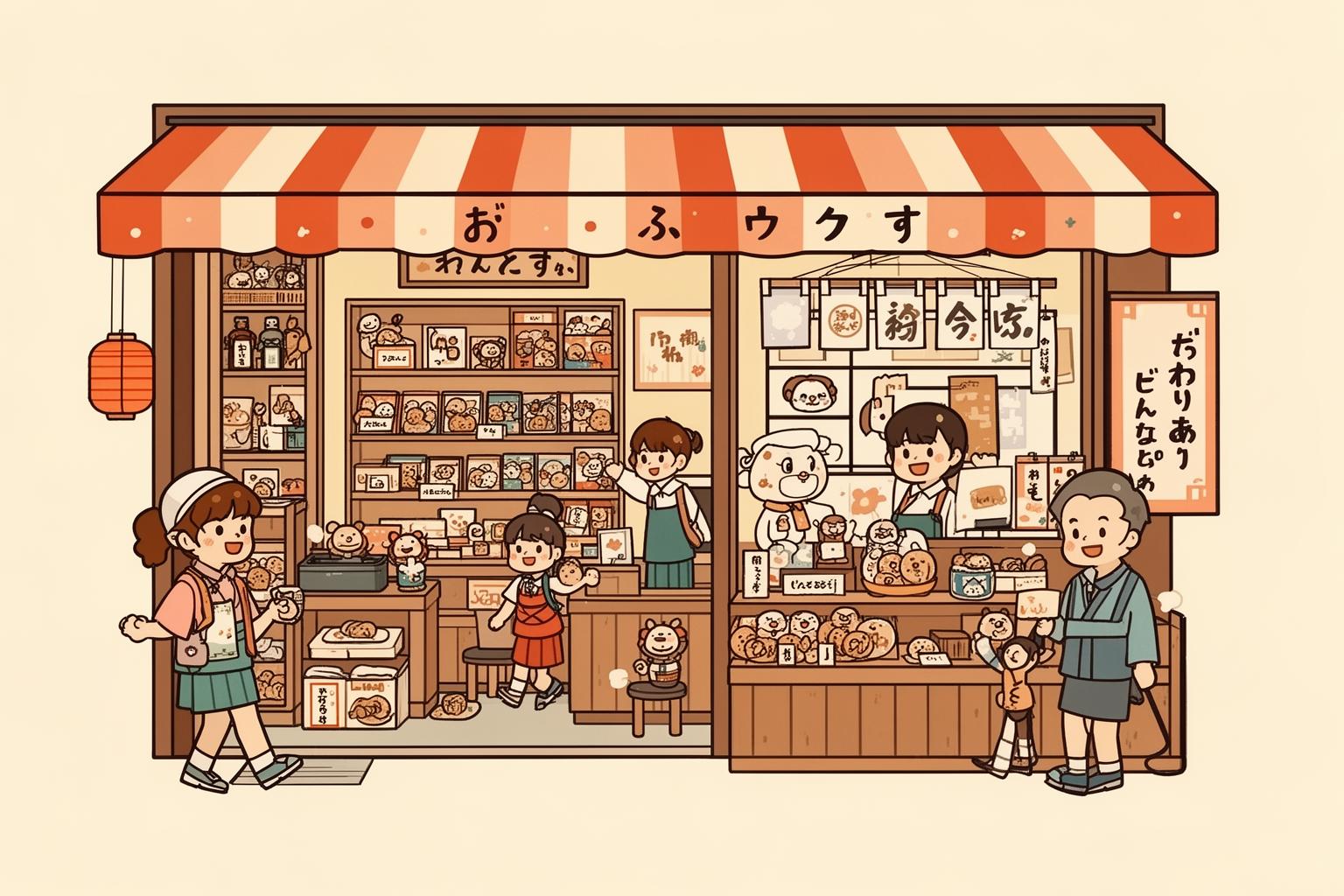
So, is the tavern gone forever? Is the quest truly over? Not quite. While the physical dagashiya may have vanished from the everyday scenery, its spirit lives on, fueled by the powerful magic of nostalgia. For the generations who grew up surrounded by their warm, cluttered charm, the memory of the dagashiya serves as a strong link to a lost childhood. This shared longing has sparked a small but meaningful revival, ensuring the legacy of these little shops endures in new and unexpected ways. The quest now isn’t to find a secret game code but to recapture a past that feels more tangible and connected than our present.
You can still find dagashiya if you know where to search. Some, like the famous Kami-kawaguchiya in Tokyo (the one shown on the map), have defied all odds and remained, preserved as living museum pieces. Visiting one is like stepping back in time, a pilgrimage for those wanting to reconnect with their younger selves. Others appear as re-creations in tourist spots or inside larger shopping centers, offering a curated, sanitized version of the original experience. They sell the classic snacks and toys, but often lack the crucial element: the authentic, lived-in community atmosphere. They are monuments to the tavern, but not the tavern itself.
The Retro Revival and the Dagashiya Bar
The most intriguing development, however, is how the dagashiya concept has been reclaimed by the very kids who once frequented them. Across Japan, a new type of venue has emerged: the dagashiya bar. These izakaya-style pubs cater primarily to adults in their 30s, 40s, and 50s. The idea is brilliantly simple. For a modest cover fee, you get all-you-can-eat access to an extensive selection of classic dagashi. You can fill a small basket with Umaibo, Butamen, and ramune candy, just like when you were ten.
But now, you can enjoy these treats alongside a draft beer or a highball. The décor is pure retro, featuring old movie posters on the walls and, importantly, vintage Famicom or Super Famicom consoles connected to CRT televisions, with a library of classic games ready to play. These bars are nostalgia hubs. They provide a space where adults can briefly escape the pressures of mature life and reconnect with the simple joys of childhood. Friends gather, play the same games they once struggled to master thirty years ago, and debate which dagashi was the best. It’s the dagashiya experience, reimagined for an adult audience. It proves that the tavern model—a place to gather, play, and bond over shared culture—is timeless and powerful.
The Spirit of the Tavern in the Modern Age
Ultimately, the story of the dagashiya teaches us how physical spaces shape culture and community. While the shops themselves may be gone, the basic human need for a ‘tavern’—a place to connect with your tribe—is everlasting. This spirit hasn’t disappeared; it has simply moved on. Today, it thrives in different forms tailored to the modern age. It lives in local trading card game shops, where players battle and trade. It exists in the vibrant atmosphere of fan conventions, where enthusiasts of the same anime or video game meet face-to-face. And it flourishes online, across millions of Discord servers, Twitch channels, and forums dedicated to every imaginable hobby and passion.
These are the new taverns, the new guild halls. They fulfill the same core roles of building community, sharing information, and fostering social connection. Yet, we must remember what made the dagashiya so special in our cultural memory. It was an analog solution in an analog era—a low-pressure, child-centered world that provided ideal social infrastructure for a generation of kids. It taught us how to be friends, to share, and to belong. It wasn’t just a store selling cheap candy. It was the save point of our entire childhood, the place where we leveled up in real life. Understanding that helps explain much about the Japan we know today—our love for retro culture, our yearning for community, and the bittersweet nostalgia for a time when the greatest adventure could be bought for just one hundred yen.