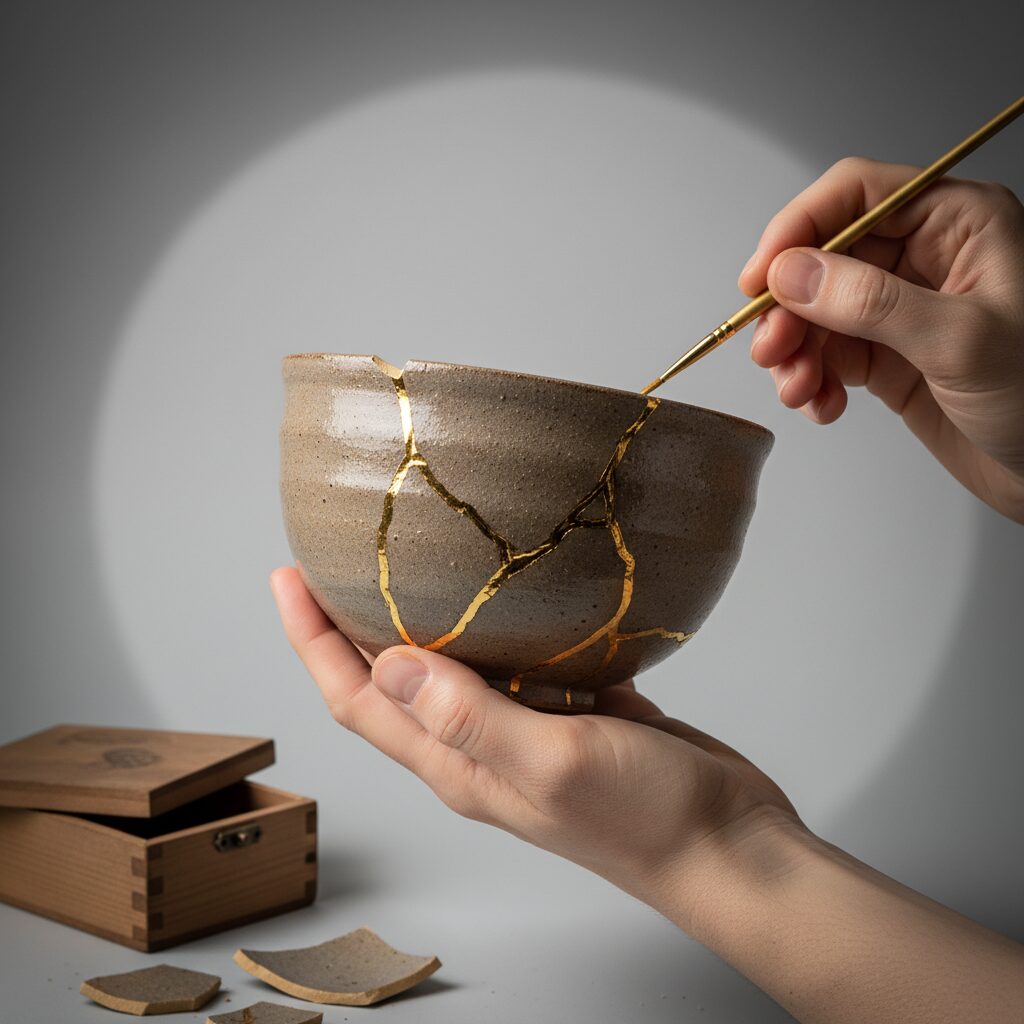
Yo, what’s up. Taro here. So you’ve probably seen it scrolling online. A ceramic bowl, maybe a teacup, that’s clearly been shattered but is pieced back together with these insane-looking veins of gold. It’s not trying to hide the damage; it’s screaming it. The cracks are the main event. And if you’re from anywhere else, your first thought is probably something like, “Cool, but… why?” Why would you take something broken and make the breaks the most eye-catching part? Shouldn’t a good repair be invisible? It’s a legit question. In a world obsessed with flawless finishes, perfect selfies, and getting things back to “good as new,” Kintsugi feels like a total glitch in the system. It’s one of those things about Japan that seems super deep and aesthetic on the surface, but also a little… confusing. Is it just a quirky craft, or is there something bigger going on? The short answer? It’s way bigger. Kintsugi isn’t just about fixing pottery. It’s a full-blown philosophy, a window into the Japanese mindset that embraces what’s broken, what’s aged, and what has a story. It’s about finding a different kind of beauty, one that doesn’t come from perfection but from resilience. It’s a vibe that runs deeper than just ceramics, touching everything from architecture to how people think about life itself. So, let’s ditch the surface-level takes and really break down the why. Forget what you think you know about repair. We’re about to dive into the world of golden scars and figure out what they can tell us about Japan’s complex relationship with perfection and its total opposite.
This philosophy of embracing imperfection extends beyond art, offering a unique perspective on everyday life, much like the Japanese sentō experience.
The Vibe Check: What Kintsugi Actually Is (and Isn’t)
More Than Just Glue and Gold Dust
First, let’s cover the essentials. When you look at a Kintsugi piece, it’s not some quick epoxy repair with gold paint casually sprinkled on. This craft is a serious, time-honored tradition. The process is slow, intentional, and based on natural materials. The crucial element is urushi lacquer, which is not just any varnish—it’s the sap of the Chinese lacquer tree, used in Japan for thousands of years on everything from bowls to samurai armor. It’s exceptionally durable and waterproof, yet notoriously challenging to work with. Think of it as nature’s superglue that demands great patience and skill.
The process begins by carefully gathering every broken shard of the ceramic piece—no chip is discarded. The artisan then meticulously fits them together using a mixture of urushi and natural binders like rice flour. This is not a one-step process. Each thin layer must be applied and then cured for days or even weeks inside a special wooden chamber called a muro, where temperature and humidity are tightly controlled. It’s a slow cycle of applying, curing, and sanding repeatedly until the cracks are flawlessly filled and the piece becomes structurally sound—often stronger than before it broke. Only at the very end, when one of the last layers of urushi is still sticky, does the craftsman dust it with powdered gold, silver, or platinum. The precious metals bond to the lacquer, forming those iconic, shimmering lines. The finished piece isn’t merely “restored” to its former state—it’s transformed. It becomes a new creation that bears its history on the surface. The intention is never to conceal damage, but to honor it, incorporating the trauma into the object’s identity and making it central to its beauty.
Busting the Myth: It’s Not a DIY Weekend Project
If you browse online, you’ll find countless “DIY Kintsugi Kits” for sale, usually packaged with a tube of epoxy, some gold-colored mica powder, and a promise that you can fix your favorite mug in about fifteen minutes. And while there’s nothing wrong with a fun craft project, it’s vital to recognize that this is not genuine Kintsugi. They’re Kintsugi-inspired, yes, but fundamentally different from the traditional art. It’s like comparing a microwave dinner to a meal crafted by a Michelin-star chef. One prioritizes speed and convenience; the other values technique, history, and deep respect for materials.
Real urushi is difficult to work with. The raw sap contains urushiol, the same allergen found in poison ivy and poison oak. Handling it without proper knowledge and care can cause painful, blistering rashes. Artisans spend years mastering its use. Additionally, urushi cures through a chemical reaction that depends on precise humidity and temperature, rather than air drying as paint does. If conditions aren’t optimal, it won’t harden properly. This is why traditional Kintsugi is a slow, careful discipline—a dialogue between the artisan, the broken piece, and the living lacquer material. The instant epoxy kits completely miss this essence. They replace the deep philosophical core of patience, respect, and transformation with a quick cosmetic fix. So while these kits might be fun for mending a plate, they lack the cultural and historical significance of true Kintsugi. Authentic Kintsugi embodies the belief that healing takes time, that strength comes from careful attention, and that the materials themselves possess a spirit deserving of respect.
The Backstory: Where Did This ‘Celebrate the Break’ Idea Come From?
The Shogun and the Cracked Tea Bowl
Where did this radical idea of emphasizing cracks originate? It’s not as if it’s always existed. The most well-known origin story, one you’ll hear in nearly every workshop in Kyoto, takes us back to the 15th century, during the Muromachi period. The central figure is Ashikaga Yoshimasa, the 8th shogun of the Ashikaga shogunate. According to the tale, Yoshimasa had a favorite celadon tea bowl, a treasured item imported from China. One day, to his dismay, it broke. Heartbroken but unwilling to lose the bowl, he did what anyone in his place would do: he sent it back to skilled craftsmen in China for repair.
After many months, the bowl finally returned. And although it was technically fixed, the Chinese artisans had repaired it using the common method of the time: drilling small holes and binding the broken pieces together with unsightly, bulky metal staples. It was purely practical. The bowl held water, but it looked dreadful. The scars were crude, industrial, and utterly lacking in any aesthetic value. Yoshimasa was deeply disappointed. He saw the repair not as restoration but as a desecration of the bowl’s beauty. This dissatisfaction sparked creativity. He turned to his own Japanese craftsmen and challenged them: find a better way. A way to repair this bowl that is not merely functional, but also beautiful—that respects the object rather than simply stapling it back together. This challenge inspired the development of a technique using precious urushi lacquer and powdered gold. They didn’t just mend the break; they transformed it into a striking feature, creating a new landscape on the bowl’s surface. This represented a significant paradigm shift. Repair ceased to be about hiding flaws and became an art form in itself, an opportunity to add a new layer of history and beauty to an object.
The Zen Connection: Wabi-Sabi 101
But the shogun’s broken bowl is only part of the story. The roots of Kintsugi run much deeper, grounded in the philosophical soil of Zen Buddhism and the aesthetic of wabi-sabi. You’ve likely heard the term wabi-sabi used often. It’s frequently applied to describe anything in Japan that looks rustic or aged. Yet it is much more than that. It’s a comprehensive worldview, a particular way of seeing and appreciating existence. At its core, wabi-sabi is about discovering profound beauty in things that are imperfect, impermanent, and incomplete. It stands in direct contrast to the classical Greek ideal of beauty, which prizes symmetry, perfection, and lasting permanence.
Wabi evokes quiet, rustic simplicity. It’s the contentment found in owning just enough, taking satisfaction in the humble and understated. Imagine a simple, unadorned wooden cabin nestled in the woods. Sabi refers to the beauty that arises with age. It’s the patina on weathered metal, the smooth, worn surface of a stone path, or the faded colors of aged fabric. It’s the physical proof of time’s passage and the stories an object carries. As someone who spends time outdoors, I witness it often in nature: the gnarled, twisted trunk of an ancient pine that has endured centuries of typhoons, moss covering a forgotten stone statue. It’s the beauty born from weathering storms and exposure to the elements. Kintsugi perfectly embodies wabi-sabi. A broken bowl is imperfect; the repair acknowledges its impermanence. The final piece, with its golden scars, is incomplete in that its story is ongoing. The cracks aren’t viewed as damage to erase but as celebrated marks of the object’s sabi, its unique history etched onto its surface.
Tea Ceremony: The OG Stage for Imperfection
The cultural setting where these ideas of wabi-sabi truly took root and blossomed was the Japanese tea ceremony, or chanoyu. By the 16th century, under the influence of legendary tea masters such as Sen no Rikyū, the tea ceremony underwent a transformation. Rikyū rejected the lavish, ostentatious style of tea gatherings popular among the elite, which often featured expensive, flawlessly crafted porcelain imported from China. Instead, he championed the wabi-cha style, emphasizing simplicity, rusticity, and a profound, quiet spirit.
He and other tea masters began to value locally made, roughly crafted ceramics. They favored bowls that were slightly asymmetrical, bearing uneven glazes and a humble, earthy character. These bowls weren’t “perfect,” but they felt alive and genuine. Within this context, a bowl repaired with Kintsugi was not merely acceptable; it was often deemed more valuable and interesting than an unbroken one. Why? Because in the intimate, contemplative atmosphere of the tea room, every object becomes a subject of appreciation. A Kintsugi bowl could be the centerpiece of conversation—the host sharing the story of its breakage, perhaps a cherished heirloom accidentally dropped, while the guest admires the beautiful repair. The golden veins physically represent the object’s journey, standing as a testament to its endurance. It embodied Zen principles of mindfulness and embracing the present moment, imperfections included. The tea ceremony provided the ideal stage for Kintsugi to evolve from a simple repair method into a profound philosophical art form, deeply entwined with Japan’s most refined cultural customs.
The Maker’s Mindset: It’s Not About the Gold, It’s About the Story

The Philosophy of ‘Mottainai’: Waste Not, Want Not, But Make It Art
To truly grasp the Kintsugi mindset, you must first understand a fundamental Japanese concept: mottainai. Translating this term directly into English is challenging. It’s often rendered as “waste not, want not,” but that oversimplifies it. Mottainai is more of an emotional response—a profound feeling of regret about waste. It’s not limited to wasting physical items like food or resources; it also encompasses wasting time, potential, or opportunities. Rooted in Buddhist beliefs about the interconnectedness of all things, it emphasizes respecting the resources we receive. In everyday life, parents often scold their children with “mottainai!” when rice is left uneaten. This reflects a core cultural value.
Kintsugi can be seen as the ultimate embodiment of mottainai. When a treasured bowl breaks, the easiest response in today’s throwaway culture is to sigh, sweep up the pieces, and discard them. The object has lost its function and, therefore, its value. Problem solved. But the mottainai mindset resists this notion. It recognizes the broken bowl as a loss—not just of clay and glaze, but of the labor of the potter, the energy used in firing, and the history the item carries. Throwing it away denies its entire existence. Kintsugi presents an alternative path, going beyond mere repair or recycling. It proclaims, “Let’s not simply mend this; let’s honor it.” By dedicating many hours and precious materials like urushi and gold to the restoration, the craftsman makes a powerful statement: the object is not disposable. Its history matters. Its scars matter. Breaking doesn’t lessen its worth; it creates a new kind of value, transforming it from a mass-produced item into a unique piece of art.
Scars as a Narrative
This is the true essence of the practice. The gold isn’t just decorative; it’s a storytelling element. The gleaming lines map out the object’s trauma, a visible record of what it has endured. They narrate a tale. Consider this in human terms. Everyone carries scars, both physical and emotional. The natural reaction is to conceal them, cover them with makeup, or pretend they don’t exist. We see them as imperfections, reminders of weakness or pain. We aim to present a flawless, unbroken version of ourselves to the world. Kintsugi philosophy reverses this entirely. It suggests that scars are not something to be ashamed of. They prove our resilience. They mark survival. They tell the story of battles fought—and crucially, won. To hide them would be to erase a vital part of our journey, a key part of what shapes who we are today.
A Kintsugi-restored object is one of a kind. Before it broke, it might have been one of many identical bowls produced in a kiln, replaceable and uniform. But after shattering and being reborn through Kintsugi, it becomes irreplaceable. No other object in the world will have broken the same way or been repaired with the same golden lines. Its damage and subsequent healing confer a radical individuality. This represents a profound shift from mass production’s logic, which values uniformity and interchangeability. The Kintsugi mindset values not uniformity, but the unique journey of each individual object. It finds beauty not in flawlessness, but in the graceful acceptance of a history that includes being broken.
Kirei and Utsukushii: Two Shades of ‘Beautiful’
To appreciate this aesthetic more deeply, it helps to understand a subtle distinction in the Japanese language. Japan has several words for “beautiful,” and two of the most common are kirei (綺麗) and utsukushii (美しい). To non-native speakers, these may seem interchangeable, but they convey distinct nuances.
Kirei generally refers to a more surface-level kind of beauty. It means “pretty,” “clean,” “neat,” or “tidy.” A perfectly arranged bento box is kirei. A brand-new car shining in a showroom is kirei. A cherry blossom tree in full, flawless bloom is kirei. It denotes an objective, almost detached beauty, often tied to newness and perfection.
Utsukushii, by contrast, implies a deeper, more emotional beauty. It’s something that moves you inwardly, that has soul. The loyalty of a dog, a selfless act of kindness, or an elderly couple holding hands can be described as utsukushii. It relates to an inner quality rather than outer appearance. A weathered temple gate, with peeling paint and darkened, rain-stained wood, might not be kirei, but for those who appreciate its history and endurance, it is deeply utsukushii.
Now, consider our bowl. A brand-new, perfectly symmetrical, flawless piece of porcelain is undoubtedly kirei: pretty and pristine. But a Kintsugi bowl, with its scars boldly highlighted in gold, transcends that. It may no longer be “pretty” in the traditional sense. It is something more—it is utsukushii. Its beauty arises from its story, resilience, and embodiment of wabi-sabi. It evokes an emotional response, prompting reflection on time, damage, and healing. It holds an inner beauty unattainable by a perfect, unbroken bowl. This distinction is crucial to understanding why celebrating cracks isn’t unusual in Japanese aesthetics; it simply reflects access to a different, deeper kind of beauty.
Kintsugi in the Wild: Is This Philosophy Still Alive in Modern Japan?
The Modern Artisan’s Perspective
So, is Kintsugi merely an old, dusty craft preserved in museums and quiet Kyoto workshops, or does it remain a vibrant, living part of contemporary Japan? The truth lies somewhere in between. Traditional Kintsugi continues to be practiced by a devoted group of artisans who dedicate their lives to mastering the delicate art of urushi. They serve as the custodians of the craft, carefully restoring priceless antiques and family heirlooms. Yet, the philosophy has also been embraced by a new generation of contemporary artists and designers who are pushing the technique’s boundaries.
These modern creators don’t always wait for objects to break naturally. Some intentionally break and reassemble ceramics, using Kintsugi not just as a repair method but as a primary means of artistic expression. They may combine fragments from different vessels—a practice called yobitsugi—to form entirely new hybrid pieces. Others adapt the Kintsugi aesthetic to materials like glass, wood, or even concrete. This evolution prompts interesting questions: If an object is deliberately broken only to be repaired, does it carry the same philosophical significance? Must the “trauma” be accidental for the repair to feel genuine? The debate persists. For some traditionalists, intentional breaking misses the essence of honoring an object’s authentic history. For the artists, however, it’s a physical exploration of deconstruction and reconstruction, fragmentation and unity. It demonstrates that Kintsugi is not a static tradition but a flexible idea that continues to inspire and evolve within the modern art scene.
Beyond the Bowl: Kintsugi’s Influence in Everyday Life
What’s truly fascinating isn’t just what’s happening inside art galleries—it’s how the core Kintsugi spirit—embracing imperfection and history—emerges in other facets of Japanese life, even when people aren’t consciously linking it to golden pottery.
Take architecture, for example. Stroll through a fashionable district like Daikanyama in Tokyo, and you’ll notice sleek, modern buildings that incorporate old, weathered materials. A café might feature a polished concrete facade but showcase a massive central beam crafted from dark, scarred reclaimed wood salvaged from an ancient temple. Designers deliberately preserve cracks, stains, and nail holes in the wood. These aren’t flaws; they’re design elements that add warmth, character, and a historical narrative to an otherwise sterile environment. It’s the Kintsugi principle applied on an architectural scale.
You can also find it in fashion. The Japanese aesthetic of boro is a perfect illustration. Boro textiles are old, indigo-dyed cotton fabrics meticulously mended and patched over generations. Historically, this was done out of sheer necessity by rural families who couldn’t afford new cloth. Today, these heavily patched, layered textiles are regarded as high art, coveted by designers and collectors alike. The intricate sashiko stitching used for mending is celebrated for its beauty. Like Kintsugi, boro makes the act of repair visible, transforming a history of hardship and poverty into a complex, beautiful tapestry.
The Perfectionism Paradox
All of this sounds wonderful—Japan celebrates cracks, honors the old, and embraces imperfection. But hold on. Anyone who’s spent time in Japan knows it can also be one of the most perfectionistic cultures on earth. This is the land of the Shinkansen bullet train that arrives precisely on schedule, of department store clerks who wrap your purchase with microscopic care, of chefs who devote years to mastering the perfect bowl of rice. How can a culture be simultaneously obsessed with flawless perfection and enamored with celebrating brokenness? It’s a puzzling paradox that often baffles visitors.
The key may lie in where perfectionism is applied. In many parts of Japanese society, the demand for perfection centers on the process, the service, and the execution of a task. The train must run on time because the system itself demands perfection. Gifts are wrapped flawlessly as a sign of respect for the recipient. The chef’s technique must be impeccable to honor the ingredients. Kintsugi repairs exemplify this principle. Artisans apply urushi with absolute, painstaking precision. Sanding is thorough. The final gold line must be flawlessly executed. The perfectionism is in the craftsmanship.
The object being repaired, however, is inherently imperfect. So, it’s not a contradiction but a synthesis. Kintsugi is the art of applying a perfect process to an imperfect object. Perhaps this philosophy provides a vital psychological and spiritual release in a high-pressure society. It’s a cultural recognition that while we strive for excellence in our actions, the world itself—and everything and everyone within it—is fundamentally imperfect. Things break. Plans falter. People suffer. Kintsugi offers a beautiful, tangible metaphor for facing that reality: not by denying the break, but by using our finest efforts to mend it and, in doing so, create something even more beautiful and resilient than before.
So, Should You Get a Kintsugi Kit? A Final Word
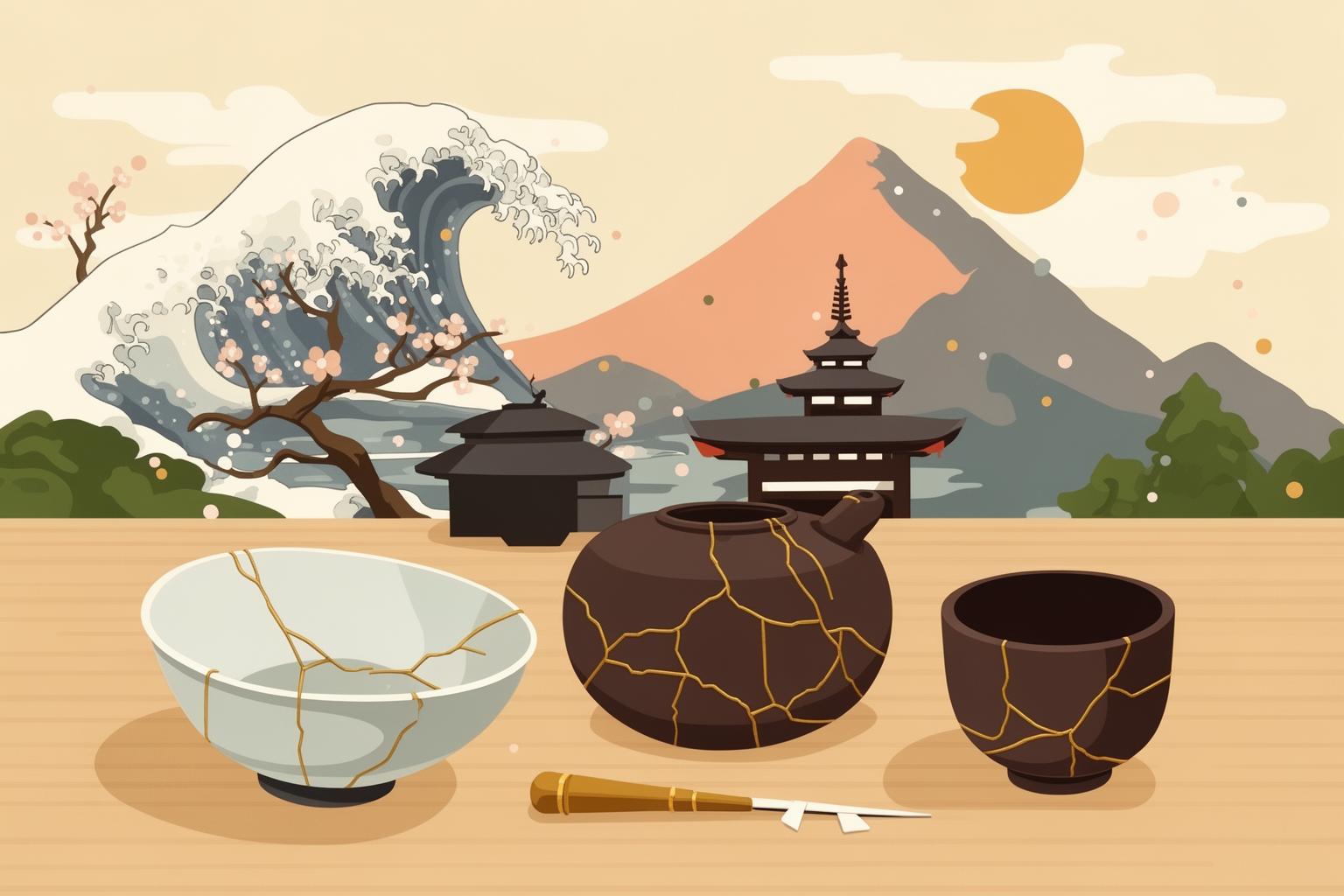
We’ve explored the philosophy, history, and contemporary essence of Kintsugi. Now, let’s return to the original question. When you see this beautiful craft, it’s natural to want to try it yourself. The act of repairing something broken with your own hands is deeply therapeutic. So, what about those DIY kits?
If you view it as a fun, Kintsugi-inspired craft project, go ahead. Using epoxy and gold powder to mend a chipped plate can be a meditative way to embrace the spirit of mottainai and create something unique. Just be aware of what that entails. You’re not practicing the traditional art, but you are connecting with its fundamental idea of honoring a break. If you want the authentic experience, consider attending a workshop in Japan that teaches traditional techniques using real, non-toxic urushi alternatives or, for the truly committed, genuine urushi under expert guidance. This will give you a richer understanding of the skill, patience, and history behind the art form.
In the end, Kintsugi’s true power lies not in the gold or lacquer but in its perspective on life. It is a quiet rebellion against the pursuit of perfection. It reminds us that a life without a few cracks is one not fully lived. It shows that loss and damage don’t have to be the end—they can mark the beginning of a new, more meaningful chapter. So next time you see a bowl with golden seams, don’t just see a repaired object. See a survivor. See a story. See a philosophy that suggests the most beautiful things are not those that have escaped damage, but those that have been broken and found the courage to heal and wear their scars with pride.