Yo, what’s the move? Taro Kobayashi here, and today we’re ditching the usual mountain trails and forest bathing for a different kind of expedition. We’re about to dive deep, and I mean deep, into the concrete canyons of Japan’s past. Forget the neon glow of Shibuya and the serene temples of Kyoto for a minute. We’re going on a vibe check of a place that’s low-key one of the most liminal, atmospheric spots in the entire country: the Showa Era danchi. These aren’t just apartment buildings; they’re sprawling concrete jungles, monuments to a bygone dream. They were once the pinnacle of modern living, buzzing with the energy of Japan’s economic miracle. But now? Now, they’re often wrapped in a strange, heavy silence. It’s a quiet so loud it practically screams. And in that quiet, new legends are born. We’re talking modern yokai, digital-age ghosts haunting analog architecture. This is a journey into the heart of suburban Japan, a place where the past hasn’t just passed—it lingers, watching from a thousand identical windows. It’s an urban hike into an eerie, forgotten world, and trust me, the vibes are immaculate, in the spookiest way possible. If you know, you know. Let’s get it.
The Concrete Dream: A Quick History Sesh
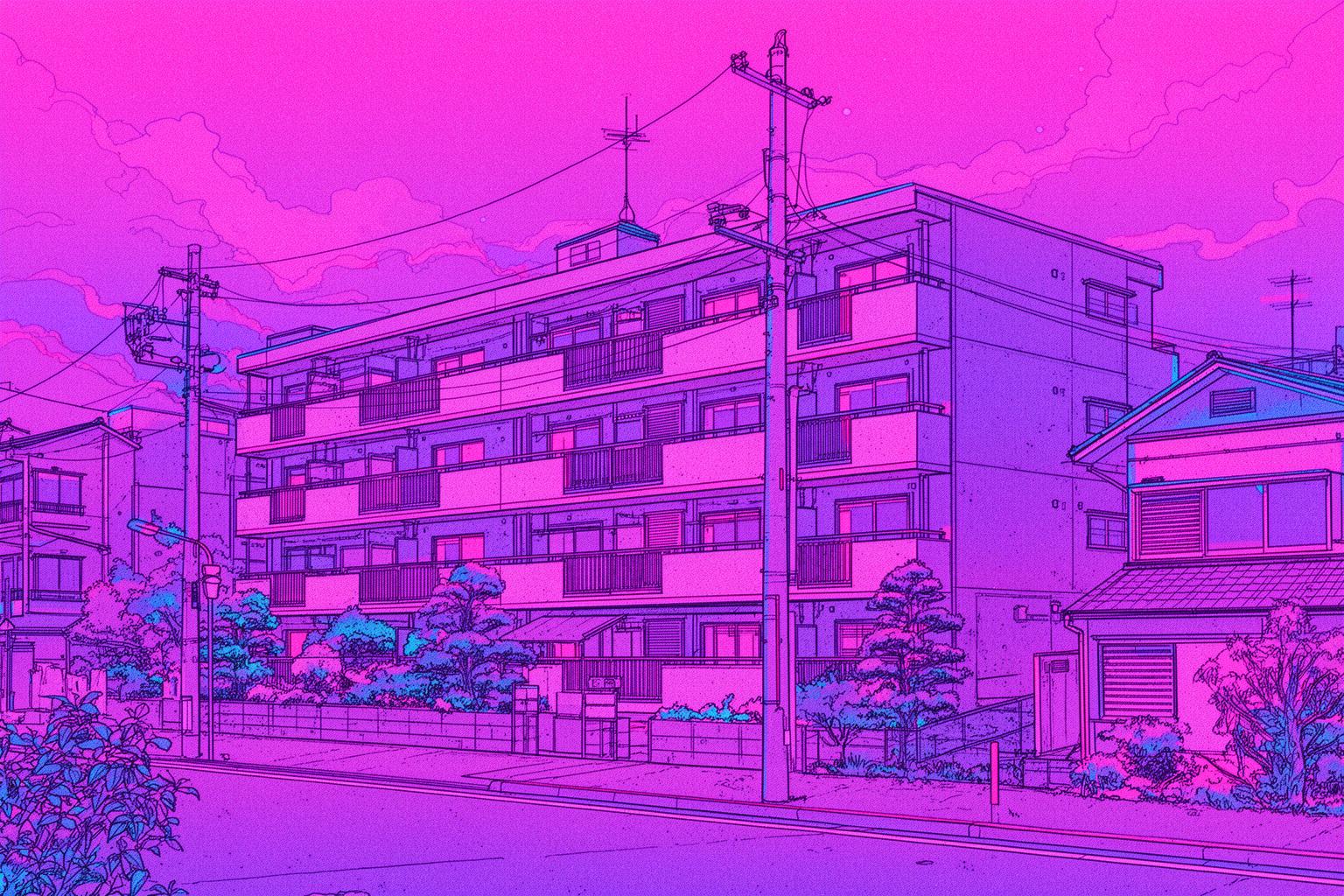
Before diving into the spooky stuff, you need to know the backstory. It’s crucial context, seriously. What exactly is a danchi? The word 団地 (danchi) literally means “group land,” referring to the vast public housing complexes that sprang up across Japan, mainly from the mid-1950s through the 1970s. This was the Showa Era, a period when Japan was rapidly rebuilding itself from the ruins of World War II into an economic giant. Cities like Tokyo and Osaka were booming. People flooded in from rural areas for work, and they all needed places to live. The housing situation was desperate. So, the government, through the Japan Housing Corporation (JHC), came up with a smart solution: danchi.
These weren’t just buildings; they were a whole vibe. They symbolized the future. For a generation raised in traditional, often cramped wooden homes, danchi were the dream. We’re talking concrete structures that were fireproof and earthquake-resistant. They included modern conveniences that were a huge deal back then: private kitchens with stainless steel sinks, flush toilets, and even bathrooms with tubs. This was peak aspirational living. The floor plans were often called ‘2DK’—two rooms plus a dining/kitchen area. Compact, efficient, and completely new. Families lucky enough to win the housing lottery for a spot in a danchi were considered winners. These complexes were meant to be self-contained communities, often featuring parks, playgrounds, clinics, post offices, and shopping arcades. They represented a clean, orderly, and prosperous vision of life for the Japanese nuclear family.
Architecturally, danchi were marked by a stark, brutalist-inspired functionalism. Picture long, monolithic blocks of reinforced concrete, arranged in neat, repetitive rows. The design emphasized standardization and efficiency. Every door was identical. Every window matched in size. Stairwells, corridors, mailboxes—all uniform, stretching seemingly endlessly. This uniformity was part of their charm at the time; it signified equality and modernity. It was a clear break from the chaotic, organic layouts of older neighborhoods. But as we’ll see, that same uniformity is what now gives these places their uniquely eerie atmosphere. The dream they were built for has faded, but the concrete endures, a silent reminder of a future that never quite unfolded as imagined.
Vibe Check: The Sound of Silence in the Concrete Jungle
Alright, let’s discuss the feeling you get when you step into one of these places. As an outdoor specialist, I’m accustomed to a particular kind of quiet—the quiet of a forest, a mountain summit, or a remote coastline. That quiet is alive; you hear the wind, the birds, the rustling leaves. It’s a peaceful, restorative silence. The silence in a Showa danchi, however, is different. It’s a heavy, oppressive silence—an unnatural stillness that seems to actively absorb sound. It’s the kind of silence that raises the hairs on your arms. You wander through these vast complexes, sometimes home to thousands, and on a weekday afternoon, you might not see or hear a single soul. It’s wild.
Your footsteps echo in an oddly loud, almost disrespectful way. The distant, muffled sound of a TV behind a closed door, the squeak of a rusty bicycle, the sudden coo of a pigeon—these small noises only accentuate the overwhelming stillness. The playgrounds are especially eerie. You’ll find retro-futuristic concrete play structures—slides shaped like robots, globe-shaped jungle gyms, faded pastel swings—all perfectly still. Built for the laughter of the baby boom generation, they now stand mostly empty, monuments to a lost youth. The wind whistling through the empty metal swing frames sounds like a sigh. It’s a melancholy that seeps deep into your bones.
Visually, it’s a trip. The scale and repetition are hypnotic and disorienting. Long, open-air corridors stretch to a vanishing point, lined with identical metal doors, each bearing its own collection of personal touches—a faded wreath, a small nameplate, an umbrella stand. These small signs of life only deepen the sense of emptiness. The concrete walls are often stained with black and rust-colored streaks from decades of rain, forming patterns that look like tears or abstract paintings of decay. This is what the internet aesthetes call “liminal space” in its purest form. It’s a place of transition, between what was and what will be, as if you’ve glitched out of reality and entered a loading screen for a world buffering indefinitely. The sun casts long, sharp shadows that slice across courtyards, making the geometry feel even more alien and imposing. At dusk, when lights flicker on one by one in random windows across the monolithic facades, the sensation of being a solitary witness to a thousand private, unknowable lives is intense. It’s a lonely kind of beauty, no cap.
The Sensory Overload of Emptiness
You might not expect emptiness to be overwhelming, but it is. Your eyes scan endless rows of windows, searching for movement, a face, anything. Most often, you find only drawn curtains or the reflection of the sky. It creates a strange psychological effect—a kind of architectural scopophobia—the feeling that the buildings themselves are watching you. Each window becomes a potential eye, and their vast number makes you feel incredibly exposed, even when completely alone.
The smell is a mix of damp concrete, overgrown weeds in neglected flowerbeds, and the faint, nostalgic scent of sun-dried laundry. Occasionally, you catch a whiff of cooking—soy sauce, miso, dashi—drifting from an open window, a sudden ghostly reminder that people truly still live here. It’s a sensory time-slip, a scent transporting you back to the Showa Era kitchen it originated from.
The texture of the place is defined by concrete: rough, weathered, and unyielding. You can trace the patterns of wooden molds used to cast it decades ago. You see cracks where nature tries to reclaim its hold, with hardy weeds pushing through. The metal stairwell railings are cold to the touch, their paint flaking away to reveal layers of past colors—a history of maintenance and neglect. It’s a tactile archive of time passing. This whole experience—the oppressive hush, the dizzying repetition, the melancholic beauty—is the perfect soil for stories. It’s the kind of place that sparks your imagination, urging you to fill the silence with something. And that, my friends, is where the yokai come in.
The New Tenants: Modern Yokai of the Danchi

Japan has a long and rich history of yokai—spirits, demons, and supernatural beings that explain the unexplainable. Kappa dwell in the rivers, and tengu inhabit the mountains. But what happens when the landscape changes? When forests and rivers give way to concrete and steel? The yokai adapt. They evolve. The Showa danchi, with its unique mix of history, isolation, and eerie atmosphere, has become the home for a new generation of urban legends. These are not ancient spirits from folklore scrolls; they are modern ghosts born from contemporary anxieties. Let’s meet some of the residents you won’t find on any official tenant list.
The Balcony Woman (Beranda no Onna – ベランダの女)
This is a classic, a foundational myth of the danchi. The story varies, but the core is always the same. As you walk through the courtyard, your gaze is drawn to a particular balcony, several floors up on a monolithic block. There, a woman stands perfectly still, staring down at you. She might seem to be hanging laundry, but the clothes on the line never move, and she never breaks her gaze. She’s there when you arrive, and hours later, when you leave, she remains in the exact same position. Some say she’s the ghost of a housewife trapped by the conformity of danchi life, doomed to endlessly repeat her domestic chores. Others believe she embodies the collective loneliness of the residents, a silent watcher who sees everything but connects with no one. The unsettling part isn’t that she’s overtly threatening—it’s her stillness. Her silent, unwavering judgment. She’s like a living statue, a permanent fixture on the building’s facade. Legend says that if you stare back at her too long, you become rooted to the spot, unable to leave the danchi grounds until sunset. She is the guardian of the complex’s melancholy, her gaze a heavy weight felt long after you look away.
The Corridor Crawler (Rōka no Haumono – 廊下の這う者)
The long, open-air corridors are among the most defining and unsettling features of a danchi. They serve as liminal passageways connecting the private homes to the outside public space. In these shadowy hallways, the Corridor Crawler is said to dwell. This entity is seldom seen clearly; it inhabits the periphery, a flicker of movement in the corner of your eye. Described as a low, dark shape, it moves with an unnatural, scuttling speed along the ceilings or high on the walls, just beyond the faint glow of corridor lights. It is born from the fear of what lurks in the shared, unmonitored spaces of the danchi. Some say it is the accumulated resentment of residents feeling their privacy compromised by the design of their homes. It feeds on this unease. The story claims the Crawler makes no sound, but you sense its presence when the air turns cold and bulbs flicker. It is drawn to arguments and bad feelings, thriving on the negative energy that festers in such close quarters. The true horror is that the Corridor Crawler represents an invasion of personal space. You lock your front door, but the Crawler is already in the shared hallway—a silent, spider-like horror mere inches from your sanctuary.
The Playground Echo (Kōen no Zankyō – 公園の残響)
This yokai is auditory and perhaps the most heartbreaking. It haunts the empty playgrounds. You might walk by at dusk, the sky a deep indigo, and find the playground deserted. Then you’ll hear it—a faint sound carried on the wind. The laughter of a child. Or the gentle, rhythmic squeak of a swing in motion. You turn, expecting to see a child playing, but find nothing. The swings are still. The sandbox is empty. The laughter fades as quickly as it came, leaving silence heavier than before. The Playground Echo is said to be the spirit of the danchi’s golden age, a lingering joy from the countless children who once filled these spaces with life. It is not malicious, but deeply sad. A ghost of a community’s future that never fully arrived. The children who played here grew up and moved away, chasing different dreams than those their parents had in these concrete boxes. The echo is all that remains. Hearing it serves as a reminder of the danchi’s slow decline, a sonic fossil of happier times. It sounds the demographic shift—an aging population in a complex built for young families. It is a bittersweet haunting that touches the heart.
The Incinerator’s Sigh (Shōkyakuro no Tameiki – 焼却炉のため息)
In the past, each danchi block, or a small group of blocks, had a large concrete incinerator chute called a “dust chute.” Residents disposed of their garbage by dropping it down the chute into a collection point in the basement. These chutes were the building’s arteries, carrying away daily life’s refuse. Today, most are sealed for safety and hygiene, but the structures remain. From these closed chutes, a new yokai has emerged. The Incinerator’s Sigh is the sound you hear when pressing your ear against the cold metal door of a disused chute. It’s a low, long, breathy sound, like a deep, weary sigh rising from the building’s depths. Legend holds this is the collective sigh of all the secrets and discarded items thrown away over decades—love letters, broken toys, failed projects; the physical remnants of forgotten dreams and disappointments. It is the building exhaling its long human history. Some darker tales claim the sigh whispers your own secrets back to you, reminding you of what you have tried to cast away and forget. It is a yokai of memory and regret, a voice from the building’s concrete core.
Urban Hiking Guide: How to Explore a Danchi Respectfully
Alright, so you’re curious. The vibe is pulling you in. You want to see it for yourself. Bet. But wait—before you just show up at a random danchi, there are some key rules you need to know. This isn’t a theme park or a deserted ruin (well, not entirely). People still live here. These are their homes. The number one rule is respect. You’re a guest in a residential community. Here’s the rundown on how to properly enjoy your urban hike.
Choosing Your Route
Not all danchi are the same. Some remain lively communities, recently renovated and full of energy. Others have fallen into a quiet, eerie state. For the full atmospheric vibe, you’ll want to seek out the older, larger complexes from the 60s and 70s. Notable examples include Takashimadaira Danchi in Tokyo (notorious for a series of suicides in the 70s, which adds to its somber atmosphere), Senri New Town on the outskirts of Osaka (one of the earliest and largest planned new towns), or Tokiwadaira Danchi in Chiba. A bit of online research using terms like 「昭和団地」(Showa Danchi) or 「巨大団地」(Kyodai Danchi – Huge Danchi) will guide you well. Google Maps satellite view is invaluable here; look for vast, repetitive building patterns.
Getting There and When to Visit
Most danchi were designed with public transportation access, usually within walking distance of a train or subway station. Getting there is generally straightforward. For the best eerie atmosphere, visit on a weekday afternoon. Kids are in school, most adults are at work, and the complex settles into its quiet rhythm. The hour or two before sunset, the “golden hour,” is also ideal. The long shadows and warm, fading light make the concrete look both beautiful and melancholic—perfect for photographers. Avoid late-night visits. It’s disrespectful to residents and can be unsafe. You’ll go from urban explorer to lurker, and that’s not the way to do it.
The Explorer’s Code
- Move Like a Ghost: Your aim is to observe without disturbing. Keep quiet. No loud talking or music. Move gently. The goal is to experience the silence, not shatter it.
- Stick to Public Areas: This is critical. Stay in public spaces—the courtyards, parks, pathways between buildings, ground-floor shops if present. Do not enter any buildings. Don’t use stairwells, residential hallways, or try to get onto roofs. That’s trespassing, and it will likely get the police involved. Respect residents’ privacy. Their doorways mark their private lives.
- Camera Courtesy: Danchi are incredibly photogenic, but be considerate. Feel free to photograph architecture, landscapes, and the overall mood. Do not take pictures of residents. Avoid pointing your camera directly at windows or balconies. If you spot someone, lower your camera and offer a polite nod. Be discreet.
- Leave No Trace: This is a key hiking principle and applies here too. Don’t leave any trash. Don’t move or damage anything. Don’t pick flowers. You’re there to witness the space, not change it. Leave the danchi exactly as you found it.
- Dress Appropriately: No need for hiking boots, but wear comfortable walking shoes. You’ll be on your feet for a while. Dress simply and unobtrusively. Blend in rather than stand out as a tourist. The less attention you attract, the better.
The Danchi in the Japanese Psyche: Pop Culture Portals

The danchi is more than just a physical space; it serves as a powerful psychological landscape in Japan. Its distinctive aesthetic and social history have made it a favored setting in Japanese film, manga, and anime to evoke a wide range of emotions, from comforting nostalgia to unsettling horror. Understanding how it is portrayed in media can deepen your appreciation of the atmosphere you sense when you’re there.
For an entire generation of Japanese people, the danchi symbolizes a nostalgic, simpler era. Consider the anime Danchi Tomoo, which presents a warm, humorous, and idealized depiction of community life in a danchi, focusing on the everyday adventures of a young boy. This reflects the fond memories many hold of growing up in these complexes, where children had numerous playmates and neighbors knew one another well. It captures the original vision of the danchi as a lively, family-centered community.
However, there is also a darker side. The horror genre in Japan is deeply fascinated with the danchi, and the reasons are clear. The uniformity, isolation, and decaying concrete structures create an ideal setting for horror. The iconic film Dark Water (2002), directed by Hideo Nakata of Ring fame, stands as perhaps the quintessential danchi horror movie. It masterfully uses the setting to transform a leaking ceiling in a dreary apartment into a source of profound dread. The film goes beyond ghost stories to explore the crushing loneliness and institutional neglect that danchi can symbolize. The long, empty hallways, the malfunctioning elevator, and the eerie water tower on the roof all become integral elements of the narrative, intensifying the protagonist’s feelings of isolation and vulnerability.
This horror motif is further examined in manga by artists like Junji Ito, who frequently employ the oppressive geometry and anonymity of apartment blocks to evoke an overwhelming cosmic dread. In anime, psychological thrillers such as Paranoia Agent utilize the danchi as a backdrop to explore social alienation and madness. In these contexts, the danchi functions as a metaphor for the darker aspects of modern urban life—a place where conformity breeds monstrosity and where crowded living only accentuates one’s solitude. So when you walk through an actual danchi and feel a slight chill, you’re not merely reacting to the silence; you are connecting with a profound, shared cultural narrative about these complex, haunted environments.
More Than Concrete: The Soul of the Danchi
So why should you, as a traveler to Japan, spend a day exploring a vast, quiet apartment complex? Because it reveals a story about Japan that no guidebook can capture. Visiting a danchi is like peeling back a layer of the sleek, futuristic image of Japan to uncover a more complex, deeply human reality underneath. It’s a lesson in history, sociology, and architecture, all intertwined in a richly atmospheric experience.
What you’re seeing is the physical embodiment of mono no aware (物の哀れ), a key concept in Japanese culture. It’s a gentle sorrow or pathos about the impermanence of things, the awareness that everything is transient. The danchi were once shining symbols of the future, filled with young families buzzing with the energy and optimism of a rising nation. Now, they stand as monuments to that past, their concrete slowly weathering, their communities aging. There’s a profound beauty in this fading. It’s the same feeling I get as a hiker when discovering an old, abandoned mountain hut or a moss-covered stone marker on a forgotten trail. It’s a connection to the people and stories that came before.
Exploring a danchi is also a direct encounter with one of Japan’s greatest social challenges today: its aging population and the associated phenomenon of kodokushi, or lonely deaths. Many of the original residents are now elderly and live alone, their children long since moved away. The silence of the danchi partly reflects this isolation. These communities, once designed to foster connection, have become places where people can quietly disappear. It’s a sobering thought, but an essential part of the story. The modern yokai we discussed—the Balcony Woman, the Corridor Crawler—can be seen as folk expressions of these very real, contemporary anxieties about loneliness, community breakdown, and being forgotten.
Yet it’s not all bleak. Many danchi still host vibrant communities. Some are being revitalized, with young families and foreign residents moving in, restarting the cycle of life. You might see a group of elderly residents playing gateball in the park or discover a lively shop tucked into an arcade. Still, the sense of a faded dream, of a past more present than the future, is unmistakable. It’s a place for reflection. It invites you to slow down, observe carefully, listen to the silence, and contemplate the nature of progress, community, and time.
Your Final Descent

Our urban hike is drawing to an end. We’ve wandered through the concrete canyons, uncovered the history etched into their stained walls, and attuned ourselves to the whispers of their modern ghosts. Visiting a Showa danchi isn’t your conventional tourist experience. There are no tickets, no gift shops, no grand attractions. Your keepsake is a feeling—a complex blend of nostalgia for a past you never lived through, a subtle chill down your spine, and a deeper appreciation for the soul of modern Japan.
It’s a test of the senses and the spirit, much like trekking through a wilderness both beautiful and daunting. It reminds us that stories and spirits don’t only dwell in ancient shrines and dense forests. They also linger in the most ordinary places, in the spaces we create and gradually forget. So next time you’re in Japan, and you’ve seen the bright lights and famous landmarks, take a short train ride to the suburbs. Locate a sprawling danchi on the map. Take a walk. Be quiet, be respectful, and let the atmosphere wash over you. Listen to the silence. And who knows, you might just catch a glimpse of the Balcony Woman, watching down at you—another fleeting visitor in her permanent concrete realm. It’s a feeling you won’t forget. Stay safe out there, and keep exploring.