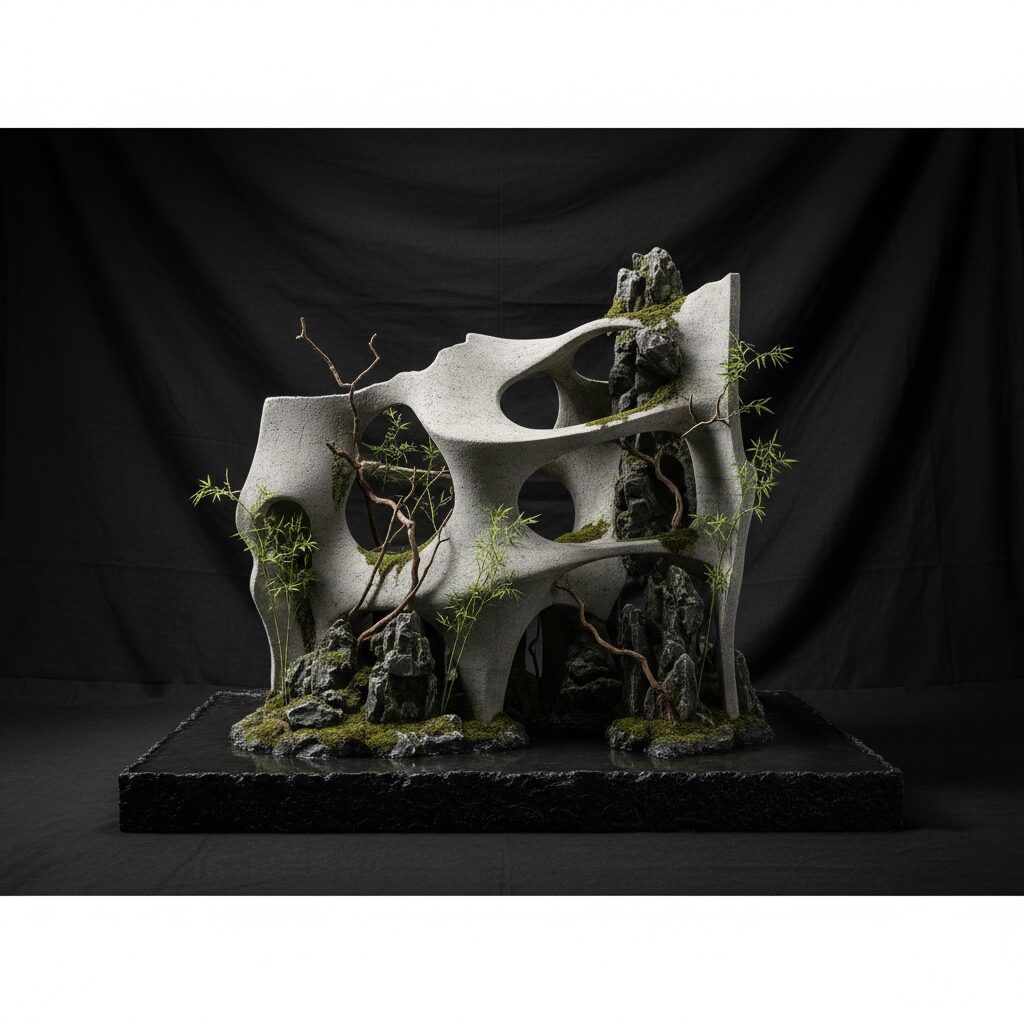
Yo, let’s get real for a sec. You’ve scrolled the feeds, you’ve seen the pics, maybe you’ve even touched down in Tokyo for a whirlwind week. You’ve seen the serene temples, the neon-drenched streets of Shibuya, the impossibly perfect bowls of ramen. But then you see… them. These absolute units of buildings. Hulking, concrete beasts that look like they crash-landed from a forgotten sci-fi anime. They’re not delicate and wooden like a temple, and they’re not sleek and glassy like a modern skyscraper. They’re raw, they’re complex, and honestly, they’re a little bit intimidating. They look like giant, concrete puzzles, with bits and pieces sticking out, looking almost… alive. You stop and wonder, “What is going on here? Why does Japan, a country so obsessed with minimalist aesthetics and natural harmony, have these monstrous, brutal structures?” It feels like a glitch in the matrix, a total contradiction. And you’re not wrong to be confused. These buildings are the physical embodiment of one of Japan’s most audacious, ambitious, and beautifully flawed dreams. This isn’t just about weird architecture; it’s about a nation trying to build its soul out of concrete and steel. We’re about to dive deep into the world of Metabolism, the movement that gave us this “Organic Brutalism.” It’s a story about starting from zero, dreaming of a future that grows like a tree, and how that sci-fi vision still shapes the Japan you see today. Forget the tourist guides; this is the architectural deep-cut that explains everything. Get ready, because once you get the Metabolist vibe, you’ll never see Japan the same way again.
To fully grasp this vision, one must explore the retro-futuristic concrete vistas of Japanese Metabolism architecture.
The Post-War Vibe: Starting from Zero

A Blank Slate, But Make It Concrete
To understand why these buildings exist, you have to rewind the clock—way back. Imagine Japan in the late 1940s and early 1950s. The war was over, and the country was, to put it mildly, devastated. Cities like Tokyo, Osaka, and Hiroshima weren’t merely damaged; they were completely destroyed. Huge portions of the urban landscape lay in ashes and rubble. It was literally ground zero. This destruction wasn’t only physical; it was a deep psychological crisis. The entire national identity, forged over centuries of tradition and a decade of intense militarism, had collapsed. Everything they once believed in had ended in total catastrophe. This total reset is difficult to imagine, but it’s essential to grasp the developments that followed. There was a wild, chaotic, almost frenzied energy in the air—a volatile mix of national trauma, profound shame, and a determined, forward-looking optimism. They couldn’t dwell on the past; it was painful. The only way forward was into the future. And they had to build it. Quickly.
The drive to rebuild went beyond erecting houses and factories. It was about creating an entirely new Japan. The old wooden buildings, so emblematic of traditional Japan, had proven terrifyingly flammable. The future had to be permanent, strong, and fire-resistant. Enter concrete. Concrete became the material of the new Japan. It was affordable, adaptable, and durable. It didn’t burn. It signified a break with the fragile past and a commitment to a lasting future. There was an almost moral urgency to this choice. Building with concrete was an act of defiance against the destruction just endured. It declared: we are here, we are solid, and we’re not going anywhere. This choice was not just practical; it held deep symbolic meaning for the nation’s psychological state. The raw, unembellished surface of concrete was viewed as honest—a rejection of the superficial façades of the old world. It provided a foundation on which a new identity could be literally constructed from the ground up.
The West is Watching, But Japan is Doing Japan
As Japan reopened to the world after post-war isolation, a wave of Western ideas flooded in, including contemporary architectural styles, especially Modernism and its more forceful offshoot, Brutalism. Architects like the Swiss-French master Le Corbusier were revered by a generation of young Japanese designers. His affinity for raw concrete (béton brut, literally “raw concrete,” the origin of the term Brutalism), his use of massive, sculptural forms, and his vision of rationally planned cities were hugely influential. His influence is clearly visible in the heavy, monumental forms of post-war Japanese architecture.
But here’s the key twist, the most crucial part of the story. Japanese architects didn’t simply become followers of Western design. They weren’t interested in mere copying and pasting. Amid a massive identity crisis, they asked themselves: “What does it mean to be Japanese in this new world?” They couldn’t return to the old imperial aesthetics, nor did they want to become a pale copy of the West. They needed something modern yet distinctly Japanese. So, they took the tools of Western Modernism—the concrete, the scale, the technology—and filtered them through Japanese philosophies and aesthetics. It was an act of cultural translation. They sought a new tradition, one that would resonate with their unique historical moment. This wasn’t about creating polite, minimalist Zen spaces; it was something far more dynamic and confrontational. They faced immense challenges: rapid, chaotic urbanization, a population boom, and the pressing need for infrastructure to support a new industrial age. Architecture became more than a style—it became a tool for national survival and reinvention.
Enter Metabolism: The City as a Living Thing
The 1960 World Design Conference: The Birth of a Movement
Everything came together in 1960 at the World Design Conference in Tokyo. This event marked Japan’s significant moment to reintroduce itself to the global design community. A group of young, ambitious, and somewhat rebellious Japanese architects, led by the already renowned Kenzo Tange, seized the chance. They published a manifesto—a booklet titled “Metabolism: The Proposals for New Urbanism.” The core members included architects such as Kisho Kurokawa, Kiyonori Kikutake, Fumihiko Maki, and the critic Noboru Kawazoe. Their central argument represented a radical break from Western architectural thinking.
They contended that cities and buildings of the past were static, designed as fixed, finished objects that could only slowly deteriorate once constructed. This approach, they claimed, was completely out of sync with the realities of modern life, particularly in a place like Tokyo where constant change was the norm. Their key idea, which inspired the movement’s name, was to view cities and buildings not as static entities but as living organisms. The term “Metabolism” was intentionally borrowed from biology, referring to the process by which living beings sustain life by absorbing nutrients, growing, and expelling waste. The Metabolists proposed that architecture should function similarly, with a metabolic cycle—designed to grow, evolve, and adapt over time. This was a groundbreaking vision, championing a dynamic, ever-changing urbanism as a direct response to the vibrant energy of their rapidly expanding cities. They were not merely designing buildings; they were creating systems for living.
The Philosophy: Mega-Structures and Micro-Capsules
How could a building “grow” like an organism? The Metabolist vision depended on a straightforward yet powerful dual concept: the megastructure and the capsule. The megastructure represented the permanent, enduring part of the city—think of it as the skeleton or the trunk and branches of a tree. These would be massive, large-scale infrastructure elements such as transportation hubs, communication towers, artificial landmasses, and the core structural frames of buildings, all built to last for centuries and to provide essential support and services.
Attached to these permanent megastructures were the capsules, which were transient, short-lived components. Think of them as the individual cells of a body or the leaves on a tree. The capsules were lightweight, prefabricated modules—apartments, offices, shops—that could be mass-produced in factories and simply “plugged in” to the megastructure. The revolutionary aspect was that these capsules were replaceable. As a family grew, they could plug in a larger capsule; when technology became obsolete, the old capsule could be removed and replaced with an updated version. This allowed buildings, and by extension the entire city, to renew themselves continuously without the need for demolition and complete rebuilding. It was a strikingly futuristic concept that embraced the traditional Japanese notion of impermanence (best exemplified by the ritual rebuilding of the Ise Grand Shrine every 20 years) combined with modern industrial technology. It laid out a blueprint for a sustainable, adaptable city of the future.
The Aesthetic: Why “Organic Brutalism”?

Brutalism’s Raw Power, But with a Pulse
We have this bold idea of living buildings. But why this particular appearance? Why the raw, exposed concrete? This is where the “Brutalism” aspect comes in. As noted, the influence of Le Corbusier and the global Brutalist movement was undeniable. For the Metabolists, raw concrete was the ideal material to convey the strength and permanence of their megastructures. It was straightforward; it concealed nothing. The texture of the wooden formwork used to cast the concrete was often left visible, giving the surfaces a rough, tactile quality. This wasn’t about polished perfection; it was about revealing the construction process, showcasing the raw power of the building’s structure.
This aesthetic deeply resonated with the post-war Japanese context. In a country forced to confront harsh realities, this architectural honesty was refreshing. There was no space for superficial decoration. The buildings carried a gravitas, a monumental weight meant to reassure. They stood as anchors in a sea of uncertainty. The massive scale and imposing forms of these concrete structures declared Japan’s renewed industrial strength and its ambition to build a future that would no longer be so easily destroyed. The sheer visual impact of a building like Kenzo Tange’s Yamanashi Press and Broadcasting Center is designed to convey an overwhelming sense of stability and permanence. It’s a fortress for a new era.
The “Organic” Twist: It’s Alive!
This is where Japanese Metabolism distinctly diverges from its Western Brutalist counterparts and gains its unique character. While many Brutalist buildings in Europe or the Americas often feel monolithic, heavy, and static—like giant, inert sculptures—Metabolist buildings seem dynamic, as if caught in a moment of growth. This is the “Organic” element of “Organic Brutalism.” The Metabolists weren’t just using concrete; they used it to express their fundamental philosophy of biological growth and transformation.
You can literally see the system in action. The designs highlight the relationship between the permanent core and the attachable units. The central megastructure is frequently a massive vertical shaft or interconnected towers acting as a spine. From this core, individual capsules or office blocks extend outward, resembling limbs or nodes on a stem. The aesthetic is one of assembly, parts coming together to form a whole. There’s a visible tension and energy in the way smaller elements attach to the larger frame. This visual language makes the buildings feel less like finished products and more like ongoing processes. They seem incomplete, as if additional pieces could be added at any time. This creates a strong biological metaphor. The buildings don’t just occupy space; they appear to inhabit it, actively growing and adapting to their environment.
The Case of the Nakagin Capsule Tower: A Dream Deferred
No conversation about Metabolism would be complete without mentioning its most famous, beloved, and tragic symbol: Kisho Kurokawa’s Nakagin Capsule Tower. Completed in 1972 in Tokyo’s Ginza district, it was the purest embodiment of the Metabolist vision ever realized. It consisted of two concrete core towers housing elevators and utilities, to which 140 prefabricated capsules were attached by high-tension bolts. Each capsule was a tiny, self-contained apartment—a “bachelor pad” for the modern salaryman—complete with a built-in bed, bathroom unit, and state-of-the-art electronics (for the 70s, anyway). The distinctive porthole window gave it an undeniably cool, spaceship-like feel.
The vision was science fiction turned reality. The capsules were designed to be replaced every 25 years. In theory, you could disconnect your old capsule and bolt on an upgraded one. You could even purchase multiple capsules and connect them to create a larger family home. It was the ultimate expression of flexible, adaptable architecture suited for a new lifestyle. But here’s the heartbreaking truth: the capsules were never replaced. Not once. The logistics and costs were prohibitive. The residents’ association never reached consensus. Over time, the building deteriorated. Water leaks, asbestos, and decaying infrastructure transformed the futuristic dream into a crumbling relic. For years, it stood as a beautiful, poignant symbol of a future that never fully arrived. Its demolition in 2022 was a tremendous loss for architecture, but it also serves as a vital lesson. It highlights the vast gap between the utopian, systemic ideals of Metabolism and the messy, complex, and often irrational realities of economics, politics, and human life. The Nakagin Capsule Tower was a magnificent failure—an experiment showing that the theory was perhaps too idealistic for the real world. Yet its power endures in the questions it raised and the possibilities it represented.
The Legacy: From Sci-Fi Dreams to Everyday Realities
Why Didn’t It Take Over the World?
If the ideas were so brilliant, why aren’t megastructures and plug-in capsules filling all our cities? The truth is that Metabolism, as a conscious movement, had a relatively brief existence. It reached its height leading up to the 1970 Osaka Expo, a major platform for Metabolist concepts. But by the mid-1970s, enthusiasm waned. The 1973 oil crisis hit Japan’s economy hard, making these massive, resource-heavy concrete projects seem extravagant and impractical. With steel and concrete prices soaring, building megastructures became economically unviable.
There was also a cultural shift. The utopian, top-down, systems-driven vision of the Metabolists began to feel somewhat rigid and authoritarian. As Japan grew wealthier, people’s preferences evolved. The collectivist spirit of the post-war era gave way to a desire for increased individualism, personal space, and more conventional comforts. The concept of living in a tiny, standardized, mass-produced capsule—no matter how advanced—lost its charm. People wanted homes that expressed their own identities, not just a cell in a vast organism. Architecture moved on, toward postmodernism and other styles often critical of the grand, monolithic ideals embodied by movements like Metabolism.
The Metabolist DNA in Modern Japan
But here’s the interesting part. While the formal movement faded, its core ideas survived. They seeped into the fabric of Japanese design and urbanism. Today, the DNA of Metabolism is woven throughout Japan; you just need to know how to spot it. It shifted from being a style to becoming a foundational way of thinking about space.
The most evident legacy is the focus on prefabrication and modularity. The dream of the plug-in capsule persists in countless modest forms. Consider the ubiquitous “unit bath”—a factory-made, all-in-one bathroom module that can be installed in an apartment within hours. This directly descends from the capsule concept. The same applies to modular kitchens, prefabricated housing parts, and even the standardized, interchangeable shelving in convenience stores. This pursuit of efficiency, quality control, and assembly-line construction is pure Metabolist thinking applied on a domestic scale.
More profoundly, consider the structure of Japanese cities themselves. The Metabolist vision of a multi-layered, three-dimensional city with interconnected systems is the reality of Tokyo and other major urban centers. Stations like Shinjuku or Shibuya are not just transit points; they are sprawling megastructures housing department stores, restaurants, offices, and hotels, all layered atop and integrated with intricate train and subway networks. Elevated highways weave between—and even through—office buildings. This is a city as a layered, interconnected organism: chaotic but functional. It is the Metabolist dream realized not through a single master plan, but via decades of organic, ad-hoc development. This accidental realization of Metabolism is arguably more successful and resilient than the original vision.
Pop Culture’s Concrete Muse
Then there’s the aesthetic. Although it fell out of favor in mainstream architecture for a time, Metabolism’s visual language was enthusiastically embraced by a generation of Japanese artists, especially in manga and anime. The sci-fi cityscapes defining Japanese cyberpunk for decades draw directly from the Metabolist playbook.
Katsuhiro Otomo’s Akira is a prime example. The sprawling, chaotic, partially ruined cityscape of Neo-Tokyo, with its towering skyscrapers, intertwined highways, and visible layers of decay and reconstruction, is a direct visual reference to Metabolist theory. Similarly, the complex, vertically-layered urban environments in Masamune Shirow’s Ghost in the Shell reflect this influence. These creators took the utopian dreams of Metabolist architects and reinterpreted them through a darker, more dystopian lens. They saw in megastructures not just rational solutions to urban challenges, but also potentials for alienation, social stratification, and the individual’s overwhelm by the system. The concrete forms that architects viewed as symbols of hope and progress became, in these artists’ hands, potent backdrops for stories of technological anxiety and social breakdown. Ironically, this pop-culture afterlife has made the Metabolist aesthetic more widely known and influential globally than the actual buildings ever were.
So, What’s the Vibe Today? Experiencing Metabolism IRL
The Pilgrimage Sites for Arch-Nerds
So you’re convinced. You want to experience these concrete giants in person. Despite the unfortunate loss of the Nakagin Capsule Tower, notable pilgrimage sites still exist throughout Japan. Kenzo Tange’s work is foundational. The previously mentioned Shizuoka Press and Broadcasting Center in Ginza exemplifies the core-and-capsule concept brilliantly. His Yamanashi Press and Broadcasting Center in Kofu is even more striking—a powerful cluster of sixteen concrete shafts supporting the building’s various functions. It resembles a miniature city.
The Kyoto International Conference Center, designed by Sachio Otani, is another absolute must-visit. Its dramatic, sloping trapezoidal forms in raw concrete are intended to reflect the surrounding mountains, providing a stunning example of blending brutalist materials with respect for the natural environment. Walking through its vast, monumental interior feels like stepping aboard a benevolent alien starship. While not strictly Metabolist, Tange’s Yoyogi National Gymnasium, built for the 1964 Tokyo Olympics and featuring an incredible suspended roof structure, embodies the same spirit of dynamic, technologically ambitious, and nationally symbolic architecture. Tracking down these buildings is more than an architectural tour; it’s a journey back through a period of remarkable creative energy and national aspiration.
Beyond the Buildings: A Way of Thinking
Ultimately, capturing the essence of Metabolism is not just about ticking off buildings on a list. It’s about grasping a core aspect of the modern Japanese mindset. It’s the key to understanding many apparent contradictions. It reveals the persistent tension in Japan between chaotic, rapid change and a deep undercurrent of order and systems. It explains the cultural comfort with impermanence and the willingness to tear down perfectly good buildings to erect new ones—a practice often surprising to Western visitors. This is not seen as wasteful but as an essential part of renewal—a deeply Metabolist concept.
When you see a tiny, pencil-thin building squeezed onto a narrow piece of land, it’s a pragmatic, capsule-like response to urban density. When you navigate the labyrinthine, multi-level environment of a major train station, you are inside a real-world megastructure. When an old traditional house is dwarfed by a futuristic skyscraper, you witness the dynamic layering of time the Metabolists sought to formalize. Metabolism was Japan’s effort to design a future that embraces its past without being limited by it. It was a bold, imperfect, and beautiful attempt to shape a national identity out of concrete, steel, and a profound belief in growth and change. It’s not just architecture. It’s the code. It’s the operating system of the complex, bewildering, and endlessly fascinating organism that is modern Japan. And once you recognize it, you’ll see it everywhere.