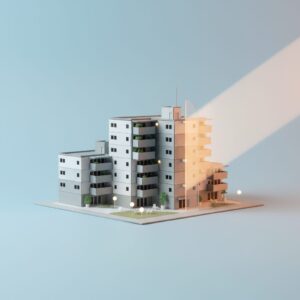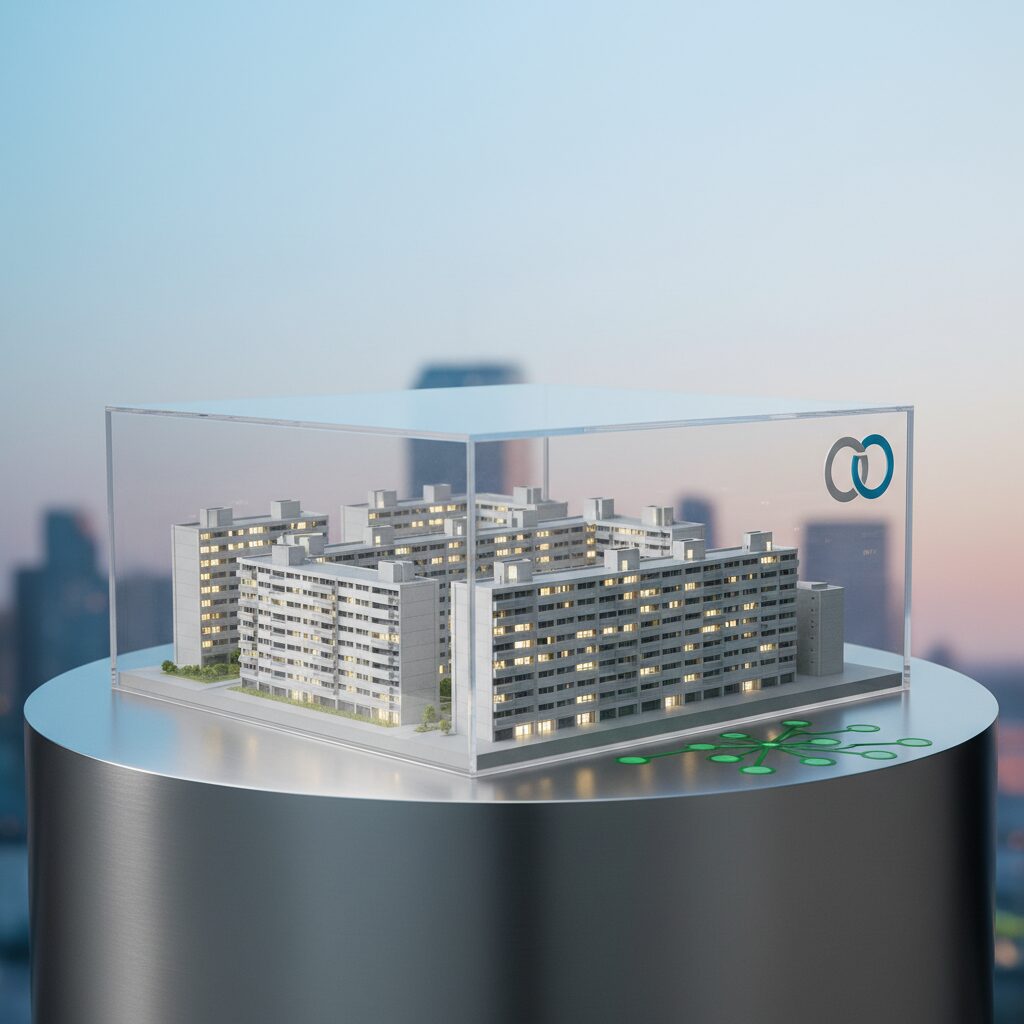
Yo, what’s the first thing that pops into your head when you think of Japan? Is it the Blade Runner-esque glow of Shinjuku’s skyscrapers? The almost sacred tranquility of a Kyoto temple garden? Maybe it’s the chaotic energy of the Shibuya Scramble crossing. It’s all valid, it’s all part of the wild tapestry that is Japan. But there’s another image, one you’ve probably seen but maybe never really seen, you know? It’s a quieter, more uniform, and low-key haunting aesthetic. I’m talking about the Danchi. These sprawling, monolithic apartment complexes, stacks of concrete boxes repeated in mesmerizing, almost oppressive patterns across the suburban landscape. They’re a fixture in so many anime, from the melancholic backdrops of Inio Asano’s manga to the surreal battlegrounds of Gantz. They’re the backdrop to countless Japanese films and TV dramas, a visual shorthand for a certain kind of everyday life. And if you’ve ever taken a train out of a major city center, you’ve definitely seen them rolling by your window, silent and imposing. The immediate question that hits you is… why? Why are these things everywhere? And more importantly, why do they give off such a potent, nostalgic, almost achingly beautiful vibe, even to people who never lived there? They’re not flashy or ancient. They’re just… concrete. But that concrete is saturated with the story of modern Japan—its biggest dreams, its quiet heartbreaks, and its strange, uncertain future. It’s a story of a nation racing to build a utopia, and what happens when that utopia gets old. So let’s get into it, let’s unpack the real deal behind Japan’s concrete utopias.
To understand this story, it’s also worth exploring the broader architectural movement that inspired these danchi, a vision explored in our article on Japan’s Metabolism architecture.
The Birth of a Dream: What Even Is a Danchi?
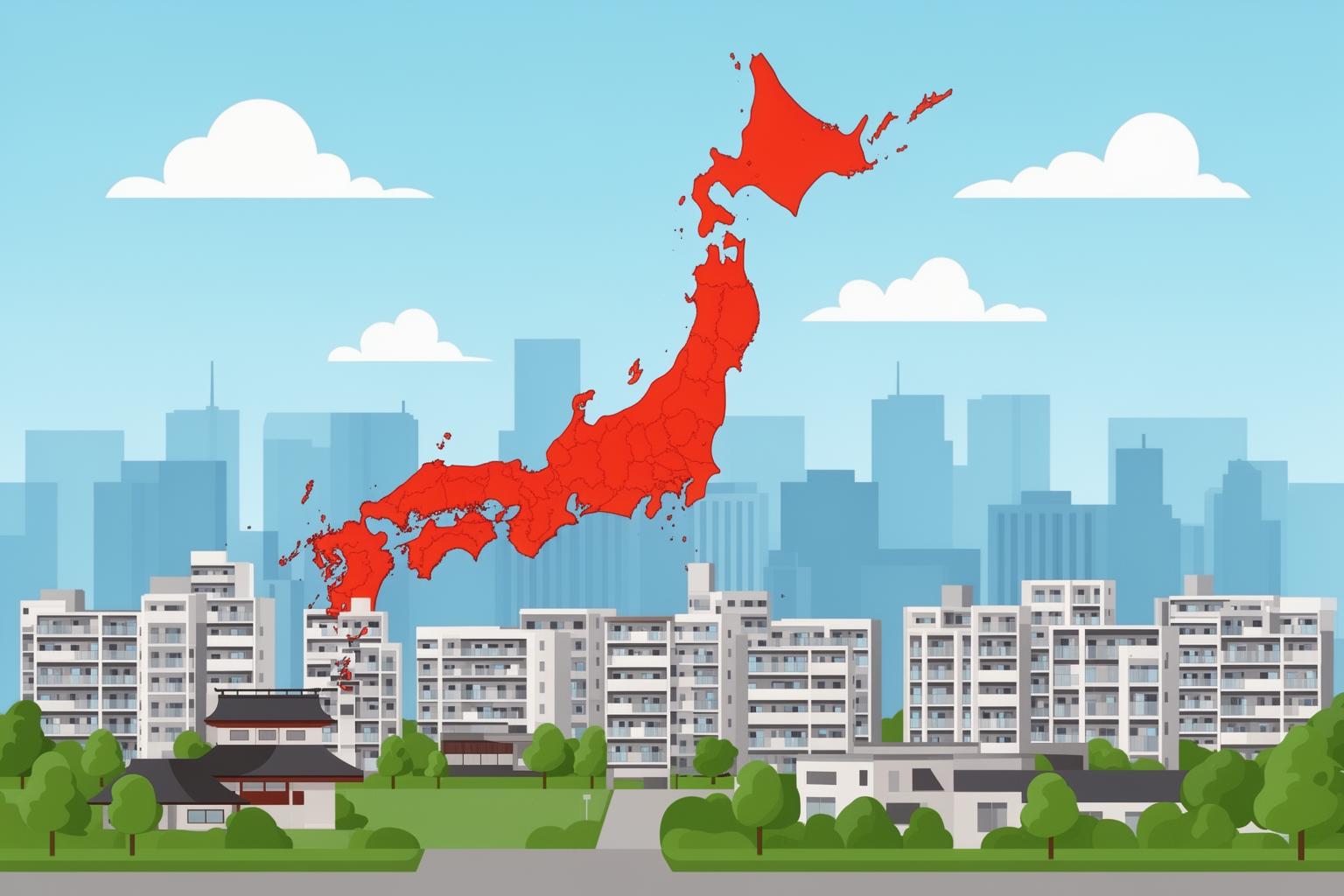
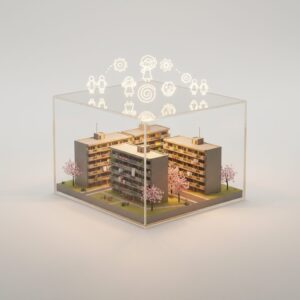
Before we can grasp the vibe, we need to understand the backstory. The term danchi (団地) literally means “group land,” but that doesn’t fully convey its meaning. Think of it as a “housing project” or “estate,” but without the negative associations these terms might carry elsewhere, at least for now. The Danchi emerged out of sheer necessity, a bold response to a national crisis. Its story goes beyond architecture; it reflects the very foundation of modern Japanese society.
Post-War Challenges, Concrete Answers
Imagine Japan in 1945—utter devastation. Major cities like Tokyo and Osaka were reduced to ash and rubble by firebombing. The country faced a massive housing shortage. Millions were homeless, living in makeshift shacks or squeezed into whatever structures remained. At the same time, soldiers returned from overseas, and a post-war baby boom had just begun. The government scrambled desperately to provide housing and rebuild the nation. The traditional way of building—small, wooden, single-family homes—was too slow, costly, and vulnerable to fires and earthquakes. They needed a new approach. Something fast, efficient, and modern.
This is where the Japan Housing Corporation (JHC), founded in 1955 and now known as the Urban Renaissance Agency (UR), came into play. Its mission was clear: rapidly construct a vast number of affordable, high-quality public housing units. Inspiration was drawn from the West, especially the modernist architectural movements in Europe led by figures like Le Corbusier. The vision focused on rational, standardized, and hygienic living. The solution? Reinforced concrete. They built vertically, creating entire new towns on the outskirts of major cities. These were not just apartment buildings; they were carefully planned communities—the Danchi.
The “nLDK” Revolution: Redefining Living Spaces
The Danchi didn’t just alter the skyline; it fundamentally transformed how Japanese people lived. Central to this was the introduction of a new floor plan concept: the “nLDK.” This acronym is now common in Japanese real estate, but at the time, it was revolutionary. It refers to layouts with ‘n’ bedrooms plus a shared Living, Dining, and Kitchen area. While this might seem normal to Westerners, it was a radical shift from the traditional Japanese home.
Traditional houses featured multi-purpose tatami rooms separated by sliding paper screens (fusuma), where the same space served as living room by day and bedroom by night after rolling out futons. Privacy was flexible. In contrast, the Danchi embraced the Western idea of specialized rooms. It strongly promoted the separation of spaces for eating and sleeping (shoku-shin bunri). This was not just an architectural change; it was a social one. It reflected a push toward a new “modern” family model focused on the nuclear family, replacing the multi-generational households of the past.
At the heart of this revolution was the Dining Kitchen, or “DK.” This combined space, often featuring a stainless steel sink, was presented as the bright, efficient center of the modern home. For housewives accustomed to cooking in dark, smoky kitchens with dirt floors, the Danchi kitchen was a shining symbol of progress. It was a clean, hygienic area where the family could gather. Owning the era’s “Three Sacred Treasures”—a refrigerator, washing machine, and black-and-white television—within a Danchi apartment represented the pinnacle of post-war aspiration. This was the concrete utopia in its purest form: a promise of a clean, convenient, and thoroughly modern life for the masses.
The Golden Age: Danchi as Aspirational Vibe
It’s difficult to exaggerate just how coveted Danchi living was in the 1950s and 60s. Today, the perception might be humble public housing, but back then, securing a spot in a new Danchi was like striking gold. It was an unmistakable status symbol, signaling that you and your family had entered Japan’s emerging new middle class. This was the golden age when the Danchi embodied the ultimate post-war dream.
A Gateway to the Middle Class
Demand for Danchi apartments far exceeded supply. The JHC introduced a lottery system for prospective tenants, and the competition was fierce. Application ratios could reach a hundred to one, or even higher for popular complexes. News crews would film the lottery drawings, capturing the elated winners and the disappointed who would have to try again. Gaining entry to a Danchi wasn’t just about securing housing; it was about ensuring a future. It meant you were part of the new Japan, the nation crafting an economic miracle from the ruins of defeat.
The ideal residents were the quintessential “salaryman” and his family. These white-collar employees, with steady corporate jobs and reliable incomes, were the driving force behind Japan’s rapid economic expansion. The Danchi was built with them in mind. It offered a lifestyle that perfectly matched their new urban reality: a manageable commute to the city, a safe environment for raising children, and a community of peers all striving for the same modern ideal. The uniform buildings mirrored the uniform ambitions of a generation focused on collective progress and stability.
Community in Concrete: Crafting a Self-Sustained World
One of the most ingenious elements of the original Danchi concept was that they were designed as comprehensive living environments, not merely housing blocks. The planners recognized that building a community was as crucial as building apartments. Consequently, large Danchi complexes functioned as self-contained towns, providing everything a young family might need right at their doorstep.
At the core of the Danchi was a central shopping arcade, or shotengai. This included a butcher, a fishmonger, a vegetable stand, a small supermarket, a bakery, and perhaps a bookstore or dry cleaner. There was a post office and a clinic as well. Expansive green spaces and parks were interspersed among the buildings, with playgrounds as a focal point. The laughter and play of children formed the constant soundtrack of the Danchi’s golden era. The complexes were designed as paradises for kids, featuring slides, swings, and sandboxes that became social centers for both children and their mothers.
This integrated design cultivated a remarkable sense of community. Everyone was at the same life stage—young, married, with small children. They had all won the same lottery to be there. This shared experience forged strong bonds. Doors were left unlocked. Neighbors borrowed soy sauce from one another. Mothers looked after each other’s children in the playground. It was a world of shared purpose and mutual support, a collective utopia where the struggles and successes of building a new life were experienced together. This deep-rooted sense of a shared past is a major reason behind the enduring nostalgia that surrounds the Danchi today.
The Vibe Shift: When the Dream Started to Fade
Nothing golden lasts forever. The utopian vision of the Danchi, once Japan’s brightest beacon of the future, began to fade over time. The very success of Japan’s economic miracle, which the Danchi helped to nurture, eventually rendered it outdated. The atmosphere shifted from aspirational and modern to cramped and old-fashioned. The concrete dream started to show its cracks, both in a literal and metaphorical sense.
The Bubble and Beyond: Outgrowing the Utopia
As Japan’s economy surged in the 1970s and boomed during the Bubble Era of the 1980s, wages increased along with ambitions. The generation that had once dreamed of a 2DK apartment now had children who aspired to something bigger. The once-groundbreaking Danchi units began to feel cramped. The standardized kitchens and bathrooms appeared outdated compared to the sleek new options available in private condominiums and, most notably, in single-family homes.
The ultimate Japanese dream shifted from the communal life of the Danchi to the individualistic ideal of owning “my home” (マイホーム, mai hōmu), a detached house with a small garden in the suburbs. The Danchi, once a symbol of upward mobility, became simply a rung on the ladder people now wanted to climb beyond. It was no longer the final destination but a starting point. As families grew wealthier, they moved out, seeking more space, greater privacy, and the status that came with property ownership. The concrete utopia was abandoned for a new, more individualized dream.
The Graying of the Concrete Jungle
The most profound and poignant change in the Danchi has been demographic. The young families who moved in during the 1950s and 60s did what people naturally do: they aged. Their children grew up and, inspired by the new dream of a single-family home, left to start their own families elsewhere. Yet their parents often remained. They had built their lives there, their friends were nearby, and the subsidized rent stayed affordable on a pension.
As a result, many of the older Danchi complexes experienced a dramatic demographic reversal. Once vibrant communities filled with children became quiet neighborhoods inhabited mainly by the elderly. Playgrounds fell silent. Local elementary schools, once overcrowded, were closed and repurposed. The shotengai saw stores shutter one after another as their customer base aged and shrank.
This “graying” of the Danchi brought serious social challenges. Once-strong community ties weakened as residents became less mobile and more isolated. The phenomenon of kodokushi, or “lonely deaths,” where elderly residents die unnoticed in their apartments for days or even weeks, tragically became associated with Danchi estates. The concrete utopia, designed to foster youthful energy and family life, struggled to accommodate the quiet realities of old age.
Stigma and Stereotypes: The Danchi’s Public Image Problem
Along with these changes came a shift in public perception. The Danchi began to carry a stigma. It was no longer viewed as housing for the upwardly mobile middle class but increasingly seen as welfare housing, a place for those unable to afford other options. This is often an unfair generalization, since UR Danchi are not exclusively for low-income households, yet the image persisted.
Popular culture reflected this darker perception. In films, anime, and manga, the Danchi transformed from a symbol of hope into a backdrop for social alienation, crime, and even horror. The identical corridors and uniform doorways became metaphors for conformity and loss of identity. The aging concrete, stained and weathered, set the scene for stories of urban decay and psychological struggle. What once made the Danchi a utopia—its orderly, collective nature—was now depicted as its most dystopian aspect.
The Danchi Renaissance: A Nostalgic Future
Just as it seemed like the Danchi was fated to become a relic of the Showa era, something unexpected occurred. A new generation, with no recollection of the original Danchi dream, began to view these concrete complexes differently. Not as decay, but as potential. Not as conformity, but as a blank canvas. The mood is shifting once more, and the Danchi is quietly undergoing a definite renaissance, driven by a combination of economic realities, retro aesthetics, and innovative design.
Retro-Cool: Why Young People are Moving Back
For young Japanese people today, especially in extremely expensive cities like Tokyo, the economic equation is straightforward. The dream of owning a detached house is more unattainable than ever. Private apartments are costly and often cramped. In this context, the Danchi offers an attractive alternative. UR apartments, in particular, frequently bypass the hefty deposits, “key money,” or guarantor fees typical of the Japanese rental market, making them much more accessible.
But it’s not only about finances. There’s a strong aesthetic appeal. The “Showa retro” trend has revived all things mid-century—from coffee shops to fashion—as cool again. The simple, functional, and somewhat dated design of Danchi buildings fits perfectly into this vibe. Their sturdy, no-nonsense construction holds a minimalist charm. Young people are attracted to the large windows, good ventilation, and the surprisingly abundant green spaces around the buildings—a rarity in today’s densely packed urban environment.
They see an opportunity to create a distinctive living space, a blank slate to express their own style. To them, the Danchi no longer represents conformity; it’s a platform for individuality. They are reclaiming the concrete and making it their own.
UR and the Modern Makeover
The Urban Renaissance Agency has not remained passive. Aware of both the challenges and opportunities, UR has been actively working to rejuvenate its extensive portfolio of Danchi estates. This effort goes well beyond mere maintenance. They are undertaking large-scale renovation projects to bring both the buildings and communities into the modern era.
This includes gutting and redesigning individual units to create more open, contemporary floor plans tailored to today’s lifestyles. They are upgrading kitchens and bathrooms, installing new wiring and insulation, and enhancing earthquake resilience. At the community level, they are transforming vacant lots into community gardens, repurposing closed shops into co-working spaces or childcare centers, and organizing events that encourage interaction between elderly long-term residents and younger newcomers. The aim is to foster multi-generational communities that respect the Danchi’s heritage while building a sustainable future.
Case Study: The MUJI x UR Project
One of the most renowned and aesthetically impactful revitalization efforts is the partnership between UR and the minimalist lifestyle brand MUJI. The MUJI x UR project exemplifies successful rebranding. Instead of concealing the age and simplicity of the Danchi, they embrace it.
MUJI’s design philosophy centers on simplicity, functionality, and timelessness. They strip old Danchi units down to their core—the “concrete skeleton.” Often, they remove unnecessary walls to create bright, open-plan living spaces. They replace outdated fixtures with simple, high-quality MUJI products. The result is a space that feels both nostalgic and strikingly modern. It is minimalist, customizable, and perfectly aligned with the aesthetic tastes of a new generation.
The project has been immensely successful and has significantly influenced perceptions of Danchi. It demonstrated that these old buildings are not meant for demolition but are valuable assets that can be adapted and reimagined. The MUJI collaboration transformed Danchi living from merely acceptable into something genuinely cool and desirable again. It represents the ultimate vibe shift, turning a symbol of post-war mass production into a canvas for bespoke, minimalist living.
Decoding the Danchi Aesthetic: That Inescapable Vibe
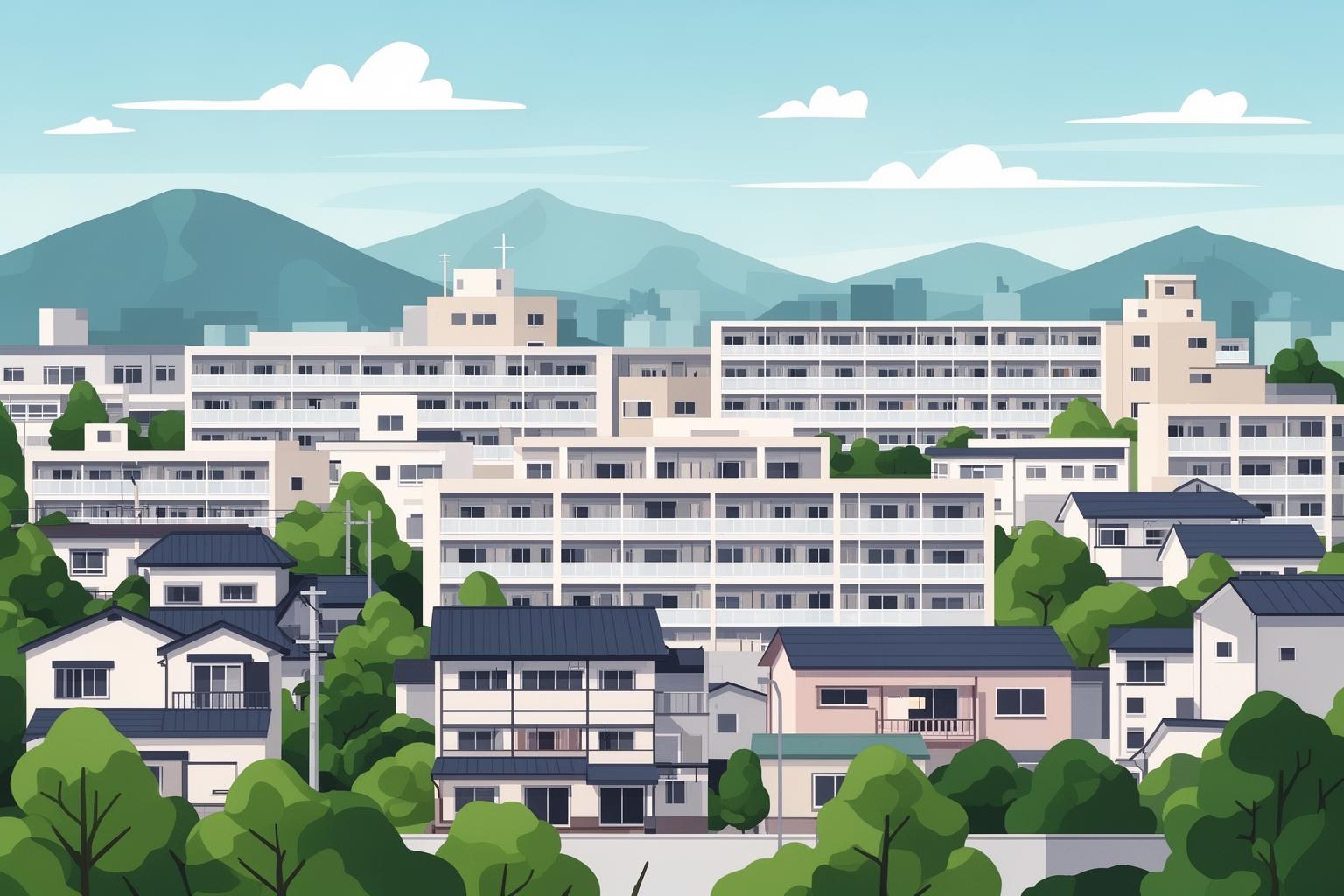
We’ve explored the history, the rise, the fall, and the rebirth. Yet one major question remains: why the vibe? Why do these endless grids of concrete hold such a strong emotional and aesthetic appeal? It’s a complex sensation—a blend of nostalgia for a past you never experienced, a feeling of serene melancholy, and an admiration for a beauty that defies convention. It’s about observing these structures and sensing the weight of millions of lives lived behind their walls.
Wabi-Sabi in Concrete? Discovering Beauty in Imperfection
In Japanese aesthetics, there’s the concept of wabi-sabi—a philosophy focused on embracing transience and imperfection. It’s about appreciating beauty in things that are modest, humble, and unconventional. Though often linked to cracked pottery or moss-covered stones, one could convincingly argue for a form of concrete wabi-sabi in the aging Danchi.
The charm of an old Danchi doesn’t lie in flawless architectural lines. Rather, it’s in the marks time has left behind. It’s the water stains streaking the facade into abstract patterns, the peeling paint, rusted railings, and ivy creeping up the walls. It’s the patchwork of varied curtains and laundry swaying from balconies, each a small sign of individual lives unfolding within uniform boxes. These imperfections tell stories, giving the buildings character, a sense of history and lived experience that sleek new condominium towers can’t replicate.
Liminal Spaces: The Haunting Emptiness
Danchi often feel like liminal spaces—places “in-between.” They stand between the bustling city center and the quiet countryside, between past and present, between shared dreams and personal realities. Walking through a large Danchi complex, especially on a quiet weekday afternoon, can feel like entering another realm.
The long, repetitive corridors, identical stairwells, and empty playgrounds, where echoes of laughter seem to linger, create a deeply atmospheric—and sometimes eerie—mood. It’s a space heavy with absence. The scale and uniformity can unsettle, making you feel small and anonymous. Yet within that anonymity is a strange tranquility. This haunting, melancholic essence is what artists and photographers find endlessly compelling. It’s a silent stage for the everyday drama, where you can almost hear the echoes of the past.
The Anime Connection: Danchi as a Visual Trope
For many outside Japan, the Danchi aesthetic is most familiar through anime and manga. Creators use Danchi as a powerful visual and narrative device. It’s a setting instantly recognizable to a domestic audience, conveying a wealth of meaning without a single word.
A story set in a Danchi often hints at themes of working-class life, childhood nostalgia, or social isolation. In slice-of-life anime, the Danchi playground is the classic scene for childhood friendships and first loves, bathed in warm, golden-hour light. In psychological thrillers or sci-fi series like Gantz, the same repetitive concrete facades symbolize oppressive conformity and a maze-like prison the characters must escape. In the works of melancholic masters like Inio Asano, the Danchi remains ever-present, its stark, lonely geometry perfectly reflecting his characters’ inner alienation.
In anime, the Danchi is more than just a background; it’s a character itself, a silent witness to the small victories and profound tragedies of ordinary Japanese life. This rich visual legacy has shaped a global audience’s perception of Danchi—not as dull housing blocks, but as places brimming with emotional and narrative depth.
So, What’s the Real Deal with Danchi?
After exploring the layers of history, sociology, and aesthetics, what do we discover? The truth is that the Danchi is not a single entity. It embodies a paradox. It stands as a symbol of both Japan’s greatest collective achievements and its most significant demographic challenges. It represents both a nostalgic longing for a simpler past and a potential model for a more sustainable, community-oriented future.
The “concrete utopia” feeling goes beyond the architecture; it encompasses the entire narrative embedded within those walls. It carries the spirit of the post-war economic miracle, the steady rhythm of countless salaryman families beginning their lives, the quiet emptiness of deserted playgrounds, and the fresh, creative energy of a generation reclaiming the space on their own terms.
To grasp the essence of the Danchi is to grasp the path of modern Japan. It is a physical timeline that one can walk through. These buildings are more than just housing. They serve as repositories of memory, monuments to a particular dream and the complex, often messy reality that ensued. They are hauntingly beautiful precisely because they are so deeply, profoundly human. And that feeling will never truly disappear.