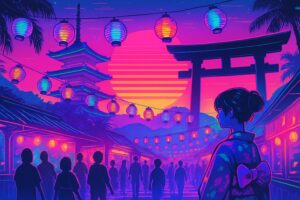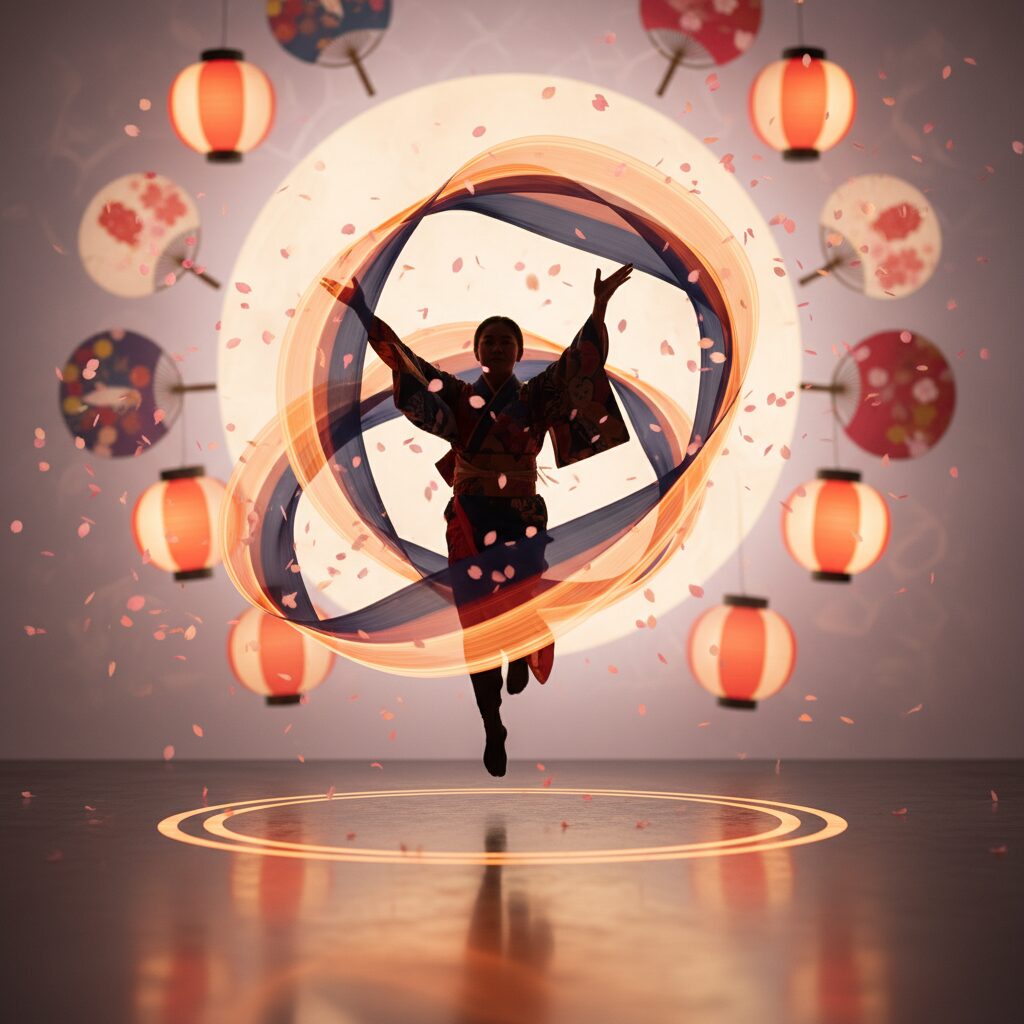
Yo, what’s up. Ryo here. Picture this: It’s August in Tokyo. The air is so thick you could swim in it, the cicadas are screaming their little heads off, and the sun has finally clocked out for the day. You’re wandering through some random residential neighborhood, miles away from the neon chaos of Shibuya, when you hear it. A deep, thumping drumbeat. A looping, kinda nostalgic melody being sung by a high-pitched voice. You follow the sound, turn a corner, and boom. There it is. A schoolyard, a small park, maybe just a blocked-off street, transformed. Rows of paper lanterns—the chochin—are glowing, casting this warm, almost sacred light. In the center, there’s a wooden tower, the yagura, looking like a makeshift festival throne. And around it, a circle of people. Dozens, maybe hundreds. Little kids in superhero-themed jinbei, teenagers looking way too cool in their perfectly tied yukata, parents, grandparents, all moving as one. They’re clapping, turning, stepping forward, stepping back, in a seemingly endless, hypnotic loop. You’ve seen this on TikTok, probably. It’s the Bon Odori, the quintessential Japanese summer dance. And your first thought might be, “Okay, cute. A little retro. But… what is this, really? Is it a mandatory neighborhood exercise class? A rehearsal for a massive flash mob?” It feels both incredibly public and deeply personal, ridiculously simple yet strangely profound. You’re on the outside looking in, and the vibe is infectious but also kinda confusing. This isn’t a performance for tourists. Nobody’s selling tickets. This is just… happening. And that’s the whole point. This circle isn’t just a dance formation; it’s a living, breathing cross-section of Japanese society, and understanding why it exists tells you more about this country than a thousand guidebooks ever could. It’s a tradition that feels ancient but is happening right now, a communal ritual hiding in plain sight. Before we dive deep into the cultural matrix behind it all, let’s ground ourselves in a typical spot where this magic happens. Check the map—this is Tsukiji Hongwanji, a temple famous for its massive, energetic Bon Odori, but the same spirit is found in countless smaller circles all over Japan.
To feel another side of Japan’s intense summer energy, check out the modern-day fire festival vibe of the bōsōzoku.
First Impressions vs. The Real Deal: Breaking Down the Bon Odori Scene
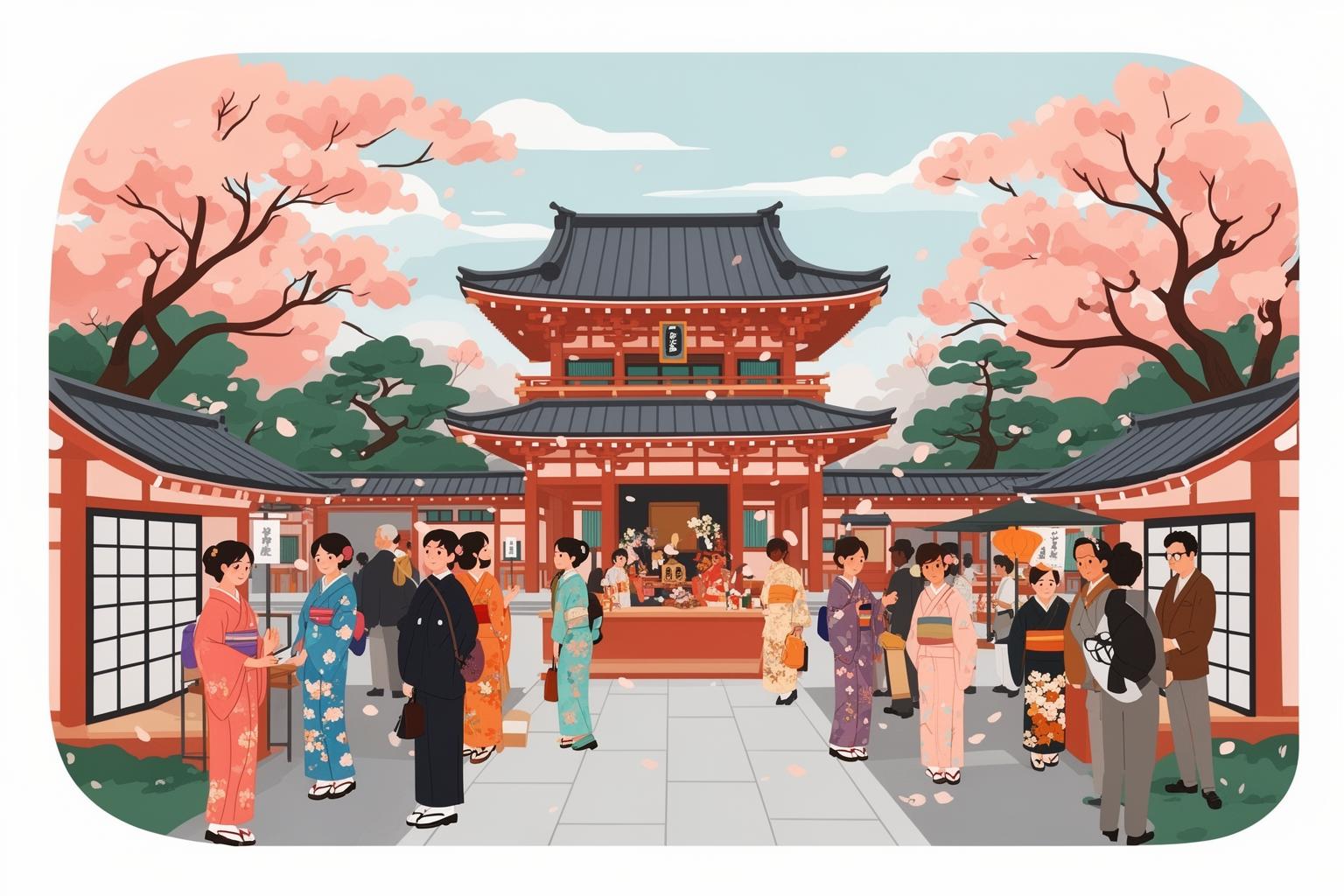
So, you’re standing there, taking it all in. The scene is a complete sensory experience, with every element packed with meaning that can easily be overlooked if you’re just scrolling past a video. It’s tempting to dismiss it as merely a quaint Japanese tradition, like line dancing but with more lanterns. However, let’s pause and focus on the details, because the setup itself is a masterful example of Japanese community aesthetics and social design. It’s all about creating a space that feels special and temporary, yet deeply rooted and welcoming to everyone, with no insider knowledge necessary.
The Visuals: Beyond Just Beautiful Lanterns
Your eyes are immediately drawn to two features: the central tower and the lanterns. The yagura is not simply a platform for musicians and singers. It serves as the axis mundi of this temporary world. It’s the source of the rhythm, the visual center that the whole community literally revolves around. Often constructed from scratch by neighborhood volunteers, it’s a rough but heartfelt piece of temporary architecture. Watching the local dads and granddads put it together in the days before the festival is a ritual in itself. It signals to everyone that something is about to unfold here. This ordinary space is about to become sacred, in a modest, communal way.
Then there are the chochin, the paper lanterns. From a distance, they form a beautiful, warm canopy of light. But if you get closer, you’ll notice many have names written in bold, black calligraphy. These aren’t random decorations. They’re a visual directory of the community’s support network. Each lantern represents a donation from a local family, a neighborhood shop, or a small business. The noodle shop down the street, the nearby real estate agent, the Suzuki family in apartment 3B. It’s their way of contributing, a quiet statement of belonging. This public but understated display of affiliation weaves the neighborhood together. In a society where open declarations of community can be rare, the lanterns glow as a tangible symbol of the invisible bonds holding the place together. They literally illuminate the event with collective spirit. And the clothing, the yukata, plays a huge role in this aesthetic transformation. It’s not the heavy, elaborate kimono you might imagine. A yukata is a light, cotton summer garment, essentially a chic bathrobe. It’s the official yet unofficial uniform of summer relaxation. Putting one on signals to yourself and others that you’re shifting from work mode to festival mode. It’s an easy way to feel festive and connected to the tradition. Crucially, there’s no dress code. Half the crowd will be in shorts and t-shirts, and that’s perfectly fine. This informality is key to the Bon Odori’s accessibility. You can come as you are. The yukata is an invitation, not a requirement—a way to deepen your participation if you catch the vibe.
The Moves: Is Everyone a Skilled Dancer?
Now, the main event: the dance itself. Watching the circle is mesmerizing. Everyone seems to know the steps. But the moves themselves are… well, quite simple. A step forward, a clap. A little turn. A gesture that looks like pulling a rope or digging with a shovel. This is no high-art performance. It’s not about individual skill or showing off. The simplicity is intentional. It’s created for mass participation, so a three-year-old and an eighty-three-year-old can dance side-by-side. The goal is unity, not technical precision.
So how does everyone know the dance? Here’s the secret: they don’t, at least not always. You learn by doing. You find a gap in the circle, stand behind someone who seems to know what they’re doing, and just… copy them. It’s a monkey-see, monkey-do process. No one will judge you for messing up. In fact, seeing someone fumble the steps with a smile is a cherished part of the experience. It shows they’re trying, they’re engaged. This creates a wonderfully low-pressure atmosphere. The only barrier to entry is the courage to step inside the circle. And what’s fascinating is that these simple moves are often rich in local history. The famous “Tanko Bushi” (Coal Miner’s Song) features motions mimicking coal digging, pushing a cart, and hanging a lantern. It’s a dance born from the daily life of coal miners in Fukuoka. The “Tokyo Ondo” incorporates gestures representing the city’s landmarks. Each region, sometimes each small neighborhood, has its own unique dance, a piece of kinetic local history passed down through generations. So when you see people dancing, they’re not just moving their bodies—they’re embodying the story of their hometown. It’s a history lesson you feel in your bones, a shared muscle memory connecting the present to the past.
The “Why” Behind the Vibe: Ghosts, Community, and a Summer Release
Alright, so we have the scene set: glowing lanterns, a central tower, simple dances. It’s a lively neighborhood block party. But the real question is why. Why has this particular ritual of dancing in a circle endured for centuries? Why does it still hold such a strong appeal in hyper-modern Japan? The answer is a fascinating blend of Buddhist spirituality, practical social engineering, and the timeless human need to unwind on a hot summer night. The surface fun actually rests on some profoundly deep cultural currents.
So… Is It Really About Welcoming Spirits?
Let’s address the main point first. The “Bon” in Bon Odori comes from Obon, a Buddhist-Confucian tradition observed in mid-August. This is the time when it’s believed that the spirits of ancestors return to visit their relatives. It’s somewhat like Japan’s version of Mexico’s Day of the Dead, but with a more reserved, less skull-focused atmosphere. Families gather to visit and clean ancestral graves and make offerings at home altars (butsudan). And Bon Odori? It began as a folk dance meant to welcome and entertain these visiting spirits. Think of it as a welcome party for your ghostly ancestors. This spiritual foundation underpins the entire event. That’s why some of the music carries a slightly melancholic, haunting tone. It’s a dance that connects the living with the dead. The repetitive movements and chanting can be viewed as moving meditation, a way to honor those who came before.
Here’s the key to understanding modern Japan: for most participants, the deep religious meaning is more of an undercurrent than a conscious thought. They’re not actively thinking, “I’m dancing for my departed grandfather right now.” Yet, that spiritual origin story gives the event a certain weight, a purpose beyond mere enjoyment. It lends the gathering a soul. This unspoken, shared understanding lifts it from a simple party to a significant tradition. Culture is operating at a subconscious level. The history is embedded in the atmosphere, creating a sense of connection to something larger than oneself—a timeline stretching back centuries. You don’t have to believe in ghosts to feel the heft of that history in the thumping of the taiko drum.
The Social Bond of the Neighborhood
If the spiritual aspect is the historical base, the social role is the modern framework holding it all up. In a country where daily life, especially in big cities, can be extremely anonymous and compartmentalized, Bon Odori serves as a powerful remedy. It’s one of the rare occasions when an entire community—people of every age and social tier—gathers in a shared public space for one purpose. This doesn’t just happen spontaneously. It’s coordinated by local chonaikai or jichikai (neighborhood associations). These volunteer groups of local residents and business owners are the unsung heroes of community life in Japan. They handle city permits, build the yagura, hang every single lantern, and clean up afterward. It’s a huge, often thankless effort driven by civic pride and the desire to keep the tradition alive.
Bon Odori reveals this usually unseen social infrastructure. It’s where neighbors who might otherwise just exchange a nod in passing get to connect. It’s a place where generations meet in the best way. You’ll see grandparents patiently teaching grandchildren the dance moves. Teenagers, who might spend most of their time online, are out in the real world, hanging with friends, snapping selfies in their yukata. Parents get a break from their usual routine, chatting with other parents while their kids run wild with sparklers. It’s a temporary, pop-up town square. In a society that values harmony but can be reserved in direct communication, the shared dance serves as perfect social lubricant. You don’t have to make small talk; you just dance together. The circle acts as a great equalizer. Inside it, you’re not a CEO or a part-time cashier; you’re simply another dancer, part of the collective, moving in sync. It’s a tangible expression of the Japanese ideal of community, where the group matters more than the individual.
The Sensory Overload: It’s Not Just a Dance
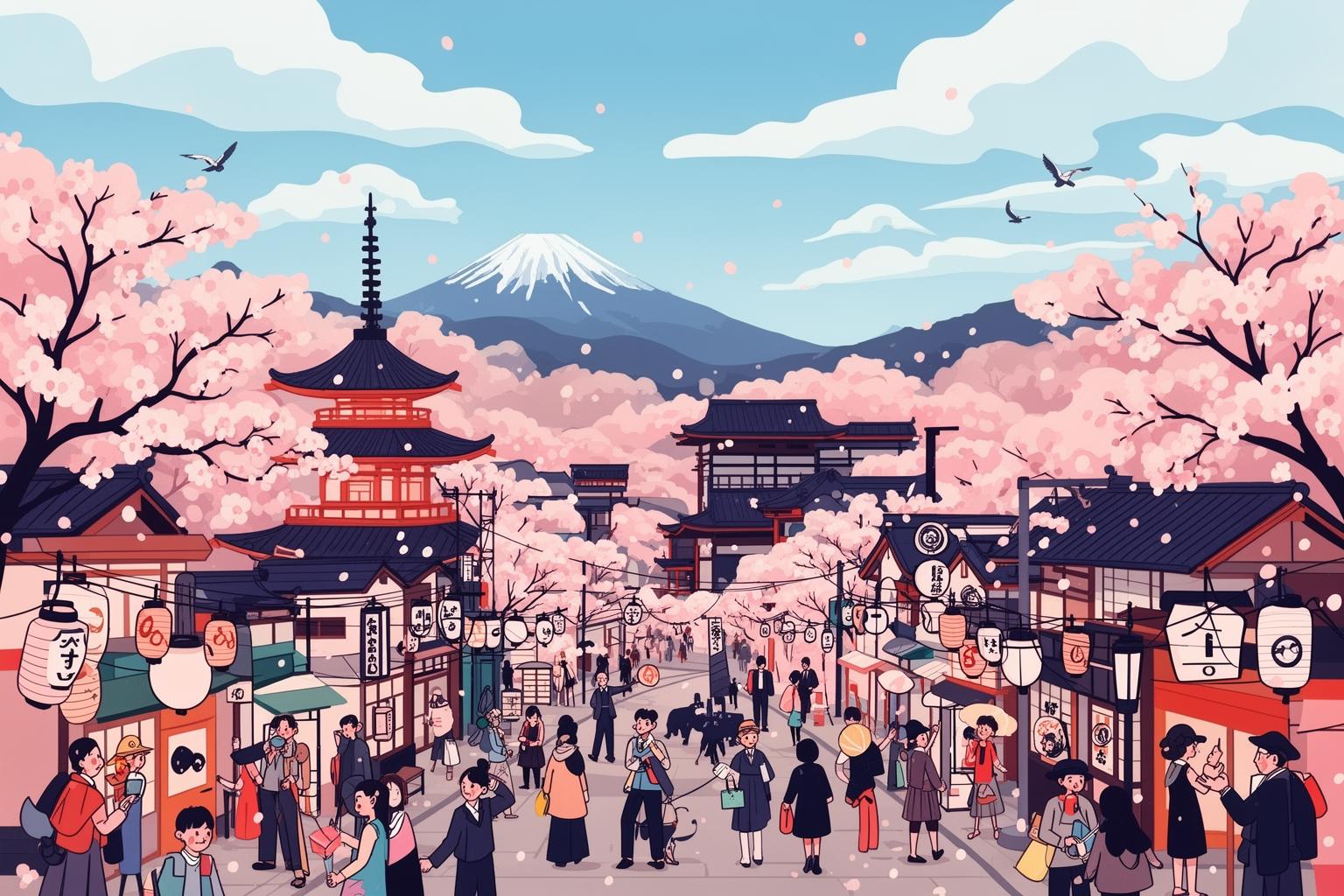
While the dance is the focal point, the Bon Odori experience is a full sensory immersion. It’s a rich blend of sounds, smells, and tastes that are as essential to the event as the dance steps themselves. Overlooking these elements is like trying to appreciate a concert by only viewing a still image of the band. The atmosphere is everything, crafted from a carefully orchestrated (or perhaps chaotically evolved) mix of audio and culinary traditions that define the Japanese summer festival, the natsu matsuri.
The Soundtrack of Japanese Summer
Close your eyes at a Bon Odori and simply listen. The soundscape is unmistakable. At its core is the taiko drum. It’s not just an instrument—it’s a physical force. The deep, resonant don-don beat isn’t merely heard; it’s felt in your chest. It’s a primal, grounding rhythm that serves as the heartbeat of the entire event, drawing everyone into its pace. Over this percussive base, you hear the melody, usually a type of folk music called ondo or bushi. The vocals often come in a high-registered, slightly nasal tone that might sound odd to the untrained ear, but it’s meant to carry across a noisy festival without modern amplification. The songs themselves are highly repetitive, which is vital for a dance that can last hours. The looping becomes hypnotic, helping you turn off your conscious mind and simply move.
What makes the soundtrack truly unique in modern Japan is its beautiful, sometimes quirky blend of old and new. For every traditional folk song about fishing villages or cherry blossoms, there’s an “Anpanman Ondo”—a Bon dance version of a popular children’s anime theme song. The kids go wild for this, and energy levels soar as they sing along while perfectly following the moves. In some places, you’ll even hear outrageous remixes of J-Pop hits or the famous theme from the anime Neon Genesis Evangelion, reworked with a taiko beat. This might seem irreverent, but it actually signals a vibrant, living tradition. It shows that Bon Odori is not a dusty relic. It’s a flexible cultural platform that absorbs and adapts to new influences, maintaining its relevance for younger generations. The format—a circle dance to a repetitive beat—remains constant, but the content evolves. This blend keeps the event from feeling like a chore or history lesson, turning it instead into a truly fun, cross-generational celebration.
The Taste of the Festival: Beyond the Dance Floor
Surrounding the dance circle is another equally vital realm: the constellation of yatai, or food stalls. The smells of a Bon Odori are unforgettable. The sweet, smoky fragrance of grilled squid (ikayaki), the savory scent of soy sauce sizzling on a hot plate of fried noodles (yakisoba), the sugary aroma of cotton candy (wata-ame). This isn’t mere background noise; it’s a fundamental part of the experience. The yatai offer a break from dancing, a spot to refuel and socialize differently. It’s where teenagers who are too cool to dance with their parents hang out, and where families grab treats for their kids. The food is simple, classic festival fare: takoyaki (octopus balls), karaage (fried chicken), grilled corn on the cob, and for dessert, chocolate-covered bananas or heaps of shaved ice (kakigori) drenched in vibrant syrup. It’s not gourmet dining, but comfort food that tastes infinitely better when eaten outside on a warm summer night, illuminated by the glow of lanterns.
The food stalls also play a vital social role. They break the intensity of the dance and create spaces for casual interaction. Waiting in line for yakisoba becomes a chance to talk with neighbors. Choosing which flavor of kakigori to get is a low-pressure activity that encourages connection. Alongside classic festival games like kingyo-sukui (goldfish scooping) or target practice, the stalls turn the event from a simple dance into a full neighborhood festival. It offers something for everyone, even those too shy or unwilling to join the dance circle. You can take part simply by being there, enjoying the food and soaking in the ambiance. This layered approach ensures the event appeals broadly and can continue for hours, becoming the signature community gathering of the summer.
Getting in the Circle: The Tourist vs. The Participant
So, you’ve been watching from the sidelines, grabbed some takoyaki, and you’re soaking in the vibe. The beat is infectious. The shared joy is palpable. Then the question arises—the one that holds back so many foreign visitors: “Can I… can I really join in? Is that allowed? Will I mess it up? Will people stare?” This hesitation is completely natural. Japan is known for its many unspoken rules, and the last thing you want is to commit a cultural faux pas. But when it comes to Bon Odori, the answer isn’t just “yes”—it’s a loud, enthusiastic “HELL YES.”
“Can I, a Foreigner, Actually Join In?”
Joining the circle isn’t just allowed; it’s often quietly encouraged. The spirit of Bon Odori is all about open, communal participation. The circle is meant to be porous. The goal is to expand it, bringing more people into the shared rhythm. The etiquette is refreshingly simple: just jump in. Find a natural gap in the ring of dancers, slip into it, and try to follow the moves of the person in front of you. That’s all. No one expects you to have memorized the choreography. No one’s grading your steps. The local obaa-chan (grandmas), who are usually the most skilled dancers and keepers of the tradition, will likely give you a warm, encouraging smile. They’re thrilled to see anyone, Japanese or otherwise, taking an interest and helping keep the tradition alive.
Being in the circle is a unique experience. The first minute is pure self-consciousness—your feet trip up, your hands do the wrong moves, you turn left when everyone else turns right. But then something shifts. The repetitive music and collective movement start to take over. Your mind stops overthinking the steps and begins to feel the flow. You become part of a bigger, moving organism. You’re no longer just an observer—you’re a participant. Your energy contributes to the whole. This experience of silent, synchronous movement with a hundred strangers is a powerful form of communication. It transcends language barriers. In that circle, you’re not a tourist anymore. You’re simply another person, connected to everyone around you by a shared beat under the summer sky. It’s a sense of belonging that’s instant and profound, an experience you won’t get just by watching from the sidelines.
Reading the Room: Not All Bon Odori Are the Same
One important tip is to remember that “Bon Odori” isn’t a single, uniform event. Its atmosphere can vary greatly depending on where you are. It’s crucial to read the room and set your expectations accordingly. On one end, there are massive, famous festivals like Gujo Odori in Gifu, where dancing goes on all night, or Awa Odori in Tokushima (which is technically a different style but shares the same summer festival spirit). These huge, city-wide events feel like a blend of a parade and a massive street party. They are thrilling spectacles, and with so many people, it’s easy for newcomers to blend in and dance freely.
At the other end, there are the very local Bon Odori gatherings—sometimes held in a small shrine parking lot or at a local elementary school. The crowd might be only a hundred people, and it can feel like you’re interrupting a private family celebration. These smaller events might feel more intimidating to join at first. You’re bound to stand out. But if you muster the courage to step into the circle, the reward is great. This is where you experience the festival’s true community-building spirit. People are more likely to engage with you, show you the steps, and welcome you as a temporary neighbor. It feels less like a performance and more like an authentic communal gathering. So, which is better? Neither—they’re just different. The big ones offer the electrifying energy of the masses, while the small ones bring the intimate warmth of a close-knit community. Experiencing both gives you a deeper understanding of what this tradition means to Japan.
The Modern Twist: Is Bon Odori Fading or Evolving?
It’s easy to romanticize traditions like Bon Odori, viewing them as timeless and unchanging cornerstones of Japanese culture. However, the truth is that they are living traditions, influenced by the pressures and changes of modern society. For every lively festival, there’s another that has quietly disappeared. Whether Bon Odori is a dying art form or a tradition undergoing significant transformation is a widely debated topic in Japan. The challenges are genuine, but so is the remarkable creativity being applied to keep the circle turning for future generations.
The Challenge of Keeping the Beat Going
Let’s be honest: organizing a Bon Odori requires a tremendous amount of effort. This responsibility largely falls to volunteer neighborhood associations called chonaikai. Many members of these groups are elderly, raising real concerns about who will take over when they are no longer able to manage the event. Younger generations, often working long hours or less connected to their immediate local community, are not always stepping up to fill the gap. This demographic shift poses a serious threat to local festivals across the country.
Moreover, modern urban life brings its own challenges. In densely populated cities like Tokyo, noise complaints are a significant issue. The loud music and drumming essential to the festival can disturb residents who aren’t participating. This has led to a fascinating and somewhat dystopian adaptation: the “Silent Bon Odori.” At these events, the main speakers are turned off, and participants wear wireless headphones broadcasting the music. From an outsider’s perspective, it looks surreal—large crowds dancing in near silence, with only the sound of footsteps and clapping. This is a clever, practical solution to a contemporary problem, but it also reveals the compromises traditions must make to survive in the 21st century. While it preserves the visual and participatory aspects, some might argue that the shared public soundscape—the very element that draws people in from blocks away—is lost.
The New Wave: Re-imagining Tradition
But it’s not all pessimism. For every story of decline, there is another of amazing innovation. The core idea of Bon Odori—a simple, participatory circle dance—has proven to be surprisingly resilient and adaptable. A new generation of organizers, artists, and communities are rethinking what a Bon Odori can be. Some companies now host Bon Odori events for employees as a form of team building. Modern cultural centers and art projects are incorporating Bon dance into their programs, sometimes collaborating with DJs who blend traditional ondo music with house beats and electronic synthesizers, creating a vibe that feels both retro and futuristic.
Pop culture has embraced the format enthusiastically. At anime conventions, for example, you might find a Bon Odori where participants dance to the themes of their favorite shows. Some forward-thinking temples hold “Bon-Disco” nights to attract younger audiences. These events may seem gimmicky to purists, but they are essential for the tradition’s survival. They introduce the format to people who might never attend a traditional neighborhood festival. They demonstrate that the spirit of Bon Odori isn’t tied to any specific style of music or location. It’s linked to the act of coming together, sharing space, and moving as one. Whether the rhythm comes from ancient taiko drums or a DJ’s turntable, the fundamental human desire for connection remains unchanged. This ongoing evolution prevents Bon Odori from becoming a mere relic, ensuring it will continue to be the soundtrack of the Japanese summer for many years to come.
The Takeaway: More Than Just a Dance
So, let’s return to where we began. You’re standing at the edge of a local park on a stifling August night, watching a group of strangers dance in a circle. At first glance, it appears simple, perhaps even slightly quaint—a touch of old-fashioned charm in a country celebrated for its cutting-edge technology and minimalist style. It’s easy to snap a quick photo for your Instagram story, tag it #OnlyInJapan, and move on. But hopefully, now you realize you’re not merely watching a dance. You’re witnessing a living, breathing blueprint of how Japanese society functions at its finest.
You’re seeing echoes of an ancient spiritual tradition, a moment to connect with the past and honor ancestors, even if it feels like just a whisper amid the festival’s background noise. You’re observing the remarkable, often unseen power of the local community—the volunteer spirit that literally builds the stage and strings the lights to create a space for connection. You’re witnessing a social equalizer in action, a rare setting where age, status, and background fade away into a shared rhythm, where belonging is found not through words but through synchronized movement. This isn’t a grand, top-down cultural performance. It’s a grassroots, bottom-up expression of identity and unity. The Bon Odori is a masterclass in building and sustaining community.
It reminds us that in a world growing increasingly fragmented and individualistic, there is deep power in simple, collective joy. It’s a physical embodiment of harmony—not as a rigid, abstract idea, but as a tangible experience. The beauty of Bon Odori lies in its openness. Its simplicity is its brilliance. The circle is always welcoming. It invites you to stop watching your life or travels from the sidelines and become a participant, even if only for a few songs. This is the authentic Japan, not the version packaged for tourists or exaggerated in media. It hides in plain sight—in countless schoolyards and shrine parking lots—waiting for you to find the courage to step in, stumble through the steps, and become part of the circle, all beneath the warm, forgiving glow of paper lanterns.