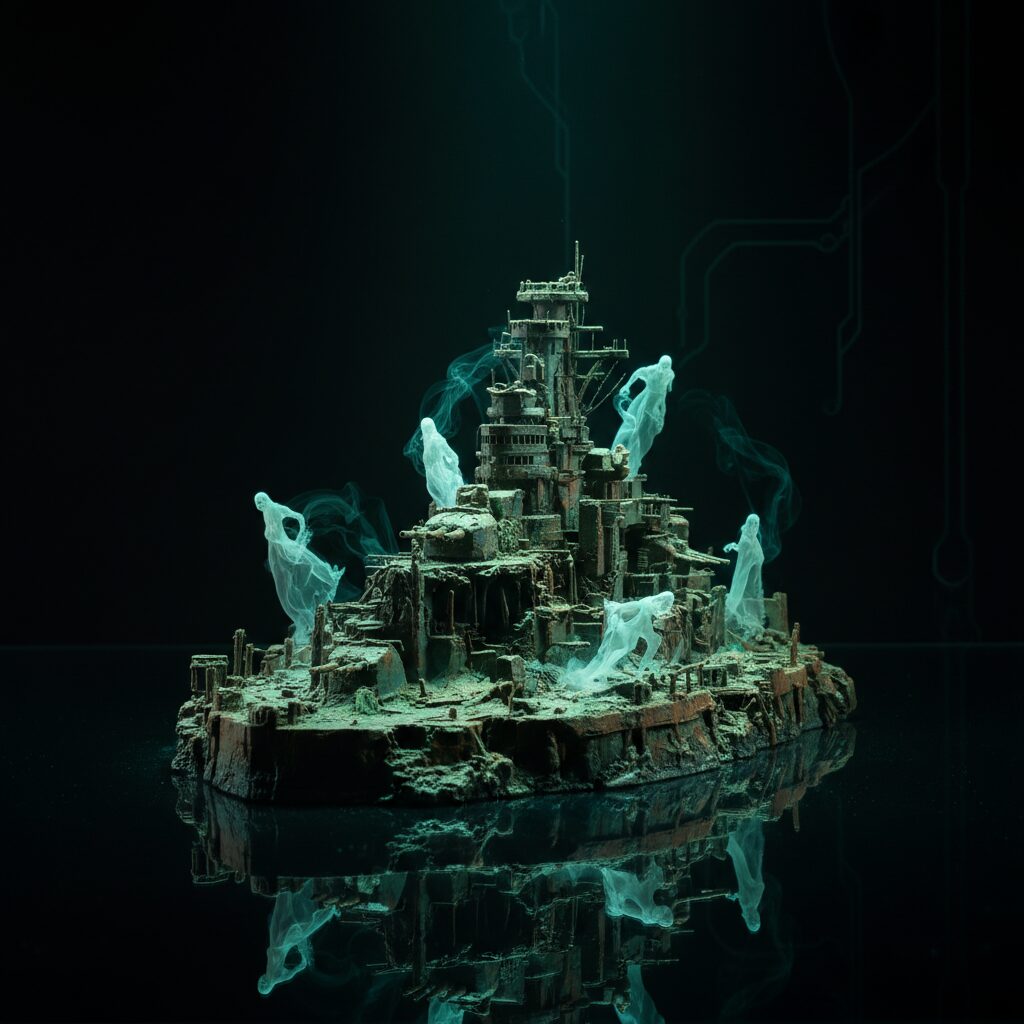
So you’ve seen the pictures. A fortress of decay rising from the sea, a concrete labyrinth that looks like the final level of a video game. Maybe you saw it in the Bond film Skyfall and thought, “That’s the ultimate villain’s lair.” On Instagram, it’s a paradise of ruin porn, tagged #haikyo, #urbex, #abandoned. It’s Gunkanjima, or “Battleship Island,” the undisputed king of Japan’s abandoned places. The aesthetic is undeniable. It’s cool, it’s epic, it’s haunting. But if you stop there, you’re missing the entire point. The real question isn’t what it is, but why it is. Why does this place send a shiver down the spine of modern Japan? Because Gunkanjima isn’t just a ruin; it’s a time capsule. It’s a perfect, concrete miniature of Japan’s 20th-century dream, its brutal costs, its sudden collapse, and the uncomfortable questions it leaves behind for the Japan of today. It’s not just a ghost story about a dead city; it’s the story of the ghost in Japan’s own machine, the spirit of an era that the country is still trying to understand. Before we dive into the depths of what this island truly represents, let’s pinpoint this phantom rising from the waves.
To understand the full context of this industrial ghost, consider how it fits into the larger story of Japan’s forgotten mining towns.
The Island That Coal Built: A Concrete Dream in the Middle of the Sea
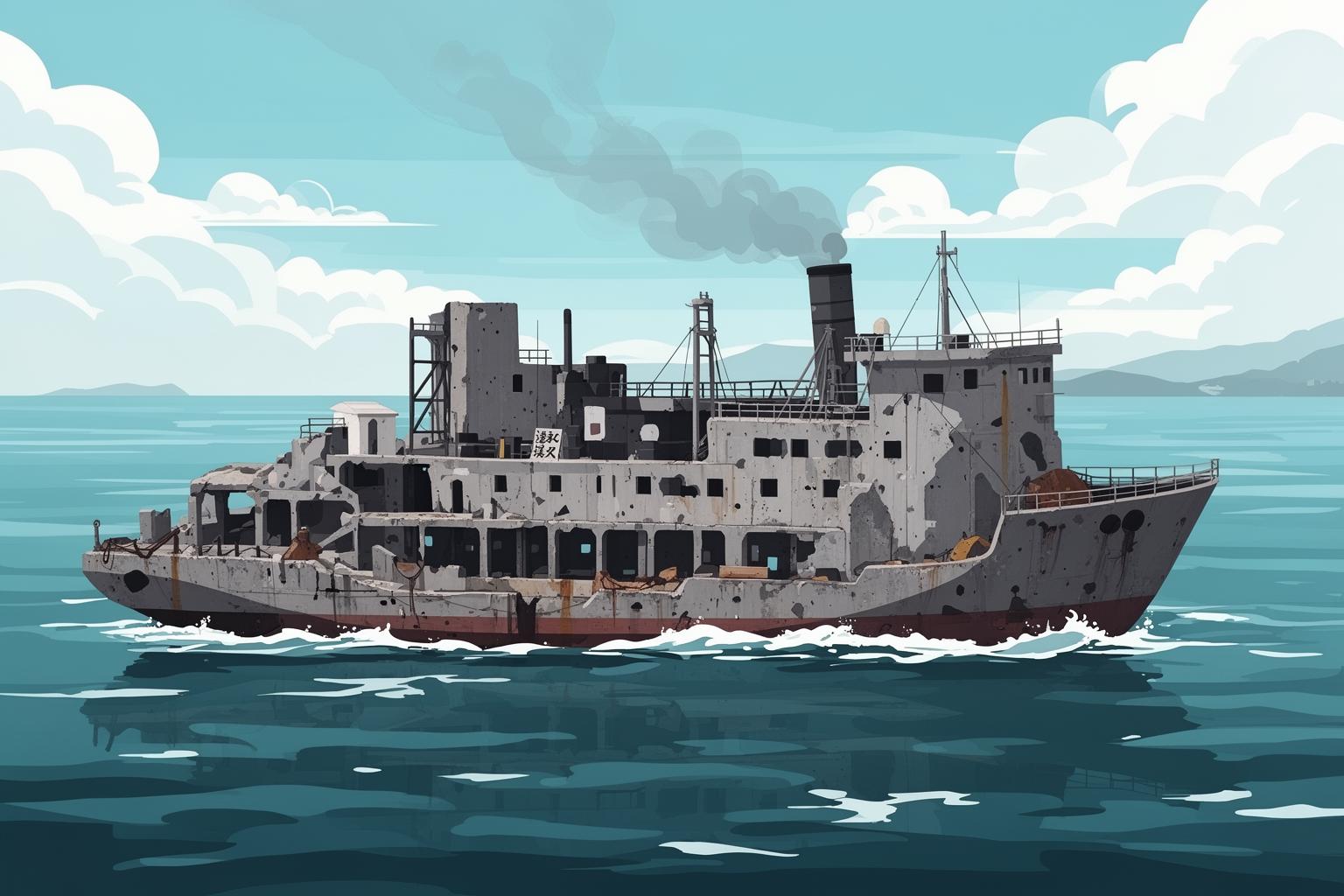
To understand Gunkanjima, you first need to grasp the hunger that gave rise to it. This was no accidental settlement; it was an industrial marvel of staggering ambition—a purpose-built mechanism for living and dying, all driven by one goal: coal. The story begins not with ghosts and decay but with fire and steam.
The Birth of a City
Picture Japan in the late 19th century. Emerging from centuries of feudal isolation during the Meiji Restoration, the nation was locked in a desperate sprint to rival Western colonial powers. The rallying cry was Fukoku Kyōhei—“Enrich the country, strengthen the army.” What powered this industrial revolution? What fueled the ships, factories, and the entire machinery of a modern state? Coal—black, messy, indispensable coal.
Off the coast of Nagasaki lay a small, unremarkable rock called Hashima. Barely more than a reef and a resting spot for fishermen, beneath its surface were rich veins of high-quality coal. In 1890, the Mitsubishi conglomerate—one of the powerful zaibatsu industrial groups closely aligned with the government’s modernization efforts—purchased the island. Their plan was not simply to extract coal but to build a permanent, self-sufficient city directly atop the mine shafts that stretched over a kilometer below the seabed. This was efficiency pushed to the edge of madness.
In the following decades, they undertook an enormous land reclamation project. Using mine slag, they constructed seawalls and poured concrete, tripling the island’s area. They shaped and reinforced it against the fierce typhoons of the East China Sea. As the island expanded, its jagged skyline crowned with the mine’s headframe came to resemble the Imperial Japanese Navy’s flagship battleship, the Tosa. The nickname endured: Gunkanjima, the Battleship Island.
Life Inside the Concrete Forest
To modern eyes, the deteriorating blocks are nightmarish. But for the thousands of Japanese workers and their families during the island’s post-war prime, Gunkanjima was a beacon of hope—a golden ticket. At a time when much of Japan was still recovering from World War II, a job with Mitsubishi on the island meant steady wages, modern housing, and access to a startlingly modern lifestyle. It was the Showa-era dream condensed into a small island.
This tiny landmass—just 480 meters long and 160 meters wide—crammed over 5,200 residents at its 1959 peak, giving it the highest population density ever recorded. To house them, Mitsubishi built a vertical city, a forest of reinforced concrete. In 1916, they completed Building 30, a massive seven-story apartment block—the first large-scale reinforced concrete building in Japan. Built like a fortress to shelter workers and endure typhoons, it was revolutionary architecture foreshadowing the high-density urban living that would define Tokyo and Osaka.
Life was lived openly, amid narrow stairways and winding corridors linking the apartment blocks, earning the island another nickname: “the island without corridors.” There were no cars, no soil—just a maze of concrete paths. Yet this was no prison. It was a vibrant, self-contained society with everything needed to thrive: a primary and junior high school with a rooftop playground; a hospital equipped with advanced medical gear; shops, a market, a post office, and a police box. For leisure, there was a cinema showing the latest mainland films, multiple bars and restaurants, pachinko parlors, a mahjong club, and even a Buddhist temple and Shinto shrine. Amenities included a communal bathhouse, barber shop, and a swimming pool filled with filtered seawater.
Residents enjoyed consumer comforts that were the envy of mainland Japan. Televisions, refrigerators, and washing machines—the post-war “three sacred treasures”—were commonplace on Gunkanjima long before they became widespread elsewhere. Mitsubishi supplied everything, creating strong community bonds and company loyalty. Everyone’s father worked the mine. Everyone’s children attended the same school. Festivals were celebrated together, typhoons endured together, lives ruled by the mine’s whistle. It was a cradle-to-grave ecosystem, the embodiment of the Japanese corporate-family ideal.
The Paradox of Progress
Gunkanjima was the symbol of Japan’s post-war economic miracle. It demonstrated the nation’s ability to overcome immense challenges through resolve, engineering, and collective effort. The island embodied the trade-off of the era: sacrificing personal space and freedom in exchange for shared prosperity and security. Its crushing population density was not seen as a burden but as a source of unity and common purpose. On Gunkanjima, no one was ever alone.
This relentless drive was fueled by men toiling deep beneath the earth and sea. Their work was grueling and hazardous—a constant fight against heat, humidity, and the dangers of gas explosions and cave-ins. Yet it was also a source of pride. These men were soldiers on the front lines of Japan’s economic resurgence, powering the nation’s revival. The island stood as a beacon of hope and progress—a concrete promise that labor would yield a better future. It was the Japanese Dream, built on rock and coal, held firm by concrete and communal spirit.
The Unspoken History: The Shadows Beneath the Miracle
This celebrated story of post-war modernity and community is the version you will frequently hear on official tours. It tells of Japan’s industrial heritage, the narrative that helped secure its UNESCO World Heritage status. However, this is only part of the story. To truly understand Gunkanjima, and by extension modern Japan’s complex relationship with its past, one must delve into the shadows—into the years before the economic miracle, when the island was a place of immense suffering.
Forced Labor: The Pre-War and Wartime Reality
Long before it became a Showa-era utopia for Japanese families, Gunkanjima played a crucial role in Japan’s imperial expansion. From the 1930s until the end of World War II in 1945, the Japanese government enacted national mobilization policies to support its war efforts. As Japanese men were deployed to the front lines, a severe labor shortage crippled domestic industries, including vital coal mines. The solution was forced labor.
Hundreds of Korean civilians, from a peninsula then under Japanese colonial rule, along with Chinese prisoners of war, were forcibly brought to Japan and made to work in its mines, factories, and construction sites. Gunkanjima was one of the most notorious sites. The conditions were hellish. They were coerced into working in the deepest and most dangerous sections of the mine, often with inadequate tools and safety gear. The work was grueling, hours were long, and food was scarce. Survivor testimonies recount constant hunger, disease, and frequent beatings from Japanese foremen. Escape was impossible; they were confined to a tiny island prison surrounded by the sea.
Though records are incomplete and disputed, it is estimated that hundreds of forced laborers died on Gunkanjima due to accidents, malnutrition, and exhaustion. This history remains the island’s darkest and most painful secret. It starkly reminds us that Japan’s industrial modernization—the very foundation of its 20th-century power—was built not only on the willing sacrifices of its own people but also on the forced sacrifices of others.
This dark chapter lies at the heart of the controversy surrounding Gunkanjima’s UNESCO listing. When the site was inscribed in 2015 as part of a collection titled “Sites of Japan’s Meiji Industrial Revolution,” South Korea protested strongly, arguing that the story of forced labor was being erased. Japan promised to establish an information center acknowledging the “full history,” including the victims who were compelled to work there. However, the implementation of this promise has caused ongoing diplomatic tension, with critics asserting that the official narrative still predominantly highlights Meiji-era achievements while minimizing or misrepresenting wartime atrocities. This reflects Japan’s broader struggle with historical memory—a national reluctance to fully confront the darkest aspects of its imperial past, which continues to strain relations with neighboring countries.
The Price of Progress
Even during the post-war “golden age,” life on Gunkanjima came at a cost. The danger within the mine was ever-present. Every family on the island knew someone who had been injured or killed in an accident. The work took a heavy toll on miners’ health, with many suffering from silicosis, or “black lung,” a debilitating respiratory disease caused by inhaling coal dust. This was part of an unspoken contract: Mitsubishi provided a modern life on the surface, while miners risked their lives and health below.
This dynamic reflects a core aspect of the Japanese work ethic, particularly from that era: the concepts of gaman (endurance and perseverance through hardship) and gisei (self-sacrifice for the greater good). Individual comfort and even safety were secondary to the goals of the company and the nation. This mindset fueled the economic miracle but exacted a tremendous human cost. Gunkanjima stands as a powerful symbol of both the triumphs and tragedies born from that relentless pursuit of progress.
The End of an Era: When the Lights Went Out
The dream of Gunkanjima, this hyper-condensed vision of Japan’s future, did not gradually fade away. It ended as abruptly as a light being switched off. The force that destroyed the island was the same one that had brought it into existence: energy. The world was changing, and the coal era was drawing to a close.
The Energy Shift
By the 1960s, the global energy landscape was undergoing transformation. Petroleum was emerging as the dominant fuel source. It was cheaper, cleaner, and more efficient than coal. Throughout Japan, domestic coal mines, often deep, expensive, and risky to operate, could no longer compete with low-cost imported oil. The government implemented policies to systematically shut them down. For a nation that had built its modern identity around coal, this was a monumental change.
For Gunkanjima, the outcome was inevitable. The very resource that had made it invaluable was now becoming a burden. The community held on for as long as possible, but the economic truth was unmistakable. In January 1974, Mitsubishi officially announced the mine’s closure.
The Evacuation
The end came quickly. Reflecting the paternalistic corporate culture of the time, the company offered all residents new positions in its shipyards and factories on the mainland. Relocation assistance was provided. In just three months, a city that had thrived with over 5,000 inhabitants was methodically and entirely emptied. On April 20, 1974, the last resident boarded the ferry and departed, leaving the island to the seagulls and the wind.
The exodus was so rapid that many lives were left behind. Personal belongings were taken, but heavy furniture, appliances, and everyday items were abandoned. In the school, books lay open on desks. In the doctor’s office, medical equipment and patient files remained untouched. In apartments, calendars still displayed April 1974, and old black-and-white televisions sat silent in room corners. Some believed the closure might be temporary, hoping to return for their possessions one day. They never did.
The Birth of a Haikyo
With the people gone, a new chapter in Gunkanjima’s existence began. It became a true ghost island, isolated from the world for nearly three decades. Nature, the one power the concrete fortress couldn’t overcome, started its slow, relentless reclamation. Typhoons that the residents once endured together in their concrete shelters now tore through the deserted city unchecked. They smashed windows, ripped off roofs, and bombarded the buildings with corrosive, salt-filled sea spray.
Concrete started to crack and crumble. Steel reinforcements rusted, bleeding down the walls. Weeds and small trees took root in the fissures, their green tendrils gradually prying apart the man-made environment. The island became an ideal laboratory of entropy. During this period of isolation, Gunkanjima’s legend expanded. It turned into a forbidden kingdom for urban explorers and photographers—a haikyo of almost mythical renown. The images they returned with depicted a world frozen in time, a modern civilization vanished overnight, leaving only its silent, decaying remains. This aesthetic of beautiful decay resonates deeply within the Japanese psyche, echoing traditional concepts such as mono no aware—a gentle sorrow for the impermanence of all things—and wabi-sabi, the acceptance and appreciation of imperfection and transience.
Gunkanjima Now: A Mirror to Modern Japan
In the early 2000s, interest in the island grew rapidly, driven by the internet and the rising popularity of haikyo. In 2009, following safety upgrades and the building of a new dock and viewing platforms, a small section of the island was officially opened to tourists. Today, boatloads of visitors travel from Nagasaki, eager to see the famed ruins up close. However, what they encounter—and what the island ultimately symbolizes—is far more complex than merely a striking photo opportunity.
The Ruin as a Tourist Attraction
First, let’s set expectations. If your idea of Gunkanjima comes from Skyfall, you’ll need to adjust it. You will not be freely exploring crumbling buildings or engaging in espionage. Visiting is a highly controlled, carefully curated experience. Tour boats dock, and guides lead visitors along a series of designated, fenced-off pathways. Access is limited to a small, pre-approved section of the island’s southern part. The most iconic and hazardous structures, such as the infamous “Stairway to Hell” or the interior of Building 30, are visible only from afar. The tour is fascinating and deeply moving, especially when former residents share personal stories, but it is essentially a look-but-don’t-touch experience. This is not an adventure; it is a mobile museum exhibit.
This very control, however, is telling. It reflects a modern Japan deeply focused on safety, order, and managing narratives. The wild, untamed ruins have been tamed for public consumption, with their dangers and secrets kept safely at a distance. The experience starkly contrasts the raw, chaotic power of the island’s decay with the meticulous orderliness of the tourist infrastructure.
What Does Gunkanjima Tell Us?
So why does this island matter beyond its sheer visual impact? Because Gunkanjima acts as a powerful and unsettling mirror to some of modern Japan’s most pressing anxieties.
First, it stands as a physical monument to the Showa era—a time now as distant to young Japanese people as the age of the samurai. The island is a fossil of a particular social contract: lifetime employment, corporate paternalism, a high-growth economy, and a demographic boom. This was a Japan of unified purpose, but that Japan is gone. The economic miracle has given way to decades of stagnation. The job-for-life system has been replaced by precarious contract work. The population is no longer booming; it is aging and shrinking rapidly. Gunkanjima is a ghost of a glorified yet alienating past for many.
Second, the island offers a terrifying glimpse of Japan’s demographic crisis sped up dramatically. The slow disappearance of communities—schools closing, shops shutting down, and homes abandoned as young people leave and the elderly pass away—is happening gradually across rural Japan. The phenomenon of akiya—abandoned houses—is a national issue. Thousands of towns and villages are gradually emptying out. Gunkanjima shows what happens when that process is compressed into mere months. It is the ultimate akiya, a ghost town serving as a stark warning about what lies ahead if demographic trends persist.
Third, as mentioned, Gunkanjima is a battleground of historical memory. How its story is told—what is included and what is left out—reflects Japan’s ongoing struggle to reconcile pride in rapid modernization with the immense suffering caused by its imperialism. It forces a conversation many in Japan would rather avoid: whose history is remembered, and in what way? Is it a triumphant tale of industrial ingenuity or a tragic story of exploitation? The truth, of course, is both, and its power lies in that uneasy contradiction.
Finally, the global fascination with Gunkanjima’s aesthetics speaks to a broader anxiety about our own civilization. In its crumbling concrete, we see the fragility of our own world. We see what happens when the economic system supporting a society abruptly collapses. It is a post-apocalyptic landscape made real, a reminder that the bustling cities we inhabit are not permanent but complex, delicate systems vulnerable to failure. It forces us to confront the impermanence of our own achievements.
Is It Worth Visiting? The Real Question You’re Asking
So, after considering everything, should you go? It depends entirely on what you seek. This isn’t simply a question of whether it’s a good or bad tourist destination.
If You’re Seeking an Adventure…
Honestly, probably not. If your dream is to explore urban ruins, climbing through broken windows and uncovering forgotten artifacts in dusty rooms, Gunkanjima will let you down. The regulated tour is the complete opposite of that experience. You are an observer, not a participant. The true adventure on Gunkanjima is historical and intellectual, not physical.
If You’re Seeking Understanding…
Then yes, absolutely. A thousand times yes. Visiting Gunkanjima is less about sightseeing and more about making a pilgrimage to the core of Japan’s 20th-century experience. It’s a place that challenges you to think, to feel, and to face complexity. The boat ride to the island is part of the journey. You watch it emerge on the horizon, a strange, jagged anomaly against the sky, and the reality of its isolation strikes you. Standing on the viewing platform, with the sea wind whipping around you while a former resident’s voice breaks as they recount the school they attended, is an experience no photo can capture.
You visit Gunkanjima not just to see ruins but to stand in the physical presence of history. You come to reflect on ambition, community, sacrifice, exploitation, and the relentless, unforgiving passage of time. You come to understand the dream Japan once pursued with fierce intensity, and to question what new dream has taken its place.
A Final Thought: The Silent Story
Ultimately, the most powerful aspect of Gunkanjima is its silence. The wind howls through empty apartment blocks, a constant, mournful sound. Beneath it lies the profound quiet of a place once filled with life that now has none. The concrete crumbles, and in a few decades, typhoons may reclaim it completely. But the stories—of proud miners, joyful children, and suffering forced laborers—are etched into the ruins. Gunkanjima doesn’t offer easy answers. It doesn’t tell you whether to condemn or celebrate. It simply stands, a silent, battleship-shaped monument to the beautiful, brutal, and deeply human contradictions of Japan’s journey into the modern world. It’s not a dead place. It’s a mirror. And what you see in it depends entirely on how deeply you’re willing to look.