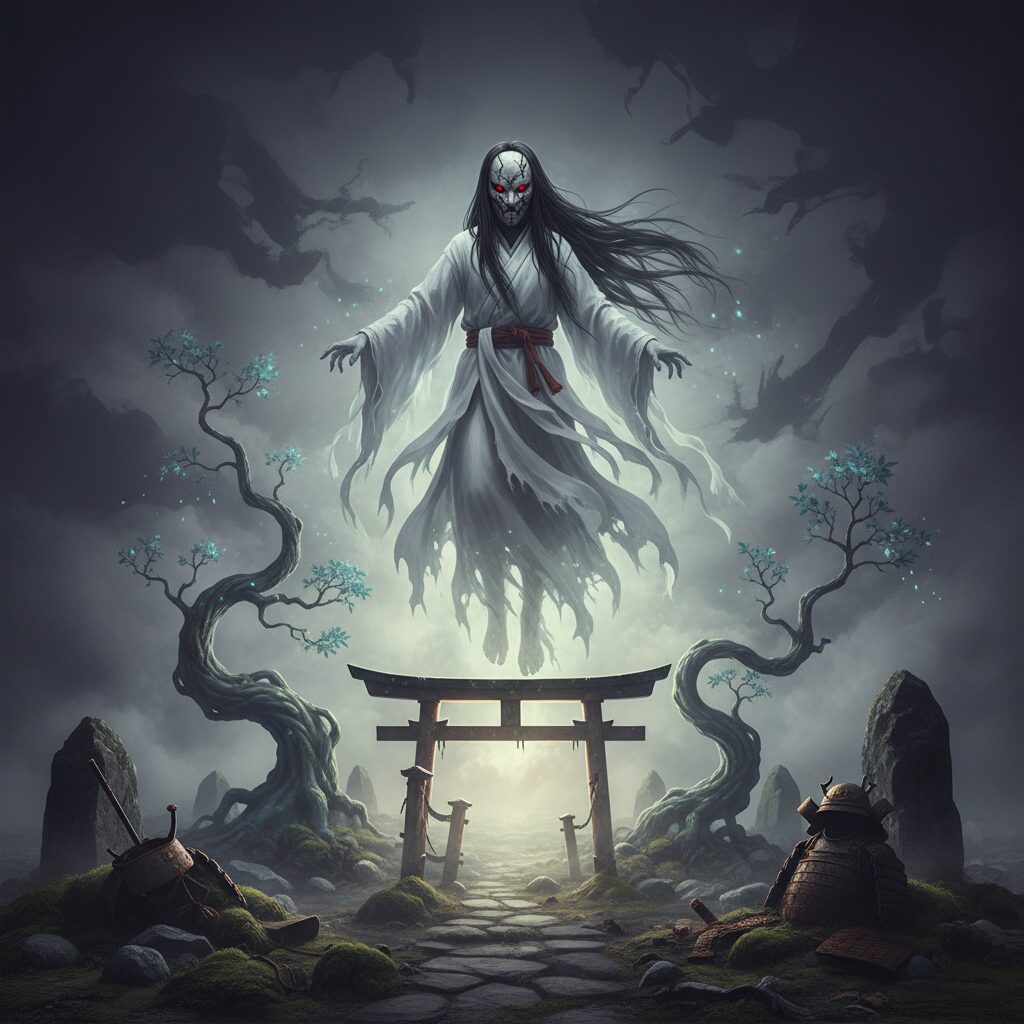
Yo, what’s the first thing that pops into your head when you think of Japan? Bet it’s something like the sensory overload of Shibuya Crossing, a million people flowing like a neon river. Or maybe it’s the serene, almost too-perfect temples in Kyoto, where every pebble feels like it was placed by a Zen master. It’s all sleek, clean, hyper-efficient, and buzzing with energy. That’s the Japan on the gram, the one on the postcards. It’s a total vibe, for sure. But what if I told you that’s only half the story? What if I told you there’s a flip side, a glitch in the matrix of modern Japan, a whole other dimension hiding in plain sight? We’re talking about places where the buzz has flatlined, where the only thing flowing is the wind through broken windows. We’re talking about haikyo—the abandoned places. Entire villages, schools, hospitals, and theme parks just… left on read by society. It’s wild. These aren’t just dusty old ruins; they possess a mood, a heavy, silent atmosphere that slaps different. It’s an eerie quiet that feels louder than any city noise. You stand there, in a classroom with textbooks still on the desks, or a home with rice bowls still in the sink, and you can’t help but feel like you’re not alone. It’s this deep, resonant feeling that the old spirits of the land, the Yokai from the folklore, are just chilling in the shadows, waiting for their moment to reclaim the turf. So, what’s the real tea on these ghost towns? Why does a country famous for its meticulous order have so many places that have been completely ghosted? It’s not a simple story. It’s a full-on saga about money, dreams, time, and maybe, just maybe, the supernatural. Let’s get into it, and unpack the soul of Japan’s forgotten frontiers.
To understand how these spirits might manifest in modern times, consider how Jujutsu Kaisen’s curses are essentially modern-day Yokai.
The Real Ghosting: Why Japan’s Countryside is Fading Out
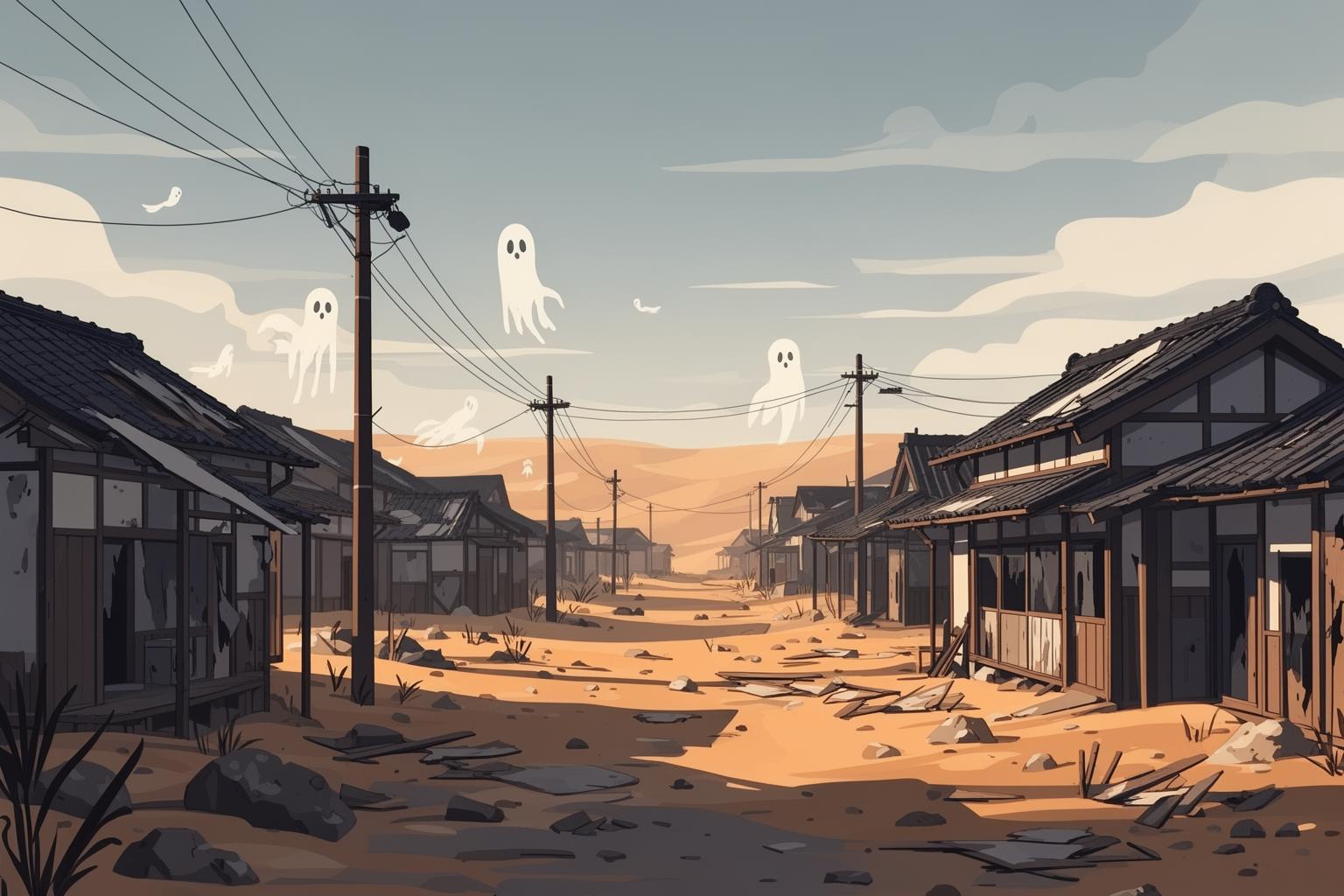
Before diving into the eerie Yokai vibes, we need to address the real-world drama that set the scene. These villages weren’t abandoned because of an ancient curse. The reality is far more recent and, in many ways, more tragic. It’s a perfect storm of economic shifts, demographic changes, and a monumental cultural transformation that reshaped the entire country within a few decades. The emptiness you see now is the aftermath—the tangible evidence of a nationwide identity crisis.
The Great Urban Migration, Reimagined
Imagine this: post-WWII Japan is roaring back to life, rebuilding from scratch. The economy is booming, powered by manufacturing, technology, and corporate growth. And this activity? It’s all happening in the cities. Tokyo, Osaka, Nagoya—these weren’t just cities; they were symbols of hope. Beamed into every home through black-and-white televisions, they embodied a future far removed from the grueling, uncertain lives of farming, fishing, or logging that had defined rural areas for centuries. For young people in small mountain villages, the choice was clear. Would you rather spend your days hunched over a rice paddy, at the mercy of the weather, or become a sharp sarariman (salaryman), suited up with a steady income, a cool apartment, and access to trendy cafes and department stores? The media sold a dream, and a whole generation bought into it. This wasn’t just a trickle; it was a tidal wave. Young people packed their belongings and headed to the Pacific coast economic belt, leaving their hometowns behind. The villages lost more than just residents; they lost their future—the hands to work the land, voices to fill schools, and energy to sustain community festivals. Gradually, the countryside grew older, quieter, and emptier, left on a permanent ‘read’ by the dazzling pull of urban life.
The Demographic Challenge: No Fresh Faces on the Horizon
This mass migration fueled a vicious cycle when combined with Japan’s other pressing issue: demographics. Japan is known for having one of the oldest populations globally and a critically low birth rate. Now consider how this plays out in a small rural village. The young who left for the cities in the ’60s and ’70s had their children there. Those children grew up as city kids, with little connection to their ancestral villages beyond occasional visits during summer Obon festivals. Meanwhile, back in the villages, the population aged steadily. The community consisted mostly of those who never left, trying to keep things alive as long as they could. But what happens when the last shopkeeper retires with no successor? When the only doctor in a fifty-mile radius passes on? When the remaining residents are too old to maintain the local shrine or clear snow-laden roads? Gradually, the community dissolves. Houses fall vacant one by one. The school, once the village’s heart, closes due to lack of students. It’s a slow, quiet, and deeply poignant decline—not a sudden collapse but a fade to black. Government initiatives promoting “U-turns” (city dwellers returning to their hometowns) and “I-turns” (city dwellers relocating to rural areas for the first time) have made some impact, but it’s a mere drop in a vast ocean. Demographic forces are too strong. These villages become living museums of a vanished era, with their last residents unwittingly acting as curators—until they too are gone.
After the Boom: The Rise of Industry Ghost Towns
Beyond the general rural-to-urban migration, many of Japan’s most dramatic haikyo stem from the boom-and-bust cycle of specific industries. Japan, resource-poor by nature, once thrived on mining, especially coal, which fueled its industrial revolution. Hashima Island (Gunkanjima) was built entirely around a coal mine, with thousands living in dense concrete apartments on a tiny sea rock, all for the mine’s sake. But in the 1960s, Japan’s primary energy source shifted from coal to cheaper imported oil, rendering mines obsolete overnight. When Gunkanjima’s coal mine shut down in 1974, the island was evacuated in weeks, transforming a bustling city into a ghost town. Similar stories unfolded in other mining towns across Japan, from the gold mines of Sado Island to the copper mines of Besshi. It was a harsh, unsentimental economic reality that left entire communities stranded. Likewise, forestry and fishing villages, once rural economic pillars, have suffered as cheap imports and changing consumer preferences crushed their industries. When a town’s raison d’être disappears, the town itself soon follows. These sites stand as monuments to the relentless, often ruthless, march of economic progress.
More Than Just Decay: The Vibe is a Whole Cultural Mood
Alright, so we understand the practical reasons: people left, industries vanished, no newcomers arrived. But that only accounts for why the buildings stand empty. It doesn’t explain the feeling. It doesn’t explain the strange, electric atmosphere in the air, the sensation that you’re being watched by more than just the echoes of memory. To grasp that, you must delve into the Japanese cultural psyche, where the boundary between the physical and spiritual is incredibly blurred. The eerie aura of a haikyo isn’t merely imagined; it’s rooted in centuries of belief.
Everything Has a Spirit, Quietly
At the heart of Japan’s indigenous religion, Shinto, lies a form of animism. This is the belief that kami—which can be roughly translated as gods or spirits—inhabit everything. Not only grand things like mountains, rivers, and ancient trees, but also rocks, waterfalls, and even man-made objects. When an object is used and cared for over a long time, it’s thought to develop its own spirit. This gives rise to the concept of tsukumogami, a type of Yokai born from household items that have reached their 100th year. Imagine old umbrellas, sandals, or cooking pots suddenly sprouting limbs and personalities. Now, apply that idea to an entire house or a whole village. A home that has sheltered generations of a family, a school that echoed with children’s laughter for decades—these places are soaked in spiritual energy. When abandoned, that energy doesn’t simply disappear. The spirits of the place, the home, the furniture, the tools… they all linger. They silently bear witness to decay. So when you step inside an abandoned Japanese house, you’re not just entering an empty building. You’re stepping into a space crowded with the spirits of forgotten things. This is the source of the feeling of being watched. It’s not necessarily threatening, like a Western ghost story. It’s more of a deep, persistent presence—a quiet chorus of forgotten souls. The Yokai aren’t intruders; they’ve always been there. The humans are the ones who departed.
The Beauty of Being Deeply Sad: ‘Mono no Aware’
There’s a profoundly important, yet untranslatable, Japanese idea called mono no aware (物の哀れ). It roughly means “the pathos of things” or “an empathy toward things.” It’s a gentle, bittersweet sadness over the impermanence of life. It’s the feeling you get when you see cherry blossoms in full bloom, knowing they’ll be gone within a week. Their beauty lies in their fleeting nature. This mindset is the exact opposite of the Western urge to preserve everything forever, to resist decay. In Japan, impermanence isn’t just accepted; it’s viewed as a source of profound beauty. And haikyo perfectly embody mono no aware. Standing in a crumbling tatami room, watching sunlight stream through a hole in the roof to illuminate swirling dust motes, is deeply moving. You sense the passage of time viscerally. You think of the family who lived there, the meals they shared, the seasons witnessed through now-paperless shoji screens. It’s a sad feeling, but not a negative one. It’s a tender, melancholic acceptance of the life-death cycle—creation and decay. This connects to another aesthetic ideal, wabi-sabi, which embraces beauty in imperfection, asymmetry, and age. A cracked teacup is more beautiful than a flawless one because its flaws tell a story. A haikyo, in all its decaying splendor, is pure wabi-sabi. It’s a beauty that doesn’t demand attention but softly whispers the stories held within its walls.
Nature’s Ultimate Revival
And then there’s the most powerful force of all: nature. When humans leave, nature doesn’t merely return; it launches a full-scale takeover. Witnessing this is breathtaking. This is where haikyo transcend sad ruins to become something sublime and otherworldly. It’s a visual celebration of nature’s reclaiming power. Thick ivy cloaks entire buildings, softening their harsh lines and shaping them into organic sculptures. Trees sprout from living rooms, their branches breaking through roofs to reach the sky. Moss blankets everything, transforming concrete and asphalt into a lush, vibrant green carpet. Along some coastal villages, the ocean slowly erodes foundations, while in the mountains, landslides may swallow houses whole. This process vividly demonstrates the Shinto belief that nature is the ultimate, divine force. It feels as if the kami of forests and mountains are reclaiming what was always theirs. The sight of a rusting car being choked by vines or a torii gate leaning crookedly amid an overgrown forest is both humbling and awe-inspiring. It’s a powerful reminder that human creations are temporary. We are only visitors here. Nature has the final word, and its victory is often breathtakingly beautiful.
A Field Trip to the Flip Side: Haikyo You Can (Almost) Feel
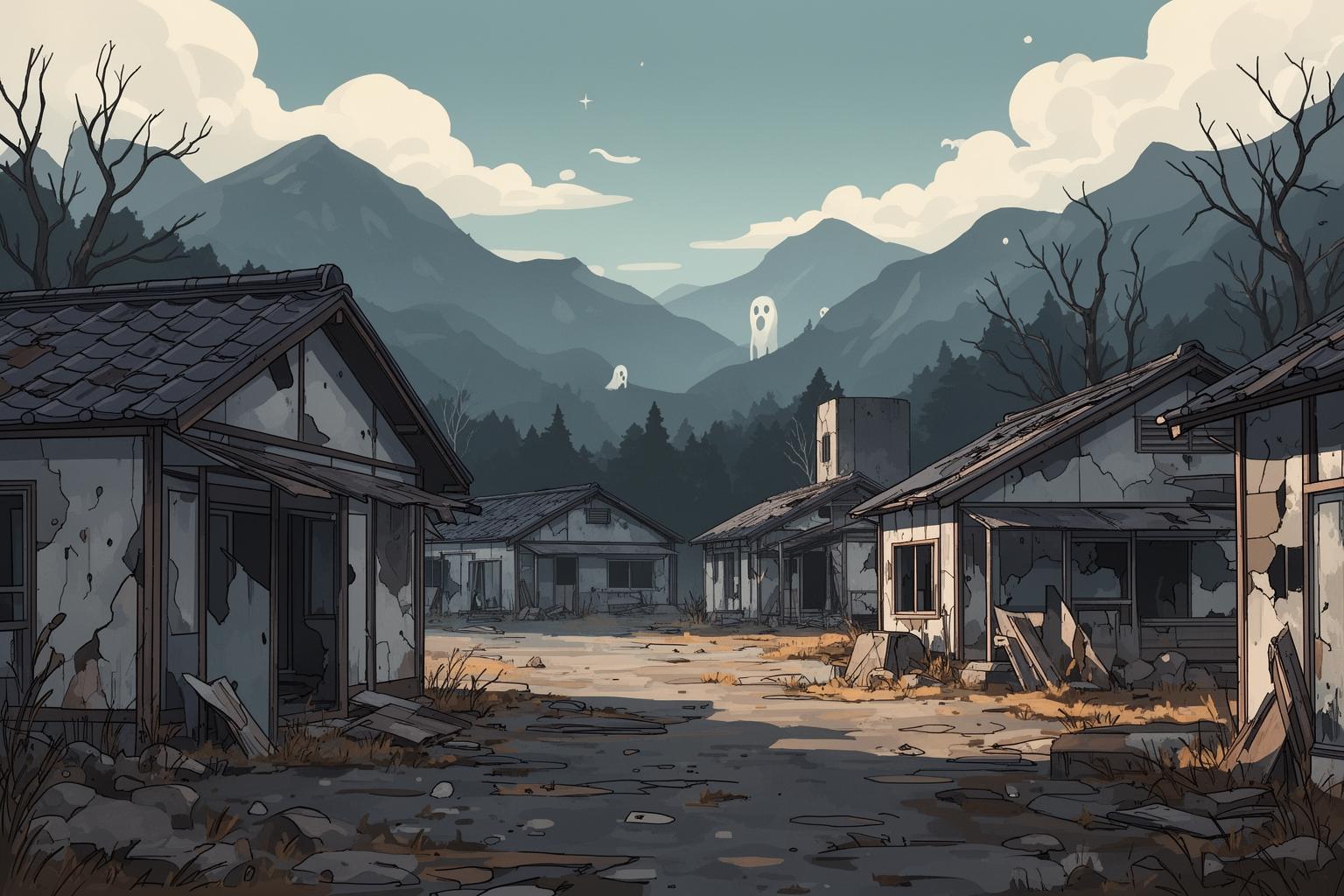
Discussing these places is one thing, but to truly capture their essence, you need to experience them visually. While I can’t take you there in person, allow me to paint a picture of a few iconic haikyo that encapsulate this entire intricate narrative. These are not mere spots on a travel guide; they are destinations that reveal the epic story of modern Japan’s soul.
Nagoro: The Village Where Scarecrows Keep the Spirit Alive
Nestled deep in the remote, winding valleys of Shikoku Island is Nagoro, also known as the “Scarecrow Village.” On the surface, it might sound charming, but the atmosphere is something else entirely. Nagoro endured the familiar fate of rural depopulation. Young people left, and the population dwindled to just a few dozen. One resident, Tsukimi Ayano, returned to care for her father and was struck by the village’s loneliness. To counter the emptiness and honor the memory of her departed or relocated neighbors, she began creating life-sized scarecrows, or kakashi, and positioning them around the village in lifelike poses. What began as a small effort has since grown to over 300 scarecrows, outnumbering the human population by more than ten to one. The effect is profoundly surreal, exuding major uncanny valley vibes. You’ll see crowds of scarecrows waiting for buses that no longer come, classrooms frozen mid-lesson with scarecrow children and teachers, and figures farming, fishing, drinking tea, or sleeping. Each has its own distinct face and personality. It’s a deeply moving artistic reflection on loss and memory, but it’s also undeniably eerie. As you wander the quiet streets, the unblinking button eyes seem to follow you everywhere, prompting you to wonder: are they just dolls, or vessels? Placeholders for the spirits of those who’ve left? Nagoro is a hauntingly beautiful testament to one woman’s determination to keep her village from fading away.
Tomogashima: The Real-Life ‘Laputa’ Setting
If you’re a Studio Ghibli fan, you’ve likely dreamed of discovering the real Laputa from Castle in the Sky. Tomogashima Island, situated in the sea between Wakayama and Awaji Island, comes as close as one can get. This island was a secret, off-limits military zone from the Meiji Restoration until the end of WWII. The Japanese Imperial Army constructed impressive red-brick fortresses and cannon batteries here to protect Osaka Bay. After the war, the armaments were removed, and the island was abandoned, left to the mercy of nature. Over decades, the forest has orchestrated a slow takeover. The result is a stunning landscape where once-mighty military installations are being gradually reclaimed by roots and vines. You can traverse dark, echoing tunnels linking the batteries, their arching ceilings dripping with moisture. Explore circular cannon emplacements that now resemble sacred clearings, their crumbling brick cloaked in a thick mossy blanket. The mood is steeped in history with a Ghibli-like sense of wonder and melancholy. It doesn’t feel like mere ruins; it feels like the remnants of a lost civilization, where you half-expect a friendly robot to emerge from the greenery. It’s a perfect example of nature’s transformation—turning symbols of war into sites of peaceful, haunting beauty.
Gunkanjima (Hashima Island): The Concrete Ghost Ship
Then there is the ultimate haikyo challenge: Gunkanjima. Its name means “Battleship Island,” named for its silhouette of concrete apartment blocks that resemble a warship on the horizon. Off the coast of Nagasaki, this island was once the most densely populated place on Earth. It was a self-contained city built by Mitsubishi to support the undersea coal mine beneath it. The island had schools, a hospital, a cinema, shops—everything needed for a community, all squeezed onto a tiny rock. Life was tough, and the history is grim, including forced labor during wartime. Yet for the Japanese workers living there post-war, it symbolized modernity and community. In 1974, when the coal ran out and the mine closed, the island was abandoned. Thanks to its concrete construction designed to withstand fierce typhoons, the city’s framework has remained astonishingly intact. Visiting today (via official guided boat tours) feels like stepping into a post-apocalyptic film. You wander silent hallways inside vast apartment blocks, peeking into rooms where 70s televisions and furniture still gather dust. Salt and wind have eroded the concrete, exposing rusted steel skeletons beneath, making the buildings appear as if they’re weeping rust. Gunkanjima is not a gentle, moss-covered ruin; it’s a raw, brutal, and powerful monument to Japan’s industrial drive and the human cost behind it—a concrete Pompeii frozen in a moment of sudden abandonment.
Kinugawa Onsen: The Bubble Economy’s Hangover
Not every haikyo hails from the distant past. Some haunt from a more recent, more extravagant era: the late 1980s Japanese bubble economy. During that time, money flowed freely, and developers erected massive, lavish resort hotels in scenic locations nationwide. Kinugawa Onsen, a hot spring town north of Tokyo, was one such locale. Grand hotels with hundreds of rooms, opulent banquet halls, and sprawling bathhouses lined the river. Companies regularly bussed employees there for decadent parties. But when the bubble burst in the early ’90s, the festivities abruptly ended. Lavish spending stopped, and these colossal hotels were left half-empty and unable to cover their enormous operating costs. One by one, they went bankrupt and were abandoned. Today, walking along the Kinugawa river is surreal. On one side are thriving, operational hotels; on the other, their decaying twins—enormous concrete shells with shattered windows, peeling facades, and interiors ravaged by time and vandals. It’s a stark visual metaphor for boom-and-bust. A glance inside (from a safe and legal distance, of course) reveals faded grandeur: tattered wallpaper in grand lobbies, overturned banquet tables, and empty, mineral-stained onsen pools slowly reclaimed by mold and nature. These ruins narrate a story of ambition, excess, and the inevitable morning-after hangover.
So, Is It Just Spooky Tourism? The Ethics of the Haikyo Vibe
After learning about all these amazing places, your immediate urge might be to grab your camera and start exploring. While the appeal of haikyo-tanken (ruin exploration) is undeniable, it carries significant practical and ethical concerns. This is not your typical tourist activity, nor is it comparable to a haunted house attraction. It’s far more complex than that.
To begin with, a reality check: entering most haikyo is technically illegal. These sites are privately owned, even if they appear completely abandoned. Trespassing is a legal offense, and although arrests are uncommon, the risk remains. More importantly, it’s extremely dangerous. Buildings left to decay for decades are structurally unsound—floors can give way, roofs may collapse, and stairs could fail without warning. There are also hazards like broken glass, rusted metal, and possibly asbestos. Additionally, the wildlife in Japan’s rural areas includes perilous creatures such as giant venomous hornets (suzumebachi), wild boars, and even bears, which often inhabit these abandoned places.
Beyond the physical dangers lies a profound ethical question: what does it mean to visit these sites? Among dedicated haikyo explorers, the unwritten rule is “take only pictures, leave only footprints.” It’s about capturing and preserving a moment in time without causing disruption. However, the rise of social media has brought a surge of visitors primarily interested in snapping edgy selfies for the ‘gram. This trend has led to more vandalism, theft, and general disrespect. These locations once housed people’s homes, schools, and workplaces, filled with personal belongings and memories. Treating them merely as photo backdrops dishonors the lives once lived there. Genuine exploration involves embracing mono no aware—being a respectful witness to the quiet, gradual story of decay. It’s about hearing the silence and reflecting on history, not pursuing cheap thrills or social media fame. The boundary between documentation and voyeurism, appreciation and exploitation, is delicate.
The Final Takeaway: Why These Ghost Villages Matter
So, why should we pay attention to a cluster of crumbling buildings in the middle of nowhere? Because these haikyo are much more than mere ruins. They are not just eerie sites; they are a tangible expression of Japan’s most urgent contemporary challenges. They illustrate what happens when a graph of demographic decline and a map of economic centralization intersect with the real world. They are the scar tissue left from the nation’s rapid, sometimes painful, process of modernization. Visiting them, or even simply learning about them, offers a deeper understanding of Japan—far beyond the polished facades of its cities.
These forgotten villages are where hyper-modern, highly efficient Japan steps aside, allowing a much older, more animistic, nature-worshipping Japan to reemerge. The sense that Yokai might be about to return is more than just a spooky fantasy; it’s a compelling metaphor. The Yokai embody the untamable spirit of the land, the cultural DNA that endures even when concrete and steel crumble. They symbolize the idea that when human systems falter, older, more mysterious forces reassert themselves. They are the lingering spirits of objects, the restless energy of the land, the shared soul of communities that have disappeared but refuse to vanish completely. These places represent a dialogue between past and present, humanity and nature, order and chaos. Within this quiet, decaying, and profoundly beautiful conversation, one can glimpse the authentic, complex, and endlessly captivating soul of Japan. It’s an entire mood, and once you grasp it, you’ll never see the country the same way again.