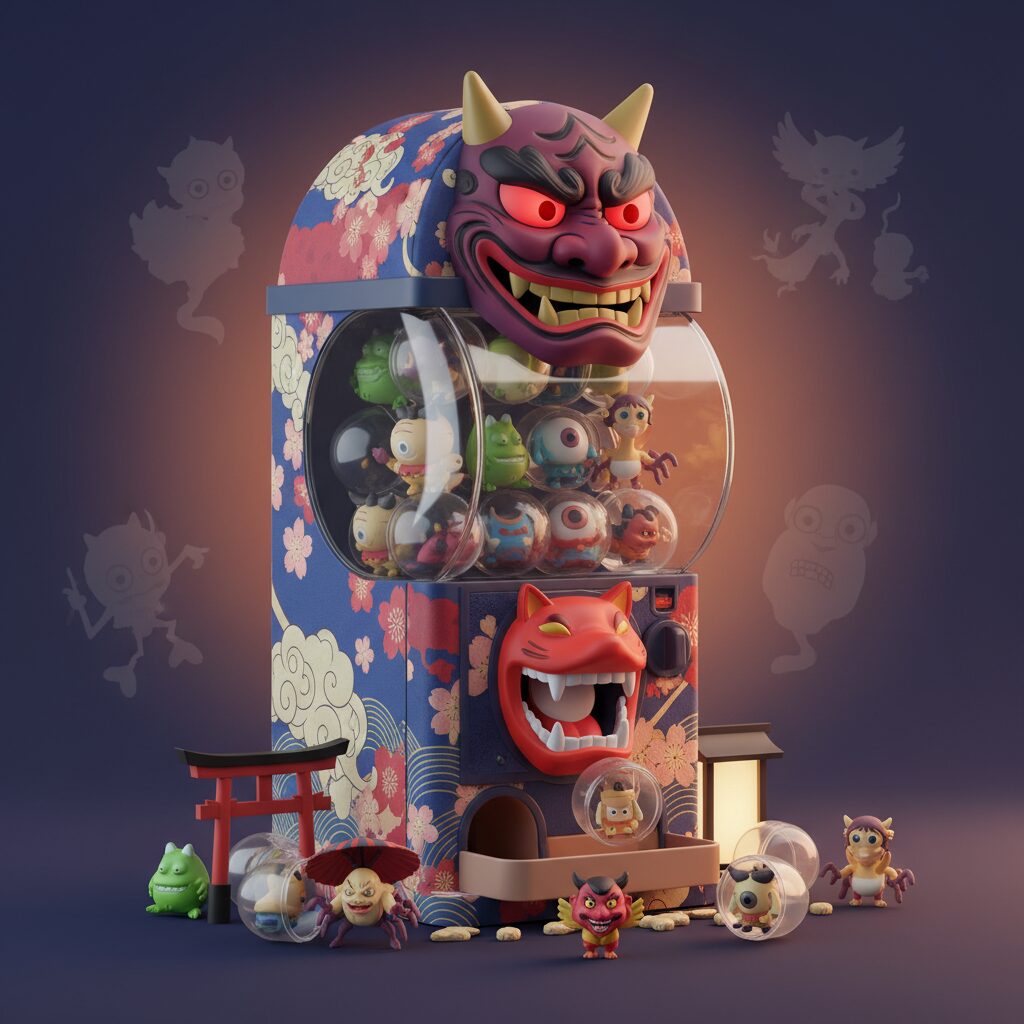
Walk into any multi-story electronics building in Akihabara, or duck into the labyrinthine corridors of Nakano Broadway, and you’ll inevitably be met by the same sound. It’s a low, rhythmic, mechanical symphony: the heavy gacha-gacha of a plastic handle being turned, followed by a resonant pon, the satisfying clunk of a capsule dropping into a tray. You’re standing before a wall of Gashapon machines, hundreds of them, each a brightly colored portal promising a tiny, meticulously crafted piece of some pop culture universe. You see the usual suspects: anime heroes, video game characters, tiny Shiba Inus in adorable hats. But then you spot it. A series of figures so out of place it makes you stop. Inside these cheap plastic spheres are creatures from a different era entirely. A one-eyed umbrella with a long tongue. A turtle-like humanoid with a water-filled dish on its head. A grotesque, long-necked woman peeking over a screen. These are Yokai, the ghosts, demons, and supernatural beings of ancient Japanese folklore. And it begs the question that hits you harder than the Tokyo summer humidity: Why? Why is a culture so obsessed with futuristic technology and streamlined modernity also compulsively sealing its most ancient, terrifying monsters into 300-yen plastic capsules? This isn’t just about selling a quirky toy. This is a cultural feedback loop, a conversation between the past and present happening on a massive, commercial scale. You’re not just looking at a vending machine; you’re looking at a modern altar to centuries of folklore, a place where anxieties about the unknown are literally packaged, paid for, and pocketed. It’s a phenomenon that reveals a fundamental truth about Japan: the past is never really past. It just gets smaller, cuter, and infinitely more collectible. Before we dive into the guts of this cultural curiosity, let’s ground ourselves in the epicenter of this modern ritual. This is where the hunt begins.
This modern packaging of ancient spirits can be seen as a playful extension of Japan’s deep-rooted animistic beliefs, where gods and spirits are believed to inhabit all things.
The Gashapon Grind: More Than Just a Toy Machine
To truly understand why a tiny plastic Kappa holds such significance, you first need to grasp the machine that dispenses it. For most people outside Japan, a capsule toy machine is a sad, overlooked fixture in a supermarket lobby, stocked with cheap, poorly made bouncy balls or sticky hands that lose their charm within minutes. It’s a low-budget distraction aimed at children. In Japan, however, Gashapon—or Gachapon, as the terms are interchangeable—is an entirely different phenomenon. It represents a deeply rooted cultural ritual, a multi-billion yen industry, and a serious hobby pursued by millions of adults. It’s a form of micro-gambling perfected into an art, a small thrill that punctuates the otherwise rigid routine of everyday life. The entire experience is meticulously designed for maximum satisfaction.
A Brief History of Cranking the Handle
The name itself is purely Japanese onomatopoeia, capturing the essence of the entire process. Gasha, or gacha, is the sound of the stiff plastic crank as it’s forced clockwise, engaging the internal gears. Pon is the hollow, definitive noise of the capsule dropping into the retrieval slot. Together, these sounds provide a two-part auditory reward signaling the end of the transaction. The concept was imported from the United States in the 1960s, but like many Western imports—from cars to fashion—Japan didn’t merely adopt it; it absorbed, refined, and uniquely transformed it. What began as a simple novelty for children quickly developed further. Manufacturers realized the appeal wasn’t just the toy inside but the suspense of the acquisition. They started producing series of toys, typically with six to eight different figures, including one or two “secret” or rare items. Suddenly, it wasn’t just about receiving a toy. It was about getting the toy you wanted, or better yet, collecting all of them. This shift turned the Gashapon machine from a basic dispenser into a game of chance. For a few hundred yen, you play a tiny lottery: will you get the main character? A dull sidekick? Or, worst of all, a duplicate of one you already own? This tension fuels the culture. It transforms a simple purchase into a narrative, a mini-drama unfolding before the machine. You’ll find salarymen in suits, students, tourists, and dedicated collectors standing before rows of these machines, feeding coins in and repeating the ritual. It’s a universally recognized, class-neutral ceremony.
The Psychology of the Capsule
The psychological pulls of Gashapon run deep, engaging several key principles of Japanese consumer and aesthetic culture. The strongest is the collector’s impulse, which is amplified here like nowhere else. The idea of kompu gacha, or “complete gacha,” where players are motivated to collect an entire set to unlock a special reward, was so influential in mobile gaming that it required government regulation. Gashapon represents the analog counterpart to this. Each capsule contains a small paper insert depicting the complete set—a visual checklist planting an immediate desire in the collector’s mind. Your single figure looks lonely next to the picture of the full lineup. The drive to complete the set is a powerful motivator, encouraging repeated plays and spawning a secondary market where collectors trade duplicates to fill gaps. Then there is the Japanese aesthetic appreciation for miniaturization. There is a long-standing cultural tradition of valuing small, meticulously crafted objects, from bonsai trees and netsuke carvings to intricate bento boxes. Gashapon toys inherit this legacy. The sculpting and painting quality on a 300-yen figure can be astonishing. These are not crude plastic lumps; they are tiny, finely detailed sculptures. This attention to detail grants them perceived value far beyond their cost, elevating them from disposable trinkets to display-worthy collectibles. Finally, Gashapon democratized collecting. In the West, collecting often entails considerable financial investment—comic books, vintage toys, or art. Gashapon makes anyone a collector. For the price of a coffee, anyone can begin a collection. This low barrier to entry makes it an inclusive hobby, enabling people from all backgrounds to join the shared culture of hunting, collecting, and curating.
Enter the Yokai: Japan’s OG Monsters
Now that we’ve established the cultural significance of the Gashapon machine itself, let’s explore what’s inside. Why Yokai? To foreign eyes, these creatures can appear strange, amusing, or even terrifying. They don’t fit neatly into Western categories like ghosts, goblins, or fairies. They are something wholly different—products of a unique spiritual and cultural ecosystem. Understanding them is essential to grasping why they have become Gashapon superstars. In many ways, they are the ideal subject for a system built on variety, mystery, and a hint of the unknown. They represent Japan’s original pantheon of the strange—a vast cast of characters awaiting their moment in the plastic spotlight.
What Exactly Is a Yokai?
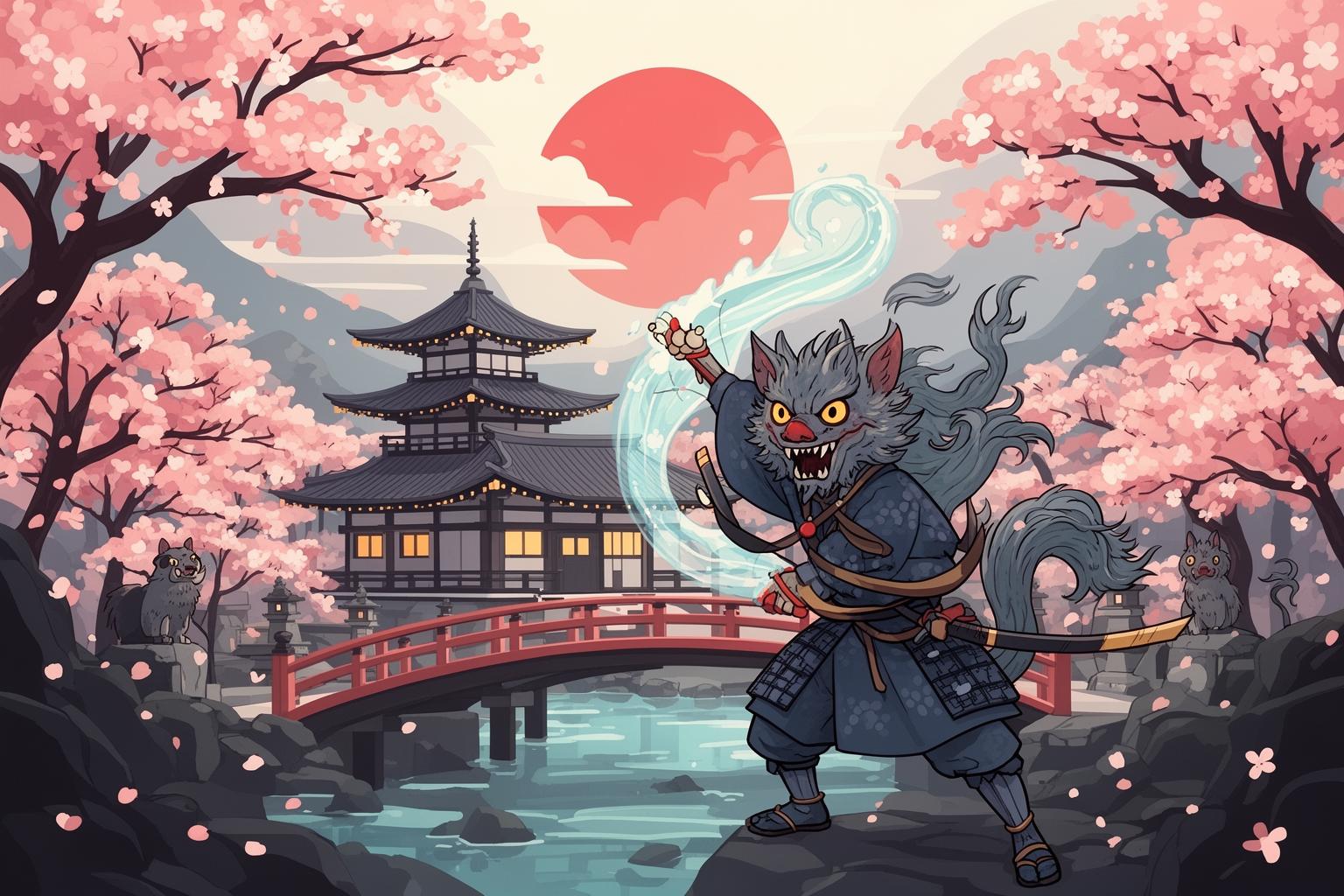
Translating “Yokai” is notoriously tricky. Terms like “monster,” “ghost,” or “spirit” all fall short. A more accurate, though somewhat clunky, definition might be “a manifestation of the strange and unexplainable.” They personify phenomena that defy simple logic. Before scientific explanations existed, Yokai offered a framework to understand the world. That strange noise in the ceiling at night? It might be a Tengu having taken up residence. The sensation of being watched in a dark forest? Perhaps a Kodama, a tree spirit. A sudden sharp gust of wind? The work of a Kamaitachi, a sickle-weasel Yokai. They embody a Shinto-inspired worldview—an animistic belief that spirits, or kami, inhabit everything from mountain rivers to kitchen utensils. Yokai are often the more mischievous, dangerous, or bizarre members of this spiritual realm. Some, like the fearsome Oni (ogres or demons), represent forces of destruction and malice, used to frighten children into obedience. Others are more nuanced. The Kappa, a water-dwelling creature, is infamous for drowning children and horses, yet it can be persuaded to share advanced medical knowledge if tricked into bowing, causing the water on its head dish to spill and rendering it powerless. Then there are the Tsukumogami, a category of Yokai especially relevant to our Gashapon discussion. These are everyday household objects—sandals, lanterns, umbrellas, pots—that, upon reaching their 100th year, gain a spirit and come to life. This concept reflects a deep cultural respect for objects and serves as a warning against wastefulness. Every item holds the potential for life, for spirit, and should be treated with care. This diverse cast of characters provided pre-modern Japan with a rich tapestry of stories, moral lessons, and explanations for a world often unpredictable and dangerous.
The Edo Boom: From Folklore to Pop Culture
For centuries, Yokai were primarily local folklore figures, their stories passed down orally. Their appearances and traits varied widely from village to village. This changed during the Edo Period (1603–1868), a long era of peace and stability under the Tokugawa shogunate. With peace came a cultural and artistic flourishing, alongside increased urbanization and literacy. The supernatural became a popular subject for entertainment. It was during this time that Yokai transitioned from whispered local legends into a form of mass media. The key figure in this transformation was Toriyama Sekien, an artist and scholar. In the late 18th century, he published a series of illustrated books, most notably The Illustrated Night Parade of a Hundred Demons (Gazu Hyakki Yagyō). Sekien traveled across Japan collecting local tales, then drew and named hundreds of Yokai, creating what was essentially the world’s first monster encyclopedia. He didn’t just document existing Yokai; he invented many new ones, giving shape to vague legends and creating creatures from scratch. This act of cataloging was revolutionary, transforming the fluid, chaotic world of oral folklore into a codified visual language. Suddenly, a Kappa from one province looked the same as a Kappa from another. This made Yokai a shared, collectible form of knowledge. Artists like Utagawa Kuniyoshi and Hokusai embraced these images, producing dramatic and beautiful ukiyo-e woodblock prints depicting Yokai in epic battles or humorous scenarios. The Hyakki Yagyō, or Night Parade of One Hundred Demons, became a popular motif—a chaotic, celebratory, and terrifying procession of supernatural beings haunting the streets at night. This Edo-period boom transformed Yokai from objects of fear and reverence into characters and entertainment. It was the first time they were collected and categorized for mass consumption, a historical precedent that perfectly parallels the Gashapon phenomenon today.
The Modern Parade: Why Yokai in a Capsule Makes Perfect Sense
The leap from an 18th-century woodblock print to a 21st-century plastic toy may seem enormous, yet the cultural logic behind it is surprisingly straightforward. The Gashapon machine carries on the tradition begun by Toriyama Sekien, continuing the process of cataloging, taming, and popularizing the supernatural world. However, one crucial step was necessary to bridge the gap between the feudal era and the modern collector: Yokai had to be given personalities. They needed to become more than just monstrous curiosities; they had to become characters people could root for.
Shigeru Mizuki and the Post-War Yokai Renaissance
While Toriyama Sekien cataloged the Yokai, it was manga artist Shigeru Mizuki who revived them for the 20th century. Mizuki, who grew up hearing local ghost stories from an elderly woman in his town, created the seminal manga series GeGeGe no Kitaro in the 1960s. The story follows Kitaro, a Yokai boy who, despite his eerie appearance, fights alongside humanity against evil Yokai and greedy humans. Mizuki’s work was revolutionary. He transformed the encyclopedic lists from the Edo period into a living narrative. Characters like the one-eyed Medama-oyaji (Kitaro’s father, who appears as an eyeball in a small body) and the rodent-like Nezumi-otoko became beloved icons. Mizuki’s brilliance lay in making the world of Yokai relatable. No longer mere explanations for strange phenomena, Yokai now had motivations, emotions, and social structures. Some were noble, others mischievous, and some simply struggling to survive in a world that was forgetting them. GeGeGe no Kitaro became a cultural phenomenon, spawning numerous anime series, films, and video games. It single-handedly reintroduced generations of Japanese children to their folkloric heritage. Mizuki did for Yokai what Marvel Comics did for Norse mythology—turning an ancient pantheon into a modern pop culture universe filled with heroes, villains, and complex moral questions. This re-characterization was the essential final step for the Gashapon boom. Yokai were no longer just monsters; they were celebrities.
The Gashapon as a Modern Bestiary
With this background, the wall of Yokai Gashapon machines in Akihabara becomes perfectly comprehensible. Each machine, offering a curated series of six to eight figures, serves as a miniature, 3D version of Toriyama Sekien’s catalogs—a modern bestiary in capsule form. Collecting is no longer merely about owning toys; it’s about participating in a longstanding tradition of cataloging the supernatural. Turning the crank is a ritual linking you to Edo-period artists and storytellers. You attempt to capture a fragment of that vast, chaotic folklore world for yourself. Completing a set is deeply satisfying because it represents a small triumph of order over chaos. You have successfully assembled your own miniature chapter of the Yokai encyclopedia—a personal Hyakki Yagyō, a night parade you can display on your desk. The paper insert inside each capsule acts as the modern equivalent of a page from Sekien’s bestiary, presenting the taxonomy of the mystical world you’re collecting. This process transforms the collector from a passive consumer into an active curator, a modern folklorist building their own spirit collection. The hunt for a rare figure echoes the folklorist’s search for an obscure local legend, a treasure hunt for hidden knowledge.
The Appeal of the Arcane
Why does this resonate so strongly now? In a society often defined by efficiency, predictability, and social conformity, Yokai represent a thrilling infusion of the irrational and mysterious. They connect to a wilder, more enchanted Japan—a time when the world was partially unexplained and unmapped. For many Japanese people, collecting Yokai offers a way to connect with a cultural identity that feels both deeply authentic and increasingly distant amid their hyper-modern lives. It’s a tangible piece of heritage, a nostalgic link to childhood ghost stories. For visitors and foreigners, Yokai Gashapon provide one of the most accessible gateways into the often-impenetrable realm of Japanese spirituality and folklore. While you may not fully understand the nuances of Shinto-Buddhist syncretism, you can hold a 300-yen plastic figure of a Kasa-obake (the one-eyed umbrella) in your hand. It is more than a simple souvenir; it is a conversation starter and a physical artifact of Japan’s strange and wonderful inner world—a way to take a piece of mystery home, encapsulated in plastic.
Beyond the Plastic: The Deeper Cultural Currents
The link between ancient beliefs and contemporary hobbies goes beyond mere historical precedent. The Yokai Gashapon phenomenon directly taps into some of the most fundamental undercurrents of the Japanese worldview. It is a modern manifestation of age-old ideas about the nature of reality, the spirit world, and humanity’s place within it. Seeing a salaryman eagerly opening a capsule containing a mischievous Tengu is witnessing a direct, though playful, continuation of animistic traditions that have shaped Japanese culture for millennia. This is not a contradiction of modernity; rather, it is an adaptation of ancient beliefs to fit a modern context.
Animism in Your Pocket
At its heart, the traditional Japanese belief system of Shinto is animistic. It holds that divinity, or kami, is not a singular, transcendent entity but exists in countless forms throughout the natural world—in mountains, rivers, trees, rocks, and even extraordinary people. This worldview blurs the boundary between the physical and spiritual realms, suggesting that the world is alive with unseen forces and personalities. Yokai extend this concept, representing stranger, more specific, and often more dangerous spirits on the fringes of human experience. The idea of the Tsukumogami perfectly illustrates this principle applied to daily life—the belief that an object, after a hundred years of use, could spontaneously gain a soul and become a Yokai speaks volumes about the relationship between humans and their possessions. It encourages respect and care for objects that serve us, acting as a counterpoint to modern disposable consumer culture. Now consider the Gashapon toy: a mass-produced, inanimate plastic object. Yet, through the ritual of Gashapon—the anticipation, the crank of the handle, the luck of the draw, and the act of collecting—it acquires meaning and personality. The collector projects value, story, and significance onto it. In a beautifully meta sense, collecting these plastic Yokai is a modern form of animism. We give these objects a “soul” by elevating them from mere commodities to treasured parts of a curated collection. The Gashapon capsule serves not just as a container for a toy, but as a vessel carrying a tiny spark of this ancient animistic worldview, delivered into the palm of your hand.
Taming the Chaos, One Capsule at a Time
Yokai originally emerged as explanations for the terrifying and uncontrollable aspects of life. Typhoons, earthquakes, droughts, plagues, and sudden illnesses were attributed to angry gods or malevolent spirits. Yokai personified these anxieties, giving face and name to the formless fears haunting human existence. Naming something is the first step toward controlling it; telling its story is the next. By creating rich folklore around these forces, people could begin to understand them, develop rituals to appease them, and design strategies to avoid them. This process of externalizing and categorizing fear is a fundamental human coping mechanism. The modern world faces its own anxieties—economic instability, social pressure, information overload, existential dread. Collecting Yokai Gashapon can be seen as a playful, contemporary version of this ancient coping strategy. The terrifying demons of old are now rendered in cute (kawaii) or cool (kakkoii) plastic forms. Their threat is neutralized. The Kappa that once drowned children now sits adorably on your computer monitor. The fearsome Oni is transformed into a rare item in a limited-edition series. This process of miniaturizing and aestheticizing danger makes it manageable. The vast, chaotic pantheon of supernatural beings is reduced to a series of discrete, collectible objects. This mirrors a broader cultural tendency in Japan to handle overwhelming complexity through meticulous categorization and mastery of detail. Whether it’s the train enthusiasts (densha otaku) who memorize every timetable and model number, or the intricate classification systems in traditional arts, this approach breaks down a large, chaotic system into small, knowable parts. Collecting Yokai Gashapon is the latest, perhaps most whimsical, expression of this deep-rooted cultural impulse.
The Collector’s Parade vs. The Real Parade
A more critical question arises: Does this endless cycle of commodification and “cutification” strip Yokai of their original power and meaning? When a fearsome spirit, once meant to warn people away from dangerous waters, becomes a keychain, has something essential been lost? The answer is almost certainly yes. The raw, primal fear these creatures once inspired has been replaced by the thrill of consumer acquisition. The Hyakki Yagyō is no longer a terrifying spectral event to avoid at all costs, but rather a desirable complete set to display on a shelf. Yet, perhaps this isn’t so much a loss as it is an evolution. The relationship between humanity and its monsters continually changes. In a world with scientific explanations for weather and disease, Yokai no longer need to fulfill that role. Instead, their significance has shifted. They no longer serve as explanations for the unknown but have become symbols of cultural identity, nostalgia, and a link to a more enchanted past. The modern Yokai parade isn’t a procession of demons through a Kyoto street; it’s the silent, colorful, meticulously arranged parade on a collector’s IKEA shelf. It reflects a contemporary relationship with the supernatural—one defined less by fear and more by fascination, curation, and personal expression. The monsters have been tamed, but in doing so, they have ensured their survival in the modern imagination.
Your Own Yokai Hunt: Where to Find the Modern Parade
For anyone visiting Japan, taking part in this modern ritual is surprisingly simple. You don’t need to explore a haunted forest or a distant mountain shrine. The gateways to the Yokai world are brightly lit, air-conditioned, and conveniently situated in the shopping and entertainment districts of every major city. As a photographer, I find these places endlessly captivating — not just because of the toys themselves, but for the human drama playing out before the machines. These new temples summon ancient spirits with coins and plastic cranks.
The Temples of Gasha: Akihabara and Nakano
While Gashapon machines are found everywhere from airports to supermarkets, the true pilgrimage sites for serious collectors are in Tokyo. The Akihabara Gachapon Hall is exactly what it sounds like: a storefront filled solely with hundreds of Gashapon machines, arranged in neat rows like soldiers. The sensory overload is intense. The steady chorus of gacha-gacha-pon, the click of capsules, the low hum of fluorescent lights, and the focused energy of collectors scrutinizing display cards create a cathedral of chance. Another important spot is Nakano Broadway, a few stops west of Shinjuku. This aging shopping complex is a multi-level paradise for otaku culture, with narrow corridors packed with Gashapon machines often specializing in niche or vintage series. Strolling through these areas feels like navigating a modern, commercial version of a Shinto shrine complex. Each machine is a small sub-shrine dedicated to a particular pop culture deity or, in this case, a clan of Yokai. People approach them with quiet reverence, read the scripture (the display card), make their offering (a few hundred yen coins), and perform the ritual (the crank) hoping for a blessing (the figure they desire). The blend of intense consumerism and quasi-religious ritual is a spectacle in itself, perfectly capturing contemporary Japanese culture.
Reading the Signs: How to Spot a Yokai Series
Amid the visual chaos of hundreds of machines, identifying the Yokai series becomes a fun challenge. You start to notice the visual cues. The display card artwork is often a clear sign — it may feature traditional calligraphy, designs resembling old woodblock prints, or a dark, spooky aesthetic that contrasts with the bright, cheerful anime characters nearby. You’ll spot kanji characters such as oni (鬼), yōkai (妖怪), or hyakki yagyō (百鬼夜行). The manufacturers themselves also indicate quality. Brands like Kitan Club and Kaiyodo are known for their intricate, high-quality figures. Their Yokai series often feature designs by famous artists and are regarded as miniature works of art. The level of detail distinguishes these from children’s toys: figures with multiple points of articulation, translucent parts, and exquisitely detailed paint jobs capturing the creature’s traditional depiction. This dedication to quality reinforces that this is a serious hobby — an adult pastime, a sophisticated cultural engagement disguised as a simple game. So next time you stand before one of these glowing walls of capsules, take a closer look. You’re not just seeing toys. You’re witnessing the culmination of a long cultural journey, where ancient fears and folklore wonders have been distilled, redesigned, and reborn in plastic. You are observing the modern Night Parade, summoned not by magic, but by the irresistible, rhythmic call of gacha-gacha-pon.