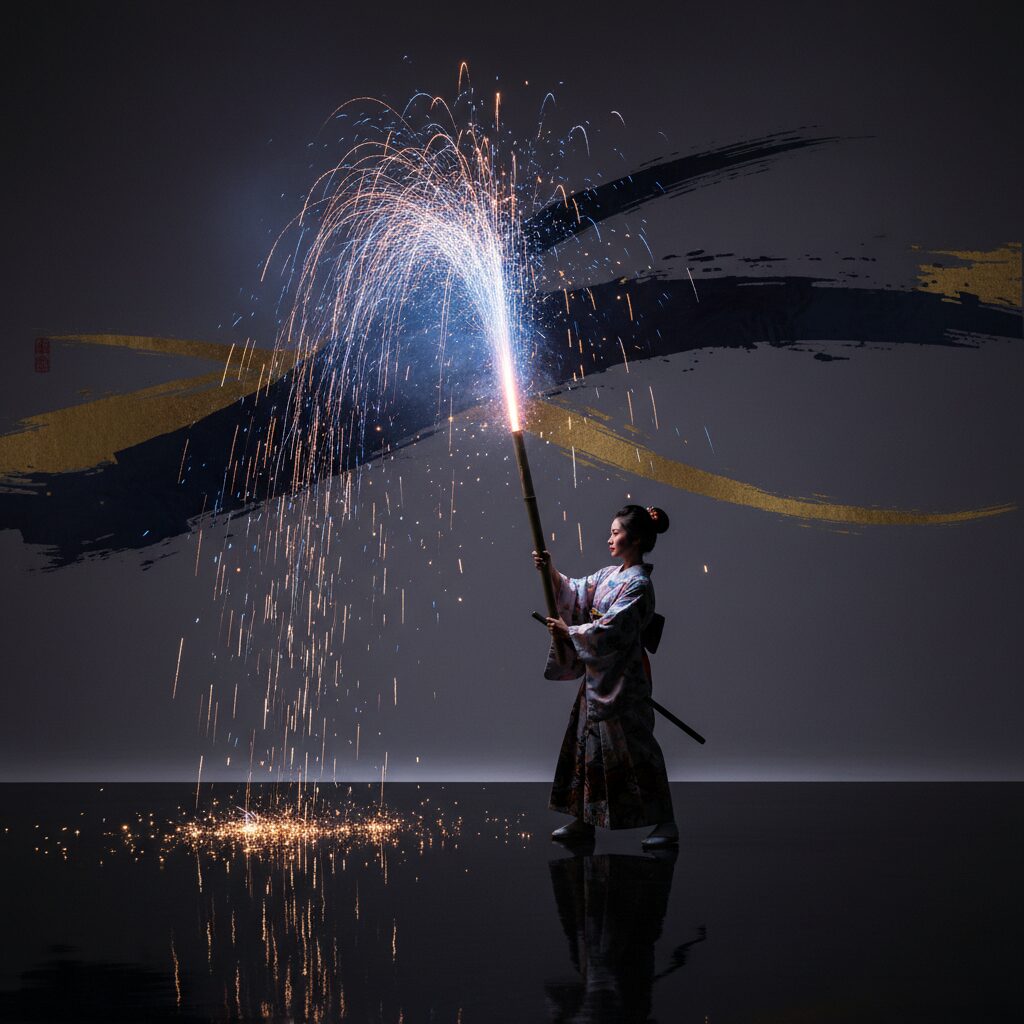
Yo, let’s be real. You’ve probably been scrolling through your feed, maybe late at night, and you see it. A video from Japan. Some guy, dressed in what looks like traditional gear, is standing in the middle of a crowd, holding a massive bamboo tube. And then it happens. The tube erupts. Not with a little firework, but with a colossal pillar of fire and sparks, shooting twenty meters into the sky. The guy doesn’t run. He holds it. He braces himself as a torrential downpour of white-hot sparks engulfs him completely. Your first thought is probably something like, “What is happening? Is this real? Why would anyone do that?” It looks like a scene from an action movie, a stunt gone wrong, or just pure, unadulterated madness. And that’s the question, right? Why are people in Japan willingly hugging a volcano? Is it an extreme sport? A religious ceremony that’s gone way over the top? A major safety violation that everyone is just vibing with?
Okay, let’s break it down. What you’re seeing is Tezutsu Hanabi, or hand-held fireworks. And no cap, it’s one of the most intense, visceral, and deeply misunderstood cultural practices in Japan. This isn’t your standard Fourth of July or New Year’s Eve firework display where you sit back on a blanket and watch pretty colors from a safe distance. This is raw, personal, and profoundly spiritual. It’s a tradition that stretches back centuries, a rite of passage, a community’s prayer rendered in gunpowder and fire. To get it, you have to look past the insane visuals and understand the heart, the history, and the sheer grind that goes into holding a pillar of fire. This is a story about more than just fireworks; it’s about the Japanese relationship with tradition, community, and the divine. It’s a whole mood, a conversation with the gods where you have to be loud enough to be heard. So let’s get into it, and figure out why these dudes are literally playing with fire.
This profound connection to community and the divine is a thread that runs through many Japanese summer traditions, such as the deeply spiritual Bon Odori festivals.
More Than Just a Firework: The Vibe is Seriously Ancient
First and foremost, you need to understand that Tezutsu Hanabi is not a modern trend created for social media fame. Its origins run deep, reaching back nearly 500 years to the Sengoku period, Japan’s era of warring states. The story traces its beginnings to signal fires, an early form of battlefield communication. The basic concept of gunpowder packed into a tube—the precursor to firearms—was adapted for signaling purposes. Yet Japan has an extraordinary ability to take something practical, even martial, and transform it over centuries into something profoundly spiritual and artistic. As peace settled over the land during the Edo period (1603–1868), this technology of fire and powder did not vanish; rather, it was repurposed and became ritualized.
This transformation occurred mainly in one distinct area of Japan: the Higashi-Mikawa region of Aichi Prefecture, with the city of Toyohashi as its undisputed center. Here, Tezutsu Hanabi evolved into an offering, a Shinto ritual dedicated to the local gods, or kami. In Shintoism, purification, or misogi, is of great importance. Fire, with its intense, destructive, and cleansing power, is regarded as one of the ultimate purifying forces. By presenting this spectacular fire display, communities prayed for tangible blessings: a bountiful harvest, protection from plagues and disasters, prosperity for their families, and the safety of their homes. The deafening roar was thought to frighten away evil spirits and demons, while the shower of sparks served as a blessing, a divine rain cleansing all it touched.
So, when you see a man holding that pillar of fire, he is not merely a performer. He is a vessel, a messenger. He is a hōnōsha—an offerer. He carries the collective prayers and hopes of his entire community, packing them into that bamboo tube, and delivers them directly to the heavens in the most dramatic fashion possible. It is a direct, unfiltered line of communication with the divine. This is not some abstract prayer whispered quietly in a shrine; it is a full-bodied, multi-sensory outcry of devotion, a testament to the community’s faith and resilience. This historical and spiritual context is absolutely essential. Without it, it’s just a dangerous stunt. With it, it becomes a profound act of faith passed down through generations, a living, breathing piece of history exploding in the present day.
The Grind is Real: Making Your Own Fire
Here’s a plot twist that changes everything: the men who hold these fireworks actually make them themselves. These aren’t off-the-shelf items you can simply buy at a festival supply store. Creating a Tezutsu Hanabi is a long, arduous, and deeply personal journey. It’s a craft, an art form, and a spiritual practice all combined. The process can take months, and it’s a huge part of what makes the final act of holding the fire so meaningful. It’s the ultimate form of DIY—yet on a spiritual, explosive, and life-threatening level.
The Soul of the Bamboo
It all begins with the bamboo. Not just any bamboo will suffice. It must be mōsōchiku, a thick, powerful species harvested from local mountains at a precise time of year—usually winter, when the bamboo is driest and strongest. The selection is meticulous. Skilled craftsmen seek stalks at least three years old, with thick walls and perfectly spaced nodes. They tap the bamboo, listening for a particular sound that signals its density and integrity. This isn’t merely wood; it’s the vessel that will contain a controlled explosion. Any crack or flaw could spell disaster. Once harvested, the bamboo is dried for months, sometimes years, to eliminate every trace of moisture. It’s then cut to a specific length, typically around 80 centimeters, and the inner nodes are carefully hollowed out to create a smooth, uniform barrel.
The Binding of Tradition
Next comes the wrapping. The hollow bamboo tube is tightly bound with thick ropes made from straw or hemp, called nawa. This isn’t just decorative. These ropes provide essential structural reinforcement, helping the bamboo endure the intense pressure of the burning gunpowder. The wrapping itself is a skill passed down from master to apprentice. The ropes are soaked in water to become pliable, then wound around the bamboo with immense tension, forming beautiful, intricate patterns. Each community—and sometimes each family—has its own distinctive wrapping style, a signature that identifies the maker. This act of binding is symbolic, representing the strength and unity of the community supporting the individual in their dangerous task. It’s a physical embodiment of collective responsibility.
The Heart of the Matter: The Gunpowder
The most crucial and hazardous step is packing the gunpowder, or wakō. This isn’t the fast-burning, high-explosive powder found in modern fireworks. Tezutsu Hanabi uses a slow-burning black powder—a traditional blend of sulfur, charcoal, and saltpeter. The exact formula is often a closely guarded secret, handed down through generations within a family or local guild. The ingredients are ground into a fine powder and then carefully, methodically packed into the bamboo tube in a process called kayaku-zume. The maker uses wooden mallets and tamping rods to compress the powder, layer by layer, millimeter by millimeter. It demands immense focus and a delicate touch. Packed too loosely, it will fizzle out; packed too tightly, pressure can build too rapidly, causing the tube to explode in the holder’s arms. The maker often works alone in a purified space, treating the process with the reverence of a religious ritual. They literally pour their soul, prayers, and focus into this explosive core. This is what elevates the act from reckless to righteous. When a man holds that firework, he holds his own creation—a product of his hands, sweat, and spirit. He is responsible for its performance, and his honor is at stake.
The Main Event: What It Actually Feels Like to Hug a Volcano
Festival day, or matsuri, pulses with electric energy. In these small towns of Aichi, the air is thick with anticipation, rich with the scents of street food, incense, and the faint, sharp hint of sulfur. As dusk falls, the atmosphere shifts. The lively, playful mood of the day transforms into a primal, nervous excitement. The hōnōsha, the offerers, assemble at the local Shinto shrine, dressed in traditional festival attire: a thick, fire-resistant cotton jacket called a shōbō hanten or hanten, simple trousers, and tabi socks. Their jackets are often soaked with water for extra protection. They offer prayers, asking the kami for safety and a successful offering. There is a solemnity to the ritual, a quiet focus among the men who are about to confront something truly elemental.
Then, the procession begins. The men carry their hand-crafted Tezutsu to the firing site, usually on shrine grounds or a specially prepared open area. The crowd parts, faces filled with a mix of reverence and awe. There are no barriers or safety nets as seen in the West. Instead, there is an unspoken trust between participants and spectators. The audience knows the risks and the rules of engagement; they watch for flying sparks and give the men ample space. This is no passive spectacle—everyone present actively partakes in the ritual.
The Roar and the Rain of Fire
When his turn comes, the holder takes his position, cradling the heavy bamboo cannon under his arm and bracing it against his hip. He draws a deep breath. A partner approaches carrying a long, burning pole. For a brief moment, there is complete silence. Then, the fuse is lit. The initial ignition hits with a violent shock. It’s not a gentle whoosh, but an explosive roar—a guttural gōon that feels less like a sound and more like a physical force. A percussive blast shakes your chest and the ground beneath your feet. A towering column of incandescent orange and yellow fire erupts from the tube, soaring into the night sky like a burning star of fierce intensity.
For the holder, the physical ordeal is immense. The tube, weighing up to 20 kilograms, thrashes and roars, trying to break free from his grasp. His entire body is locked in a tense battle against the raw power he has unleashed. The heat is blistering, an invisible wall pressing against his face and body. Then comes the hinoko, the rain of fire. As the gunpowder burns down the tube, it releases a continuous, dense shower of sparks. But these aren’t the delicate twinkles of a sparkler—these are large, molten globules of burning charcoal and sulfur that cascade down, completely engulfing the holder. They describe the sensation not as a sharp burn, but as a heavy, stinging rain of hot sand hitting every exposed inch of skin. Sparks get in their eyes, mouths, and clothes. This is the moment of purification, the ultimate test of endurance and spirit. The holder must not flinch. He stands firm, gaze unwavering, enduring the fiery baptism. He becomes a silhouette—a human form at the center of a self-created inferno. It is a moment of terrifying beauty, a perfect fusion of human courage and elemental chaos.
The Grand Finale: The “Hane”
Just when it seems over, the most dramatic moment arrives. After about 30 seconds of roaring fire, the main flame subsides. But at the bottom of the tube, the maker has packed a final, more powerful charge. With a deafening, concussive bang, the base of the firework explodes. This is the hane, or “jump.” The blast is so forceful it often tosses the heavy bamboo tube from the holder’s hands. The deep, resonant boom echoes through the night and is said to be the final, powerful shout that drives away lingering evil spirits. A successful hane signals a masterfully crafted firework and a triumphant offering. The community cheers. The holder, often dazed, blackened with soot, and steaming from water and heat, bows in gratitude. If the hane fails—a dud called sukashi—it brings great shame to the maker, indicating something was amiss in his craft or spirit. This explosive finale elevates the entire experience—it’s not just about enduring the fire, but about delivering the prayer to its loud, conclusive, and victorious end.
So, Is It Safe? The Unspoken Rules of Organized Chaos
From an outsider’s viewpoint, Tezutsu Hanabi appears to be an absolute safety nightmare. People hold giant explosives, spectators stand just meters away, and a constant shower of hot sparks falls around them. By any Western standard, regulators would shut this down immediately. However, to understand why it works, you need to grasp the Japanese concept of organized chaos and the power of community responsibility. It is dangerous—injuries, typically minor burns, do occur—but major accidents are surprisingly rare thanks to a system based on generations of trust, passed-down knowledge, and extreme discipline.
First, the equipment is traditional yet functional. Thick, multi-layered cotton hanten jackets, when soaked in water, provide remarkable protection against the sparks. Participants wear head coverings and sometimes goggles. Crucially, no one holds the fire alone. He is supported by a team from his community group, or ren. Men in front of him, called the sakite, and men behind him, the ushirodate, constantly douse him and the surrounding area with buckets of water. They serve as his literal guardians, monitoring every move and ready to intervene if he stumbles. This is not an individualistic display of bravado; it’s a collective performance where everyone plays a part in ensuring everyone’s safety.
Moreover, the knowledge required to handle these fireworks isn’t gained from a manual. It is absorbed over a lifetime. Children in these towns grow up watching their fathers and grandfathers participate. They learn through observation, helping with preparations, feeling the heat, and hearing the roar from an early age. By the time a young man is prepared to hold his first Tezutsu, he has an instinctive understanding of the risks and the correct techniques. Enormous social pressure also drives everyone to perform safely and correctly. A reckless act would shame not only the individual but also his family and entire community group. This concept of avoiding trouble for the collective, meiwaku, is a powerful social force in Japan and, in this high-stakes setting, functions as a more effective safety regulator than any written law could be. It’s a system that trusts people to be responsible, disciplined, and aware of their role within the group—a stark contrast to more litigious cultures that attempt to eliminate all risk through regulation.
Not Just for the ‘Gram: The Real Meaning Behind the Fire
So, after all this—the history, the meticulous craftsmanship, the terrifying ordeal—we return to the initial question: Why? Why do they persist in this extraordinarily dangerous and demanding tradition in the 21st century? The answer is complex, touching the very core of modern Japanese identity, where ancient customs intersect with contemporary life.
Rite of Passage
For many young men in the Higashi-Mikawa area, taking part in the Tezutsu Hanabi festival represents the ultimate rite of passage. It is a public proclamation of their shift from boyhood to adulthood. By creating their own firework and then enduring the shower of flames, they demonstrate their bravery, discipline, and dedication to their community’s traditions. This earns them respect. They are no longer just boys; they become full members of the group, men who have faced the fire and stood firm. In a time when traditional signs of adulthood are becoming unclear, this offers a distinct, powerful, and unforgettable milestone. It’s a way to forge identity not only for the individual but for the entire generation, linking them to a long line of men who have done the same.
Community and Connection
In many rural areas of Japan, communities are confronting issues such as depopulation and an aging population. Traditions like Tezutsu Hanabi serve as the bonds that keep these communities united. The months of preparation—harvesting bamboo, twisting ropes, packing powder—are all done collectively. It’s a time for strengthening ties and for older generations to pass down their skills and stories to younger ones. The festival itself becomes a grand homecoming event, with people who have moved to big cities returning to their hometowns to take part or watch. It reinforces a sense of belonging and shared identity that is increasingly rare in today’s fragmented world. The collective experience of risk and triumph forges an unbreakable connection. They are not just neighbors; they are brothers in fire.
A Conversation with the Gods
At its essence, despite the adrenaline and spectacle, Tezutsu Hanabi remains a deeply spiritual event. For many participants, it is a sincere prayer. It serves as a way to connect with something greater than themselves—whether the kami of the local shrine, the spirits of their ancestors, or simply the cyclical forces of nature. In our sanitized, predictable world, Tezutsu Hanabi provides a rare chance to confront something raw, powerful, and uncontrollable. It is a moment of pure presence, where the roaring fire burns away all distractions, leaving only the holder and his offering. Whether seen through the lens of formal Shinto belief or a more personal, secular spirituality, holding that fire is a profound instant of catharsis and connection. It is a way of declaring, “We are still here. We are strong. We are grateful.” And they express it in a language of fire the heavens cannot ignore.
The Bottom Line: Should You Go See It?
If you have the opportunity to witness a Tezutsu Hanabi festival, you definitely should. But come with the right mindset. This isn’t a polished, commercialized tourist event. It’s a genuine, raw, and sometimes chaotic local religious festival. The atmosphere is authentic, and so are the sparks flying around. Don’t expect stadium seating, VIP areas, or a perfectly orchestrated experience. You’ll be standing in a crowded, smoky environment, so stay aware of your surroundings. Wear sturdy shoes and non-flammable clothing (cotton is preferable to synthetics), and be ready to move if a stray spark comes your way.
Most importantly, be a respectful observer. Remember that you are a guest at a sacred community event that has been carried on for centuries. Don’t push to the front for a better photo; give the participants and their support teams the space they need. Be quiet and respectful during the shrine prayers. Buy a drink or snack from a local vendor to support the community sharing this incredible tradition with you. By doing so, you’re not merely a tourist; you become a temporary participant in the ritual’s energy.
Tezutsu Hanabi perfectly embodies much of what makes Japan both fascinating and perplexing to outsiders. On the surface, it appears as pure, chaotic energy. But beneath that, there is a complex system built on immense discipline, deep meaning, and strong community ties. It’s a tradition that trusts its people to be courageous and responsible, to literally hold their history in their hands. It reminds us that the most powerful experiences often push us to our limits and compel us to face elemental forces in the world and ourselves. It’s not just about holding fire; it’s about holding tradition itself. And that, truly, is a whole mood.