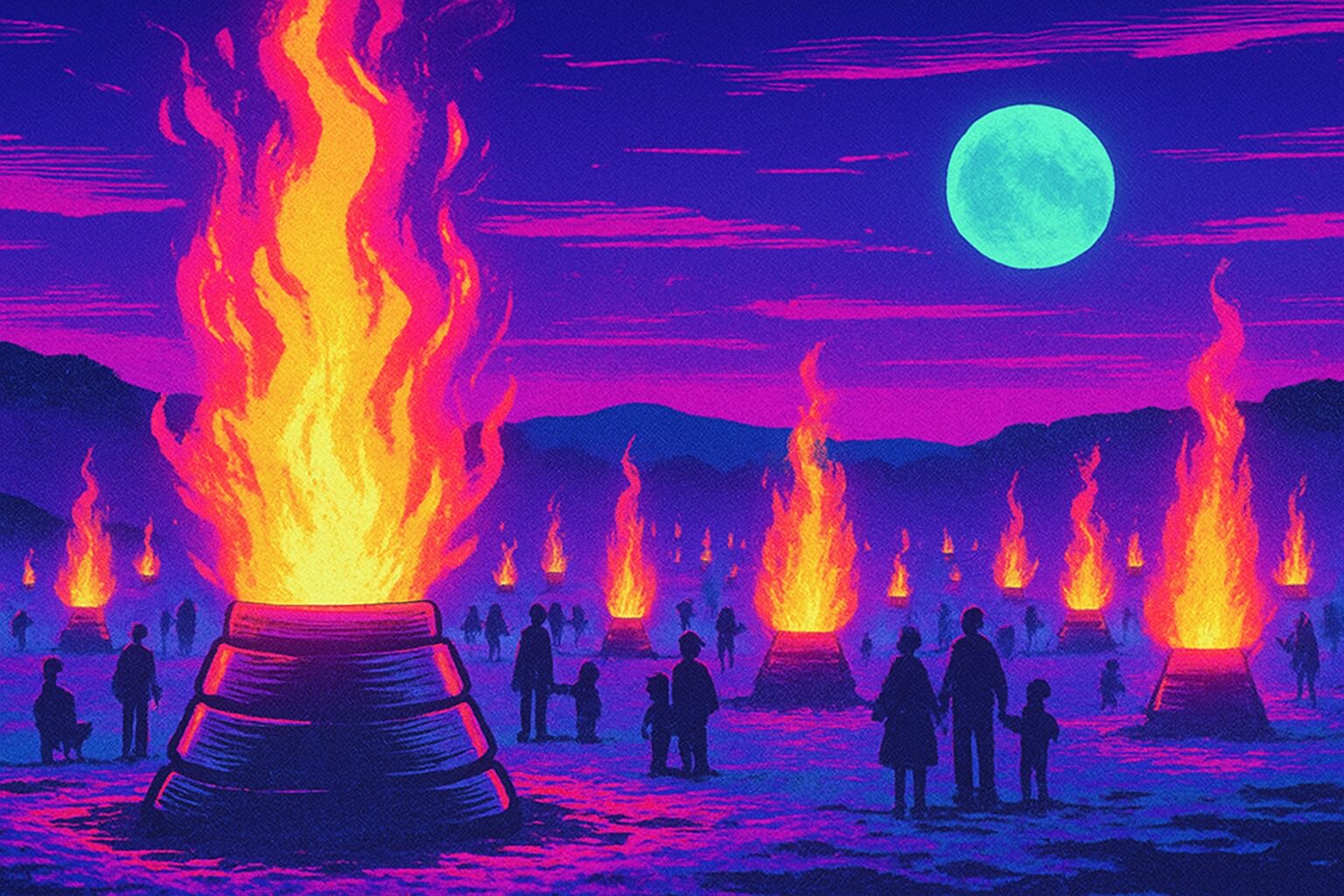
Picture this: the thick, humid air of a Japanese summer night, alive with the rhythmic beat of taiko drums. The air smells of woodsmoke and sweet yakisoba sizzling on a griddle. All around you, a sea of people moves as one, their faces illuminated by the flickering, dancing light of a colossal bonfire or a procession of massive, fiery torches. This is the raw, primal energy of a traditional Japanese fire festival, or ‘matsuri’—a visceral experience that connects communities, purifies spirits, and has burned brightly in the nation’s cultural heart for centuries. It’s a spectacle of organized chaos, a celebration of impermanence, and a powerful, shared human moment. Now, imagine transposing that very essence—the communal awe, the dynamic, living light, the feeling of being part of something larger than yourself—into the hyper-modern landscape of 21st-century Tokyo. How could technology possibly capture the soul of a ritual so ancient and elemental? The answer lies not in recreating the fire, but in reimagining the flame. Welcome to the world of teamLab, an immersive universe where art, technology, and nature collide to create a breathtakingly new kind of festival, a digital ceremony for a new age. This is not a quiet, sterile gallery where you passively observe art from a distance. It is a living, breathing ecosystem of light, sound, and sensation that you step into, becoming a part of the artwork itself. It’s here, within these interactive realms of shimmering crystals, cascading digital waterfalls, and blooming floral galaxies, that the spirit of the ancient fire festival is reborn, pulsating with a future-forward vibe that feels both deeply familiar and utterly revolutionary. It’s a place where you don’t just see the light; you feel its warmth, you guide its path, and you share in its ephemeral glow with everyone around you.
To explore more about the traditional roots of these communal celebrations, check out our guide to Japan’s vibrant music festivals with camping and bonfires.
The Digital Bonfire: Deconstructing TeamLab’s Fire Festival Aesthetic
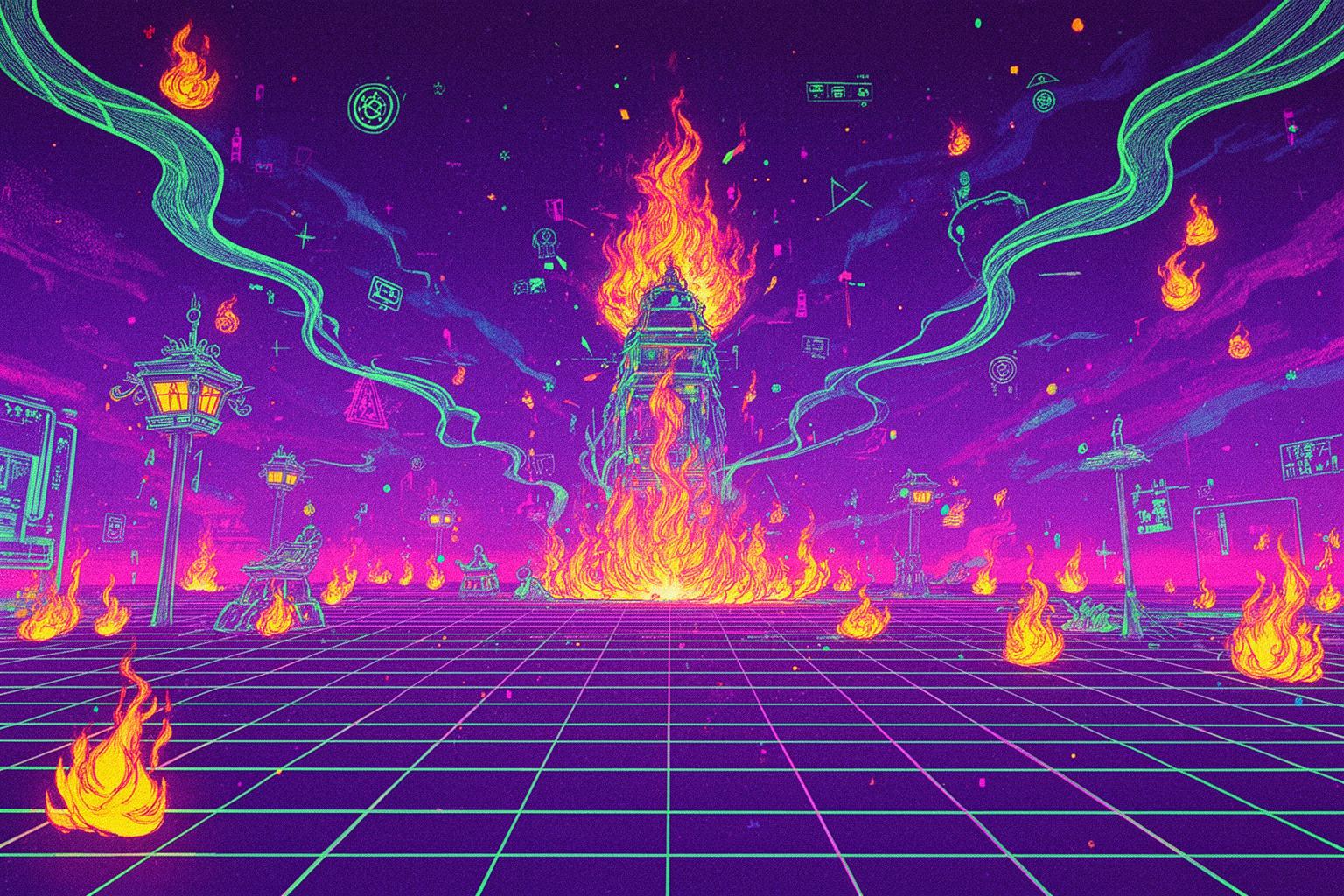
To fully understand what teamLab accomplishes, one must look beyond the dazzling surface of its light installations. This goes beyond simply producing beautiful images with projectors and LEDs; it is a profound exploration of humanity’s age-old practice of gathering around light. At the heart of a fire festival lies the central bonfire—a gathering point that draws people together, offering light, warmth, and transformation. TeamLab’s artists and “ultra-technologists” have deconstructed this idea and reimagined it using a digital language, creating artworks that function as contemporary bonfires, igniting a sense of connection and collective awe. They have succeeded in capturing the essence of a matsuri, its energy and communal spirit, through a series of interactive experiences that resonate on a primal level.
Take, for instance, the renowned installation Forest of Resonating Lamps. Upon entering this seemingly endless space filled with suspended Murano glass lamps, you are instantly embraced by a warm, gentle glow. The lamps are dynamic; when you stand near one, it illuminates brightly, sending its light like a wave to the two nearest lamps, which then pass it along to their neighbors, creating an ongoing, flowing chain reaction. The color of the light shifts fluidly, immersing the mirrored room in shades of fiery orange, deep crimson, cool cerulean, and soft amber. The experience vividly mirrors the spread of a flame. It visually embodies connection, illustrating how one presence can trigger a response that ripples throughout the entire environment. This is the bonfire effect at work. Just as festival-goers are united by the shared glow of flames, visitors in the lamp forest are linked through this responsive, shared luminescence. The light acknowledges your presence, engages with it, and uses it to communicate with the entire space. It is a quiet, beautiful dialogue in the language of light, echoing the nonverbal communication and shared experience of a crowd gathered around a crackling fire. The soft, warm glow also evokes traditional Japanese paper lanterns, or chochin, which line festival streets, guiding attendees and creating an atmosphere of enchanted celebration.
Another striking example is Universe of Water Particles on a Rock where People Gather. Here, a vast simulated waterfall cascades down a virtual rock positioned in the room’s center. The water, rendered with breathtaking realism, flows over the digital rock and onto the floor, parting and swirling around the feet of anyone standing in its path. You become an obstacle—a human rock—in the digital stream, and the water responds to your presence in real time. The roar of the waterfall fills the area, creating a powerful, meditative soundscape. Although this piece features water rather than fire, its effect is remarkably similar. The central “rock” serves as a gathering spot, a place for people to assemble and witness the spectacle, just like a bonfire. The constant, dynamic, and untamable movement of the water particles mimics the chaotic, mesmerizing dance of flames. There is a raw energy here, a sense of nature’s vast power being channeled into the space. It evokes the sensation of standing before something immense and elemental—a feeling that fire festivals, with their towering torches and blazing pyres, aim to inspire. The artwork’s title explicitly states: this is a place “where people gather,” highlighting teamLab’s intent to create communal focal points within their digital realms.
Moreover, installations such as Memory of Topography explore the seasonal themes central to Japanese festivals. Many matsuri correspond with the agricultural calendar, celebrating planting, harvesting, and the cycle of the seasons. In this piece, a serene digital landscape of flora and fauna evolves over the course of a year. Flowers bud, bloom, scatter, and fade. Insects and animals appear and vanish in rhythm with the seasons. The artwork is not a prerecorded loop; it is generated in real time by computer programming, continuously changing without ever repeating the same state twice. This directly reflects the cyclical, transient nature of the real world that traditional festivals honor. It stands as a digital embodiment of mono no aware, the Japanese aesthetic concept expressing a gentle sadness at impermanence. Much like the cherry blossoms’ beauty stems from their fleeting nature, the appeal of this digital ecosystem lies in its constant, unrepeatable transformation. This connection to the natural cycles of life, death, and renewal is a foundational theme in many Shinto and Buddhist-inspired festivals, especially those like Obon, which use fire rituals to guide ancestral spirits.
More Than Just a Light Show: The Communal Heartbeat
A festival means nothing without its people. The spirit of a matsuri isn’t sparked by the fire alone but by the collective energy of its participants. It’s a shared, interactive experience. This is perhaps the most vital aspect that teamLab captures. Their installations remain incomplete without human presence; they are designed to be engaged with, transformed, and co-created by the visitors. This shifts the audience from passive observers to active contributors, a fundamental principle of any genuine festival.
This is most evident in The Infinite Crystal Universe. Entering this space feels like being transported to the core of a galaxy. Countless points of light, formed by LEDs on vertical strands, extend endlessly in all directions, their reflections on mirrored floors, walls, and ceiling creating a three-dimensional infinity. The visual beauty alone is stunning, but the true enchantment comes through interaction. With a dedicated smartphone app, visitors can choose various cosmic elements—stars, planets, nebulae—and “swipe” them into the universe. The selected element then takes shape within the crystal matrix, soaring through the space and transforming the lightscape. Suddenly, you’re not merely watching; you’re a creator, conducting a cosmic symphony. Everyone present contributes simultaneously, their individual actions blending into a complex, ever-evolving, and entirely unique tapestry of light. This serves as a vivid metaphor for the communal energy of a festival. Imagine a lantern festival where each person releases their own light into the sky or a torch procession with each participant carrying a single flame. The combined effect becomes a spectacle far greater than its individual parts. In the Crystal Universe, you are part of a creative moment—a digital space molded by the collective will of all participants. It inspires a sense of shared authorship and an unspoken, powerful connection with the strangers around you.
In a different, more reflective manner, Floating in the Falling Universe of Flowers conveys a similar sense of community. In this dome-shaped room, visitors can lie down or recline and look up as digital flowers continuously sprout, bloom, and gently drift down from above. The flowers respond to your presence; if you remain still, more flowers will bloom around you, but if you move, they scatter. The experience is deeply immersive and meditative, creating a shared dreamscape for everyone inside. Though the interaction is subtler, the sense of unity is equally strong. There is a quiet, mutual reverence in the room. People naturally slow their movements and become silent, united by their collective upward gaze. It’s a moment of shared awe, a silent communion reminiscent of a festival’s final moments when the crowd watches the last embers of a great bonfire fade away. The connection arises not from noise and action but from shared stillness and wonder.
This principle of interaction is deeply grounded in Japanese philosophical ideas like ma, the concept of negative space or the interval between things. TeamLab’s art doesn’t merely fill a space with objects; it activates the ma—the space between people, and between a person and the art. Your movement, your touch, your very presence becomes part of the artwork’s fabric, bridging the gap and creating a tangible connection between you, the art, and others sharing the space. It is this activation of the in-between that turns a simple art viewing into a profoundly communal experience—the true heartbeat of any festival.
Echoes of Antiquity: Tracing the Matsuri Spirit in Digital Realms
The genius of teamLab lies not only in its futuristic vision but also in how profoundly its work is interwoven with Japan’s ancient cultural and spiritual traditions. The “fire festival vibe” is not a coincidental aspect of their aesthetic; rather, it is a direct, though abstract, continuation of a long and rich history. To truly grasp the depth of their digital creations, one must appreciate the profound significance of fire in Japanese culture.
For centuries, fire festivals have been an essential part of life in Japan, fulfilling numerous roles closely tied to Shinto and Buddhist beliefs. Fire is regarded as a potent force of purification (oharai), capable of burning away impurities, misfortune, and spiritual defilement. The Nachi Fire Festival in Wakayama Prefecture is a striking example, where priests carry twelve massive, blazing torches, each symbolizing a deity of the Kumano mountains, down the steps of the renowned shrine, their flames purifying the gods’ path. Fire also serves as a bridge between the physical and spiritual realms. The most famous instance is Kyoto’s Gozan no Okuribi, or Daimonji. At the conclusion of the Obon season, enormous bonfires shaped like kanji characters are lit on five mountains surrounding the city to guide ancestral spirits back to the spirit world. It is a solemn, beautiful spectacle that unites the entire city in a collective act of remembrance. Additionally, fire can symbolize a test of courage and raw, untamed energy, as demonstrated in festivals like the Nozawa Onsen Fire Festival, where villagers engage in intense, ritualized battles to attack and defend a wooden shrine using flaming torches.
These ancient traditions find captivating new expressions within teamLab’s digital landscapes. The theme of purification, for example, resonates powerfully in their water-based installations. When you walk barefoot through the warm, knee-deep water of Drawing on the Water Surface Created by the Dance of Koi and People – Infinity, with digital koi swimming around your legs and bursting into flowers upon contact, you participate in a modern form of misogi. Misogi is the traditional Shinto ritual of purification by washing in a river or waterfall. At teamLab, you are cleansed not by real water but by light, data, and sensation. You emerge from the experience feeling renewed, your senses heightened, as if you have been purified from the noise of the outside world. It is a symbolic cleansing for the digital era.
The concept of transformation is also fundamental. A festival creates a liminal space—a temporary threshold between the ordinary and the extraordinary. For hours or days, normal rules are suspended, and the community enters a heightened state of being. TeamLab Borderless, with its philosophy of a world without maps or boundaries, perfectly captures this transformative journey. You wander from one immersive environment to another without defined borders. A flock of digital crows might fly out from one wall, soar through the corridor you’re in, and merge into the digital waterfall in the next room. You become lost, discover hidden spaces, and emerge from the experience changed in a fundamental way. The space itself is in constant flux, transforming around you and mirroring the transformative power of a festival to alter one’s perspective and state of mind.
Moreover, the profound connection to nature, which forms the foundation of Shintoism and nearly all traditional matsuri, stands as teamLab’s most enduring theme. Their overarching project seeks to explore a new relationship between humanity and nature through digital art. They create digital ecosystems that are beautiful, complex, and responsive. Flowers bloom and wither, seasons shift, and animals move through these virtual worlds. They utilize technology not to fabricate an artificial realm apart from nature but as a means to foster a deeper appreciation for the natural world’s beauty, complexity, and fragility. This parallels how a harvest festival employs ritual and celebration to honor nature’s blessings and affirm the community’s reliance on it. TeamLab invites us to consider our place within the environment—real or digital—and to acknowledge our impact upon it.
Finally, the most profound connection is the acceptance of impermanence. As noted, teamLab’s artworks are algorithmically generated in real-time. They are not looping videos. The intricate patterns of light, the movements of the flowers, the paths of digital creatures—each moment is unique and will never repeat. The image you witness is born and then disappears forever. This is a digital embodiment of the traditional Japanese aesthetic that finds supreme beauty in the transient and ephemeral. A real bonfire is a living entity; it bursts to life, shifts shape with every gust of wind, and eventually fades to embers and ash. Its beauty is inseparable from its impermanence. By creating art that is similarly fleeting, teamLab taps into this profound cultural current, reminding us to be present and to treasure the beauty of the moment, as it will never come again. It is in this shared appreciation of a beautiful, fleeting moment that the spirit of the matsuri truly endures.
A Practical Guide to Your Digital Pilgrimage
Exploring the world of teamLab is a must-do experience in Tokyo, but a little preparation can greatly enhance your visit. With two major, distinctly different facilities in Tokyo—teamLab Planets and the newly reopened teamLab Borderless—it’s helpful to understand what each offers. Think of this not just as visiting a museum, but as embarking on a pilgrimage into an alternate reality.
teamLab Planets (Toyosu, Tokyo)
The Concept: The guiding phrase for Planets is “Body Immersive.” This is a sensory and physical experience. From the moment you enter, you’ll be asked to go barefoot and stay that way throughout your visit. You’ll walk on soft, yielding surfaces, pass through dark corridors, and wade through knee-deep water. The aim is to erase the boundary between you and the art, making your body the chief medium for experiencing it.
Access: Situated in the modern waterfront area of Toyosu, getting there is simple. The easiest route is via the Yurikamome Line, an automated train offering scenic views of the bay, to Shin-Toyosu Station, just a minute’s walk away. Alternatively, you can reach Toyosu Station on the Tokyo Metro Yurakucho Line or Kokusai-tenjijo Station on the Rinkai Line, each about a 10-15 minute walk. The area also hosts the Toyosu Fish Market, successor to the famous Tsukiji Market, allowing you to pair your visit with a top-tier sushi breakfast.
Tickets: Booking tickets online in advance is absolutely necessary. Popular time slots, especially on weekends and holidays, sell out weeks or even months ahead. Walk-ins are almost impossible. Ticket prices fluctuate daily, so check the official site for the most current rates.
What to Wear: This is important for Planets. Because you’ll be wading through water, wear pants that can easily be rolled up to your knees, like shorts or loose trousers. Skirts and dresses aren’t recommended due to some installations with mirrored floors, but don’t worry if you forget—the facility offers free shorts to borrow. Since you’ll be barefoot, shoes aren’t a concern, but be ready for a variety of floor textures.
Timing and Tips: Allow at least two to three hours to fully enjoy the experience. The journey is linear, following a set route through the exhibits. Weekday mornings tend to be the least crowded. Upon arrival, you’ll receive a locker for your shoes, socks, and bulky bags. Don’t miss the on-site vegan ramen restaurant, UZU Tokyo, where you can dine inside an art installation—an unforgettable extension of the immersive experience.
teamLab Borderless (Azabudai Hills, Tokyo)
The Concept: Borderless truly lives up to its name. Its motto is “Wander, Explore, Discover.” Unlike Planets, there’s no fixed path or map. It’s a vast, labyrinthine space where artworks are not confined to single rooms. They move, interact, and flow fluidly from one area to another. The fun comes from getting lost, finding hidden corners, and creating your personal journey in this limitless universe.
New Location: Note that teamLab Borderless has relocated from its original Odaiba site to the futuristic Azabudai Hills complex. This new urban center boasts upscale shops, restaurants, green spaces, and cultural venues, making it a destination on its own. Mentioning Azabudai Hills is essential for up-to-date travel plans.
Access: The new venue is centrally located and easy to reach. The nearest station is Kamiyacho Station on the Tokyo Metro Hibiya Line, which connects directly to the complex. Roppongi-itchome Station on the Namboku Line is also within walking distance. Positioned near Roppongi, it’s easy to combine your visit with a tour of Tokyo’s lively arts and nightlife district.
Tickets and Timing: Like Planets, advanced online booking is crucial. Because of Borderless’s vast, non-linear layout, plan to spend even more time here—at least three to four hours to explore thoroughly, though you could easily stay longer. The scale is enormous, and the urge to discover what lies around the next corner is strong.
What to Expect: Get ready for a mentally and physically stimulating exploration. Wear your most comfortable walking shoes, as you’ll cover a lot of ground. The space is dimly lit with many disorienting areas, flashing lights, and uneven floors. Highlights in the new location include the breathtaking, evolved Bubble Universe and the colossal Megalith Crystal Formation. Don’t miss the EN TEA HOUSE, where digital flowers bloom and scatter in your tea as long as the cup contains liquid.
Beyond the ‘Gram: Finding Deeper Meaning in the Digital Light
Discussing teamLab’s immense popularity on social media is unavoidable. The installations are unquestionably stunning and highly photogenic. A quick search reveals millions of images of people posing in the Forest of Resonating Lamps or silhouetted against the Infinite Crystal Universe. This has caused some critics to dismiss teamLab’s work as a shallow “Instagram museum,” merely a collection of attractive backdrops created to generate shareable content. While the visual allure is undeniable, reducing the experience solely to its photographic appeal overlooks the deeper essence—missing the forest for the trees, or in this case, the digital forest for the selfies.
To genuinely connect with the spirit of these digital festivals, one needs to consciously look beyond the camera lens. The most profound moments at teamLab are often those that cannot be captured in a photo. It is the sensation of the soft, uneven floor in the Soft Black Hole, which makes you rethink the simple act of walking. It’s the subtle vibration transmitted through the floor that harmonizes with the deep, resonant soundscape in the Universe of Water Particles. It’s the collective gasp of a group of strangers when a new, breathtaking visual sequence appears in the Crystal Universe. These are immersive, multi-sensory experiences that engage your balance, touch, and hearing as much as your sight.
My advice to first-time visitors is this: by all means, take your photos. Capture the beauty and create lasting memories of your visit. But also select one or two installations where you deliberately put your phone away. Find a quiet corner, sit down on the floor, and simply be present. Observe how the light interacts with other visitors. Notice how the artwork responds not only to you but to the collective presence in the space. Listen carefully to the sound design, which is not merely background music but a carefully crafted auditory environment that shapes your emotional experience. It is in these calm, attentive moments that the deeper layers of meaning begin to emerge.
The installations are far more than passive spectacles; they are interactive philosophical explorations. They pose questions without providing straightforward answers. By making you an integral part of the artwork, they encourage reflection on your own place in the world. What is the boundary between myself and my surroundings? How does my presence, no matter how small, ripple outwards and influence the whole? In an age of growing digital isolation, what does it mean to share a physical space and a fleeting moment of beauty with others? This is the true essence of the teamLab experience. It offers a chance for introspection and connection that transcends a perfectly framed photo. It is a playground for the senses, and at the same time, a gymnasium for the soul.
The Ever-Burning Flame
Ultimately, what teamLab has created goes far beyond a collection of breathtaking digital art installations. It represents a powerful and moving evolution of an ancient human ritual. They have harnessed the primal, elemental energy of the fire festival—the communal gathering, the shared awe inspired by dynamic light, the celebration of a beautiful, fleeting moment—and have lovingly reinterpreted it in the language of our era. They have constructed new kinds of bonfires, made from code and light, around which a new generation can come together.
The shimmering lamps, cascading waterfalls, and infinite galaxies do not reject tradition but instead affirm its lasting significance. They remind us that our fundamental human need to connect, to be amazed, and to feel part of something greater than ourselves remains unchanged, even as our world evolves. TeamLab presents a vivid, hopeful vision of a future where technology serves not as a source of isolation but as a means of reconnection— with nature, with our own senses, and, most importantly, with one another. It is a new form of ceremony, a digital matsuri whose glowing embers hold limitless potential. It is the ever-burning flame of human wonder, passed down through generations, now shining brighter than ever at the heart of Tokyo.