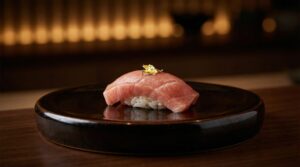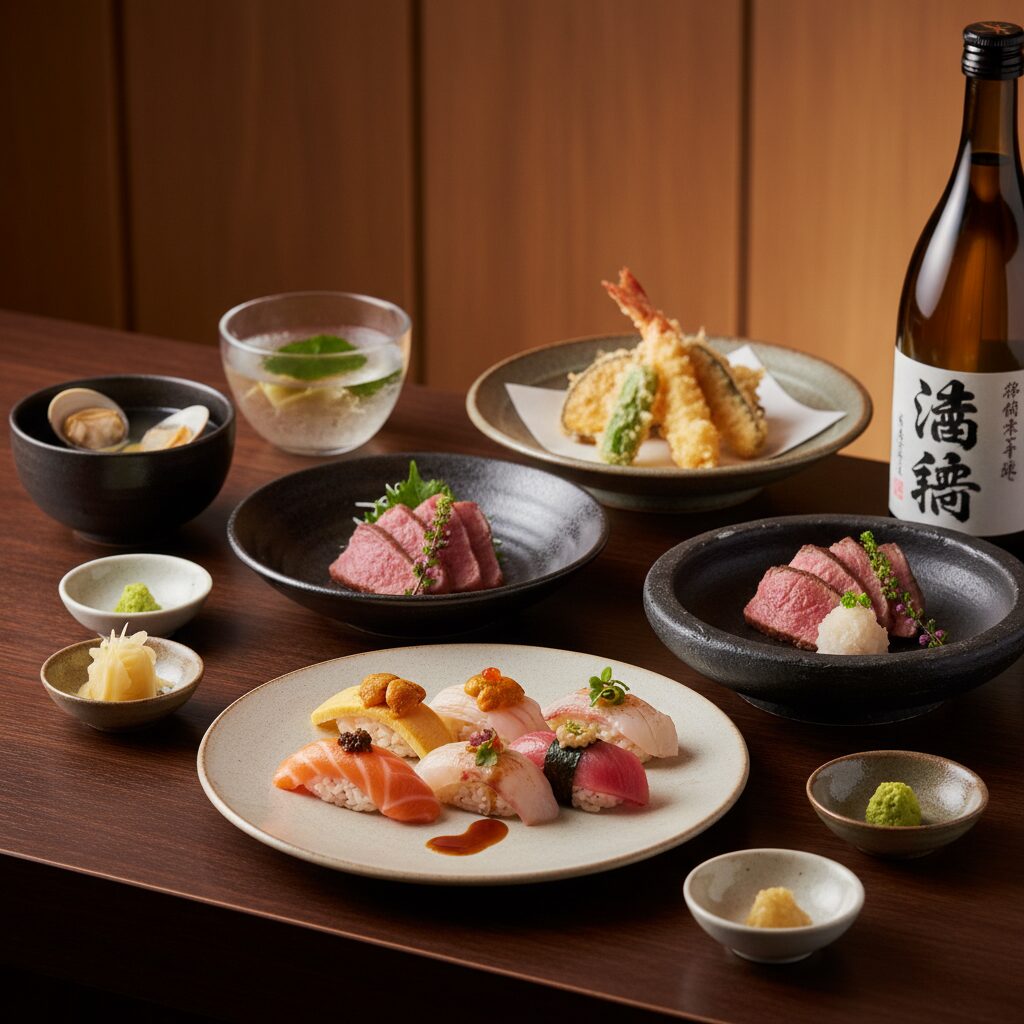
Hey everyone, Sofia here! So, let’s talk about a scene you’ve probably seen a million times on screen or on your feed. A tiny, spotlessly clean bar. A deadly serious-looking chef with a knife that looks like it could slice through time itself. A row of guests, sitting ramrod straight, barely breathing, let alone speaking. A single, perfect piece of sushi is placed before them, and they eat it with the reverence of a religious offering. The vibe is… intense. You’re probably thinking, “Is this dinner or a high-stakes exam?” It’s a legit question. You came for a meal, but you feel like you’ve stumbled into a secret society with a rulebook you never received. What’s the deal with Japan’s counter dining culture? Why is it so quiet, so formal, so… theatrical? This isn’t just about food; it’s a full-on cultural immersion. You’re not just a customer; you’re an audience member, a participant in a performance that’s been refined over centuries. The counter isn’t just a table; it’s a stage. And that tasting menu? That’s `omakase`, a concept that goes way deeper than just “chef’s choice.” It’s a dialogue, a trust fall, and an art form all rolled into one. Before we dive into decoding this whole mesmerizing experience, let’s get our bearings. We’re talking about a world often centered in areas known for their culinary excellence, like the iconic district of Ginza in Tokyo.
To fully appreciate this immersive performance, consider how the experience is elevated in settings like a private onsen villa with a personal chef.
Beyond the Menu: What ‘Omakase’ Actually Means
Alright, let’s get one thing clear right from the start. Translating `omakase` (お任せ) as “chef’s choice” is technically accurate, but it completely misses the deeper meaning. It’s like calling the Mona Lisa simply “a portrait of a woman.” Not wrong, but lacking the essence. The true meaning, the cultural depth, is more like “I entrust myself to you.” It’s a profound expression of vulnerability and respect. When you say `omakase shimasu`, you are consciously surrendering control. You’re not just letting the chef select the dishes; you’re placing your trust in their entire philosophy, years of training, taste, sourcing on that particular day, and artistic vision for your experience. This is a world apart from a Western-style tasting menu, where you get a printed list of the 12 courses ahead of time. That’s a predictable transaction. Omakase is an unpredictable journey. The chef acts as your guide, and you’ve agreed to follow without a map. It’s a significant cultural leap for many who are used to customizing every last detail of their order.
It’s More Than “Chef’s Choice” — It Means “I Trust You”
This act of surrender lies at the heart of the experience. It’s meant to be a passive reception of the chef’s art. The chef observes you, the other diners, and the atmosphere. They might notice you enjoying a certain type of fish and serve you another slice from a different cut. They could see you struggling with wasabi and adjust the amount on the next piece. This is a dynamic, living performance, not a pre-recorded show. The menu isn’t even firmly fixed in the chef’s mind; it unfolds in real-time, piece by piece. That’s why written menus are rarely seen in upscale omakase restaurants. The menu is the chef’s creative spirit, shaped by the freshest ingredients available on Earth that day. By entrusting them, you free them to be at their most imaginative. You’re not just a customer ordering food; you’re a patron commissioning a fleeting masterpiece. This trust is the invisible ingredient that makes the entire experience possible. It turns a simple meal into something almost spiritual. You’re not merely eating fish; you’re consuming a story—the story of the season, the ocean, and the chef’s lifelong dedication.
The Unspoken Agreement
This trust is mutual. When you say `omakase`, you enter an unspoken social contract. The chef vows to provide the very best they can offer. In exchange, you, the guest, have responsibilities. Your part is to be a worthy recipient of this art. This is the origin of many seemingly strict rules. It’s not about being pretentious or exclusive; it’s about preserving the integrity of the experience for everyone. Your role is to be fully present. That means putting away your phone—seriously. The light from your screen is distracting, and documenting every dish pulls you out of the moment. More importantly, it tells the chef your attention is divided. Punctuality is also crucial. Arriving late to omakase is a serious breach. The meal’s timing is coordinated for all guests. Being late disrupts the flow and forces the chef to rush you or delay everyone else. It’s like showing up late to a concert and expecting the orchestra to start over just for you. Another major point is avoiding perfumes or colognes. Your sense of smell deeply influences taste, and strong fragrances ruin the subtle aromas of sushi—not just for you, but for those beside you. This is considered extremely rude. This contract is about mutual respect: respect for the chef, the food, fellow diners, and the moment itself.
The Counter as a Stage: The Theatrics of It All
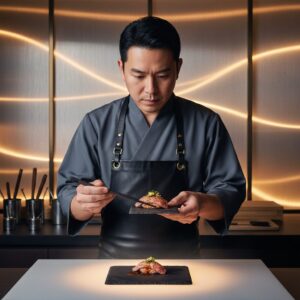
Once you grasp the trust involved, the counter reveals itself for what it truly is: a stage. The `itamae` (sushi chef) takes center stage, and every element within this space is part of the production. The minimalist decor, focused lighting, and immaculate wooden counter—all are crafted to eliminate distractions and direct your full attention to the performance. The limited seating, often just eight to twelve seats, creates an intimate theater-in-the-round. You have a front-row view of a master at work. This is no hidden kitchen behind swinging doors; here, the creation itself is the entertainment. The drama lies in the details, with the star being a figure deeply rooted in Japanese culture: the `shokunin`.
Shokunin: The Master of the Craft
The chef behind the counter is more than a cook; they are a `shokunin` (職人). This term has no exact English equivalent. It transcends “artisan” or “craftsman.” A `shokunin` is someone who has devoted their entire life to mastering their chosen profession—not for money or fame but for the pursuit of perfection itself. There is a spiritual and philosophical aspect to this. The `shokunin` seeks to refine their craft daily, embodying a profound sense of responsibility to produce the highest quality work and contribute positively to society through it. For a sushi `itamae`, this process spans decades. Apprenticeships are famously rigorous. An apprentice may spend years simply learning how to cook and season the rice—the `shari`—which many chefs regard as more important than the fish. For a long time, they are not allowed to touch the fish, let alone serve customers. Instead, they learn by observing, absorbing the master’s every movement endlessly. This commitment explains why the chef’s motions are so mesmerizing. They are a form of `kata`—a sequence of movements perfected through countless repetitions. The way they wipe the counter, the flick of the wrist shaping the rice, the single fluid slice of the `yanagiba` knife—none of these movements are wasted. It’s a ballet of efficiency and grace. That gleaming, impossibly sharp knife isn’t just a tool; it is considered an extension of the chef’s soul (`tamashii`). The intense expression on the chef’s face is not unfriendliness; it signifies deep concentration, akin to that of a surgeon or concert pianist. They are fully absorbed in their task, channeling all their knowledge and spirit into the single piece of sushi they are preparing for you now.
The Supporting Cast: Ambiance and Etiquette
Every aspect of the environment acts as a supporting actor in this performance. The counter is often crafted from a single, magnificent plank of `hinoki` (Japanese cypress), a wood cherished for its beautiful grain, subtle fragrance, and natural antibacterial qualities. It is sanded daily to a silky smooth finish. The ceramics are selected with exceptional care—each plate or vessel chosen to complement the specific piece of food it holds, taking into account color, texture, and seasonal relevance. The silence within the room plays a vital role as well. It’s not an awkward silence but a shared, reverent quiet that lets you hear the gentle tap of the knife on the board, focus on textures in your mouth, and fully appreciate the subtle flavors. In this quiet space, a bond forms between the chef and guests, a connection founded on mutual appreciation. To preserve this delicate atmosphere, a certain etiquette is expected. Though this unwritten rulebook can seem intimidating, each rule serves a logical and respectful purpose.
The Unwritten Rulebook
Let’s highlight the essentials of omakase etiquette. This isn’t meant to intimidate but to empower you. Understanding the reasons behind the rules makes them feel less like restrictions and more like keys to a deeper enjoyment.
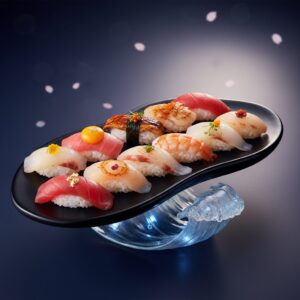
First, eating the sushi. When the chef places a piece of `nigiri` on the counter or your plate, the clock starts ticking. You should eat it immediately—within seconds. This is not a mere suggestion. The chef has prepared that piece to be savored at a very specific temperature and texture. The rice is slightly warm, which helps release its flavor and aroma, while the fish is cool. This contrast in temperature is critical to the overall experience. If you let it sit while taking photos or finishing your conversation, that perfect harmony is lost. The rice cools down, the `nori` (seaweed) becomes soggy, and the fish’s texture changes. Eating it promptly shows respect for the chef’s precise timing.
Second, how to eat it. Ideally, you should consume `nigiri` sushi in one bite. The chef creates it as the perfect balance of fish, rice, wasabi, and seasoning in a single mouthful. Taking two bites disrupts that careful construction. If using your hands (which is perfectly acceptable and often preferred for `nigiri`), pick it up gently, turn it over, and dip a small corner of the fish—never the rice—into the soy sauce, if any is offered. The rice acts like a sponge, soaking up too much soy sauce, overpowering delicate flavors and causing the rice to fall apart.
However, at most high-end omakase establishments, you should not add any soy sauce at all. The chef has already seasoned each piece to perfection, often with a light swipe of a special soy sauce blend called `nikiri`. Adding more soy sauce implies that the chef’s seasoning is incorrect and is, albeit unintentionally, an insult to their craftsmanship. Trust that they know best.
The pickled ginger, or `gari`, is not a topping but a palate cleanser meant to be eaten in small amounts between different pieces of fish to reset your taste buds. Do not place it on top of your sushi. Regarding drinks, it’s best to stick with sake, beer, or tea, as their flavors complement the sushi. A big, oaky red wine would overpower the food completely.
Finally, interacting with the chef involves reading the room, or as the Japanese say, `kuuki wo yomu` (reading the air). Some chefs are outgoing and enjoy chatting with guests, while others prefer quiet concentration. The best approach is to be observant. If the chef starts a conversation, feel free to engage courteously. Ask polite questions such as “What is this fish called?” or “Where is it from?” but avoid lengthy personal stories or complex questions that interrupt their flow. Remember, they are focused on serving everyone in a precise rhythm. Your conversation is part of the shared atmosphere, so keep it respectful and discreet.
Is It Worth It? Decoding the Vibe and the Value
All of this brings us to the big question, especially when you consider the price: Is it really worth it? An omakase dinner at a top-tier Tokyo restaurant can cost hundreds or even thousands of dollars. It’s a significant investment. So, what exactly are you paying for? It’s a matter of value, and that value goes far beyond just the raw ingredients—it lies in the entire, multi-layered experience.
The Price Tag Isn’t Just for Fish
Let’s be honest, the fish is exceptional. The chef or their trusted supplier was likely at the Toyosu fish market at 5 a.m., bidding on the finest tuna, sourcing the most succulent sea urchin, and hunting down a rare seasonal fish available for only a few weeks each year. Many ingredients have been meticulously prepared. Some tuna cuts are aged for days or weeks to develop deeper, more complex flavors—a process requiring great skill and expertise. The rice is not just any rice; it’s a specific variety cooked with precision and seasoned with a proprietary blend of aged vinegar, often kept secret. You’re paying for the sourcing, preparation, and rarity.
But there’s so much more. You’re paying for time—specifically, the chef’s time: decades spent as an apprentice and years dedicated to mastering their craft. You’re paying for their knowledge (`waza`), their ability to assess a fish and know exactly how to cut it to enhance texture and flavor. You’re paying for the curation—the artful progression of the meal designed to build flavor and intensity, guiding you from light, delicate white fish to richer, fattier cuts. And you’re paying for `omotenashi`—the uniquely Japanese hospitality focused on anticipating guests’ needs before they are even expressed. It’s the seamless service, the perfectly timed cup of tea, the feeling of being truly cared for. You’re not simply buying a meal; you’re buying a ticket to an exclusive, immersive performance where you are the honored guest.
Real vs. Expectation: Finding Your Counter Vibe
It’s also crucial to understand that not all counter dining experiences are the solemn, Jiro-style, silent sushi temples. That’s just one very specific, high-end expression of the tradition. Japanese counter culture is incredibly diverse. There are tempura bars where chefs fry perfectly battered pieces one by one right before you. There are yakitori spots where you can watch the master grill skewers over charcoal with mesmerizing precision. There are modern `kappo` restaurants, which are more freestyle, blending various cooking techniques within an omakase format.
Even within sushi, the atmosphere varies widely. Some neighborhood sushi bars are lively and friendly, where the `taisho` (master) cracks jokes and shares sake with regulars. Trendy, innovative restaurants run by younger chefs put their personal twist on tradition. There are even `tachigui` (standing) sushi bars serving exceptional quality at a lower price point, with a fast-paced, energetic vibe. The key is to align your expectations with the reality. Don’t enter a three-Michelin-star Ginza establishment expecting a loud, casual party. Conversely, don’t expect a neighborhood spot to offer the same hushed reverence. The best approach for visitors is to do research, use a reliable booking service, or consult your hotel concierge who understands your desired vibe and can recommend a fitting place. Knowing what kind of experience you’re signing up for is the first step toward truly appreciating it.
The Cultural Takeaway: Why This Matters in Japan
So, why did this particular style of dining culture develop in Japan? It’s no coincidence. The omakase counter perfectly embodies several fundamental principles of Japanese culture. Grasping these is the final key to understanding why this experience is as it is. It goes beyond mere dining etiquette; it offers insight into the Japanese way of viewing the world.
Kata: The Significance of Form
In Japan, there is a profound cultural respect for `kata` (型), meaning “form” or “pattern.” You encounter `kata` everywhere: in the precise choreography of martial arts, the ritualistic steps of the tea ceremony (`sado`), and the disciplined rules of flower arranging (`ikebana`). The concept is that there is an ideal, most effective, and most beautiful way to perform every task. This form has been perfected over generations of masters. By learning and mastering the `kata`, an artisan reaches a level of expertise where they no longer consciously think about each step. Movements become instinctive, enabling effortless grace and even innovation within the established structure. The entire omakase experience is a `kata`. The chef’s movements are a `kata`. The progression of the meal is a `kata`. Even the guest’s manners follow a `kata`. Observing the form does not limit you; it involves you in a shared ritual that enables everyone to attain a deeper appreciation. You enter a story told for centuries and, for a brief moment, become part of it.
Ichigo Ichie: This Moment, Once in a Lifetime
Perhaps the most beautiful and profound idea underlying the omakase experience is `ichigo ichie` (一期一会), which means “one time, one meeting.” This philosophy, rooted in Zen Buddhism and the tea ceremony, reminds us to treasure every encounter as unique and unrepeatable. This exact moment, with this particular chef, these precise ingredients freshly sourced from the ocean today, this specific group of diners, and this atmosphere—it is a rare convergence that can never be duplicated. It is a once-in-a-lifetime event. This mindset explains the intense emphasis on seasonality and presence. It’s why the chef encourages you to eat the sushi now, to be fully in this moment. It’s why ingredients are chosen only at their fleeting peak. The omakase experience is an exercise in mindfulness—a call to set aside distractions and fully embrace a unique, beautiful moment that will inevitably pass. You are not simply having dinner. You’re partaking in an ephemeral work of art. The counter isn’t merely a barrier; it’s a bridge, linking you to the chef, to nature, and to a profound cultural tradition of valuing the present moment. And that, beyond any scrumptious piece of fatty tuna, is the true magic of it all.