Yo, let’s get real for a sec. Picture this: It’s the mid-2000s. You’re crammed onto a Tokyo train during rush hour, the vibe is a mix of sleepy and stressed, and everyone’s face is lit by the glow of a screen. But it’s not a sleek smartphone like today. It’s a chunky, colorful flip phone—what Japan calls a ‘garakei’ (ガラケー). And you see a high school girl, uniform and all, her thumbs flying across the tiny keypad in a blur. You might think she’s just firing off texts to her squad, but what if I told you she was writing a novel? A whole entire novel, chapter by chapter, pouring her heart out onto that tiny screen for millions to read. Wild, right? That, my friends, is the world of ‘keitai shousetsu’ (ケータイ小説), or cell phone novels. It’s a phenomenon that feels almost alien from a 2020s, smartphone-centric perspective. Why would anyone choose to write, let alone read, a book on a device that was, let’s be honest, kinda clunky? It seems inefficient, maybe even a little absurd. But here’s the tea: Keitai shousetsu wasn’t just a quirky fad. It was a legit cultural movement, a perfect storm of technology, social pressure, and youthful angst that tells you so much about Japan during a specific, transitional moment in time. It’s a key to understanding why Japanese digital culture evolved so differently from the rest of the world. It’s a story about finding a voice when you feel voiceless, and creating a space of your own in a world that feels hella restrictive. To get the vibe, you gotta picture the epicenter of this youthquake, a place where trends are born and die in the blink of an eye: Shibuya. This is ground zero for the culture that made it all happen.
To truly understand the cultural ecosystem that nurtured this phenomenon, you need to explore the epicenter of youth trends like the iconic Takeshita Street.
The Vibe Check: What Even IS a Keitai Shousetsu?
So, before we get into the details, let’s cover the basics. What exactly is a keitai shousetsu? At its essence, it’s a novel written on a mobile phone, specifically designed for display on a mobile screen. This isn’t just about the device used for writing; the medium itself fundamentally shaped the entire art form. Consider the small, vertical screen. Reading is done by scrolling down with your thumb, one line at a time. This physical reality led to a completely unique literary style, worlds apart from a traditional paperback.
To start, the formatting is distinctive. Sentences are extremely short—really brief—and separated by frequent line breaks. It looks less like a block of prose and more like a poem or the transcript of a text message exchange. Check out this example:
He stood there.
In the rain.
Without an umbrella.
I couldn’t look away.
My heart ached.
(T_T)
This style wasn’t just a stylistic choice; it was practical. It made the text easy to read on a tiny screen while being jostled on a train. Each thumb scroll revealed a new line, a new thought, a new beat in the story. It created a unique rhythm, a staccato pulse echoing the fast-paced, fragmented nature of a teenager’s thoughts and feelings. It focused on immediate, striking delivery. There was no room for lengthy descriptions or complex subordinate clauses—just raw, direct emotion.
Speaking of emotion, keitai shousetsu was saturated with it, largely due to heavy use of what we now call emojis and emoticons. But back then, Japan was the origin point. They developed a rich visual language of ‘kaomoji’ (顔文字), complex emoticons formed from Japanese characters. These weren’t mere cute decorations; they were essential to storytelling. A simple (´• ω •`) could express shyness, a (ノ°Д°ノ) could convey panic, and the classic 。・゜・(ノД`)・゜・。 expressed deep sorrow more effectively than paragraphs of description. It was a new kind of grammar, a fusion of text and image native to the digital realm. The language itself had its own vibe, packed with youth slang, abbreviated words (gyaru-moji, or gal characters), and a general disregard for formal grammar. It was written in the vernacular of Shibuya’s streets, not the halls of university literature departments.
The genres were intense, no joke. While there was some variety, the scene was overwhelmingly dominated by teen romance. But this wasn’t lighthearted, fairytale stuff. We’re talking gritty, melodramatic, and often tragic stories. The main themes included first love, yes, but also serious issues like bullying (ijime), terminal illness, unwanted pregnancy, sexual assault, and suicide. It was the raw, unfiltered diary of a generation, diving into the darkest aspects of teenage life. The most famous example, ‘Koizora’ (恋空, Love Sky), which became a cultural phenomenon, contained all these elements and more. It was sensational, certainly, but it struck a chord because it felt authentic to its readers. It addressed their anxieties and fears in ways mainstream media avoided.
Lastly, the distribution method was revolutionary. These novels were published serially on dedicated websites like Maho i-Land (魔法のiらんど, Magic i-Land). Authors posted new chapters frequently, sometimes multiple times daily. This created a real-time feedback loop. Readers left comments, offering encouragement, suggestions, or sharing their own emotions. It was interactive storytelling. The boundary between author and reader blurred, fostering a close-knit community around the unfolding story. It was less like reading a completed book and more like following a live-streamed emotional experience. This intimate, immediate connection was the secret ingredient that made keitai shousetsu so addictive.
The Perfect Storm: Why Japan? Why Then?
Alright, we understand the ‘what.’ But the real puzzle is the ‘why.’ Why did this phenomenon erupt in Japan in the early 2000s and not, for instance, in America or Europe? The answer isn’t just one factor; it’s a convergence of technology, social norms, and a unique market environment. It was, honestly, the perfect storm.
The Tech: All Hail the Garakei
To truly grasp keitai shousetsu, you first need to appreciate the overwhelming dominance of the ‘garakei’ or flip phone. In the West, early 2000s internet access was tied to a desk setup—chunky desktop PCs, dial-up modems, and timed sessions online. In Japan, the future was already in people’s pockets. Thanks to NTT DoCoMo’s ‘i-mode’ service launched back in 1999, millions of Japanese users accessed a curated internet on their phones. They could email, browse websites, play games, and download ringtones long before the iPhone existed. For a whole generation of young Japanese, their phone was far more than a calling device; it was their main portal to the digital world.
This mobile-first culture is crucial. Many teenagers didn’t have personal computers in their rooms; the family PC was often in the living room, monitored by parents. The garakei, however, belonged to them. It was private, personal, and always by their side. This fostered a culture of constant, low-key connectivity, ideal for serialized content. You could read the latest chapter of your favorite novel during a brief train ride, while waiting for a friend in Shibuya, or sneaking reads under the covers late at night.
And then there’s the input method. Typing on a numeric keypad feels like a nightmare today, but Japanese youth mastered it. Known as ‘pokeberu uchi’ (ポケベル打ち) from its pager origins, or later the more intuitive flick input, it allowed surprisingly fast typing once learned. Still, it had its limits. Short, simple sentences were easier to type than long, complex ones. This physical constraint shaped the literary style. The staccato rhythm of keitai shousetsu wasn’t merely an artistic decision; it was a path of least resistance dictated by technology. The tool shaped the art. From an East Asian cultural perspective, this is reminiscent of how brush and inkstone influence calligraphy aesthetics. The properties of the tools become inseparable from the art itself. Here, the 12-key numeric pad was the brush, the screen the paper.
The Social Scene: A World of Their Own
Technology set the stage, but society wrote the script. Japanese life, especially for teens, is intensely high-pressure. There’s the brutal ‘juken’ (受験), or exam hell, that determines high school and university futures. Classroom social hierarchies enforce conformity, where standing out risks harsh ‘ijime’ (bullying). Overarching cultural concepts like ‘tatemae’ and ‘honne’—the public facade versus true feelings—permeate social life.
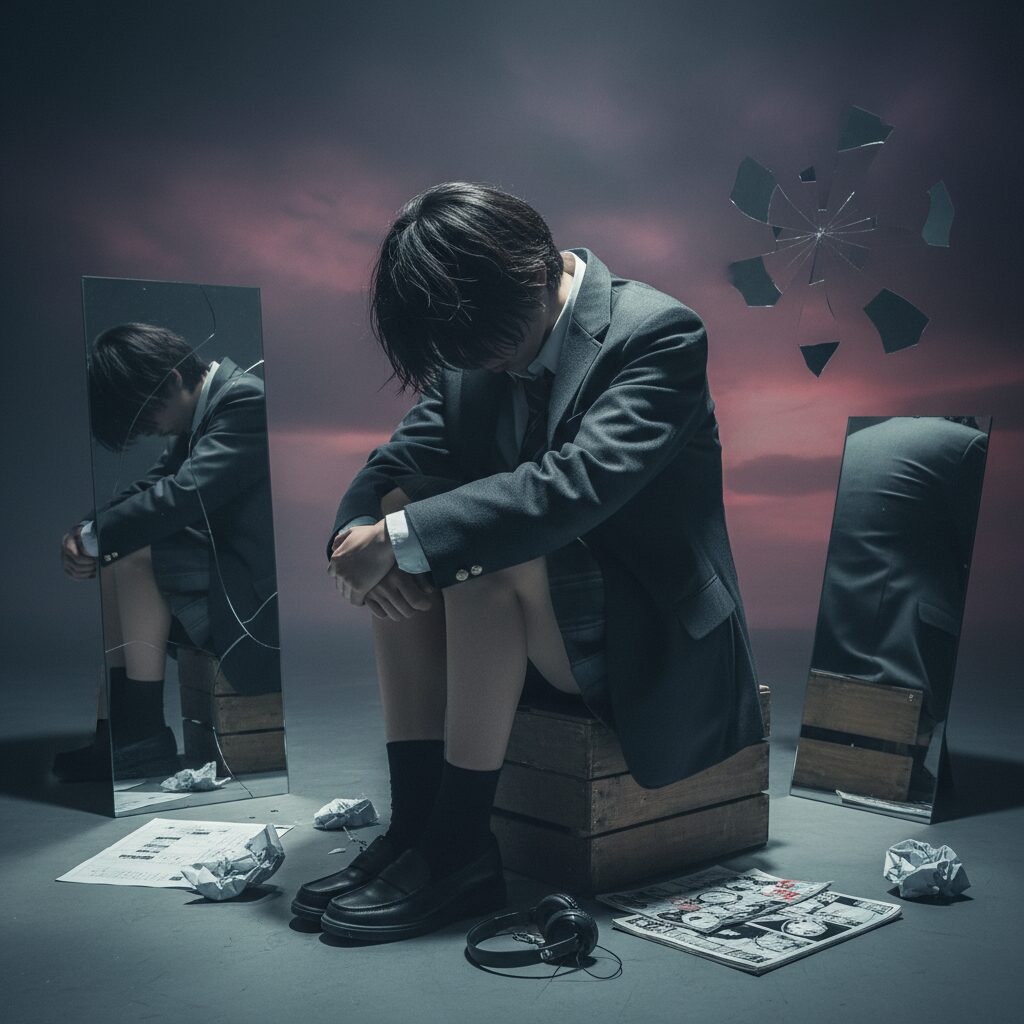
Expressing raw, messy, authentic emotions is incredibly difficult under these conditions. You can’t just tell a teacher you’re depressed or admit loneliness to classmates. There’s immense pressure to maintain harmony and avoid burdening others. So where does all that adolescent angst go? It gets bottled up. That’s where the keitai stepped in. The cell phone offered a portal to a different world, a semi-anonymous space where you could finally express your ‘honne’.
For many young writers, penning a keitai shousetsu was cathartic. They poured anxieties, fantasies, and traumas into fictional stories, processing their experiences without fear of real-world judgment. This fostered a strong community. Readers facing similar struggles found solace in these stories. Comment sections overflowed with messages like, “This is my story too,” or “I thought I was alone in feeling this.” The novels created a digital ‘ibasho’ (居場所)—a Japanese notion of “a place to belong.” In a society where many felt alienated and misunderstood, keitai shousetsu offered a vital sanctuary. It was a subculture made by and for them, completely outside the control of adults, teachers, or mainstream media.
The Publishing Revolution: From Screen to Shelf
For some time, keitai shousetsu was an enormous underground phenomenon. Millions of young people read these stories on their phones, while the mainstream remained oblivious. Then publishers noticed the staggering traffic on sites like Maho i-Land. Stories with tens of millions of page views signaled a massive untapped market. So, publishers took a radical step: they began printing cell phone novels as physical books.
This flipped the traditional publishing model on its head. Usually, a publisher risks backing an unknown author, prints a book, and hopes it sells. With keitai shousetsu, the market was already established. These stories had millions of passionate fans eager to own physical copies. The risk for publishers was practically zero.
The results were astonishing. In 2007, five of Japan’s top ten bestselling novels originated as keitai shousetsu. The most famous, ‘Koizora’ (Love Sky) by an anonymous author named Mika, sold millions and was adapted into a blockbuster movie and TV drama. It became a cultural phenomenon. Suddenly, amateur writers—mostly young women with no formal training—were millionaire bestsellers overnight. Books featuring the distinctive keitai shousetsu style—vertical text, ample white space, and kaomoji printed on the page—filled bookstores nationwide.
This was a major disruption. It democratized publishing. No agent or industry connections were needed to get published—just a phone and a story that resonated. It was a grassroots movement bypassing traditional cultural gatekeepers. This model—where content proves its popularity online before a mainstream release—is now standard for everything from webtoons to web novels adapted into anime. But keitai shousetsu authors were the true pioneers.
The Content Controversy: Is This Even Literature?
Naturally, not everyone was on board with the keitai shousetsu craze. The Japanese literary establishment was, to say the least, shaken. They viewed this new phenomenon not as a revolution, but as a threat to the very essence of Japanese literature. The backlash came quickly and intensely, igniting a nationwide debate about what truly qualifies as a “book.”
The Literary World’s Backlash
Criticism arose from every corner of the literary field. Esteemed critics, seasoned authors, and academics launched a unified attack. Their critiques generally centered on a few main points. First, they condemned the language. The simple vocabulary, heavy slang use, “incorrect” grammar, and countless emoticons were seen as a degradation of the Japanese language. How could this be compared to the nuanced, elegant prose of Nobel laureates like Yasunari Kawabata or Kenzaburo Oe? To them, it was infantile babble, not genuine literature.
Second, they criticized the plots. The stories were dismissed as formulaic, melodramatic, and emotionally manipulative. The recurring themes of tragic love, terminal illness, and dramatic betrayals were deemed cheap and sensationalist. Critics argued that the characters lacked psychological depth and complexity found in “serious” literature, or ‘junbungaku’ (純文学). These stories were viewed as disposable entertainment, rather than lasting art. One of the most prominent and vocal critics was Shintaro Ishihara, an acclaimed novelist and then-governor of Tokyo, who infamously labeled the novels as “vulgar” and “intellectually deficient.”
This conflict was about more than just personal taste. It was a cultural battle. The literary establishment stood for high culture, tradition, and art carefully crafted and curated by experts. Keitai shousetsu was the opposite: a product of low culture, the masses, raw, unfiltered emotion created by amateurs. It was a bottom-up phenomenon that disregarded traditional rules and gatekeepers. The success of these novels directly challenged the authority of the literary world and raised a frightening question for them: If this is what people truly want to read, what does it mean for us? It was a classic struggle between the old guard and the new, a fight over cultural legitimacy.
A Language for a Generation
But here’s the thing: judging keitai shousetsu by the standards of traditional literature is like evaluating a hip-hop track by the criteria of a classical symphony. It’s the wrong framework. They aimed to achieve entirely different goals. Supporters and fans of keitai shousetsu never claimed it was the next ‘Tale of Genji.’ Instead, they argued it was something new—a form of expression uniquely suited to its era and medium.
Let’s reconsider that seemingly “simplistic” language. The short sentences and frequent line breaks were not signs of poor writing; they were deliberate stylistic choices that crafted a distinct reading experience. This style lent the prose a breathless, urgent quality, mimicking the rhythm of a heartbeat or spoken conversation. It was language meant to be felt as much as read. As someone who appreciates both classical Chinese poetry and modern East Asian pop culture, I see a compelling parallel here. Traditional forms like Haiku or Tanka are celebrated for conveying deep emotion through brevity and strict structure. Keitai shousetsu did something similar, but its rules were shaped by the digital interface. It was a new kind of poetic constraint—a vernacular for the mobile age.
The heavy use of kaomoji and slang wasn’t a failure of language but an expansion of it. These writers employed every available tool to express emotion as directly and powerfully as possible. In a culture where open verbal expression of feelings can be difficult, these visual and linguistic shortcuts proved incredibly effective, conveying a vast range of emotion in a small space. This was a language its target audience—Japanese teenagers—intuitively understood. It was their language.
Most importantly, these stories gave a voice to a demographic often marginalized in mainstream literature: young women. These weren’t tales about teenage girls penned by middle-aged men; they were stories by young women, for young women, about issues that mattered to them. They were messy, painful, and often raw, but they were authentic. They captured a unique emotional terrain, a feeling the Japanese call ‘setsunai’ (切ない)—a profound, bittersweet sadness, a painful longing. That feeling was at the heart of the keitai shousetsu experience, and it’s why millions of readers connected so deeply with these stories. While it may not have been “high literature,” it was undoubtedly a powerful and legitimate form of cultural expression.
The Ghost in the Machine: Where Did Keitai Shousetsu Go?
If keitai shousetsu was once such a huge phenomenon, where is it now? You hardly hear about it anymore. The garakei flip phone has been replaced by the smartphone, and the cultural conversation has moved on. It might seem like the entire phenomenon just disappeared, a strange blip in Japan’s cultural history. But that’s not the full picture. The original form may be gone, but its spirit genuinely lives on everywhere. It didn’t die; it simply evolved and transformed into new forms.
The Smartphone Takeover
The biggest reason for the decline of the classic keitai shousetsu was the arrival of the smartphone. When Apple’s iPhone arrived in Japan in 2008, it took a few years to dominate, but it changed everything. The smartphone offered a completely different user experience. Instead of a small vertical screen and a numeric keypad, users now had a large, high-resolution display and a full QWERTY keyboard. The very limitations that shaped the keitai shousetsu style suddenly disappeared.
With a full keyboard, typing longer sentences and more elaborate paragraphs became much easier. The need for the ultra-short, staccato style faded. The bigger screen allowed texts to be formatted more like a traditional book, reducing the constant line breaks. The unique literary style born from the garakei’s restrictions was no longer necessary.
Moreover, the smartphone introduced a vast ecosystem of apps and social media. In the 2000s, youth culture gravitated around specialized websites like Maho i-Land. By the 2010s, that energy shifted to platforms such as Twitter, Mixi (for a while), then Instagram, LINE, and TikTok. These platforms provided new, more immediate ways to express oneself and connect with others. If you wanted to share a quick thought, you could tweet it. If you wanted to share a visual moment, you could post it on Instagram. The space that keitai shousetsu occupied—serialized, personal storytelling and community building—was now replaced by multiple apps. Young people’s attention fragmented, and the long-form cell phone novel lost its central role in their digital lives.
The Legacy: It Didn’t Die, It Evolved
Calling keitai shousetsu dead misses the point. Its influence is deeply embedded in modern Japanese digital entertainment. Its legacy is significant. First, it proved that user-generated, mobile-first content was viable. It showed a generation of creators that you don’t need publishers or studios to reach a large audience; you just need a platform and a compelling story. This ethos directly led to the current surge in web novels.
Websites like ‘Shōsetsuka ni Narō’ (小説家になろう, lit. “Let’s Become a Novelist”) are the spiritual successors to Maho i-Land. These massive platforms allow amateur writers to post serialized stories for free. The most popular ones gain large followings and, just like the old keitai shousetsu, get picked up by publishers to be turned into light novels, manga, and hit anime series. Huge franchises like ‘Re:Zero − Starting Life in Another World,’ ‘That Time I Got Reincarnated as a Slime,’ and ‘Mushoku Tensei: Jobless Reincarnation’ all began as web novels on this site. The business model is a direct descendant of the keitai shousetsu revolution.
Second, the habit it created—reading serialized, vertically scrolling stories in small chunks on your phone—is now how most people consume comics and stories. Consider the explosive growth of webtoons on platforms like LINE Manga, Piccoma, and Comico. While visually driven, the user experience is essentially identical to keitai shousetsu: short, digestible chapters optimized for a phone screen, released serially, with a built-in community of commenters. The medium evolved from pure text to a text-image hybrid, but the delivery model and its place in daily life remain a continuation.
Even the spirit of raw, unfiltered self-expression persists. This is evident in the worlds of YouTubers and VTubers, who cultivate passionate communities around personal stories and direct interaction with fans. The core idea of keitai shousetsu—bypassing traditional media to create a direct, intimate connection with an audience—is now the foundation of the entire creator economy.
So, Why Should You Care? The Big Picture Takeaway
At the end of the day, you might be thinking, “Okay, interesting story, but it’s just about some melodramatic teen novels from 15 years ago. Why does it matter?” It matters because keitai shousetsu provides one of the clearest and most fascinating examples of how culture, technology, and society are deeply intertwined. It’s a microcosm that reveals so much about modern Japan.
For anyone seeking the real story of Japan, this phenomenon serves as a vibe check on an entire generation. It demonstrates that technology is never simply a neutral tool. The specific design of the Japanese flip phone—its screen size, keypad, and early internet connectivity—directly shaped the creation of an entirely new form of literature. The device’s limitations became the framework of the art form. This is a powerful lesson in an era where we are all navigating our relationship with the algorithms and interfaces that influence our lives.
Beyond that, it pulls back the curtain on the pressures and desires of Japanese youth. It stands as a testament to the universal human need for an “ibasho,” a place to belong and be authentic, especially when the “real world” demands conformity. The semi-anonymity of a screen name on a keitai shousetsu site offered a refuge to express the “honne,” the messy, genuine feelings that had no other outlet. It was a silent, collective cry typed out on millions of tiny keypads during the quiet solitude of a crowded train.
Lastly, it’s a story about power. It’s about how a generation of young women, armed with nothing but their flip phones, managed to disrupt the publishing industry, challenge the definition of literature, and create a cultural movement on their own terms. They showed that the stories that resonate aren’t always the ones celebrated by critics, but the ones that connect deeply on an emotional level. They were the original content creators, pioneers of a digital-first media landscape that we all now inhabit.
So, no, keitai shousetsu isn’t just an odd footnote. It’s a crucial chapter in the story of our relationship with technology. It’s a snapshot of a generation caught between traditional social structures and new digital possibilities. Understanding it means understanding the intimate, often painful, and profoundly human stories typed out, one character at a time, on the glowing screens that illuminate our world. It’s a vibe, a moment, and a message that still, honestly, hits different.