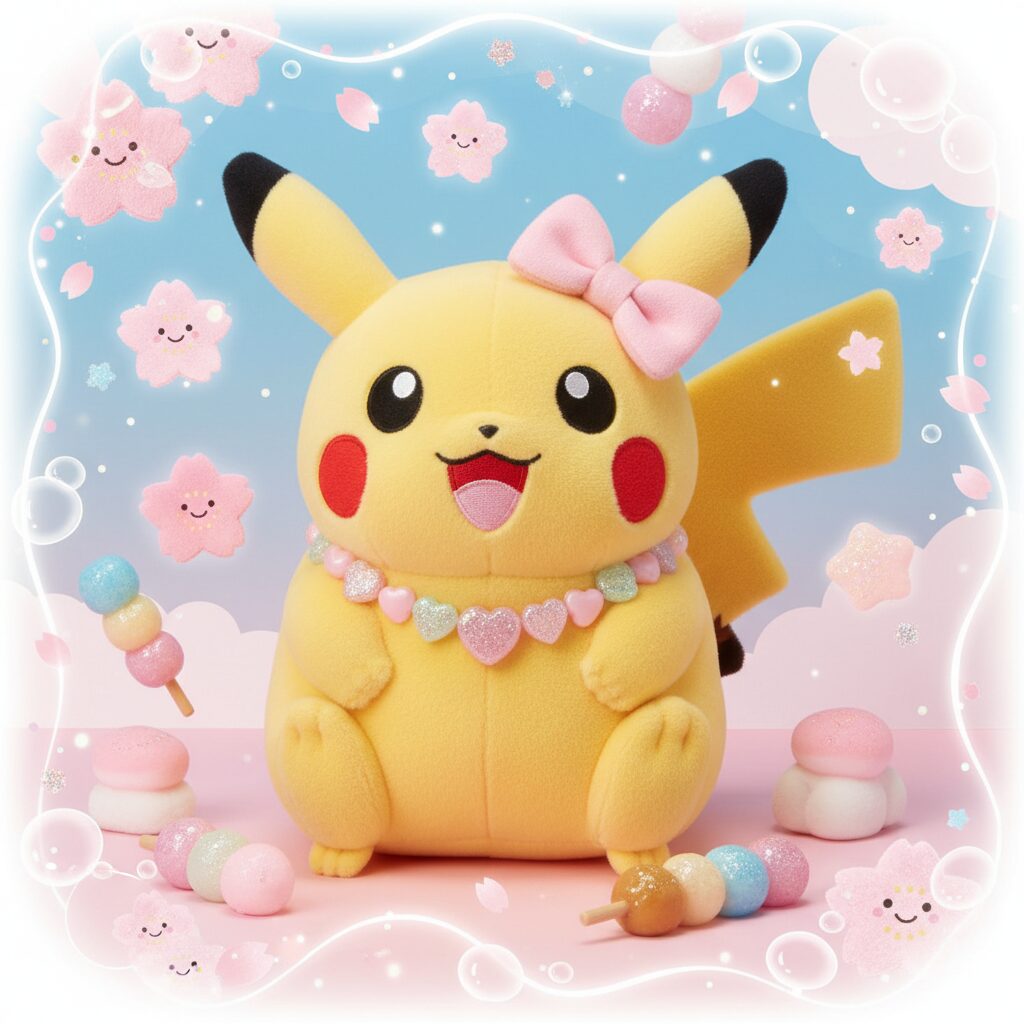
Yo, what’s the deal with Japan and cute stuff? Seriously. You can’t walk five feet in Tokyo without being blasted by some pastel-colored, big-eyed mascot trying to sell you anything from banking services to construction site warnings. And let’s be real, this ain’t just a Japan thing anymore. You walk into a Target in Ohio or a department store in London, and there he is: Pikachu. A yellow electric mouse, beaming from a lunchbox, a t-shirt, a mountain of plushies. The whole world is swimming in Pokémon, a franchise that has raked in more money than Star Wars and Harry Potter combined. It’s an absolute empire built on the back of… cuteness. But here’s the question that probably pops into your head, especially if you’re looking at Japan from the outside in: Why? Why is this aesthetic so ridiculously pervasive, and how in the world did a bunch of adorable “pocket monsters” become one of the most powerful cultural exports of all time? It’s easy to dismiss it as childish or just a weird quirk. But that’s a rookie mistake. What you’re looking at isn’t just “cute.” It’s `kawaii`, and it’s one of the most potent, complex, and brilliantly monetized cultural concepts on the planet. This isn’t just about fluffy animals; it’s about rebellion, social pressure, psychological comfort, and a genius business strategy that Nintendo and The Pokémon Company perfected into an art form. They didn’t just sell a game; they bottled a uniquely Japanese feeling and sold it to the world. And to understand how they pulled off this global heist of hearts and wallets, you gotta look past the sparkle and dive deep into the cultural matrix that spawned it all. We’re about to unpack how the soft power of `kawaii` became a hard-hitting economic juggernaut. It’s a whole vibe, a masterclass in cultural branding that starts right here, in the heart of its modern-day mecca.
To fully grasp the cultural matrix that spawned this empire, it’s essential to explore other rebellious aesthetics like the bronzed rebellion of Japan’s ‘Gyaru’ culture.
The Real Deal with ‘Kawaii’ Culture
First, let’s clarify one thing. Translating `kawaii` (可愛い) simply as “cute” is like reducing “sushi” to just “fish on rice.” You miss the full flavor, texture, and entire cultural context that define it. This fundamental misunderstanding trips up many people trying to connect with Japanese culture. In the West, “cute” is merely an adjective, a descriptor—like saying a puppy or a baby is cute, which is fairly straightforward. `Kawaii`, however, represents a whole aesthetic universe. It functions as a noun, a verb, an exclamation, and a lifestyle. It embodies a feeling and an atmosphere. It’s less about mere attractiveness and more about evoking affection, pity, and a strong urge to protect. It’s about being small, vulnerable, innocent, and crucially, non-threatening. This is the secret ingredient. Something `kawaii` is inherently harmless, without any edge or aggression. It’s pure softness, unblemished. That’s why something can be `kawaii` without fitting the typical “cute” mold. Take Gudetama, the lazy egg yolk from Sanrio. Is a lethargic, depressed egg with a visible butt crack “cute”? Not really. But is it `kawaii`? Definitely. It’s pathetic, relatable in its laziness, and utterly non-threatening. You don’t fear Gudetama; you feel a peculiar kinship with its existential sloth. You want to poke it or maybe wrap it in a tiny bacon blanket. That feeling of protective affection lies at the heart of `kawaii`.
More Than a Word, It’s a Feeling
The range of `kawaii` is vast and includes several sub-genres that highlight its complexity. There’s `busu-kawa`, meaning “ugly-cute,” describing things so strange or unattractive they become endearing again, like a pug’s smooshed face. Then there’s `kimo-kawa`, or “gross-cute,” for objects that are somewhat creepy or unsettling but still lovable, like quirky mascots or characters. There’s also `ero-kawa`, which combines cute aesthetics with subtle eroticism, often seen in anime and idol culture. Finally, there’s the classic, pure `kawaii`, embodied by characters like Hello Kitty. What unites all these is the element of harmlessness and the emotional effect they produce. A genuinely `kawaii` item disarms you, bypassing your critical adult mind and striking straight at your emotions. It doesn’t seek respect or admiration; it asks only for care and affection. This distinction is crucial. A majestic lion isn’t `kawaii`. A powerful superhero striking a dynamic pose isn’t `kawaii`. But a tiny, chibi version of that superhero with oversized eyes and a wobbling head? That’s peak `kawaii`. The aesthetic strips away power, menace, and complexity, leaving a core of lovable vulnerability. This emotional design is intentional; it’s deeply rooted in a cultural history that found a fresh voice in a surprisingly rebellious movement.
The Roots: From Heian Court to 1970s Teen Rebellion
Believe it or not, the essence of `kawaii` has echoed through Japanese culture for centuries. Over a thousand years ago in the Heian period, Sei Shonagon wrote in The Pillow Book about her fondness for “small and pretty things.” This taste for the miniature and delicate is a foundational strand in Japanese artistic tradition, traceable through generations of art, literature, and design. Yet the modern, vibrant form of `kawaii` we recognize today emerged much more recently and defiantly. It originated in the classrooms of the early 1970s, not corporate offices, but teenage schoolgirls’ handwriting. In quiet protest against the rigid, hierarchical nature of traditional Japanese script, girls began developing their own style called `maru-moji` (round writing). They wrote horizontally, adorned notes with hearts, stars, and cartoon faces, and made characters rounded, soft, and nearly illegible to adults. This was a subversive visual language—a rejection of the stiff, formal world they were expected to enter. It carved out a space of innocence and playfulness within a society demanding rapid conformity and maturity. This teenage rebellion was the spark that transformed `kawaii` from a passive appreciation of small things into an active, youth-driven cultural movement. Savvy companies took notice—Sanrio, originally a silk goods company, saw enormous commercial potential in this aesthetic surge. In 1974, they introduced a character who would become the global icon of `kawaii`: Hello Kitty. Her design is a masterclass in `kawaii`—simple lines, a large head, no complex backstory, and notably, no mouth. This was genius. Without a mouth, Hello Kitty has no fixed expression; she can be happy, sad, or anything the viewer imagines. She is a perfect blank canvas for emotional projection. She doesn’t dictate feelings; you do. This choice perfectly captured the essence of `kawaii`: a non-threatening, emotionally receptive presence that asks only for your affection. Hello Kitty’s phenomenal success proved that `kawaii` wasn’t a fleeting trend; it was a deep cultural craving that could be packaged, marketed, and sold on a massive scale.
Enter the Nintendo Entertainment System: Cute as a Trojan Horse
While Sanrio was busy establishing a merchandise empire centered around stationery and accessories, another Kyoto-based company, which had been producing playing cards since the 19th century, was poised to infuse the `kawaii` ethos into an entirely new medium, ultimately propelling it onto the global stage. That company was Nintendo. To appreciate Nintendo’s brilliance, one must recall the context of the early 1980s video game industry. In North America, the market had spectacularly crashed in 1983, leaving a digital wasteland. It was flooded with poor-quality games for consoles like the Atari 2600. The aesthetic was often dark, gritty, or based on a crude interpretation of sci-fi and action tropes. Video games were regarded by many parents as a corrupting, isolating influence. When Nintendo decided to introduce its Famicom (Family Computer) to the West as the Nintendo Entertainment System (NES) in 1985, they recognized the need to overcome this toxic reputation. Their strategy was to use a form of `kawaii` as a Trojan horse. They deliberately designed the console to appear less like intimidating computer hardware and more like a sleek, friendly VCR. The games themselves were a stark contrast to the grim shooters and confusing action titles that had doomed the Atari. They were bright, colorful, and overwhelmingly charming.
The Famicom Invasion and the Power of Pixels
The star of the show, of course, was Super Mario Bros. Let’s analyze Mario as a character design. He is the opposite of the typical 80s action hero. He’s not a muscle-bound commando or space marine. He’s a short, stout Italian plumber with a big nose and a bushy mustache. His power-ups don’t provide bigger guns; they make him slightly taller or allow him to throw fireballs from his hands. His world isn’t a post-apocalyptic cityscape; it’s the vibrant, slightly psychedelic Mushroom Kingdom. The enemies aren’t terrifying monsters; they’re adorably grumpy mushrooms (Goombas) and turtles (Koopa Troopas). Even the main villain, Bowser, despite his fire-breathing, carries a certain cartoonish charm that keeps him from being genuinely frightening. This entire design philosophy was a calculated choice. Shigeru Miyamoto and his Nintendo team understood that to appeal to the widest possible audience—kids, parents, and those who had never played video games before—the experience had to be inviting and non-threatening. The pixelated `kawaii` of their characters lowered the barrier to entry. The game looked fun and harmless, encouraging people to pick up the controller. This strategy completely revitalized the home video game market. Nintendo wasn’t just selling games; they were selling joy and a sense of wonder, all wrapped in a deceptively simple and cute aesthetic. They proved that you didn’t need photorealistic graphics or gritty violence to create a compelling experience. All it took was solid gameplay and an irresistible, `kawaii`-inspired charm.
Kirby: The Ultimate Embodiment of ‘Kawaii’ Power
If Mario was the approachable everyman hero, then Kirby, created by Masahiro Sakurai in the early 90s, was the purest expression of Nintendo’s `kawaii` design philosophy. Kirby is literally a pink, round blob with large eyes and tiny nubby arms. He is the epitome of a non-threatening presence. He is almost weapon-grade `kawaii`. But beneath this simple, adorable exterior lies a surprisingly deep and powerful gameplay mechanic. Kirby’s primary ability is to inhale enemies and copy their powers. This serves as a brilliant metaphor for Nintendo’s overall strategy. The cute, harmless-looking exterior literally absorbs the more aggressive or complex elements of the world and makes them its own. The `kawaii` facade is not a sign of weakness; it’s deceptive camouflage for immense versatility and power. The Kirby series often presents deceptively challenging gameplay, with complex levels, hidden secrets, and tough boss battles. Yet the entry barrier is almost nonexistent because the character and his world are so overwhelmingly pleasant and inviting. Anyone can pick up a Kirby game and enjoy floating around and swallowing things. But for those who explore further, there’s a rewarding depth of mastery to be discovered. This is Nintendo’s magic trick, perfected with Kirby: use `kawaii` to draw players in and make them feel safe, then gradually reveal a deep, engaging, and robust gameplay experience. This formula was applied to countless franchises, from The Legend of Zelda with its charming Toon Link redesign in The Wind Waker to Animal Crossing, a game that appears to be a gentle village simulator but is actually a complex web of economic and social systems. The lesson was clear: `kawaii` wasn’t just a visual style; it was a powerful tool for game design and audience engagement. And this lesson would reach its ultimate peak with the creation of their next global phenomenon.
Pokémon: The ‘Gotta Catch ‘Em All’ ‘Kawaii’ Machine
In the mid-1990s, all the lessons Nintendo had learned about the appeal of `kawaii`, accessibility, and complex gameplay systems coalesced into a single, groundbreaking idea. This idea originated from a developer named Satoshi Tajiri and his company, Game Freak. The concept was simple yet revolutionary: a role-playing game where players didn’t slay monsters but instead collected, trained, and befriended them. It was called Pocket Monsters, or Pokémon. Pokémon harnessed the `kawaii` elements simmering within Japanese culture and weaponized them for worldwide success. It was more than just a game; it was a carefully crafted ecosystem of cuteness, designed from the ground up to be as addictive and emotionally impactful as possible. Blending Japan’s passion for collecting with the `kawaii` aesthetic and a straightforward gameplay loop accessible to anyone around the globe, the result was a cultural Chernobyl—a shockwave that continues to reshape the entertainment industry today.
Satoshi Tajiri’s Vision: Nostalgia and the Joy of Collecting
The heart of Pokémon came from a deeply personal and nostalgic place for its creator. Satoshi Tajiri grew up in rural Tokyo, where his favorite childhood activity was exploring nature and collecting insects—a pastime known as `mushi tori`, a traditional Japanese summer activity for children. As he matured and witnessed the natural spaces of his youth being overtaken by urban development, he sought to create a game that would give children the same joy of discovery and collection he once experienced. This is a vital piece of the puzzle. Pokémon’s foundation isn’t rooted in combat or aggression; rather, it’s grounded in wonder and a nostalgic yearning for a simpler, nature-connected era. This sentiment is universal. The game taps into the primal human instinct to explore, discover, and categorize the world around us. The creatures themselves were designed to support this. They weren’t grotesque demons like those in Dungeons & Dragons or menacing aliens from other sci-fi games. Instead, they were companions often inspired by animals, insects, plants, or even inanimate objects. The game’s language is deliberately softened: Pokémon don’t die in battles; they “faint.” You aren’t a warrior; you’re a “Trainer.” Your goal isn’t world domination but to become the very best, “like no one ever was,” through bonds of friendship and trust with your Pokémon partners. This reframing of the monster-battling genre was sheer brilliance. It removed moral ambiguity and violence, replacing them with a narrative of partnership and self-improvement, all wrapped beautifully in a `kawaii` package.
The ‘Pikachu Principle’: The Perfect ‘Kawaii’ Ambassador
Though the first-generation game featured 151 unique creatures, one of them became the face of the entire franchise and a global icon comparable to Mickey Mouse: Pikachu. Interestingly, Pikachu wasn’t originally intended as the primary mascot; that role was initially meant for Clefairy. However, during playtesting and early marketing, the little electric mouse captured audiences in a way impossible to overlook. The reasons behind this provide a perfect example of effective `kawaii` design, which we can call the ‘Pikachu Principle.’
The Power of Neoteny
Pikachu’s design heavily employs neoteny—the retention of juvenile traits in adults. Features like its large head relative to its body, wide-set eyes, small nose and mouth, and round physique are all elements our brains instinctively associate with babies and toddlers. This triggers a nurturing response. When we see Pikachu, our brains urge us to protect it because it seems small and vulnerable. This is `kawaii` 101, executed flawlessly. Pikachu’s design is soft and rounded, with no sharp or threatening angles, making it appear entirely harmless.
Simplicity and Recognizability
The design is remarkably simple. Its bold yellow color, long ears with black tips, red cheeks, and lightning bolt-shaped tail create a silhouette instantly recognizable, even from afar or in a simplified form. You could sketch Pikachu with a few lines, and people would immediately identify it. This simplicity is essential for a global brand—making the character easy to replicate on merchandise, easy for children to draw, and easy to remember. It transcends language and cultural barriers through purely effective visual design.
Vulnerability with a Spark of Power
Crucially, Pikachu isn’t entirely defenseless. It wields a powerful electric attack—an important element in the `kawaii` equation Nintendo perfected. It’s small and cute, evoking protective instincts, yet a capable partner in battle. Pikachu isn’t just a pet; it’s a friend who can defend itself and its Trainer. This duality deepens the bond with the character. You aren’t merely a caretaker—you’re part of a team. This balance of vulnerability and hidden strength makes Pikachu dynamic and aspirational, rather than just a passive figure of affection.
Universal Phonetics
Even Pikachu’s name and sounds are brilliantly designed. “Pika” is the Japanese onomatopoeia for a spark or flash of light, and “chu” mimics the sound a mouse makes. The name literally describes the character: an electric mouse. More importantly, these syllables are simple and found in nearly every language. Anyone, anywhere can say “Pikachu.” Its cry in the anime—a repetition of its own name—cemented this universal appeal. This was a branding masterstroke ensuring the character’s global accessibility.
The Ecosystem of Cute: From Game Boy to Global Merchandise
The true genius of Pokémon wasn’t limited to character design but extended to the entire ecosystem built around them. The game mechanics, marketing, and merchandising all integrated perfectly to create a self-sustaining cycle of `kawaii` engagement.
The Gotta Catch ‘Em All Loop
The slogan “Gotta Catch ‘Em All!” stands as one of the most effective marketing phrases ever crafted. It transformed the game from a story-driven RPG into an addictive collector’s quest. With 151 unique creatures, each with distinct designs, types, and abilities, the game offered immense replay value. Since many Pokémon were irresistibly `kawaii`, capturing them felt less like restraining wild beasts and more like making new friends. This drive to collect was heightened by releasing two versions of the game—Red and Blue—with exclusive Pokémon in each. To complete their collections, players had to connect with friends using the Game Boy’s link cable to trade. This brilliantly turned solo gameplay into a social experience, fostering communities and sparking playground conversations worldwide.
The Nurturing Power of Evolution
The evolution mechanic added a strong emotional hook. Players typically started with a small, cute, and relatively weak Pokémon, such as Charmander. Through training, battling, and care, they watched it evolve into a stronger form, Charmeleon, and eventually into the powerful Charizard. This process created deep attachment and pride, mirroring the experience of raising a pet or child. You fondly recalled your mighty Charizard when it was just a tiny, vulnerable lizard. This emotional investment elevated Pokémon from a simple game to a meaningful journey for millions of children. It wasn’t only about winning battles but sharing an adventure with your companions.
The Merchandising Juggernaut
The simple and `kawaii` designs of Pokémon were a merchandiser’s dream. They were ideal for plush toys, action figures, trading cards, lunchboxes, apparel—virtually anything featuring their images. The trading card game became its own phenomenon, extending the video game’s collection mechanic into the physical world. The Pokémon Company was established to manage this flood of merchandise, maintaining strict quality control and consistent branding. The business model evolved beyond releasing video games every few years; it centered on selling the world of Pokémon itself, delivering the sense of companionship and adventure through a continual stream of products. The `kawaii` aesthetic was the critical lubricant fueling this entire economic engine, making each product both desirable and emotionally resonant.
Beyond the Game Console: ‘Kawaii’ as a Social Anesthetic
To fully understand why `kawaii` culture, as refined by Nintendo and Pokémon, became such a powerful phenomenon both in Japan and internationally, you need to look beyond the products themselves and consider the social and psychological needs they satisfy. In Japan, `kawaii` is more than just an aesthetic; it serves as a form of social anesthetic. It acts as a coping mechanism for living in a high-pressure, high-stress, and often rigidly conformist society. Grasping this context is essential to comprehend why a grown adult in a business suit might carry a Pikachu keychain on their briefcase without any hint of irony.
A Buffer Against Conformity
Japanese society places great importance on the group over the individual, on harmony, and on adhering to strict social roles and expectations. The well-known saying, “The nail that sticks out gets hammered down,” encapsulates this. From the demanding examination systems in schools to the notoriously long working hours and hierarchical corporate structures, the pressure to perform, conform, and suppress one’s personal feelings (`honne`) in favor of a polite public facade (`tatemae`) is enormous. Within this environment, `kawaii` culture offers an essential outlet. It creates a “safe” space of softness, innocence, and playfulness entirely detached from adult responsibilities. It is a pocket of psychological comfort. That cute character on a phone case or bento box represents a small, personal act of rebellion. It signals that despite wearing a suit and a serious exterior, there remains a part of you that values tenderness and emotion. This ties into the concept of `iyashi`, meaning “healing” or “therapy.” `Kawaii` items can have an `iyashi` effect, offering a moment of mental calm and emotional release during a stressful day. Watching a cute cat video or playing a game like Animal Crossing is more than just a pastime; it functions as self-care, a way to recharge one’s emotional resilience. The non-threatening quality of `kawaii` is crucial here. It places no demands on the individual, makes no judgments; it simply exists to comfort and delight. In a world filled with obligations, such unconditional affection—even from inanimate objects—can be immensely powerful.
The Darker Side of Cute? ‘Burikko’ and Manufactured Innocence
Yet, it’s important to examine this critically. The ubiquity of `kawaii` comes with its problematic sides. The aesthetic can reinforce and perpetuate regressive social norms, especially regarding gender. The concept of `burikko` illustrates this well. It refers to women who deliberately act childlike or overly cute, using a high-pitched voice, feigned innocence, and helpless gestures to appear appealing to men. This is a performance of `kawaii`, a calculated use of manufactured innocence to conform to a patriarchal ideal of a non-threatening, docile woman. This raises difficult questions. Does a culture that prizes cuteness and vulnerability so intensely pressure women to infantilize themselves? Does the idealization of the `kawaii` girl create a climate where assertive, ambitious women are seen as unattractive or “un-cute”? Moreover, one might argue that `kawaii` culture, functioning as a social anesthetic, can also serve as a tool of social control. By offering an easily accessible retreat into a world of softness and comfort, does it diminish the motivation for genuine social change? If people find solace in cute characters and comforting products, are they less inclined to challenge the stressful, often oppressive systems that make such escapism necessary? This is a complex debate without straightforward answers. `Kawaii` can be both a form of personal expression and a cage of social expectation, a source of true comfort and a mechanism for maintaining the status quo. This duality is what makes it such a compelling and lasting cultural phenomenon.
The Unstoppable Cuteness Engine
When observing the global empire Pikachu established, it’s essential to recognize that this was no coincidence. It wasn’t merely about designing a cute character and striking luck. Nintendo and The Pokémon Company’s success represents the result of a profound, intuitive grasp of a distinctively Japanese cultural concept, refined and strategically adapted for an international audience. They didn’t just create `kawaii` characters; they deconstructed the psychological and emotional cues that make the `kawaii` aesthetic so compelling. They tapped into the 1970s youth rebellion, which positioned cuteness as a language of gentle defiance. Following Nintendo’s approach, they used a charming, non-threatening exterior as an entry point to intricate and captivating systems. With Pokémon, they perfected this formula by combining the universal, nostalgic delight of collecting with a nurturing mechanic that fosters real emotional connections. They designed the ideal ambassador in Pikachu—a character that is neotenous, simple, easy to pronounce globally, and perfectly balanced between vulnerability and strength. Around this concept, they created a resilient ecosystem that keeps the engagement cycle ongoing, moving fluidly from the Game Boy screen to the trading card binder to the bedroom shelf filled with plush toys. Pokémon’s worldwide dominance is not just about a successful video game; it’s about exporting a feeling. It’s the packaging of the Japanese desire for `iyashi`—healing, comfort, and a safe emotional haven—and the discovery that this desire is universal. In today’s increasingly complex, stressful, and often confrontational world, the charm of something unconditionally soft, simple, and non-threatening is more potent than ever. Nintendo and Pokémon mastered the art of `kawaii`, creating an unstoppable engine of cuteness that has conquered the world, one adorable electric mouse at a time. It’s not simply a game; it’s a global mood, a soft-power superpower, and whether we realize it or not, we all live within its cute, cuddly empire.