Yo, let’s talk about Japan. When you picture it, you’re probably seeing neon-drenched Tokyo streets, ancient Kyoto temples, or maybe that perfect shot of Mount Fuji. All solid choices, for sure. But I want to take you somewhere else, a place that hits different. A place that’s low-key one of the most breathtaking landscapes I’ve ever had the privilege to frame with my camera. We’re heading to Takamatsu, a chill city on the island of Shikoku, to a spot that’s not just a garden, but a straight-up living, breathing masterpiece of art and nature. I’m talking about Ritsurin Garden, or Ritsurin Koen. This isn’t just another pretty park; it’s a three-star Michelin Guide feature and a designated “Special Place of Scenic Beauty,” which is basically Japan’s version of saying it’s a national treasure. It’s a full-on sensory experience, a historical saga etched into ponds and pines, and a place where you can feel the centuries slow down to the pace of your own heartbeat. This is the art of the Japanese landscape garden turned up to eleven, a sprawling canvas where every rock, every tree, every ripple in the water is part of a grand, epic poem. It’s the kind of place that redefines your whole vibe, leaving you with a sense of calm that sticks around long after you’ve left. So, grab your camera, open your mind, and let’s drop into the world of Ritsurin Garden. It’s time for a major vibe check.
For those looking to explore more of Shikoku’s unique cultural landscapes, consider visiting the historic thatched-roof villages of Iya Valley for another unforgettable Japanese experience.
A Vibe Beyond the ‘Gram: The Soul of a Daimyo Garden
Entering Ritsurin feels like passing through a portal. The city noises of Takamatsu gradually fade away, replaced by the symphony of nature—the crunch of gravel beneath your feet, the soft lapping of water against the shore of a pond, and the whisper of wind through countless pine needles. This is no coincidence; it is deliberate, intentional design. Ritsurin is a classic kaiyu-shiki teien, or “stroll garden.” The idea is this: you don’t simply stand still and gaze from one spot. You’re meant to move through it. The winding paths are crafted to conceal and then reveal views, creating a sequence of perfect, composed scenes that unfold as you walk. It’s like watching a film where you serve as both audience and camera operator. One moment you’re in a cool, shaded grove; the next, you turn a corner to find a vast, sunlit pond with a beautifully arched bridge opening up before you. This is storytelling through landscape.
The garden’s history runs deep, tracing back to the Edo Period. Construction began in the 1620s, but it was the Matsudaira clan, the local feudal lords or daimyo, who devoted over a century to refining it, finally completing the masterpiece in 1745. That history is palpable. This isn’t a place hastily put together; it’s the product of generations of meticulous care, artistic vision, and an extraordinary amount of labor. Every stone was placed with intention, every tree shaped over centuries. As you walk these paths, you are literally following in the footsteps of samurai lords who sought peace and contemplation within these serene landscapes. The sheer scale—75 hectares, which is vast—means you can easily lose yourself in the most wonderful way. You might find a secluded bench beside a smaller pond and feel as though you’re the only person in the world, surrounded by a carefully curated wilderness that feels both wild and perfectly, impossibly controlled.
Borrowing Scenery: The Art of Shakkei
One of the first things you’ll notice—something that truly elevates Ritsurin from being merely a great garden to a legendary one—is the mountain that stands perfectly in the background. That’s Mount Shiun, and its presence is no coincidence. This is the ultimate showcase of Japanese garden design, a technique called shakkei, or “borrowed scenery.” The designers didn’t simply create a garden; they integrated the entire mountain into their artwork. By framing views within the garden to include Mount Shiun, they made the space feel limitless, blurring the boundary between the artificial and the natural. The mountain becomes the final, most dramatic element of this landscape painting you walk through—it’s pure genius. From certain vantage points, like the top of the man-made hill Hiraiho, the mountain’s green slope seems to flow seamlessly into the garden’s trees, as though it’s part of the property itself. This connection to the broader world gives the garden a sense of grandeur and timelessness that’s difficult to put into words. It feels grounded in the earth itself, reminding us that true art doesn’t exist in isolation but engages in dialogue with its surroundings. As a photographer, this is a dream—you’re not merely capturing a garden; you’re capturing the relationship between human creativity and the raw beauty of nature, a conversation that has unfolded for centuries.
The Main Event: Hitting the Highlights Reel

While the essence of Ritsurin lies in the journey itself, there are undoubtedly some must-see spots that stand out. These locations will fill your camera’s memory card and imprint vivid memories in your mind. But keep in mind, even these well-known places are just moments within a broader story, so take your time making your way to them.
Nanko (South Pond) and Engetsu-kyo Bridge
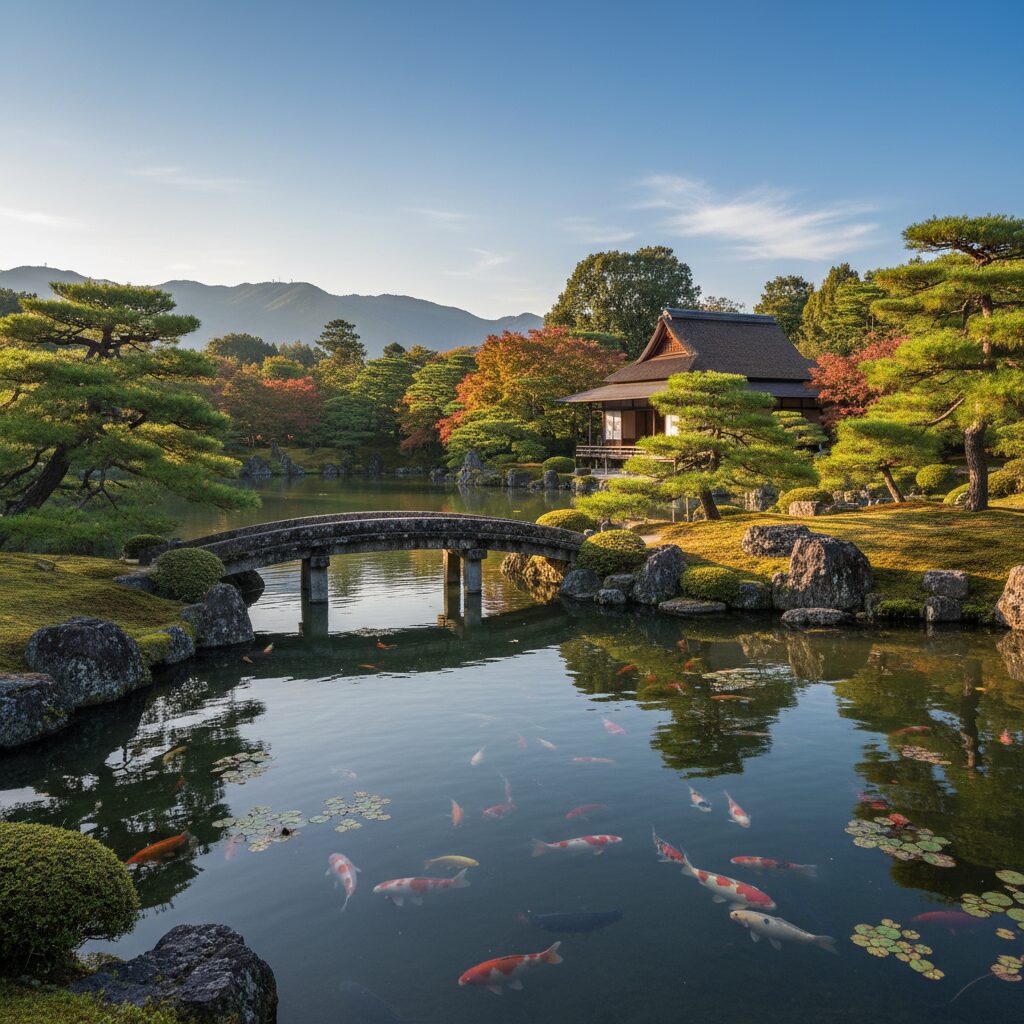
This is the quintessential shot. If you’ve seen a photo of Ritsurin Garden, it’s likely this one. Nanko, the South Pond, is the garden’s largest body of water, dotted with charming islands and encircled by ancient, carefully sculpted pines. Gracefully spanning a channel is Engetsu-kyo, the “Crescent Moon Bridge,” a classic wooden half-moon bridge whose reflection in the calm water below forms a perfect circle. It’s visually stunning. Crossing the bridge feels almost ceremonial. You pause at its peak to gaze down on the massive, colorful koi carp gliding lazily beneath. These hefty fish have been swimming here for generations. The view from the bridge, taking in the pond, the Kikugetsu-tei teahouse, and the backdrop of Mount Shiun, captures the essence of Japan in a distilled form. It’s a moment of deep beauty and calm that truly resonates. You can’t help but stop and simply breathe. This is where the garden’s artistry is most powerful and evident. The scene looks so flawless it seems unreal, but the texture of the aged wood beneath your feet and the sound of the water remind you it’s completely genuine.
Kikugetsu-tei Teahouse: Sip and Stare
Situated right at the edge of Nanko pond, the Kikugetsu-tei Teahouse serves as the spiritual core of the garden. The name translates beautifully as “Scooping the Moon Pavilion.” Legend says that here, you could feel as if you might scoop the moon’s reflection right out of the water. Originally a summer villa for the daimyo, it was designed with one purpose: to relax and savor the view. With open sides, the teahouse creates a seamless connection to the garden even when you’re inside. Removing your shoes and stepping onto the cool tatami mats offers a refreshing reset. You can order a bowl of matcha green tea and a traditional sweet, then simply sit and gaze. The view from the tatami floor, mere inches above the water, offers a completely different perspective than standing. You see the garden from a grounded, intimate vantage point. The water, islands, and ancient pines unfold into a panoramic masterpiece laid out just for you. This is more than a cafe break—it’s a meditative experience, inviting you to slow down and notice the details: the light dancing on the water, the silhouette of a pine branch against the sky, the gentle movements of the koi. It’s an ultimate moment of zen, a chance to fully absorb the garden’s serene beauty.
Hiraiho and Fuyoho: The View from the Top
To truly grasp the brilliance of Ritsurin’s design, you need some elevation. The garden includes several man-made hills, or tsukiyama, crafted to resemble natural mountains and offer breathtaking viewpoints. The most notable is Hiraiho, a perfectly conical hill meant to evoke Mount Fuji. The climb is short but invigorating, and the reward is enormous. From the summit, the entire South Garden spreads out below. This is where you capture that iconic, postcard-perfect shot of Engetsu-kyo Bridge arching over the pond, framed by the teahouse and Mount Shiun. From here, the scale and intricate design become clear. You can trace the shorelines, see how the islands are strategically placed for balance, and understand how the paths lead you through the landscape. Nearby, Fuyoho offers a slightly different yet equally stunning viewpoint, focusing more on the North Garden. Visiting these vantage points is essential—it’s like seeing the blueprint of a masterpiece after wandering its corridors, deepening your appreciation for the visionaries who crafted this place.
A Year in Ritsurin: Catching the Seasons
Like any reputable Japanese garden, Ritsurin is a vibrant, ever-evolving entity that offers a unique display with each passing season. Truly, there is never a bad time to visit, as every season brings its own distinct and remarkable atmosphere.
- Spring (March-May): Spring bursts forth in a riot of color. The garden awakens, led by the cherry blossoms (sakura), which paint the scene with delicate pink and white petals, creating a dreamy, ethereal ambiance, especially near the North Pond. Special evening light-up events highlight the blossoms against the night sky, producing an almost otherworldly spectacle. Later in the season, azaleas bloom in vivid pinks, reds, and purples, covering the hillsides with bold shades. The air feels fresh, filled with a strong sense of renewal.
- Summer (June-August): Summer at Ritsurin is rich and immersive. The greenery deepens to lush, almost electric shades. The constant call of cicadas sets a hypnotic soundtrack. This season showcases irises (shobu), blooming in striking purple and white fields in the northern section. The pond’s lotuses open their large, perfect flowers, evoking a prehistoric beauty. While the heat and humidity can be intense, the shade of ancient trees offers a cool sanctuary. The garden pulses with life at its fullest, sending out a raw, vibrant energy that captivates completely.
- Autumn (October-December): If spring resembles a delicate watercolor, autumn feels like a vibrant, fiery oil painting. Japanese maples (momiji) turn brilliant crimson, gold, and orange throughout the garden. The fiery leaves contrast stunningly with the deep green pines and blue ponds, their reflections doubling the colorful impact to create a kaleidoscope of hues. As in spring, autumn illumination events light up the foliage by night. Strolling through the garden after dark, with glowing maples mirrored in dark ponds, is an unforgettable, almost spiritual experience.
- Winter (December-February): Winter exposes the garden’s bare framework, revealing its fundamental structure and beauty. Crowds thin out, and a deep calm settles. Bare branches of deciduous trees form intricate patterns against the sky, while evergreen pines stand as the landscape’s stoic guardians. If covered with snow, the garden transforms into a magical scene. This season also offers a chance to admire yukitsuri—ropes arranged in conical shapes from tree tops to lower branches, protecting them from heavy snow. These functional designs become an art form, adding unique geometric beauty to the winter scenery. Winter invites quiet reflection and appreciation of the garden’s stark, minimalist elegance.
More Than Just a Pretty Face: The Deeper Layers

To truly appreciate Ritsurin, you must look beyond its surface beauty and grasp the symbolism and philosophy embedded in its design. This is where Japanese gardens rise above horticulture and become a form of philosophy. Every element serves as a metaphor. The large ponds symbolize the ocean, while the small islands within them represent the mythical isles of immortals from Chinese legend. The carefully positioned rocks are more than mere stones; they symbolize mountains, shorelines, and even animals. Their texture, shape, and placement all contribute to a sophisticated aesthetic language.
The pines, especially, are the heart of Ritsurin. There are over a thousand black pines in the garden, each meticulously pruned and shaped over centuries. They are living sculptures. Their branches have been trained into dramatic, graceful forms that convey age, resilience, and the struggle against nature. They embody the aesthetic of wabi-sabi—the beauty found in imperfection, impermanence, and rustic simplicity. Look for notable specimens such as the Tsuru-Kame-Matsu (Crane and Turtle Pine), a towering black pine whose form evokes these two symbols of longevity, or the Neagari-goyo-matsu (Root-exposed Five-needle Pine), a shogun’s gift that resembles a vast, ancient bonsai. These trees are more than plants; they are revered elders, silent witnesses to centuries of history. Spending time with them, you begin to understand that the garden is a meditation on time itself—the patient, persistent effort of humans working in harmony with nature to create something enduringly beautiful.
The Practical Sesh: Your Guide to Nailing the Visit
Alright, let’s dive into the logistics. Getting to and enjoying Ritsurin is super straightforward, but a few tips will help you get the most out of your visit.
- Access: Ritsurin is conveniently located near the center of Takamatsu. From Takamatsu Station, you can catch a local train—the JR Kotoku Line will take you to Ritsurin Koen Kitaguchi Station (the North Gate) in about 7 minutes. Alternatively, the Kotoden Kotohira Line stops at Ritsurin Koen Station (close to the East Gate) in roughly the same time. You can also opt for a bus or taxi, both quick and easy choices. If you’re up for it, a pleasant 30-40 minute walk from the main station area is also an option.
- Timing is Everything: This is key. Do not, I repeat, do not rush through this garden. You need to dedicate time to it. I’d recommend budgeting at least two to three hours, though honestly, you could easily spend half a day or more just wandering and soaking in the atmosphere. One of the best things about Ritsurin is its hours: it opens at sunrise and closes at sunset, which vary throughout the year. The best advice? Arrive early—right when it opens. Morning light is magical, casting long shadows and making the moss glow. The crowds are minimal, and you’ll have the garden nearly to yourself. It’s a photographer’s dream and a peaceful retreat for the soul.
- Level Up Your Experience: For something truly special, take a wasen boat ride on the South Pond. These traditional, flat-bottomed wooden boats are guided by a person in traditional attire using a pole. The 30-minute ride offers a water-level perspective, letting you admire the bridges and pines from below. The guide will highlight details you might otherwise overlook. It’s incredibly peaceful and offers a glimpse into how the daimyo enjoyed their private retreat. It costs a bit extra but is absolutely worth it.
- Fuel Up: Beyond the Kikugetsu-tei Teahouse, several smaller rest houses and shops are dotted around, especially near the main East Gate. You can pick up snacks like dango (sweet rice dumplings) or ice cream. Just outside the garden, you’ll find numerous excellent udon restaurants—Kagawa Prefecture is Japan’s udon capital, so be sure to try some authentic Sanuki udon while you’re here.
- Local Pro Tip: Use Ritsurin Garden as your base for exploring Takamatsu. You can easily combine it with a visit to the Isamu Noguchi Garden Museum (book well in advance) for a modern take on sculpture and landscape. Or head up to Yashima, a flat-topped mountain overlooking the city, for stunning views of the Seto Inland Sea and its islands. Takamatsu also serves as the main gateway to the famous art islands like Naoshima and Teshima, so you can spend a morning finding your zen at Ritsurin before hopping on a ferry for an afternoon of contemporary art. It’s an unbeatable cultural combo.
So there you have it. Ritsurin Garden is far more than just a beautiful collection of trees and ponds. It’s a historical masterpiece, a lesson in design, and a sanctuary for the soul. It teaches you to slow down, to observe carefully, and to appreciate the profound beauty born when human creativity works patiently in harmony with nature. Walking its ancient paths, you feel connected to something far older and deeper than yourself. You’ll leave with your camera full of stunning images, yes, but also with a piece of that calmness embedded in your spirit. It’s a place that doesn’t just show you beauty; it lets you truly feel it. It’s a quiet masterpiece that speaks volumes, waiting to share its story with you. Don’t miss it.