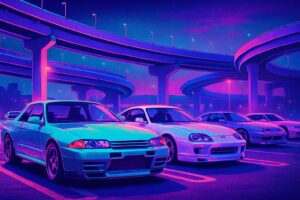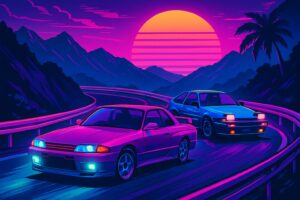
Yo, what’s up. Ami here. So, let’s get real. You’ve doomscrolled through the Reels and TikToks late at night, right? You’ve seen it. That insane footage from Japan. A gleaming GT-R, maybe a souped-up Supra, slicing through a ribbon of orange light like a ghost. The Tokyo skyline is a blur of neon and steel in the background, the engine is screaming, but the vibe… it’s weirdly quiet. It’s not like the chaotic, block-party energy of a street race in L.A. or the bravado-fueled showdowns you see in movies. It feels… solitary. Personal. Almost like a religious ritual. You see the driver, face illuminated by the dash, totally in the zone, and you gotta wonder, what’s actually going on inside their head? Why does the ultimate expression of speed in Japan feel so… lonely?
This isn’t just about going fast. It’s a whole mood, a philosophy, and if you really wanna get it, you have to look past the horsepower and into the heart of a story that’s basically the bible for this scene: Wangan Midnight. Forget the high-school-drama drifting of Initial D. Wangan Midnight is the grown-up, existential, and frankly, way more intense older brother. It’s a deep dive into the psyche of the drivers who prowl the Shuto Expressway’s Bayshore Route—the infamous Wangan. This stretch of asphalt is their sanctuary, their battlefield, and their place of worship. The series captures the essence of this pursuit: it’s not about beating other people. It’s about a deeply personal, almost spiritual battle with yourself, your machine, and the unrelenting, unforgiving road. It’s about finding a moment of pure clarity at over 300 kilometers per hour. Before we dive into the deep end of this concrete ocean, let’s get the lay of the land. This is the stage where legends are born and demons are faced.
This solitary pursuit of speed on the Wangan stands in stark contrast to the communal, hands-on passion found in Japan’s obsession with tiny cars and DIY Mini 4WD culture.
More Than Just Speed: The “Wangan” Philosophy
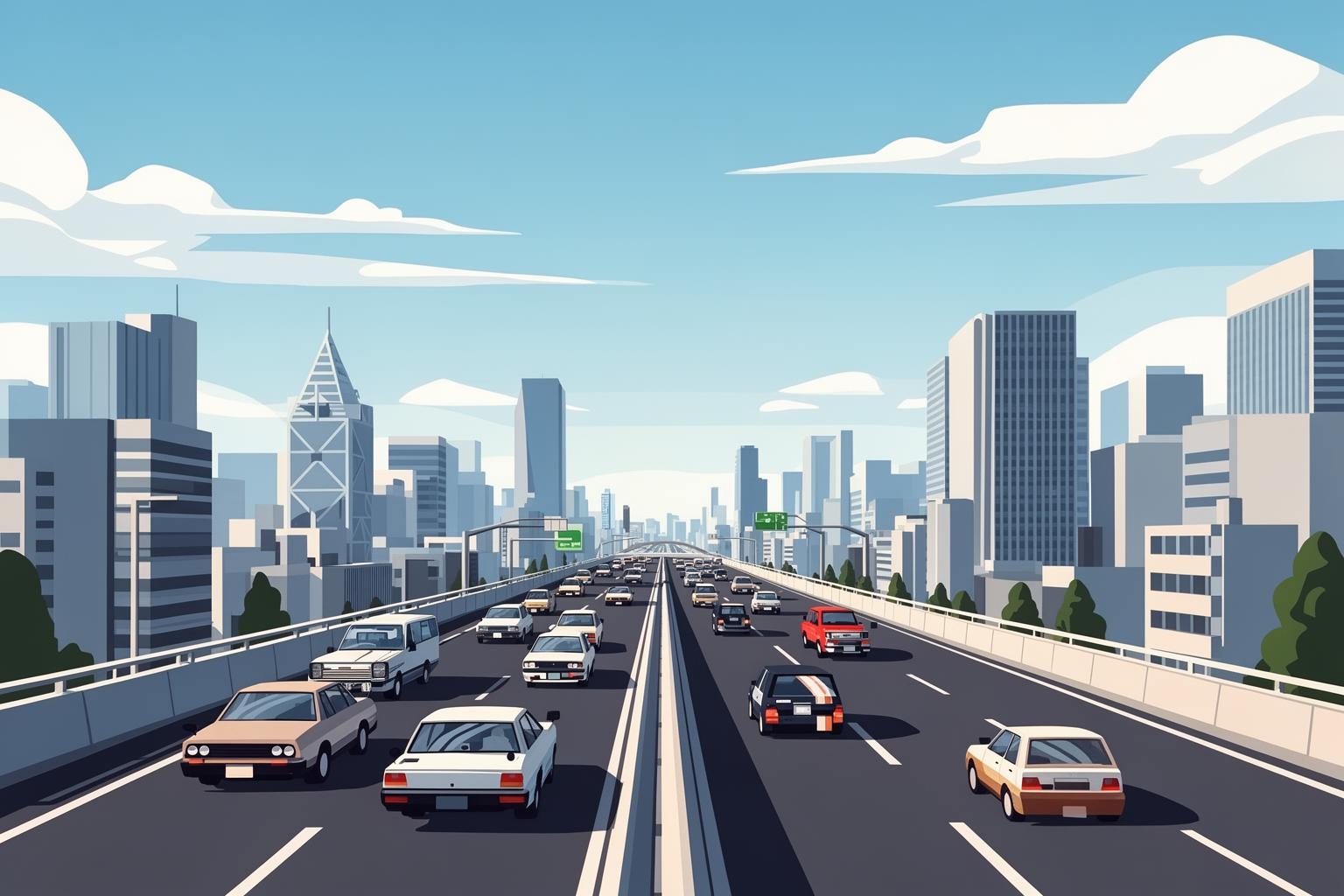
First, you need to understand that this entire scene is worlds apart from the Fast & Furious franchise. There are no dramatic heists or speeches about ‘family’ over a barbecue. The Wangan philosophy is much more introspective—it’s a quiet obsession. Think of it less as a competition and more as a personal journey. In Wangan Midnight, the protagonist, Akio Asakura, discovers a haunted Nissan Fairlady Z (S30), a car so heavily modified and seemingly cursed that all its previous owners met tragic ends. They call it the ‘Akuma no Zetto’—the Devil Z. Here’s the key: Akio doesn’t view the car as just a tool to win races; he sees it as a challenge, a partner, a living entity he must understand and tame. This relationship forms the heart of the entire story and culture.
This brings us to our first significant cultural translation. In the West, a car is generally seen as a machine—a means of transport, a status symbol, or a project to be mastered and controlled. But in Japan, there’s a deep cultural undercurrent, rooted in Shinto-animist beliefs, that objects made with passion or used for a long time can develop a spirit or personality. This concept is known as tsukumogami. The Devil Z is the ultimate automotive tsukumogami. It possesses a will of its own. It’s not just about tuning the engine; it’s about having a dialogue with the metal and rubber. Akio isn’t merely driving; he is striving to achieve harmony with a machine that actively resists him. The goal isn’t a trophy; it’s that one perfect run where the driver’s will and the car’s ‘soul’ fully align. Everyone else on the road—the Porsche-driving surgeon Tatsuya Shima, the R32-piloting model Reina Akikawa—they’re not just rivals. They’re fellow pilgrims on the same journey, each wrestling with their own ‘devil’ in the form of their chosen machine. They race not for bragging rights, but to test themselves, pushing their limits and deepening their understanding of their cars. It’s a high-speed, high-stakes path of self-discovery.
The Concrete Jungle as a Sacred Space: Why the Highway?
So why this place? Why this particular stretch of elevated highway winding around Tokyo Bay? To understand it, you have to experience the suffocating pressure of everyday life in Japan. It’s a society grounded in harmony, rules, and the collective good. From the way you stand on the escalator to the exact words you choose with your boss, life is a delicate choreography of social duties. You wear a mask—not a physical one, but a social facade called tatemae, your public face. Your true emotions, your honne, remain carefully hidden. It’s orderly, it’s safe, but it can also feel stifling. Space is scarce, both physically and emotionally. Everything is dense, crowded, and meticulously scheduled. Now imagine this: it’s 2 AM. The city has finally quieted down. You slide into the driver’s seat of a machine you’ve invested your heart and savings in. You merge onto the Wangan. Suddenly, all those rules and constraints vanish. The road stretches out into a vast, empty expanse of concrete and light.
A Ritual of Escape
This late-night drive is a contemporary ritual. It’s a pilgrimage. During the day, the Wangan functions as a congested artery of commerce, packed with trucks and commuters. But at night, it transforms. It becomes a space of pure possibility. No pedestrians, no traffic signals—just a long, flowing ribbon of asphalt with sweeping curves and seemingly infinite straights. It’s one of the rare places in the greater Tokyo area where you can genuinely be alone, anonymous, and fully in charge of your own destiny, if only for a few minutes. This is where honne breaks free. The engine’s roar is the only sound that matters. The expectations of your boss, your family, society—all dissolve into the Doppler effect. On the Wangan, you’re no longer Tanaka-san from accounting. You’re the pilot of a 600-horsepower beast. This act of driving isn’t merely about excitement; it’s a crucial psychological release. It’s a ceremony of shedding your social skin and reconnecting with a primal, individual self buried beneath the weight of daily life. The solitude isn’t a flaw; it’s the whole point. In that isolation, racing through the darkness, a person can finally feel free.
The Aesthetics of the Asphalt Ribbon
And let’s consider the visuals, because they play a huge role in the allure. The Wangan isn’t beautiful in a natural, scenic way. Its beauty is stark, industrial, and distinctly Japanese. It’s a cyberpunk dreamscape made real. As you speed across the elevated sections, you’re immersed in a uniquely Japanese urban aesthetic. The cold, industrial glow of the Kawasaki factory district surrounds you, flames licking from smokestacks against the night sky. You cross massive bridges like the Rainbow Bridge or the Tsurumi Tsubasa Bridge, their steel cables illuminated like celestial harps. The whole Tokyo and Yokohama skyline spreads out before you, a sparkling tapestry of endless skyscrapers and glowing windows, each one a story you’re rushing past. The road itself shines under an unbroken chain of orange sodium lamps, casting hypnotic, rhythmic reflections off your car’s polished paint. It’s an entire vibe. There’s a Japanese concept, mono no aware, often translated as ‘the pathos of things’ or a gentle sadness for the fleeting nature of beauty. A Wangan run is pure mono no aware. The beauty of the view, the perfection of a corner taken just right, the scream of the engine at redline—it’s all fleeting. It exists only in that moment, gone the next. The drive is a collection of these ephemeral moments. It’s not just a race; it’s an aesthetic experience, a high-speed meditation on the beauty of a modern, man-made world.
The Solitary Racer: A Modern Samurai?
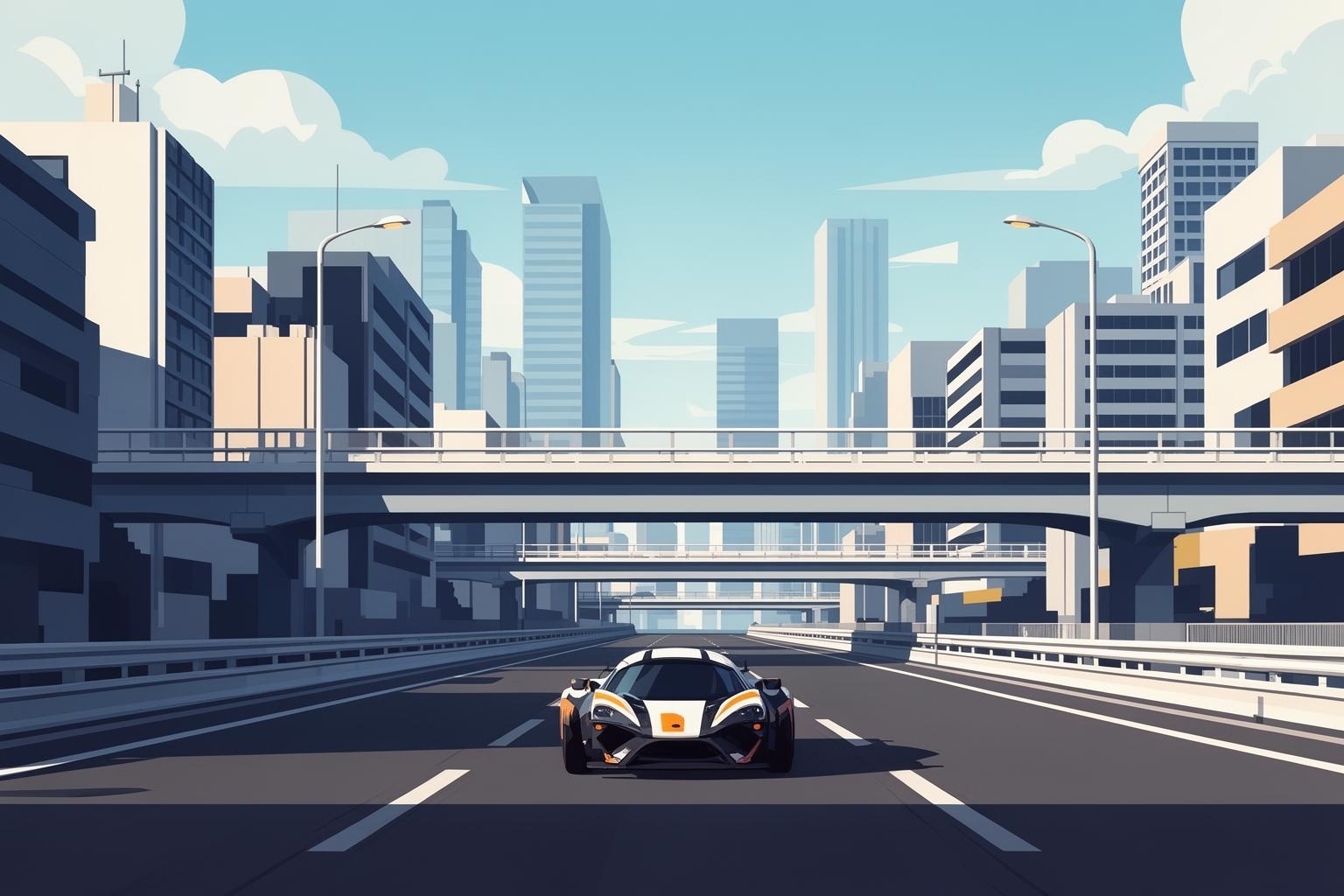
It may seem like a stretch, but if you look carefully, you can detect faint echoes of the old samurai code, Bushido, in the unwritten rules of the Wangan. This isn’t a chaotic free-for-all. There’s a strange, underlying sense of honor throughout it. The true Wangan racers—the ones portrayed in the anime and respected in real life—aren’t merely reckless hooligans. They consider themselves practitioners of a distinct craft, which comes with its own code of conduct. This isn’t about causing chaos for ordinary citizens; it’s a controlled, consensual duel between those who willingly take part.
The Code of the Road
The unspoken rules are crucial. You don’t engage with ‘civilians’. If a regular car blocks your path, you back off and wait. You don’t weave through traffic like a maniac just to prove a point. The challenge is meant only for those who are ‘in the know’. A potential race often begins with a subtle exchange: a flash of headlights, a pull alongside, a mutual acknowledgment. It’s a challenge given and accepted. The aim is a ‘clean’ run, a test of machine and skill against another dedicated racer—not a demolition derby. There is also a profound respect for the machine—both your own and your opponent’s. In Wangan Midnight, drivers often know the intimate details of each other’s cars, the tuners who built them, and the philosophies behind their setups. There’s a shared language and mutual respect for the dedication required to build and drive these machines at their limits. This self-regulating order within a technically illegal and chaotic activity reflects a distinctly Japanese approach. It’s about preserving harmony, even among those who operate on the margins. It contrasts sharply with the Western outlaw archetype; it’s more like a ronin—a masterless samurai—living by his personal code outside the mainstream but still adhering to a strict sense of honor.
The Pursuit of Perfection (Kodawari)
Perhaps the most crucial cultural key to understanding the Wangan mindset is the concept of kodawari. There’s no perfect one-word translation, but it essentially means the relentless, obsessive pursuit of perfection within a chosen craft. It’s the sushi chef who spends a decade mastering just the rice. It’s the calligrapher who practices a single stroke a thousand times. And it’s the Wangan racer who spends countless nights and a fortune trimming fractions of a second off their time or squeezing out 5 more horsepower. The cars in Wangan Midnight are in a constant state of evolution. They’re never ‘finished’. After every high-speed run, Akio returns to the garage with his mentor, Jun Kitami, the legendary ‘Devil’s Tuner’. They analyze, tweak, and rebuild—boring out the engine, adjusting the ECU’s fuel map, refining suspension geometry, experimenting with turbo setups. This endless cycle of pushing limits, identifying weaknesses, and dedicating oneself to improvement—that’s the true objective. Winning a single race is secondary. The real victory lies in the process, in the relentless pursuit of the perfect machine, the perfect setup, the perfect harmony. This is kodawari in its purest, most intense form. Tatsuya Shima with his ‘Blackbird’ Porsche 911 exemplifies this as well. Though a successful surgeon, his true passion—his kodawari—is perfecting his car to reign supreme on the Wangan. This obsessive focus distinguishes serious racers from casual speed-demons. It’s not a hobby; it’s a discipline, a way of life, akin to a martial art.
The Machine with a Soul: Japan’s Relationship with Technology
To truly understand why the Devil Z is seen as a character rather than just a car, we need to delve deeper into Japan’s unique relationship with technology, which differs fundamentally from the typical Western perspective. Unlike the deep-rooted cultural fear in the West of technology turning against its creators, as depicted in The Terminator or The Matrix, Japan often perceives technology as a partner or co-existing entity. This perspective stems from the ancient Shinto belief system—an animistic faith that recognizes gods, or kami, in everything from natural elements like rocks and rivers to human-made objects. Rather than fading away, this worldview has evolved and remains influential in modern Japan.
From Tsukumogami to the “Devil Z”
We previously touched on tsukumogami, the notion that objects gain a spirit after 100 years. While no one literally believes their Toyota harbors a ghost, the cultural feeling underlying this idea still exists. There is a sense that when a person invests immense effort, passion, and time into an object, it absorbs part of that energy and acquires a life of its own. This can be seen in ceremonies like hari-kuyō, where people bring old, broken sewing needles to a shrine to honor and thank them before disposal—a gesture of respect toward inanimate tools. The Devil Z takes this concept to an extreme and adds a sinister edge. It’s a car imbued with the ambition, obsession, and tragic failures of its previous owners. It possesses a ‘memory’—not simply breaking down mechanically, but displaying a malevolent personality that challenges its driver. When Akio crashes, it’s portrayed not as mere mechanical failure but as the Z rejecting him. His mission becomes earning the car’s respect, merging his soul with its dark, powerful spirit. This personification of technology is a hallmark of Japanese storytelling, appearing in everything from the giant mechs of Gundam to the androids in Ghost in the Shell. The machine is never merely a machine; it is a partner, a mirror of its pilot, or a force to be comprehended rather than controlled.
The Human-Machine Interface
This perspective creates a distinct form of interaction. A top-tier Wangan driver is more than just a pilot executing commands—they are a diagnostician, a kind of machine-whisperer. They sense subtle vibrations through the chassis, recognize engine notes at various RPMs, and detect scents indicating overheating oil or a burning clutch. In Wangan Midnight, the legendary tuner Kitami often speaks of the car ‘speaking’ to its driver. He believes that ultimate speed is achieved when the human becomes an extension of the car’s senses, and the car becomes an extension of the human’s will. The continual tuning process represents this ongoing conversation. Adjusting the suspension isn’t merely a mechanical tweak; it’s asking the car, ‘How do you want to handle this corner?’ and then interpreting its response through the feedback felt on the steering wheel during the next run. This symbiotic relationship with technology—a dialogue rather than a one-sided command—is central to the Wangan philosophy. You don’t conquer the Devil Z; you learn to dance with it.
The Real-World Wangan: Meeting Spots and Modern Realities
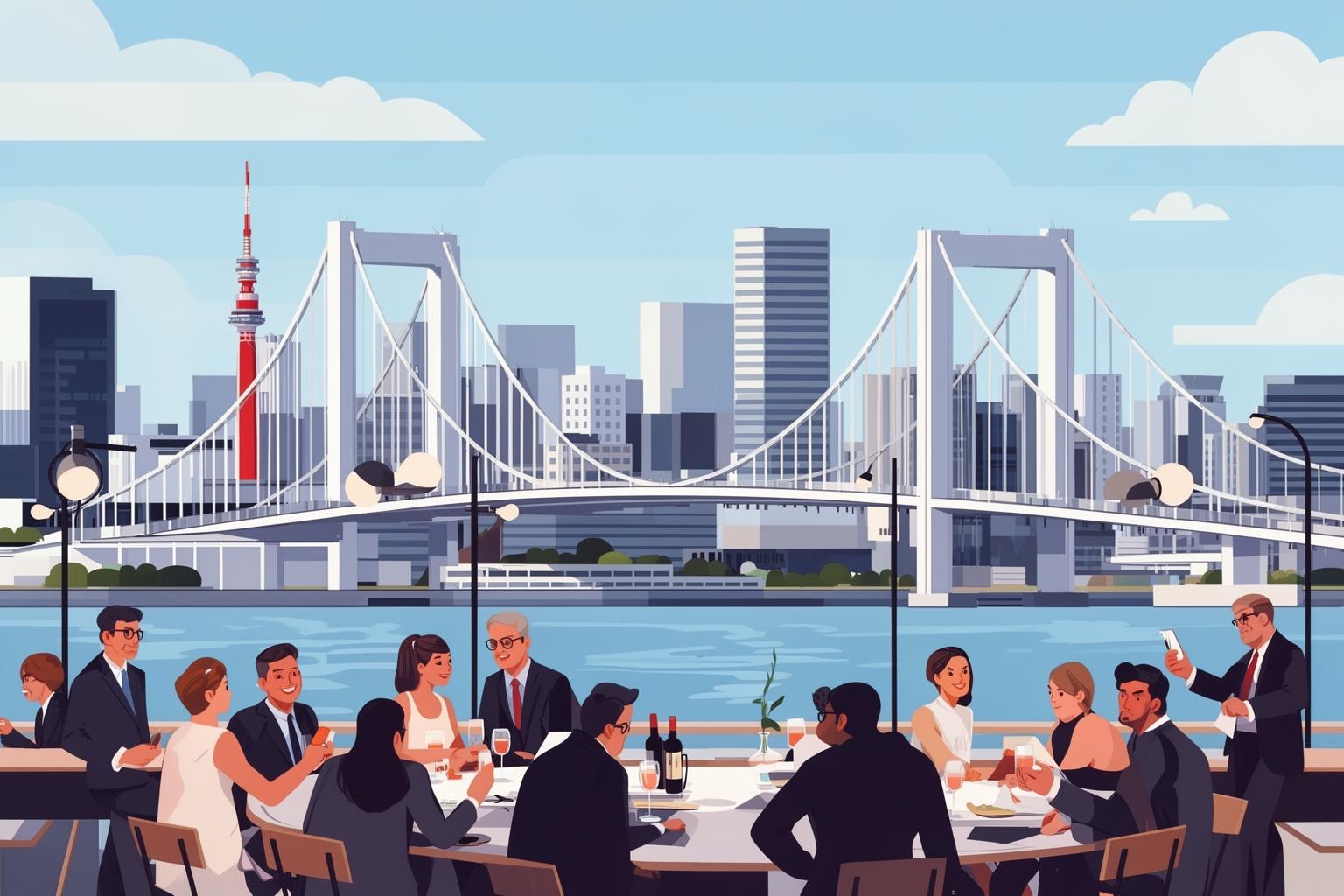
Alright, let’s step away from the anime for a moment and focus on the real world. This culture, although often mythologized, is very much genuine. At the heart of it all are the massive parking areas, or ‘PAs,’ located along the expressway. These aren’t your typical dingy rest stops—they serve as unofficial clubhouses, showrooms, and social hubs for the entire JDM community.
Daikoku PA: The Never-Ending Car Show
If there’s a sacred place, it’s Daikoku Futo Parking Area. Hidden within an industrial port zone in Yokohama, and accessible only via the expressway, this enormous lot has gained legendary status. On any weekend night, arriving at Daikoku feels like entering a live car magazine. You’ll spot everything—from impossibly low VIP sedans and flamboyantly decorated dekotora trucks to classic Skylines, modern Lamborghinis, and heavily modified machines built specifically for Wangan runs. But surprisingly, the atmosphere is calm. It’s not a wild, chaotic environment. People simply park, pop their hoods, and appreciate. This place embodies mutual respect. Owners quietly stand near their cars while others stroll around, snapping photos and admiring the craftsmanship. It’s a social gathering, but distinctly Japanese—there’s less loud boasting and more quiet pride. The kodawari is on full display: the flawlessly welded exhausts, meticulously cleaned engine bays, and rare wheels. Daikoku isn’t the starting line of a race; it’s the gallery where this automotive art is showcased before hitting the road. It’s where the community connects, exchanges knowledge, and proudly presents the fruits of their personal obsession.
The Crackdown and the Culture’s Transformation
Now for some reality. Street racing at 300+ km/h is incredibly dangerous and highly illegal. The ‘golden age’ of Wangan racing portrayed in the 90s-set manga is mostly behind us. Law enforcement has become much tougher—installing more cameras, increasing patrols, and ready to shut down entire parking areas like Daikoku at a moment’s notice. This crackdown has forced the culture to change. The all-out, high-speed battles stretching across the bay have become rare and extremely risky. The scene has evolved into something different. It’s shifted towards ‘cruising’—driving through the route at a lively but controlled pace—and social meetups at the PAs. The emphasis is no longer just on speed, but on celebrating car culture itself. The passion for tuning and love for these machines remain as strong as ever, but now expressed with more restraint and caution. The fantasy of Wangan Midnight endures as a guiding myth, yet its real-world practice has had to adapt in order to survive in modern Japan.
So, What’s the Real Vibe? Decoding the Loneliness
So let’s return to where we began: that sensation of loneliness. By now, you should realize it’s not the loneliness of sadness or isolation. It’s the loneliness of deep focus, of meditation. It’s a chosen state. In a society centered on the group, the team, the company, the Wangan offers a rare, fleeting moment of pure, unfiltered individualism. It’s the ultimate expression of your honne—your true, authentic self. When you’re behind the wheel, speeding down that empty stretch of highway, none of the social masks matter. You are defined solely by your skill, your courage, and the conversation you’re sharing with the machine you created. The other drivers aren’t your rivals; they are the only others who understand the call of this concrete cathedral. They are fellow monks in the same high-speed monastery. This solitary pursuit is a paradox: a way to find yourself by losing yourself in the machine and the moment. It’s about adhering to the strict, unspoken rules of a very specific subculture in order to break free from the overwhelming rules of the mainstream. To understand the Wangan racer, you have to discard the idea of a finish line. There is no ‘winning.’ The goal is the drive itself. It’s the pursuit of that elusive, perfect moment when the roar of the engine, the blur of city lights, and the driver’s consciousness all converge into a single, silent point of absolute clarity. It’s not just driving. It’s a high-stakes, high-octane quest for Zen.