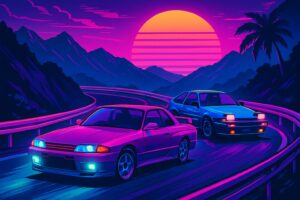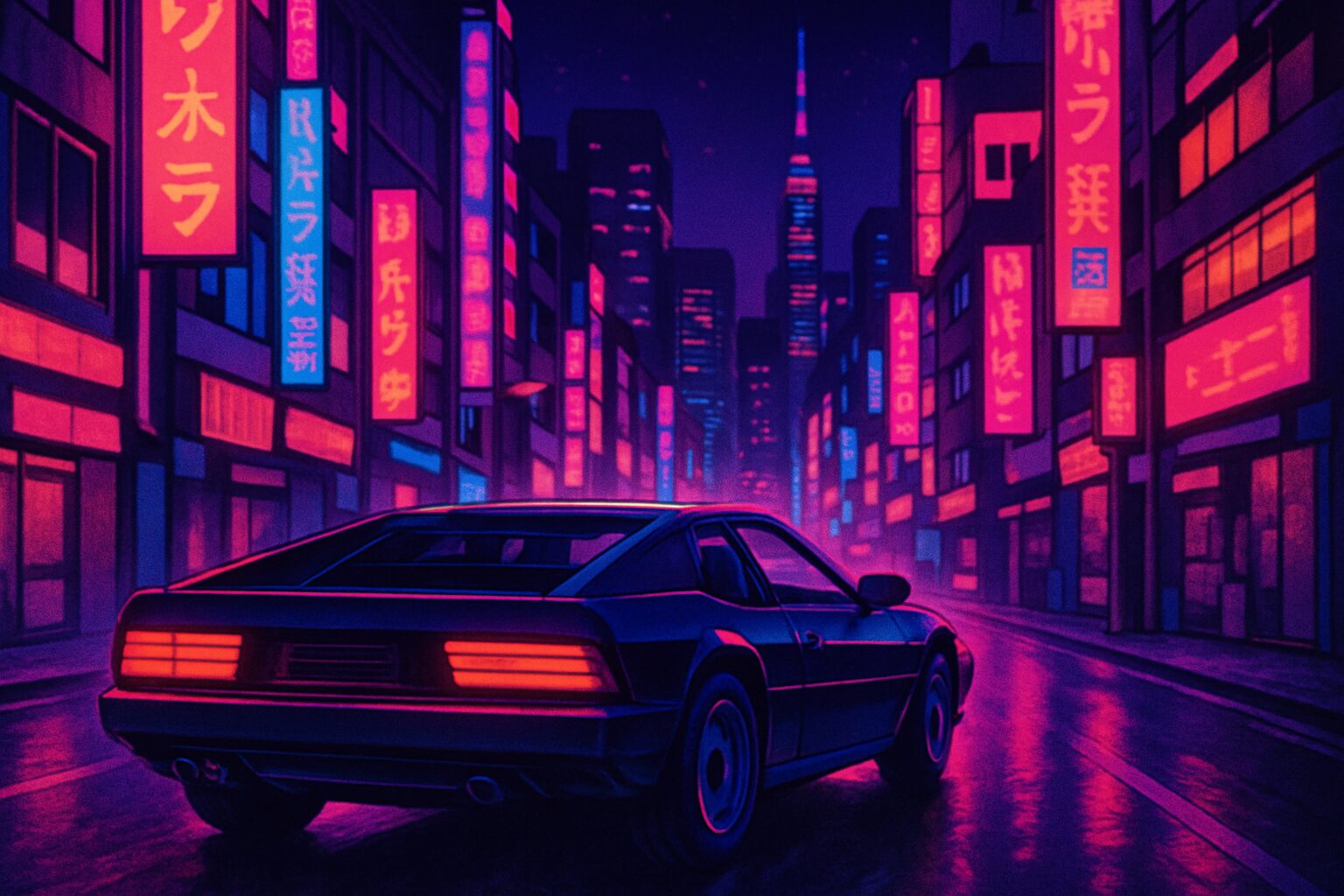
Yo, what’s the deal? Ryo Kimura here, tuning in from the heart of the electric metropolis. Let’s talk about a vibe. Not just any vibe, but a full-blown sensory download, a time-slip into a dream you didn’t even know you had. Picture this: it’s past midnight in Tokyo. The city, a sprawling galaxy of neon and shadow, is breathing. The air is cool, carrying the faint hum of a million sleeping souls and a billion glowing lights. You’re behind the wheel of a legendary piece of Japanese steel—a JDM icon, a machine with a soul. And pulsing from the speakers isn’t some top-40 track. It’s the smooth, sophisticated, and impossibly nostalgic sound of City Pop. This isn’t just a drive; it’s a moving meditation, a cinematic experience where you are the undisputed main character. It’s the synthesis of sound, steel, and skyline that unlocks a hidden level of Tokyo, one that thrums with the ghosts of a future that was, a bubble of optimism and analog cool that never truly burst. It just went underground, waiting for you to find the frequency. This is the ultimate Tokyo experience, a cruise through the concrete jungle powered by funk-infused basslines and the low growl of a straight-six engine. It’s about feeling the city’s pulse through the steering wheel and having the perfect soundtrack to score its endless, beautiful melancholy. No cap, this is how you truly connect with the soul of Tokyo after dark. It’s a whole mood, a core memory waiting to be made. Let’s get into it.
The Soundtrack: Decoding the City Pop Phenomenon
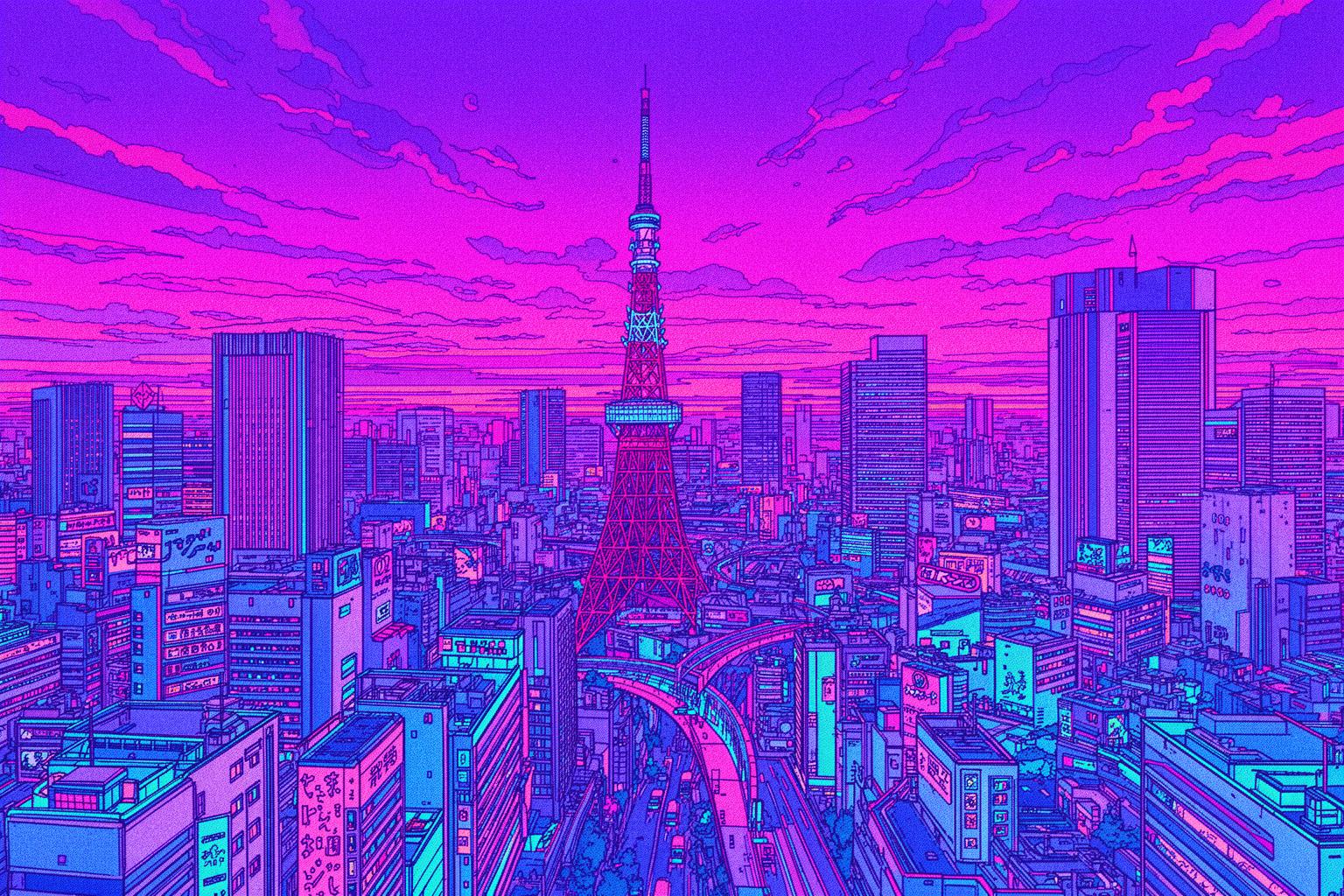
Before we even turn the key in the ignition, we need to set the frequency. What exactly is this auditory magic called City Pop? Bet. If you’ve spent any time exploring the deeper cuts on YouTube or Spotify, you’ve likely been gifted by the algorithm with a thumbnail of a serene, pastel-hued anime scene or a retro album cover, paired with a title in Japanese and a track that just hits different. That, my friend, is your entry point into the rabbit hole. City Pop is less a strict genre and more an ethereal aesthetic—a sonic snapshot of a very particular era and place: Japan in the late 1970s through the 1980s. This was the height of the nation’s economic miracle, known as the “Bubble Era” or baburu jidai. The economy was booming, optimism filled the air, and Japan was envisioning a sleek, technologically advanced, and effortlessly cool future. City Pop is the official soundtrack to that collective dream.
Musically, it’s a sophisticated fusion. It blends the smoothest elements of American genres with a distinctly Japanese perspective. We’re talking infectious funk grooves, silky soul chords, tight arrangements of AOR (Adult-Oriented Rock), complex jazz fusion harmonies, and the steady four-on-the-floor pulse of disco. The production quality was, and remains, absolutely exceptional. Record labels had seemingly unlimited budgets, funding studio time and bringing in top session musicians from bands like Toto, Chicago, and Earth, Wind & Fire to Tokyo for recording sessions. The result is a lush, polished, and layered sound—music crafted for high-fidelity audio systems in high-rise apartments or, more importantly for us, the premium cassette decks of a brand-new Toyota Soarer or Nissan Fairlady Z.
The lyrical themes unlock the entire vibe. City Pop lyrics paint vivid pictures of an urban, aspirational lifestyle. They sing of fleeting summer romances on the Shonan coast, secret rendezvous in upscale hotel bars, the bittersweet solitude amid glittering skylines, and the pure, unfiltered freedom of a late-night drive along the expressway. It’s a world of cocktails, convertibles, and complicated emotions. Both glamorous and melancholic, it captures the fleeting beauty of perfect moments. This is the sound of a generation that seemingly had it all, yet quietly yearned for something more. This duality gives the music its timeless emotional depth.
The Pantheon: Artists You Need on Your Playlist
To truly grasp the City Pop vibe, you need to know the architects behind the sound. These aren’t just names—they’re legends who crafted the sonic universe we’re about to explore. Let’s dive into the essentials.
Tatsuro Yamashita: The King
You can’t discuss City Pop without starting with Tatsuro Yamashita. He is, without exaggeration, the king of the genre. His production is flawless, his arrangements are a masterclass in musical architecture, and his voice radiates pure sunshine. His 1982 album For You is a cornerstone of City Pop. Just listen to the opening track, “Sparkle.” That iconic, razor-sharp guitar riff by Jun Aoyama shines like chrome under a streetlamp. It’s the sonic equivalent of hitting the gas and merging onto the expressway. The entire song bursts with joyous, brass-filled funk that screams optimism. Then there’s “Ride on Time.” The title itself commands our journey forward. The soaring chorus and propulsive rhythm make it the ultimate anthem for cruising with the windows down, feeling the wind whip through your hair as city lights blur into streaks. Yamashita’s music is the gold standard; it’s complex yet accessible and perfectly encapsulates the era’s feeling of endless possibility.
Mariya Takeuchi: The Queen
If Yamashita is the king, his wife Mariya Takeuchi is unquestionably the queen. Though she had a successful career for years, she skyrocketed to global internet fame with one song: “Plastic Love.” You know the one. Thanks to the mysterious magic of the YouTube algorithm, millions worldwide were captivated by this tale of love and loss in the big city. But she is far more than one track. Her music often carries a sophisticated, melancholic edge that’s intoxicating. “Plastic Love,” produced by Yamashita, is the perfect example. On the surface, it’s a danceable disco-funk track, but the lyrics tell a story of heartbreak and emotional detachment—dancing through the pain. It’s the soundtrack for quiet reflection as you cross the Rainbow Bridge, watching city lights shimmer on the water, feeling both connected and isolated amid countless other stories. Her album Variety is essential listening—a masterwork of pop craftsmanship capturing the bittersweet essence of urban life.
Toshiki Kadomatsu: The Groove Merchant
When you need to inject high-octane energy into your drive, turn to Toshiki Kadomatsu. His style of City Pop is funkier, faster, and often more aggressive. He’s the sound of 5 PM on a Friday, clocking out, loosening your tie, and hitting the city for a night of adventure. His 1985 album Gold Digger is a powerhouse. Tracks like “After 5 Clash” are pure adrenaline. The slap bass, punchy horns, and driving beat perfectly embody weaving through traffic on the Shuto Expressway as neon signs flash past in rhythmic sync. His music is technical, intricate, and addictive. It demands being played loud. Amid the concrete canyons of Shinjuku, surrounded by towering skyscrapers, Kadomatsu’s tracks match the city’s intense energy, providing the high-energy peaks of your midnight cruise playlist.
Anri: The Sound of Summer
Anri’s music is pure, distilled summer. Listening to her feels like driving a convertible down a coastal highway, even if you’re in a hardtop coupe in central Tokyo. Her songs are breezy, romantic, and effortlessly cool. The 1983 album Timely!! is a masterpiece and arguably one of the most definitive City Pop records ever made. Tracks like “Cat’s Eye” (famously the theme for the anime of the same name) and “Last Summer Whisper” are iconic. “Remember Summer Days” radiates unadulterated nostalgia, making you yearn for a summer you might never have lived. Her music is perfect for the start of your cruise, as sunset fades, or during moments on the Wangan Line, with Tokyo Bay sprawling beside you. It’s pure freedom and youthful romance—an ideal companion to the imagined sea breeze flowing through your window.
Miki Matsubara: The Midnight Door
Another artist propelled to global recognition by the internet, Miki Matsubara is the voice behind the absolute classic “Mayonaka no Door / Stay With Me.” Her 1979 debut single is, for many, the quintessential City Pop anthem. From the moment it opens with that iconic intro and her pleading, “To you… yes, my love… to you,” it’s pure magic. The song perfectly blends a catchy yet melancholic melody, a jazzy saxophone solo, and an irresistible groove. It captures the feeling of a late-night promise, a moment of emotional vulnerability under city lights. It’s the track you play after leaving the chaos of the inner city, cruising through quieter residential streets where streetlights cast long shadows on the pavement. Introspective, soulful, and deeply human, Miki Matsubara’s legacy is immortalized in this song, opening the door to City Pop for a new generation worldwide.
Of course, this only scratches the surface. The City Pop universe is vast and rich, filled with incredible artists like Omega Tribe, Junko Ohashi, Taeko Onuki, and Tomoko Aran. The key is to explore and build a playlist that maps onto the emotional journey of your drive. Start with these legends, and let the algorithm guide you deeper into the soundscape of 1980s Tokyo.
The Machine: JDM Culture and the Art of the Cruise
Now, for the other half of this perfect equation: the ride. You can’t just use any car for this. Well, technically you could, but to truly capture the vibe and align with the City Pop frequency, you need the right machine—a JDM legend. JDM, or Japanese Domestic Market, refers to vehicles built specifically for Japan, but it has also become shorthand for an era of automotive design and philosophy, mainly from the 80s and 90s—Japan’s golden age of engineering.
These cars emerged from the same economic bubble that gave birth to City Pop. They embodied Japan’s technological prowess and ambitious spirit. During this era of “gentlemen’s agreements,” manufacturers unofficially limited horsepower to 276 hp, which shifted focus to handling, balance, and delivering an exceptional driving experience. These cars were more than mere machines; they were extensions of the driver’s will, crafted with dedication to both performance and aesthetics, making them timeless icons. Driving one isn’t just transportation; it’s piloting a piece of history, a rolling sculpture representing the pinnacle of analog performance before the digital age took over.
The Icons of the Asphalt
Let’s dive into the legendary cars ideal for this journey. Each has its own personality, story, and unique connection to the road and city.
The Nissan Skyline GT-R (R32/R33/R34): Godzilla
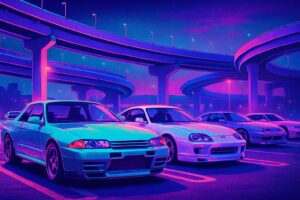
The GT-R reigns supreme on the Wangan expressway, earning the nickname “Godzilla” from the Australian press after dominating touring car races. The R32, R33, and R34 generations stand as technological masterpieces. At its core is the legendary RB26DETT—a 2.6-liter twin-turbo inline-six engine that is mechanical perfection in motion. The sound of an RB26 revving high is one of the most iconic in automotive history. The GT-R’s true brilliance, however, lies in its ATTESA E-TS all-wheel-drive system, acting like a supercomputer on wheels, delivering exceptional grip and stability to conquer both corners and straights with ferocity. Driving a GT-R on the Shuto Expressway feels like returning a predator to its natural habitat—the car alive and communicative, with twin turbos hissing through tunnels as city lights glint off its distinctive boxy-yet-curvy fenders. Its commanding presence demands respect, making it the perfect machine for an energetic, Kadomatsu-fueled blast around the C1 loop.
The Toyota Supra (A80): The Grand Tourer
If the GT-R is a precision weapon, the A80 Toyota Supra is a grand touring powerhouse—muscular and elegant. Immortalized in films and games, the Mk4 Supra owes much of its legendary status to its engine: the mighty 2JZ-GTE. This inline-six twin-turbo engine is renowned for its cast-iron block, enabling it to handle extremely high horsepower. Stock, it’s a smooth, powerful, and reliable cruiser. Its sweeping design and massive rear wing epitomize 90s perfection. The Supra’s cockpit feels like a jet fighter’s, with the dashboard angled toward the driver, imparting a grounded, substantial feel. It’s ideal for the long, sweeping curves of the Wangan Line where the 2JZ’s sequential turbos shine—the first turbo boosting low RPMs, then the second kicking in with a legendary whoosh that presses you into your seat. A Supra cruise is smooth and deliberate, perfectly matching the breezy coastal vibes of Anri or Mariya Takeuchi’s soulful melancholy.
The Mazda RX-7 (FD3S): The Rotary Artist
The Mazda RX-7, especially the third-generation FD, offers something unique—not raw power, but balance, lightness, and a distinctive heart: the 13B-REW, a 1.3-liter twin-rotor twin-turbo rotary engine. Unlike piston engines, the rotary is smaller, lighter, and loves to rev, producing a high-pitched, aggressive buzz unlike anything else on the road. The FD RX-7 is among the most beautifully designed cars, with flowing, organic lines that evoke wind-sculpted forms. Its lightweight chassis and near-perfect 50/50 weight distribution make it agile and responsive. Driving an FD through tight sections of the Shuto is like dancing; it feels nimble and almost telepathic. The rotary engine demands finesse, but when mastered, it’s incredibly rewarding. This car is for connoisseurs who value artistry and subtlety. Coupled with jazzy, intricate City Pop from artists like Hiroshi Sato, the RX-7 delivers a truly sublime and connected driving experience.
The Honda NSX: The Exotic Supercar
Developed in collaboration with legendary F1 driver Ayrton Senna, the Honda NSX was Japan’s answer to Ferrari and Porsche—a mid-engine, rear-wheel-drive supercar designed for everyday use. It combined exotic styling—a low-slung aluminum body and canopy-style cockpit—with Honda’s famed reliability and driver-friendliness. The first-generation NSX featured a high-revving, naturally aspirated V6 with VTEC. The sound of VTEC engaging around 5,800 RPM is pure joy—a sudden pitch shift from smooth hum to exhilarating scream. The NSX emphasizes poise and precision, delivering remarkable feedback. Cruising the upscale streets of Ginza in an NSX embodies the Bubble Era fantasy—a statement of sophistication, engineering excellence, and quiet confidence. The refined, luxurious sounds of Tatsuro Yamashita’s later works perfectly complement a drive in this iconic Japanese supercar.
The Stage: Crafting Your Midnight Masterpiece
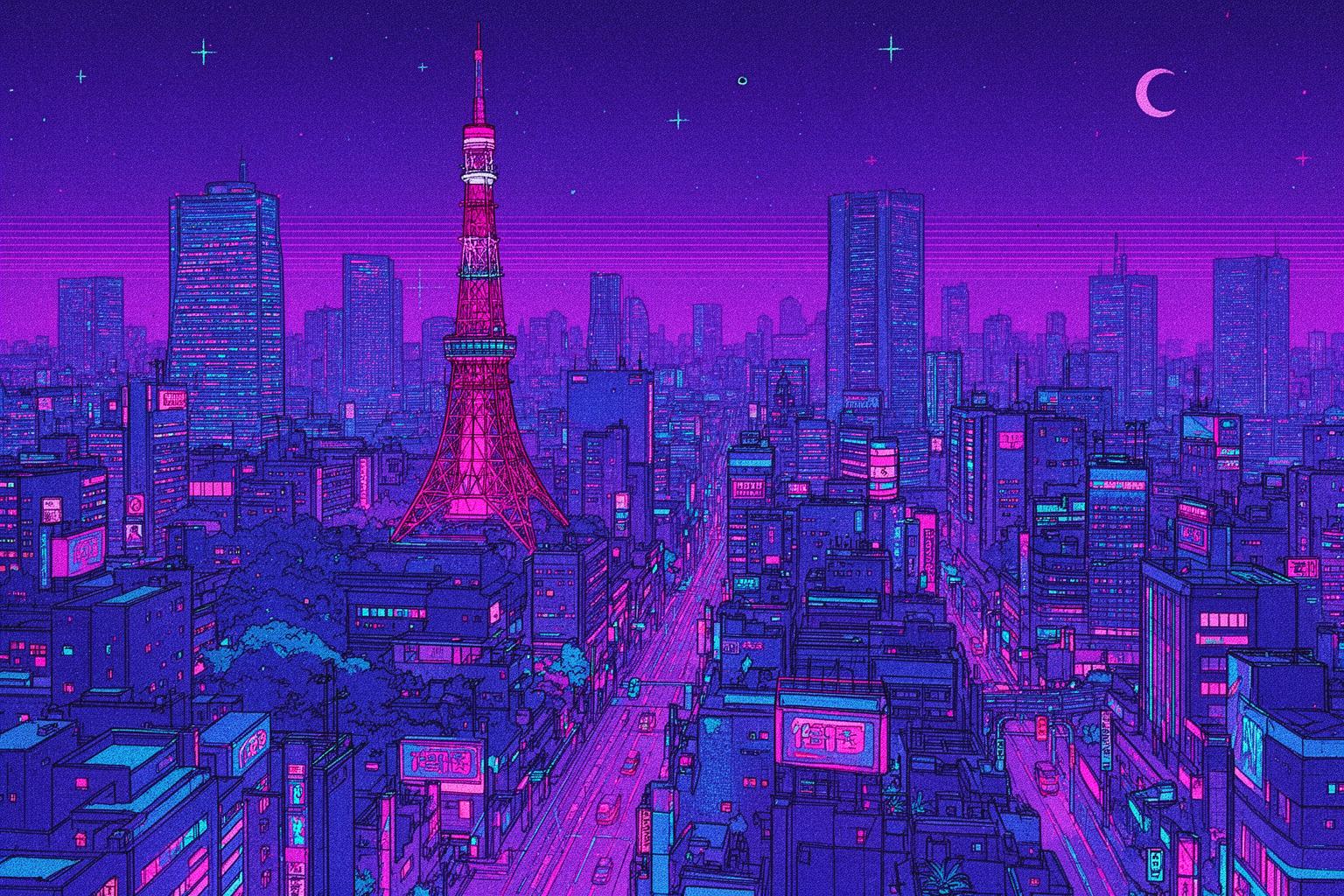
Alright, you have the soundtrack. You have the machine. Now, you need the stage. The Tokyo Metropolitan Expressway, or Shuto Expressway (Shuto Kōsoku Dōro), is more than a simple road network. It serves as the city’s circulatory system—a complex lattice of elevated highways, tunnels, and bridges weaving through, above, and beneath the urban sprawl. At night, it transforms. Traffic thins out, and the expressway becomes a ribbon of light, a private viewing platform overlooking the world’s greatest metropolis. It’s not about reaching from A to B; it’s about the journey itself. The cruise is a ritual, and the route is the scripture.
The Gathering: Daikoku & Tatsumi Parking Areas
Your journey doesn’t begin when you hit the highway; it starts at one of the legendary Parking Areas, or PAs. These aren’t just rest stops—they’re living, breathing car museums and social hubs for automotive enthusiasts. The most famous is Daikoku PA, near Yokohama but a vital part of Tokyo’s cruise culture. On a Friday or Saturday night, rolling into Daikoku feels like stepping into another world. Rows upon rows of pristine JDM legends, exotic supercars, bold VIP-style sedans, and custom creations that defy classification. The air hums with the rumble of exhausts, low conversations, and the occasional pop of a blow-off valve. Car owners polish their rides beneath the soft glow of orange overhead lights, sharing stories and appreciating each other’s builds. It’s a space of mutual respect and shared passion. You grab a hot coffee from a vending machine—a cherished Japanese ritual—and simply absorb the atmosphere. This is the pre-show, the place to get hyped and centered before your run.
Tatsumi PA is another key location, situated closer to central Tokyo on the Wangan Line. Smaller than Daikoku, it nevertheless offers one of the most iconic backdrops in the world: the sparkling skyscrapers of the Ariake and Shinonome districts. Parking here, framed by that futuristic skyline, is the ultimate photo opportunity. Tatsumi carries a slightly more serious, focused energy. It’s often a meeting point for specific groups or the final cool-down spot after a long drive. Starting or ending your night at one of these PAs is essential to the full experience.
The Route: A Narrative Journey
Let’s outline a classic route. This isn’t a GPS turn-by-turn; it’s an emotional and sensory guide. Your playlist should be queued up.
Phase 1: The Ascent & The C1 Loop (The Heartbeat)
Playlist Vibe: Up-tempo, funky, full of anticipation. Toshiki Kadomatsu’s “After 5 Clash,” Junko Ohashi’s “Telephone Number.”
Leaving the PA, you hit the on-ramp. This is the moment of transition. The quiet of the parking area fades into the hum of tires on asphalt. You accelerate, merging into a flow of taillights. The city rises around you as you climb onto the elevated sections. Your first target is the C1, the Inner Circular Route. This is the oldest and tightest section of the Shuto—a loop encircling Tokyo’s core—the Imperial Palace, Ginza, Marunouchi. The C1 is a technical challenge. Its corners are sharp, lanes narrow, demanding full attention. The experience is intense and focused. You dive into short, brightly lit tunnels that feel like warp-speed portals, the sound of your engine reverberating off the tiled walls. Then you burst into the open, surrounded by a canyon of glowing office towers. This is the city’s heartbeat, with you right in the middle of its arteries. The sensation is electric, a sensory overload in the best way.
Phase 2: The Rainbow Bridge (The Cinematic Peak)
Playlist Vibe: Epic, soaring, slightly melancholic. Mariya Takeuchi’s “Plastic Love,” Miki Matsubara’s “Mayonaka no Door / Stay With Me.”
From the C1, you seamlessly transition to Route 11 and approach the iconic Rainbow Bridge. This is the defining moment. Driving onto the bridge’s double-decker structure is breathtaking, no matter how many times you’ve experienced it. The bridge itself is beautifully lit, but it’s the view that stuns you. To one side stands the classic, elegant Tokyo Tower, glowing in its signature red and white. To the other, the futuristic skyline of Odaiba, with its unique architecture and giant Ferris wheel. The whole scene reflects in the dark waters of Tokyo Bay. This calls for a truly cinematic track. It’s a time to slow down, take a deep breath, and absorb the city’s vast scale and beauty. You feel suspended between sky and sea, a tiny moving part within a vast, glittering machine. It’s a profoundly moving, almost spiritual moment—this is the peak of the main character energy.
Phase 3: The Wangan Line (The High-Speed Meditation)
Playlist Vibe: Breezy, driving, reflective. Anri’s “Last Summer Whisper,” Omega Tribe’s “Asphalt Lady.”
After crossing the Rainbow Bridge, you merge onto the Bayshore Route, famously known as the Wangan. This expressway is a completely different animal from the C1. The Wangan is a long, wide, multi-lane highway stretching along Tokyo Bay’s coast. It’s famed for its extended straights and gentle high-speed curves. Here, you can truly let your car stretch its legs. The vibe shifts from the intense focus of the C1 to a more relaxed, meditative state. The scenery changes to industrial landscapes: massive shipping cranes, sprawling port facilities, and the glowing lights of Haneda Airport, where planes take off and land over the water. The Wangan is less about the neon jungle and more about a sense of vastness and space. It calls for smooth cruising tracks. You find a comfortable speed, settle into your lane, and flow with the road. The rhythmic thump of expansion joints—ka-thunk, ka-thunk—becomes a percussive beat beneath your City Pop soundtrack. It’s here you appreciate your machine’s engineering, its stability and power at speed.
Phase 4: The Descent into the Neon (Street Level Exploration)
Playlist Vibe: Funky, sophisticated, urban. Tomoko Aran’s “Midnight Pretenders,” a deep cut from Tatsuro Yamashita.
After your highway journey, it’s time to dive back into the city. Exit the expressway and descend into the glowing streets of a major district. Each offers a unique flavor:
- Shinjuku: The Blade Runner aesthetic brought to life. Drive past Shinjuku Station’s east exit into the dazzling chaos of Kabukicho. The density of neon signs is overwhelming, bathing your car in a kaleidoscope of colors. Then cruise past the west side, where the towering Tokyo Metropolitan Government Building stands like a sci-fi cathedral. Shinjuku is intense, chaotic, and utterly mesmerizing.
- Shibuya: While driving through the Scramble Crossing is impossible, you can circle it and catch glimpses of the iconic sea of humanity. Shibuya at night buzzes with youthful energy. Giant video screens play commercials and music videos, layering sound and light into the scene. It’s vibrant and alive, the heart of modern Tokyo culture.
- Ginza: For a change of pace, a slow cruise through Ginza is a must. Here, the vibe is pure class and sophistication. Wide boulevards lined with flagship luxury brand stores display elaborate window setups lit like museum exhibits. The architecture is elegant; the atmosphere calm and refined. It feels like driving onto a film set. It’s the perfect spot to wind down the more energetic part of your drive—a moment to quietly appreciate the city’s polished side.
The Afterglow: Vending Machine Philosophy
Your cruise is drawing to a close. The adrenaline fades, replaced by calm satisfaction. The final ritual is finding a quiet spot—maybe back at Tatsumi PA or a random side street lined with vending machines—to grab one last drink. A hot can of BOSS coffee or a cold green tea. You lean against your car, the engine ticking as it cools, and simply watch the city. This moment invites reflection. You think about the drive, the music, the feeling of perfect harmony with your machine and metropolis. These quiet moments of afterglow solidify the experience in your memory. It’s not just about the thrill; it’s about the peace that follows.
Practicalities: How to Make This Dream a Reality
This all sounds incredible, but how do you actually make it happen, especially as a visitor to Japan? It’s more accessible than you might expect. Let’s break down the logistics.
Renting Your JDM Legend
Fortunately, several specialized rental companies have emerged to serve enthusiasts eager to experience this. Companies like Omoshiro Rent-a-Car, Fun2Drive, and others offer fleets of beautifully maintained JDM icons. You can rent a Skyline GT-R, a Supra, an RX-7, an AE86, and more. The process is straightforward, but some preparation is necessary.
- International Driving Permit (IDP): This is essential. You MUST obtain an IDP from your home country’s automobile association before traveling to Japan. An IDP translates your license and is legally required to rent and drive a car here. Arrive without one, and you will be denied. No exceptions.
- Booking in Advance: These cars are very popular. Reserve your dream car well ahead of time, especially if you’re visiting during peak season. Their websites usually offer English options.
- Cost: It’s not inexpensive, but it’s an unforgettable experience. Expect to pay a premium for a 24-hour rental of a top-tier legend like a GT-R. Insurance is compulsory and included in the package. Think of it as an investment in a cherished memory.
- Driving Orientation: Most rental companies provide a detailed introduction to the car, its quirks, and local traffic rules. Pay close attention. These are powerful, often analog vehicles that deserve respect.
Know the Code
This is crucial. The Tokyo car scene is grounded in respect. This is a CRUISE, not a race.
- Safety First: The Shuto Expressway is a public road, not a racetrack. Follow the speed limits. Although traffic sometimes moves faster, reckless driving, weaving, and street racing are illegal, dangerous, and will land you in serious trouble. The notorious street racing culture of the ’90s is mostly gone. Today’s scene is about appreciation, not aggression.
- Highway Tolls: Japanese expressways charge tolls. Your rental car will almost certainly have an ETC (Electronic Toll Collection) card reader. The rental company will supply the card. Just ensure it’s inserted properly, and the gates will open automatically. You’ll settle the charges when you return the car.
- Parking Area Etiquette: At places like Daikoku and Tatsumi, be considerate. Park within marked spots. Don’t rev your engine excessively, play loud music outside your car, or litter. Authorities have shut down these parking areas for the night when things got out of hand. Don’t be the one who ruins it for everyone.
- Driving on the Left: Keep in mind, Japan drives on the left side of the road. If you’re from a right-hand-drive country, spend time getting comfortable on quieter streets before tackling the expressway.
No License? No Problem.
If you can’t or prefer not to drive, you don’t have to miss out on the atmosphere. You can still soak in the magic.
- Observation Decks: Visit the Tokyo Skytree, Shibuya Sky observatory, or Tokyo Tower at night. Put on your curated City Pop playlist and watch the endless stream of headlights along the expressways below. You can trace the routes with your eyes and gain a god-like view of the city’s energy.
- Passenger Experience: Some tour operators or private guides offer passenger rides in JDM cars. You get all the thrills of the cruise without the stress of driving.
- A Long Taxi Ride: It might sound simple, but you can hire a taxi for an hour and ask the driver to cruise the C1 loop and cross the Rainbow Bridge. Put on your own headphones, and you’ll have a surprisingly immersive experience.
The Deep Connection: Why This Vibe Is a Whole Mood
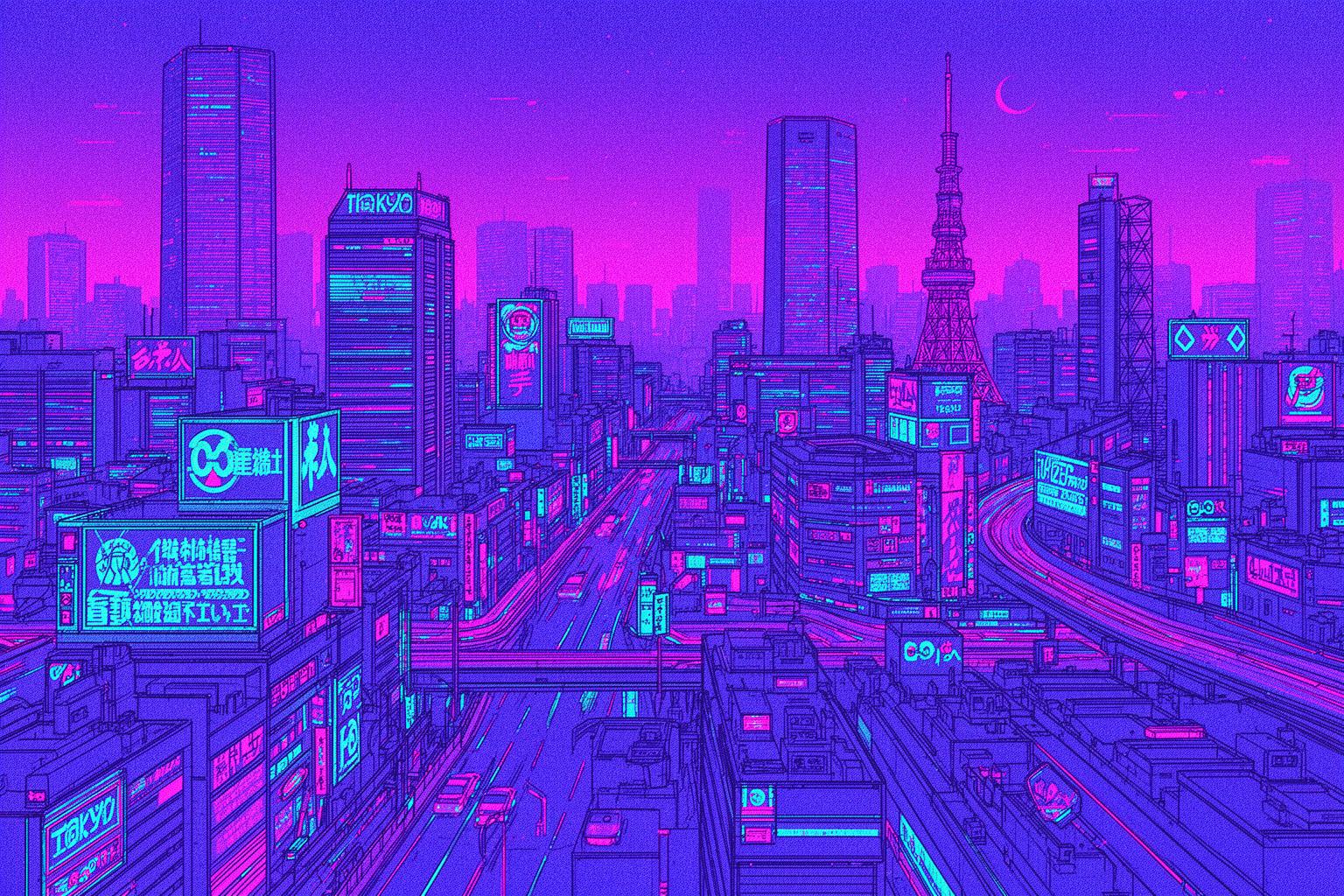
Why does this blend of 80s Japanese music and 90s Japanese cars resonate so deeply, even with those who didn’t live through that era? It’s more than just cool sounds and fast cars—it goes much deeper.
It taps into a powerful kind of nostalgia called “anemoia”—a longing for a time you’ve never experienced. City Pop represents the future as envisioned by the past: a future of sleek technology, urban glamour, and endless economic growth. When you sit in a JDM car from that same period, a marvel of analog engineering, you’re essentially piloting a relic from that very future. You’re driving through the world that the music dreamed of. Though the Bubble Era is long gone, for a few hours on a midnight cruise, you can resurrect its spirit. It’s a tangible connection to a lost utopia, a feeling both exhilarating and deeply moving.
There’s also the aesthetic of flow. The music is crafted to be smooth. Funky basslines, shimmering keyboards, a steady disco beat—they all create an effortless momentum. This perfectly mirrors the experience of driving on the expressway at night. You’re not stopping and starting; you’re in a continuous state of flow. The rhythmic passing of orange sodium lamps, the blur of neon signs, the steady hum of the engine—it all syncs with the music until car, city, and soundtrack become one seamless sensory experience. It’s a state of zen, a moving meditation where the outside world slips away, leaving only the road ahead and the groove in your ears.
Lastly, it’s about empowerment—embracing that main character energy. In everyday life, we’re often passengers. But behind the wheel of a GT-R, with the Tokyo skyline spread before you and Tatsuro Yamashita playing on the stereo, you’re the director, star, and audience of your own private film. It’s a potent feeling of freedom and control, a temporary escape into a perfectly crafted reality. You’re not merely observing Tokyo; you’re an active participant in its nocturnal dance. You add your own story, your own moving light, to the city’s grand tapestry.
This experience is more than just a drive. It’s a pilgrimage to a very specific aesthetic Mecca. A conversation with the ghosts of the Bubble Era, a tribute to a golden age of Japanese creativity. A way to connect with the deep, technological, and often lonely soul of Tokyo. So next time you find yourself in this amazing city, wait until after midnight. Find your soundtrack, find your machine, and go for a ride. The city is ready to share its secrets, and this is the only way to truly hear them. It’s a vibe that lingers long after the engine cools and the music fades. Trust me—it just hits different.