You’ve seen the images, I’m sure. The Blade Runner cityscapes of Tokyo and Osaka, the rivers of people flowing through Shibuya Crossing, the bullet trains slicing through the landscape with silent, surgical precision. Japan is the future, or at least one version of it. It’s a place of breathtaking efficiency, relentless innovation, and a work culture so demanding it has its own word for death by overwork. For decades, the story of modern Japan has been one of urbanization, of people pouring from the countryside into concrete canyons, trading green fields for glowing screens.
But what happens when that relentless forward momentum starts to take a toll on the human spirit? What’s the antidote to a society running on fumes? The answer, as it so often does in Japan, came not from some new technology, but from a profound, and newly scientific, return to the old ways. It came from the forest.
They call it shinrin-yoku, or “forest bathing.” And if that sounds a bit whimsical, a little too much like a wellness influencer’s hashtag, you’re only getting half the story. This isn’t just a poetic name for a nice walk in the woods. In Japan, shinrin-yoku is a formal, government-promoted, medically-researched practice. It’s a pillar of preventative medicine, a prescription written not on a pharmacist’s pad, but on the landscape itself.
The fascinating question isn’t whether spending time in nature is good for you—we all intuitively feel that it is. The real story is how and why Japan took this universal human experience and systematically transformed it into a field of scientific inquiry and a national public health strategy. It’s a story about a country reckoning with the consequences of its own success, and in doing so, creating a blueprint for the rest of the burned-out world. To understand shinrin-yoku is to understand a core paradox of modern Japan: a society that looks to the future for its technology, but to the ancient past for its salvation.
This shift towards nature as a national health strategy can be seen as part of a broader evolution in how Japan interacts with its environment, a journey that includes the post-war era where weekend driving became a national hobby.
The Birth of a Modern Prescription
The story of shinrin-yoku as we understand it today doesn’t originate from an ancient temple or a poet’s journal. Instead, it begins in an office in 1982 at the Japanese Ministry of Agriculture, Forestry, and Fisheries). This detail is crucial. The concept was not a grassroots movement emerging from the people; it was a deliberate, top-down response to a growing national crisis.
A Remedy for a Nation on the Edge
To understand why the government chose to prescribe nature, one must grasp Japan in the 1980s. The country was at the height of its post-war economic miracle, known as the “bubble economy.” The world marveled as Japanese corporations appeared to dominate globally. Yet, within the country, the human cost was becoming alarmingly evident. A culture of extreme work hours was standard. The “salaryman,” loyal to his company above all else, was both a hero and a warning. He endured punishingly long workdays, brutal commutes on packed trains, and obligatory evening drinking sessions with colleagues and clients. The pressure was immense.
This caused a rise in stress-related autoimmune diseases, hypertension, and mental health disorders. Most disturbingly, it led to karoshi—death from overwork. People, often in the prime of life, were literally dying at their desks from strokes and heart attacks caused by severe stress and exhaustion. Meanwhile, rapid urbanization was increasingly disconnecting the population from the natural environments that had shaped Japanese culture for centuries. The nation grew wealthier, but its people grew sicker.
The Ministry of Forestry saw a dual opportunity. Charged with managing Japan’s vast forests, which cover nearly 70 percent of the country’s land, they sought to encourage people to value and visit these forests while addressing the public health crisis. Their solution was shinrin-yoku. By naming the simple act of being in a forest and framing it as a health practice, they aimed to provide a straightforward, accessible, and cost-effective remedy for the ailments of modern urban life.
From Traditional Wisdom to Scientific Proof
For the first decade, shinrin-yoku remained a charming yet somewhat vague idea. It was promoted as a means to relax and reduce stress, based more on intuition than on evidence. This shifted dramatically in the 1990s and early 2000s as Japanese scientists began rigorously studying its effects. Japan respects data, and for forest bathing to gain serious recognition as a medical intervention, it needed scientific backing.
Researchers such as Dr. Qing Li, a physician and immunologist at Nippon Medical School in Tokyo, became leaders in this emerging field. They didn’t simply ask if people felt better after a walk in the woods; they examined what was happening to their bodies on a cellular level. They divided subjects into groups: one walked in the city, another in the forest, with detailed measurements taken before, during, and after.
The findings were remarkable and gave shinrin-yoku the scientific credibility it required. They uncovered several key biological mechanisms at work.
First, they highlighted the role of phytoncides—volatile organic compounds that trees and plants release to protect themselves from insects and decay. When humans inhale these aromatic substances—responsible for the distinct “forest smell”—it triggers a significant response in the body. Dr. Li’s research showed that breathing in phytoncides substantially increases the number and activity of Natural Killer (NK) cells, a crucial component of the immune system that seeks out and destroys infected or cancerous cells. After a three-day, two-night forest bathing trip, participants’ NK cell activity rose by more than 50 percent, with this boost lasting over 30 days.
Second, scientists measured stress hormones and found that time spent in a forest significantly lowered cortisol and adrenaline—the body’s main stress markers. Participants’ heart rates slowed, blood pressure dropped, and their nervous systems shifted from stress to relaxation.
The science was definitive: forests are not merely beautiful scenery. They are active chemical and sensory environments that directly enhance our physiological health. This research marked a turning point, transforming shinrin-yoku from a pleasant leisure activity into evidence-based medicine.
The Anatomy of a Forest Bath
One common misconception about shinrin-yoku is that it’s simply another term for hiking. This overlooks the entire concept. Hiking often focuses on exertion and reaching a destination—a summit, waterfall, or scenic overlook—with an emphasis on doing. In contrast, forest bathing centers on being. It is a slow, unhurried, and mindful immersion of the senses.
It’s an Immersion, Not a March
The aim of a forest bath is not to travel far but to connect with the environment through all five senses. It’s a conscious slowing down. Phones are turned off or left behind. There’s no route to conquer or time to beat. A typical forest bath might cover just a couple of kilometers spread over several hours.
The practice involves intentionally engaging with your surroundings:
Sight: You’re invited to notice details you might usually overlook—the intricate patterns of moss on rocks, the way sunlight filters through the canopy (komorebi, the specific Japanese term for this phenomenon), and the subtle range of greens in the leaves. It’s about allowing your soft-focus gaze to drift rather than staring intently at a trail.
Sound: You listen attentively—to the rustling leaves in the wind, the snap of twigs underfoot, the calls of various birds, and the hum of insects. Importantly, you also attune to the silence—the absence of traffic, sirens, and the urban din.
Smell: This is where phytoncides come into play. You breathe deeply, taking in the rich, earthy scent of soil, damp wood, pine needles, and the fresh, oxygen-rich air.
Touch: You might be encouraged to feel the rough bark of a tree, the cool surface of a stone, the soft springiness of moss, or dip your hands into a cold, clear stream.
Taste: While you typically aren’t eating forest plants, this sense is engaged by perceiving the clean freshness of the air or sipping water from a pure forest spring. It’s a metaphorical tasting of the forest’s vitality.
This slow, sensory journey is designed to pull you away from your busy mind, your recurring worries and to-do lists, and ground you fully in the present moment. Essentially, it is a form of walking meditation.
The Infrastructure of Wellness
True to its reputation, Japan didn’t leave this practice to chance. If shinrin-yoku was to serve as therapy, it required infrastructure. The Forestry Agency and the Forest Therapy Society, a non-profit organization, established a nationwide network of certified “Forest Therapy Bases” and “Forest Therapy Roads.”
These aren’t just any woods. To earn certification, a forest must be scientifically verified as having therapeutic effects. Researchers visit candidate sites and conduct experiments with human participants, measuring cortisol levels, blood pressure, and other biomarkers before and after a walk. Only forests that show a significant, measurable reduction in stress receive official designation.
Today, over 60 certified Forest Therapy Bases exist across Japan. These centers represent the gold standard of the shinrin-yoku experience. They offer guided programs led by trained professionals who are part forester, part therapist. These guides don’t merely lead walks; they instruct on engaging the senses, facilitate mindfulness exercises, and explain the science behind the practice. Many centers even provide pre- and post-walk health assessments, allowing participants to observe personal improvements—like lowered blood pressure—offering tangible proof of the forest’s healing effects.
This structured method is crucial. It eliminates guesswork and provides a clear, accessible path for overworked city dwellers to access these benefits. It’s a system that says, “You’re exhausted and overwhelmed. Come to this specific place, follow this particular approach, and you will feel better. We have the data to confirm it.”
The Cultural Soil: Why Shinrin-yoku Flourished in Japan
Scientific validation and government support are essential elements of the story, yet they do not fully explain why the concept of shinrin-yoku resonated so deeply with the Japanese public. The idea spread rapidly because the cultural environment was already rich, nurtured by centuries of spiritual and aesthetic traditions that placed nature at the heart of life.
Ancient Roots, Modern Application
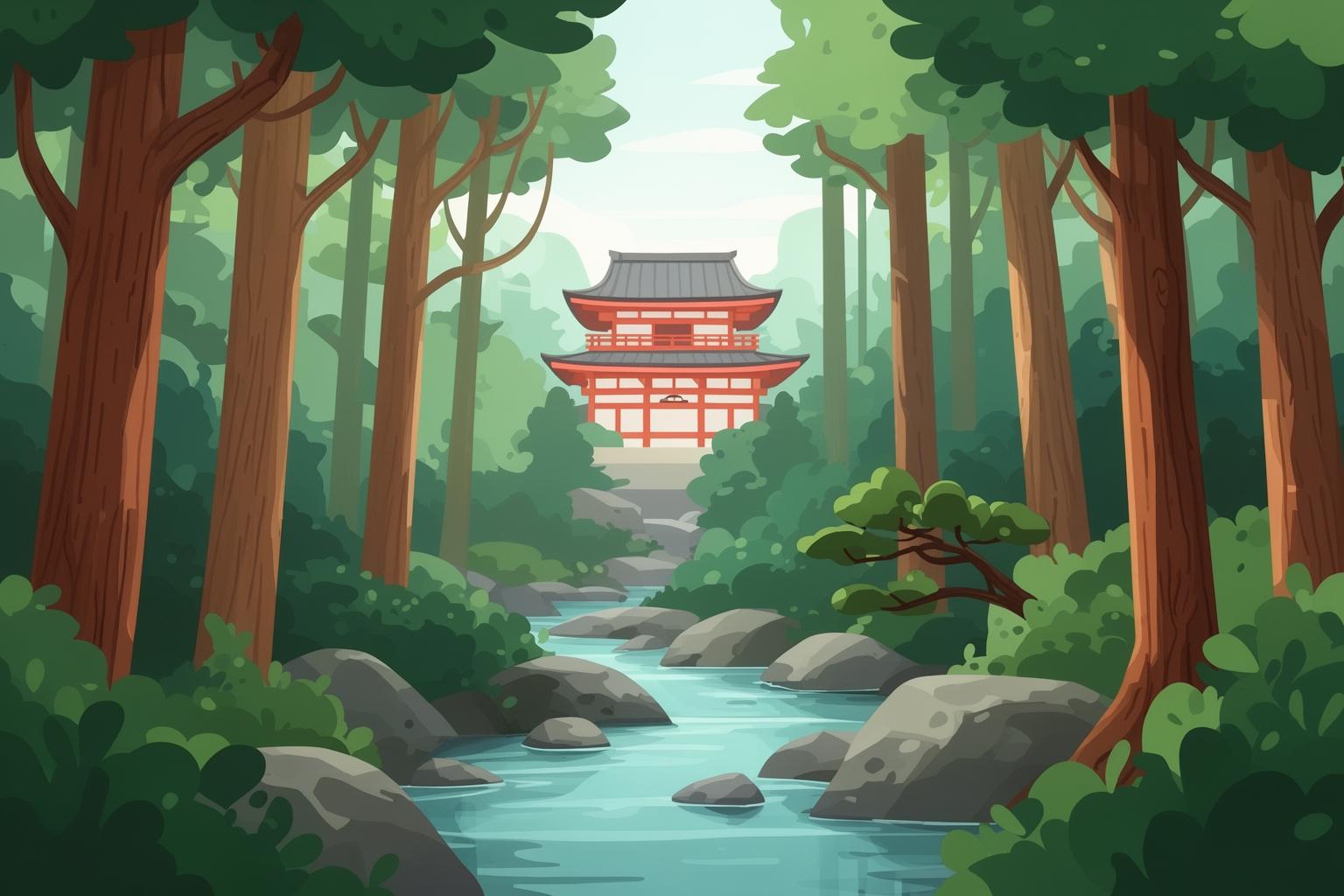
Although the term shinrin-yoku is contemporary, reverence for forests is ancient. In Shinto, Japan’s indigenous religion, nature itself is sacred. Deities, or kami, are believed to inhabit natural phenomena—mountains, rivers, waterfalls, and especially great old trees (shinboku), often marked with sacred ropes (shimenawa). Forests are more than mere groups of trees; they are considered the homes of the gods, spaces imbued with profound spiritual power and purity. For centuries, Japan’s most sacred sites, such as the Ise Grand Shrine, have been situated in deep, ancient forests. This enduring belief means that for Japanese people, entering a forest has always held more significance than a recreational activity; it carries subtle spiritual meaning.
Buddhism, introduced to Japan in the 6th century, added further depth. Zen Buddhism, in particular, with its focus on mindfulness, meditation, and achieving enlightenment in the present moment, aligns closely with the principles of shinrin-yoku. The practice of attentively and mindfully observing one’s surroundings forms a key aspect of Zen. Many renowned temples are set within carefully designed gardens and natural landscapes meant to encourage contemplation. Shinrin-yoku can thus be viewed as a secular, medicalized adaptation of these ancient spiritual traditions. It takes the essential tenets of Shinto reverence and Zen mindfulness, removes explicit religious elements, and translates them into the modern, accessible language of health and wellbeing.
The City and the Longing for Nature
Japanese culture is characterized by a striking aesthetic duality. On one side, it has created some of the world’s most densely populated, technologically advanced, and highly artificial urban settings. On the other, it sustains a deep and subtle appreciation for nature, or shizen. This appreciation extends beyond vast landscapes to finding beauty in small, fleeting moments—the brief bloom of cherry blossoms, the hues of autumn leaves, the sound of a cicada.
Traditional arts such as ikebana (flower arranging), bonsai (miniature trees), and Japanese garden design all aim to incorporate nature into human life in a controlled, curated, and highly aesthetic manner. Shinrin-yoku represents the natural continuation of this impulse. It involves immersing oneself entirely in the very environment those arts seek to capture on a small scale. The intense pressure and sensory overload typical of city life in Japan fuel a strong cultural yearning for its opposite: the calm, natural, and restorative embrace of the natural world.
The Logic of the Prescription
Lastly, framing shinrin-yoku as a “prescription” with certified “therapy” locations fits neatly within the Japanese cultural framework. There is widespread respect for systems, clear guidance, and expert advice. In a population shaped by a demanding work culture where time is scarce, the idea of merely “going for a walk” can seem trivial or inefficient.
However, presenting it as a structured, evidence-based health treatment legitimizes the practice. It allows people to feel authorized to take time off and unwind. It is not indulgence; rather, it is preventative medicine. This systematic approach—with certified guides, scientifically validated sites, and measurable health benefits—resonates with a pragmatic mindset. It offers a definite, trustworthy method for achieving a desired outcome, transforming the abstract concept of “relaxing in nature” into a clear, actionable plan.
Forest Bathing in the Wild and its Global Journey
So, what does this look like in practice? Picture a day spent at a place like the Akasawa Natural Recreational Forest, where shinrin-yoku was born. You might arrive by train, watching the scenery turn progressively greener as you leave the city behind. You meet your guide—not a rugged mountaineer, but a calm, knowledgeable professional who may begin by checking your blood pressure.
The walk itself is leisurely. The guide doesn’t lecture you on tree species but encourages you to observe. “Please find a spot to sit for fifteen minutes,” they might say. “Just listen.” Later, they could lay out yoga mats and invite the group to lie back and gaze up at the forest canopy, a practice called a “canopy bath.” There might be tea brewed with local herbs or simple breathing exercises. The entire experience is designed to maximize sensory input and quiet mental chatter. At the end, your blood pressure is measured again, and almost always, it’s lower. You don’t just feel better; you have the data to confirm it.
This powerful blend of ancient wisdom and modern science has become an influential export. Over the last decade, the idea of forest bathing has spread worldwide. Organizations in the United States, Europe, and beyond now train and certify their own forest therapy guides, explicitly basing their programs on Japanese research. Doctors in other countries are starting to write “nature prescriptions” for patients coping with stress, anxiety, and depression.
What the world has taken from Japan is that while nature’s healing power is universal, the Japanese contribution was to give it a name, a method, and a solid scientific foundation. They offered a language and framework that allowed intuitive folk wisdom to be respected by modern medicine and public health institutions.
Ultimately, shinrin-yoku is a deeply Japanese answer to a universal contemporary challenge. It’s the story of a nation that pushed urban industrialization to its limits and then wisely turned back to its oldest resource for healing. It reveals a culture that recognizes the most advanced technology we’ll ever have is the complex biological system of the human body, and that the most powerful medicine may not come in a pill, but from the simple, silent, and generous chemistry of the forest. In a world growing louder, faster, and more intangible, Japan’s prescription is a reminder that sometimes the most radical act of self-care is simply to slow down, go outside, and breathe.