Yo, what’s the deal with all the abandoned spots in Japan? For real. You scroll through social media and see these hauntingly sick photos of crumbling theme parks, deserted islands, and schools being swallowed by forests. In a country famous for being super clean, high-tech, and organized, the sheer number of these decaying places, or ‘haikyo’ as they’re called, feels like a major plot twist. The weirdest part? The vibe isn’t always creepy or depressing. A lot of the time, it’s… kinda beautiful. It hits different. There’s this strange, quiet sadness to it, a melancholic beauty that makes you stop and just feel things. If you’ve ever felt that and wondered, “Am I weird for finding this pretty?” or “Why does Japan just let these places rot?”—you’ve stumbled upon a core aesthetic of Japanese culture. This feeling has a name: ‘Mono no Aware’ (物の哀れ). It’s this deep, gentle awareness of the transience of things, the bittersweet reality that everything is temporary. It’s not about being sad that things end; it’s about appreciating the beauty of their fleeting existence. This isn’t just about ‘ruin porn’ or urban exploration. It’s a full-on cultural lens that changes how you see the world. We’re about to do a deep dive into why these ruins exist, what ‘mono no aware’ actually feels like, and how it transforms these forgotten places from tragic symbols of decay into profound monuments of time, memory, and nature’s inevitable comeback. It’s a journey into the heart of why Japan can feel so modern and ancient all at once.
To see this concept in action through the lens of urban exploration, consider the experiences of those who go hunting for modern ghosts in Japan’s haikyo.
The Ghost in the Machine: Why So Many Ruins?
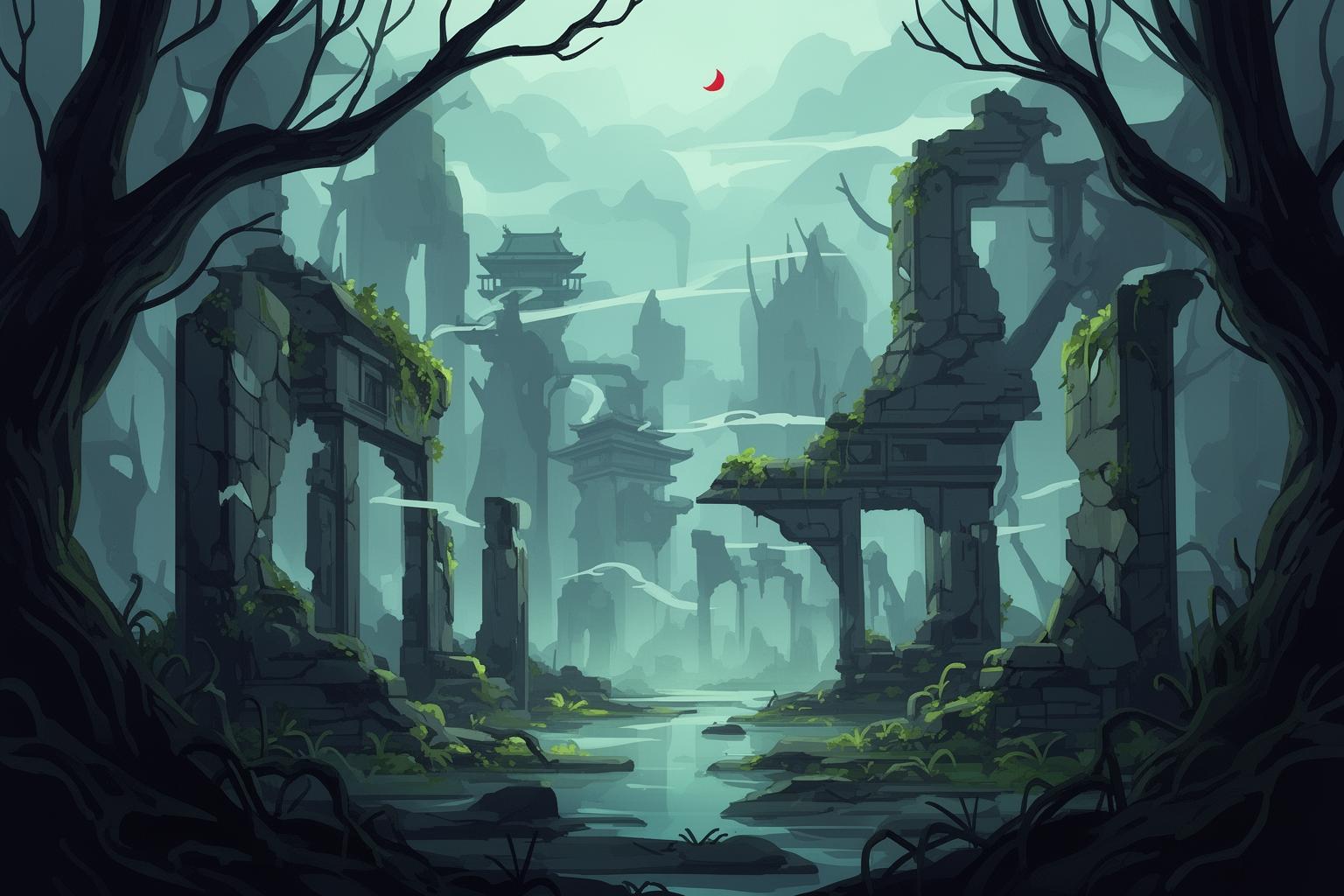
Before diving into philosophical musings, let’s ground ourselves in reality. The vast number of ruins in Japan isn’t simply due to everyone contemplating impermanence. There are concrete, practical reasons behind this abandoned landscape. It’s a tale of ambition, demographics, and rigid laws that created a perfect storm, leaving a trail of silent, decaying structures throughout the archipelago. Grasping this context is essential because the ‘mono no aware’ sentiment is intensified by the very contemporary and relatable causes for these places being deserted. These aren’t ancient castles from a forgotten era; many are recent ghosts you can almost reach out and touch.
The Bubble Burst and the Lost Decades
First, you need to understand the 1980s. Japan’s economic bubble was unprecedented. The country was awash with cash, as stock market and real estate prices soared to incredible heights. There was an infectious, almost delirious optimism that the boom was endless. With all this money flowing, what did companies do? They built—often recklessly. This wasn’t just practical development; it was pure extravagance. We’re talking sprawling, outrageously lavish ski resorts in areas with little snow, enormous fantasy-themed amusement parks in the middle of nowhere, grand hotels, and exclusive golf courses with hefty membership fees. It was a national display of economic power—a spree of monumental construction celebrating Japan’s global success.
Then, in the early 1990s, the bubble didn’t just deflate—it burst violently. The stock market crashed. Real estate values plummeted. The never-ending flow of money disappeared overnight. The shock was tremendous. Half-finished resorts were abandoned mid-construction, their concrete skeletons exposed to the elements. Newly opened theme parks suddenly had no paying visitors. Many lasted a few more years before quietly shutting down, leaving behind fiberglass castles and rusting roller coasters. This triggered what is now called the “Lost Decades,” a long era of economic stagnation. There was no money and no incentive to demolish these massive failures. Demolition costs were prohibitive, especially in a market with no demand. So, they simply stood abandoned. These ruins serve as tangible scars of a national dream that vanished, making them powerful symbols of hubris and the fleeting nature of wealth.
The Demographic Double-Whammy
While the bubble’s collapse explains the dramatic, large-scale ruins, a quieter but more widespread force accounts for the thousands of abandoned houses (‘akiya’), schools, and clinics, especially in rural areas (‘inaka’). This is the demographic crisis: an aging population combined with one of the lowest birth rates worldwide. For decades, young people have been leaving rural hometowns en masse, drawn by the allure of major cities like Tokyo and Osaka for education and careers. They start new lives, form families (or not), and rarely return.
What happens to the towns they leave behind? They slowly hollow out. Local shops shut down. The community grows older. Eventually, the elderly pass away, leaving homes empty. These aren’t just buildings; they are family homes filled with memories, photos, and furnishings from a lived life. But there’s often no one to inherit them, or heirs living in cities have no reason to maintain a distant house. The same fate happens to local infrastructure—the elementary school, once filled with children’s laughter, closes as student numbers dwindle. The clinic and town hall become obsolete. This isn’t a sudden collapse but a gradual fading, a community quietly aging into obsolescence. This slow decline is a profound source of ‘mono no aware,’ as these places didn’t end violently but simply ran out of people, their purpose slowly slipping away like sand through an hourglass.
The Stubbornness of Land Ownership
So why not just demolish all these empty houses and buildings? Here, Japanese laws and social customs complicate matters. It’s often incredibly complex and costly to remove an old building. For one, property taxes can be a significant deterrent. In many municipalities, the tax on an empty plot of land is much higher—sometimes up to six times—than on a plot with a building, even if that building is deteriorating. For an owner living far away with no plans for the land, it’s cheaper to let the rundown house stand and pay the lower tax.
Moreover, inheritance laws can create legal entanglements. When an owner dies, the property may be divided among several children or grandchildren. To sell or demolish it, the agreement of every heir is required. Locating all relatives—some of whom may never have seen the property—and getting unanimous consent can become a bureaucratic nightmare. If even one person objects or can’t be found, the property remains in legal limbo. In a culture that often avoids direct confrontation, pushing the issue can be socially uncomfortable. The easiest path is to do nothing. Thus, houses stand, schools decay, and hotels crumble—not only because of economic or demographic factors but because of legal and cultural inertia that favors letting things fade away over actively erasing them.
Beyond Decay: Finding Beauty in the Breakdown
Alright, so the practical factors are clear: economic collapse, a declining population, and stubborn laws. This clarifies the ‘what’ and ‘why’ behind the existence of ruins. However, it doesn’t explain why these ruins resonate so deeply or why they can evoke such profound beauty. Here is where cultural context—the aesthetic programming—comes into play, enabling people to perceive more than just decay and neglect. It involves fully immersing oneself in the feelings of ‘mono no aware’ and its close counterpart, ‘wabi-sabi.’ These concepts are keys to unlocking the emotional world of a Japanese ruin, transforming a heap of rubble into poetry.
The Actual Feeling of ‘Mono no Aware’
The phrase ‘mono no aware’ (物の哀れ) is notoriously difficult to translate precisely. ‘Mono’ means ‘things,’ while ‘aware’ signifies an emotion, pathos, or sadness. Hence, ‘the pathos of things’ is a common translation, but it sounds rather academic and dry. What it truly feels like is a deep, empathetic sigh towards the universe. It’s the quiet recognition that everything—a cherry blossom, a summer trip, a friendship, a life, a skyscraper—has a beginning, middle, and end, and the beauty is inseparable from that transience.
Think of the sensation you get watching the final sunset of summer. The colors are profoundly beautiful, yet tinged with a gentle sadness because it marks the end of a season. It’s not a sorrowful tragedy, but a sweet, melancholic pang—that is ‘mono no aware.’ Or consider gazing at an old, faded photo of your grandparents when they were young and in love. You feel warmth for their happiness, layered with the knowledge that the moment is permanently past. This complex, bittersweet emotion captures its essence. When observing an abandoned school, ‘mono no aware’ goes beyond ‘It’s sad that it’s closed.’ It evokes hearing echoes of laughter in the hallways, imagining children playing in the yard, and appreciating the life the building once held, all while fully aware that this chapter has ended. Peeling paint and dusty desks aren’t signs of failure; they embody the passage of time, containing profound, serene beauty. It represents acceptance, not denial, of life’s cycles of birth and decay.
Nature’s Reclamation: A Shinto Resonance?
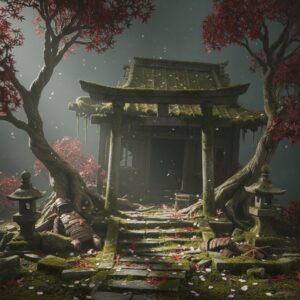
This feeling intensifies with one of the most visually striking features of Japanese ruins: nature reclaiming them. Ivy breaking through a window, moss blanketing a collapsed roof, a cherry tree blossoming in a deserted factory courtyard—this is seen not as destruction but as a powerful and beautiful process rooted deeply in Japan’s indigenous Shinto beliefs.
Shinto lacks a central god or holy scripture like many Western faiths. Instead, it is an animistic tradition that regards divinity, or ‘kami’ (神), as present in all elements of nature. ‘Kami’ inhabit majestic mountains, ancient trees, flowing rivers, and even unique stones. Nature itself is sacred and alive. From this cultural standpoint, when a human-built structure is abandoned and nature starts reclaiming it, this isn’t a tragedy, but a restoration of balance. It is the ‘kami’ of the forest, vines, and moss reclaiming their space after humanity’s temporary intrusion. The concrete apartment blocks of Gunkanjima, battered by typhoons, are disciplined by the ‘kami’ of sea and sky. The rusting roller coaster at Nara Dreamland, swathed in greenery, is embraced and absorbed by the ‘kami’ of the forest. This view transforms scenes of decay into sacred, cyclical renewal, creating remarkable visual harmony—harsh, geometric architecture softened and dismantled by wild, organic nature. It is a collaboration between the temporary and the eternal, resulting in a scene that feels not only beautiful but somehow inherently ‘right.’
Wabi-Sabi: The Companion to Mono no Aware
If ‘mono no aware’ is the emotional reaction to impermanence, ‘wabi-sabi’ (侘寂) is the aesthetic that finds beauty in the physical traces of that impermanence. The two concepts are closely linked, though ‘wabi-sabi’ emphasizes the material qualities of things. ‘Wabi’ originally referred to the solitude of living in nature, removed from society, while ‘sabi’ means ‘chill’ or ‘withered.’ Over time, they have come to define an aesthetic that celebrates beauty that is imperfect, impermanent, and incomplete.
This contrasts sharply with the classical Western ideal of beauty, which often values symmetry, flawlessness, and grandeur. ‘Wabi-sabi’ embraces the opposite. It sees beauty in a cracked and repaired teacup (‘kintsugi’), the asymmetry of a hand-crafted pot, rust on an iron gate, or the grain of weathered wood. These imperfections aren’t defects; they are marks of authenticity—evidence of the object’s journey through time. They tell stories. Ruins embody ‘wabi-sabi’ perfectly. Peeling paint reveals layers of former colors. Cracks in concrete show the stresses the building has endured. Rust patterns on metal signs are unique artworks shaped by years of sun and rain. A ‘haikyo’ explorer isn’t simply seeking grand scale but often focuses on these small, imperfect details—appreciating the texture of decay, the subtle shades of mold, and the way light filters through a broken roof. This perspective permeates Japanese culture, from Zen gardens that imitate nature’s rugged beauty to bonsai trees celebrating age and asymmetry. When applied to ruins, ‘wabi-sabi’ transforms them from failed structures into objects that have attained a deeper, more profound beauty through the very process of deterioration.
Case Studies in Ephemerality: Reading the Stories of Ruins
To truly grasp the atmosphere, you need to focus on specific locations. Each ruin shares a unique story and conveys a distinct sense of ‘mono no aware.’ These are not just interchangeable ruins; they are silent narrators, repositories of particular dreams and periods. Learning to ‘read’ them is akin to hearing the whispers of Japan’s recent past. Let’s delve into a few iconic examples that highlight various aspects of this fleeting beauty.
The Island Fortress: Gunkanjima (Hashima Island)
Gunkanjima, meaning ‘Battleship Island,’ is arguably the most renowned ‘haikyo’ in Japan, and deservedly so. It’s a breathtaking sight. From afar, the cluster of decaying concrete towers resembles a warship cutting through the sea. Up close, it’s a ghost town. From the late 19th century until 1974, this tiny island buzzed as an undersea coal mining facility owned by Mitsubishi. It was one of the world’s most densely populated areas, a self-contained city with apartments, schools, a hospital, and a cinema—everything crammed onto a rock in the ocean. It symbolized Japan’s rapid, voracious industrial growth and modernization.
When coal depleted and petroleum took over as the dominant energy source, the mine shut down. Evacuation was swift; within weeks, more than 5,000 people left, abandoning a city frozen in time. Today, tours are available (though only to limited and safe areas), offering a surreal glimpse. You’ll find 1970s-era televisions still resting in apartments, bottles and newspapers scattered on tables, and a doctor’s examination chair left in a ruined clinic. The sense of ‘mono no aware’ here is dense and heavy. This isn’t an ancient ruin from centuries ago; it’s a modern city that lived intensely and died within our parents’ or grandparents’ lifetimes. The speed of its rise and fall is staggering. It stands as a powerful, almost violent reminder of how quickly entire ways of life, entire concrete worlds, can become obsolete. The relentless assault of salty winds and typhoons steadily erodes the structures, a testament to nature’s ultimate supremacy over human ambition. Gunkanjima’s beauty is harsh, stark, and deeply disturbing—a cautionary tale etched in crumbling concrete.
The Forgotten Playground: Nara Dreamland
If Gunkanjima commemorates industrial ambition, Nara Dreamland embodies bubble-era consumer fantasy. Opened in 1961, it was a blatant, nearly lawsuit-worthy imitation of Disneyland in California, complete with Main Street U.S.A., a fantasy castle, and similar themed areas. For decades, it thrived as a destination of manufactured joy and family memories. Yet, with the launches of Tokyo Disneyland and later Universal Studios Japan, this homegrown copy couldn’t keep up. Its popularity declined, and it closed in 2006.
Due to high demolition costs, it was left to decay for a decade, becoming legendary among ‘haikyo’ explorers. Photos from this time are iconic: a pastel-pink castle with peeling paint and shattered windows; the massive wooden rollercoaster ‘Aska’ slowly swallowed by green vines and weeds, its tracks twisting through trees like a serpent’s skeleton. The atmosphere here starkly contrasts with Gunkanjima’s. This is the ‘mono no aware’ of faded joy. Theme parks are designed for sound—the screams of thrill-seekers, cheerful music, children’s laughter. Walking through it in silence is profoundly eerie. Each decaying ride and faded mascot is a ghost of a forced smile. Nara Dreamland speaks to the transience not only of industry but of dreams themselves—the corporate dream of capitalizing on trends and personal dreams of weekend happiness. Nature’s reclamation here feels gentler, a slow muffling of artificial cheerfulness under a green, organic melancholy. The park was demolished in 2016, but its memory as a premier ‘haikyo’ site perfectly captures the bittersweet beauty of forgotten fun.
The Silent Classrooms: Abandoned Rural Schools
Not all ‘haikyo’ are grand, dramatic statements like a deserted island city or theme park. Some of the most affecting ruins are the thousands of small, abandoned schools (‘haikou’) scattered across rural Japan. These places tell a more intimate and often sadder story. As mentioned, due to demographic decline in the countryside, schools in once-vibrant farming or fishing villages faced dwindling student numbers until they ultimately closed.
Visiting one of these schools is a deeply personal experience. Often, you find things left exactly as they were on the final day—textbooks and notebooks open on desks, children’s drawings of flowers and families still taped to the walls, a calendar marked with the last month of operation. In the gym, a deflated volleyball lies in a corner; scuff marks remain on the floor from the final assembly. In the music room, a grand piano gathers dust, its keys silent. The ‘mono no aware’ here is specific and profoundly relatable. It’s not about the collapse of an industry or company, but the end of a community’s future. A school is the heart of a small town, its center of hope. When the school closes, so does the town’s future. These spaces hold a quiet tragedy that strikes deeply. Seeing a tiny shoe left by an entryway or a name chalked on a blackboard evokes an almost unbearable loss—not for a forgotten past, but for a future that never arrived for that place. It’s the beauty of intimate, personal histories gradually reclaimed by the silence of time.
The Modern “Haikyoist”: Explorer or Voyeur?
This fascination with ruins has given rise to an entire subculture of explorers, often referred to as ‘haikyoists.’ Equipped with cameras and a sense of adventure, they seek out these forgotten places to document them before they vanish entirely. This contemporary phenomenon prompts some intriguing questions. What fuels the urge to trespass into decaying worlds? Is it a respectful attempt to bear witness to ‘mono no aware,’ or has it become a hunt for provocative social media content? The truth, as always, lies somewhere in the middle.
The Ethics of a Fading World
The unspoken code among dedicated ‘haikyoists’ resembles the creed of wilderness explorers: “Take nothing but pictures, leave nothing but footprints.” Genuine enthusiasts consider themselves archivists or photographers, not looters or vandals. They take great care to preserve the site exactly as they found it, understanding that the powerful atmosphere of a ruin depends on its untouched state. Their aim is to capture the essence of a place naturally frozen in time—to document how dust settles on a book or how a curtain flutters in a broken window. For them, moving an object to improve a photo is a cardinal sin.
However, the growing popularity of ‘haikyo’ on platforms like Instagram has introduced a different dynamic. The emphasis can shift from quiet reflection to obtaining the most eye-catching, ‘banger’ shot. This can result in staged photos, increased traffic to fragile locations, and eventually, vandalism and theft by those who disregard the original principles. There is an inherent tension in modern ruin exploration. Documenting and sharing these places preserves their memory and allows many to appreciate their beauty vicariously. Yet, the same exposure can hasten their destruction. It draws unwanted attention, leading authorities to seal off entrances or owners to opt for demolition to avoid liability. The ‘haikyoist’ treads a delicate line between being a respectful mourner and an unwitting participant in the final erasure of the very places they cherish.
Why This Resonates Now
So why is this subculture flourishing today? What is it about our present moment that renders these decaying, silent places so compelling? Much of it likely stems from a reaction against our hyper-modern, relentlessly fast-paced, and thoroughly digital lives. We live in a world of constant upgrades and planned obsolescence, where last year’s device is already obsolete. Our social spaces are increasingly virtual, curated, and intangible. Everything moves quickly, cleanly, and efficiently.
‘Haikyo’ provides a powerful counterbalance. A ruin is unapologetically physical, real, and chaotic. It offers a tangible link to history and the slow, inevitable passage of time. In a world clamoring for your attention at every moment, a ruin extends a deep, enveloping silence. It urges you to slow down, to observe, to contemplate. It serves as a form of real-world meditation. Confronting a vast, decaying structure once teeming with human activity puts our own daily stresses and ambitions into humbling perspective. It’s a striking reminder that everything we build and strive for is temporary. Paradoxically, that realization can be both liberating and comforting. It embodies an acceptance of impermanence that feels genuine and grounding in a world often experienced as artificial and transient in a completely different way.
So, What’s the Takeaway?
Let’s return to the original question: why do these abandoned Japanese ruins feel so beautiful? It’s because they are far more than mere decaying structures. When seen through the cultural perspective of Japan, they take on new meaning. They are not symbols of failure but stages reflecting impermanence. The emotion they inspire, “mono no aware,” is a refined response that appreciates the bittersweet beauty in the natural cycle of growth, decay, and renewal. This aesthetic has been shaped over centuries by Shinto reverence for nature’s power and the “wabi-sabi” appreciation for imperfect beauty.
These ruins hold stories; each is a physical narrative telling a unique chapter of Japan’s history. Gunkanjima reveals the saga of industrial strength and its abrupt downfall. Nara Dreamland murmurs the tale of a nation’s fleeting consumerist fantasies. The quiet rural schools offer a mournful hymn of demographic shifts and the decline of countryside life. They make history tangible, emotional, and intimately personal.
For anyone visiting or seeking to understand Japan, observing a “haikyo” is not about gawking at decay. It’s an opportunity to witness a core aspect of the Japanese worldview in practice. It invites you to look beyond the polished, efficient exterior of modern Japan and connect with a much older, more reflective mindset. It teaches you to appreciate value not only in creation but also in dissolution. It’s a quiet lesson that everything has its season, and that there is a profound, resonant beauty in the final, graceful autumn before the winter of forgetting arrives.