Yo, what’s up, world travelers and culture seekers! Shun Ogawa here, ready to drop some serious knowledge on a place that’s low-key one of Japan’s most important historical hotspots. Forget what you think you know about ancient capitals. We’re diving deep into Dazaifu, the OG administrative heart of Kyushu, a city that for centuries was Japan’s front door to the Asian continent. This ain’t just some dusty old town with a couple of temples. Nah, Dazaifu is a whole mood. It’s a place where the weight of history feels real, where art and scholarship are literally in the air you breathe, and where a legendary scholar’s epic story continues to inspire millions. It’s the spiritual home for every student cramming for exams, a pilgrimage site for art lovers, and a ridiculously scenic spot to just soak up some profound Japanese vibes. Here, the whispers of poets, politicians, and priests from over a millennium ago mix with the buzz of visitors munching on freshly grilled mochi and the sleek, modern lines of a world-class museum. It’s a mashup of the sacred and the stylish, the ancient and the avant-garde. Before we get into the nitty-gritty of why this place is an absolute must-visit, get your bearings and check out the epicenter of Dazaifu’s energy right here.
The Legend of Michizane: Japan’s Patron Saint of Brainiacs
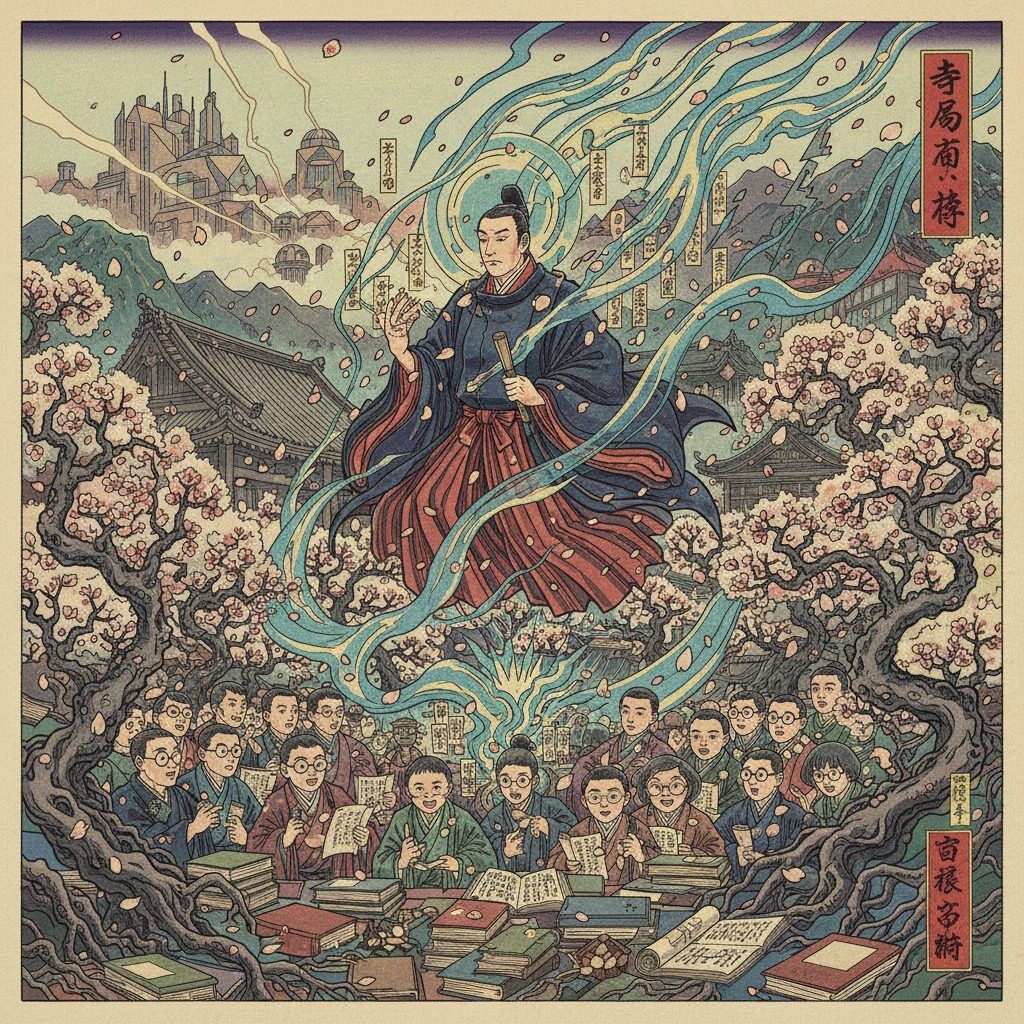
To truly understand Dazaifu, you need to know the story of one man: Sugawara no Michizane. This guy was a genuine star during the Heian period, a 9th-century legend. He was a brilliant scholar, an exceptional poet, and a high-ranking politician rapidly ascending the imperial court in Kyoto. He was basically at the peak of power, advising the emperor and challenging the status quo. But, as often happens, jealousy surfaced. The influential Fujiwara clan, envious of his rise, schemed against him. They framed him, spread false accusations, and charged him with plotting against the throne. The consequence? Michizane faced the ultimate downfall: exile. He was stripped of his rank and sent to Dazaifu, which at the time was seen as a remote outpost in Japan. It was a harsh and humiliating fall. Arriving in Dazaifu heartbroken and isolated, he was accompanied only by a few loyal followers. Legend has it he missed Kyoto—and especially his beloved plum tree—so deeply that he wrote a famous poem for it. The tree, responding to his call, supposedly uprooted itself and flew overnight from Kyoto to Dazaifu to be by his side. That tree, the legendary Tobiume or “Flying Plum Tree,” still blooms first each year at Dazaifu Tenmangu Shrine, symbolizing unwavering loyalty in a way that truly moves people. Michizane died in exile just two years later, his reputation still tarnished. But then things took a dramatic turn. After his death, a series of disasters—plagues, lightning strikes, and sudden deaths among his rivals—rocked the capital. The court, terrified, believed these were the acts of Michizane’s vengeful spirit, his onryo, seeking revenge. To calm his ghost, they posthumously pardoned him, restored his titles, and eventually deified him as Tenjin-sama, the heavenly god of scholarship, literature, and sincerity. Thus, Dazaifu, the place of his tragic exile, became the most sacred site of his worship. Today, Dazaifu Tenmangu is not just a shrine but a powerful legacy. It draws millions of students who come to pray for success in their exams, hoping to inherit some of Michizane’s brilliance. His story is a compelling tale of injustice, loyalty, and redemption—and it forms the spiritual heart of this entire city.
Dazaifu Tenmangu: More Than a Shrine, It’s an Experience
Walking toward Dazaifu Tenmangu offers a fully immersive sensory experience. The trip begins on the sando, the main approach—a lively pedestrian street lined with shops that have served pilgrims for centuries. The air is filled with the sweet, toasty scent of umegae mochi, the shrine’s signature treat, grilled over hot plates. The excited chatter of students, the calls of vendors, and the general buzz of purposeful activity create an electric atmosphere. Before reaching the main grounds, you must cross the Shinji-ike, a pond shaped like the Japanese character for “heart” (心). Spanning the pond are three bridges: a steep arched bridge called Taiko-bashi (symbolizing the past and its challenges), a flat bridge (Hira-bashi representing the present), and another arched bridge (Taiko-bashi again, symbolizing the future and its hopes). Crossing these is a purification ritual, a physical passage from the worldly to the sacred. Beyond the pond lies the inner sanctum. The grounds stretch out under thousands of plum trees—Michizane’s favorite—and ancient, gnarled camphor trees that seem to carry the wisdom of centuries in their massive trunks. One camphor tree is said to be over 1,500 years old, silently bearing witness to the shrine’s entire history. The main hall, or Honden, is a beautiful example of Momoyama-period architecture, featuring intricate carvings, gold leaf details, and a gracefully curved roof made of cypress bark. Rebuilt in 1591, it stands directly above Michizane’s grave. This is the spiritual heart of the shrine, a place where the concentrated energy of countless prayers can be felt. Visitors will see students writing wishes on wooden ema plaques, hanging them in hopes of passing entrance exams. Families celebrate, businesspeople pray for success, and tourists absorb the atmosphere. Be sure to look for the sacred ox statues scattered throughout the grounds. Legend says that rubbing the ox’s head brings blessings of knowledge and wisdom—that’s why their heads are so polished and smooth from millions of hopeful hands. The overall vibe combines solemn reverence with festive energy, creating a space that is both deeply spiritual and warmly welcoming.
Kyushu National Museum: Where History Gets a High-Tech Glow-Up

Just a short walk from the ancient grounds of Tenmangu, you’ll encounter a gateway to another world. A remarkably long, rainbow-lit escalator carries you through a tunnel and delivers you in front of one of Japan’s most stunning modern architectural feats: the Kyushu National Museum. The contrast is striking. You leave behind the traditional wooden structures and tranquil nature of the shrine, only to find yourself before a vast, flowing building of glass and steel, its wavy roof echoing the surrounding green hills. Opened in 2005, it was Japan’s first new national museum in over a century, with a mission as bold as its design. Unlike other national museums that focus exclusively on Japanese art, the Kyushu National Museum was created to explore Japanese culture through the lens of Asian history. Given Dazaifu’s historical role as a diplomatic and trade gateway to the continent, it is the perfect setting. The main exhibition hall is an expansive, fluid space called the “Cultural Exchange Exhibition.” It’s far from a dusty, static collection; instead, it offers a dynamic and interactive journey through time, illustrating how Japan’s culture was shaped by its exchanges with China, Korea, and the wider Asian region. You’ll encounter everything from prehistoric Jomon pottery to exquisite Buddhist art, samurai armor, and finely crafted ceramics that traveled along the Silk Road. The displays are extraordinary, utilizing cutting-edge technology to bring history to life. Visitors can engage with digital exhibits, watch high-definition videos that explain complex historical events, and closely examine national treasures. It’s a museum that feels alive—meant to be explored and experienced rather than just viewed. It serves as the perfect complement to the shrine, demonstrating that Dazaifu is not only about preserving the past but also about reinterpreting it and presenting it to a new generation in a fresh, engaging, and utterly impressive way. The passage through the illuminated tunnel from the shrine to the museum feels symbolic—like a journey from Japan’s spiritual heritage directly into its innovative future.
Digging Deeper: The OG Dazaifu Government Office Ruins
While Tenmangu Shrine serves as the heart of modern Dazaifu, to truly connect with the city’s original purpose, you need to visit the Dazaifu Government Office Ruins, or Dazaifu Seicho-ato. Just a short bus ride or a pleasant walk from the shrine area, this site offers an entirely different atmosphere. Here, you’ll discover a vast open park with a huge grassy field dotted by massive foundation stones. At first glance, it may seem unimpressive, but this is where your imagination should take flight. For five centuries, this was the political and military hub of all Kyushu. Imagine a sprawling complex of grand halls, gates, and corridors modeled after the imperial capital in Kyoto. This was the “Distant Imperial Court” (To-no-Mikado), where the governor-general held court, received foreign envoys from China and Korea, and planned defenses against potential invasions from the continent. It was the White House, the Pentagon, and the State Department of ancient western Japan combined. The enormous foundation stones give a sense of the power and prestige this place once held. Standing in the middle of the field, with the mountains as a backdrop, you can almost hear the echoes of officials in silk robes and the bustling activity of a busy administrative capital. To help you visualize it better, be sure to visit the Dazaifu Exhibition Hall (Dazaifu Tenjikan) located right next to the ruins. This small but excellent museum showcases artifacts excavated from the site and, most importantly, features a massive, detailed diorama of the government complex in its prime. Seeing the model brings the ruins to life, bridging the gap between the stones in the field and the magnificent city that once stood there. It’s a quieter, more reflective experience than the shrine—a place where history enthusiasts can fully immerse themselves and feel the deep, foundational layers of Dazaifu’s past.
Kanzeon-ji & Kaidan-in: The Spiritual Deep-Cuts
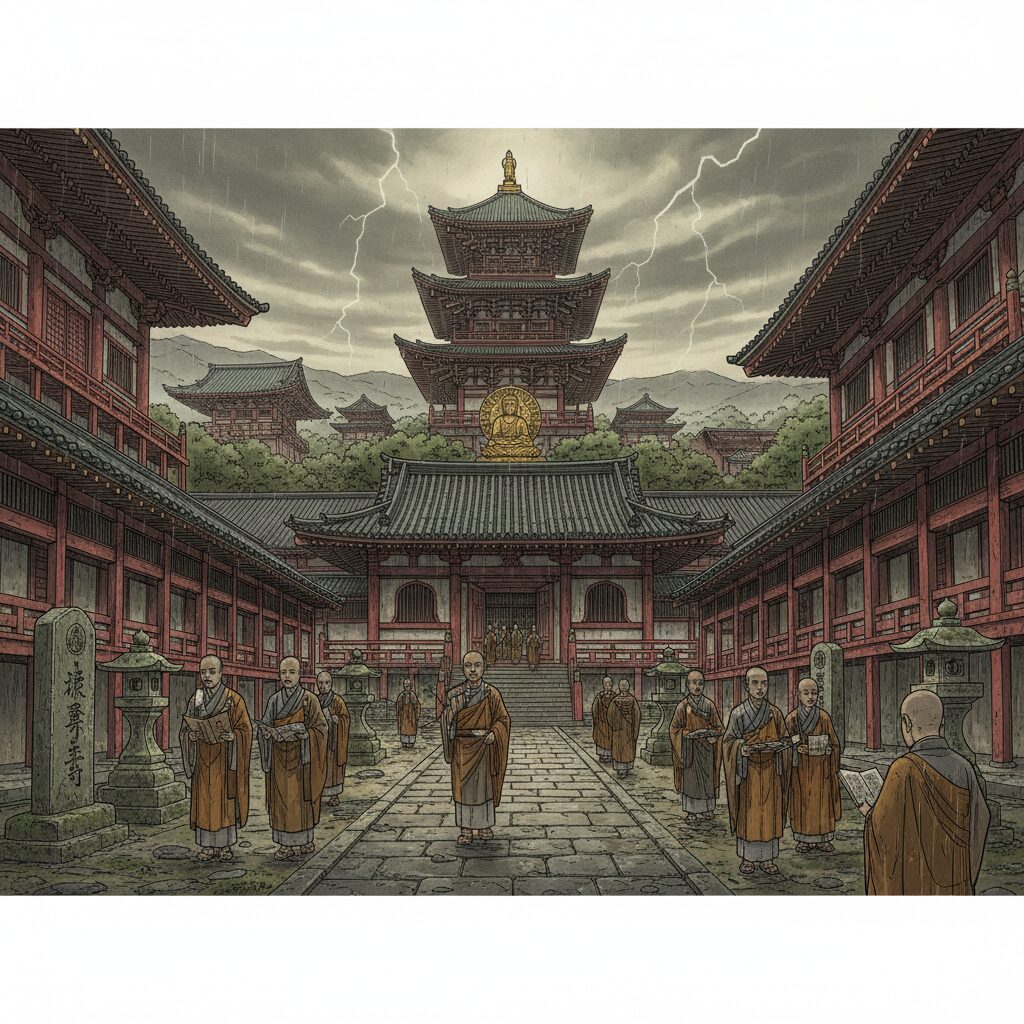
Just a stone’s throw from the government ruins lie two temples that are indispensable for anyone wishing to explore Dazaifu’s spiritual history in depth. Kanzeon-ji and Kaidan-in predate Tenmangu Shrine, representing an even earlier chapter in the region’s significance. Kanzeon-ji Temple was established in the 7th century by the emperor in honor of his mother. At one point, it was the most important temple in all of Kyushu. Although the original structures have been lost to fire and time, the temple’s Treasure Hall (Hōzō) remains stunning. It houses one of Japan’s most remarkable collections of classical Buddhist statues—a lineup of colossal wooden figures from the Heian and Kamakura periods, each designated as an Important Cultural Property or National Treasure. Entering the dimly lit hall feels like stepping into a celestial gathering. The statues, some soaring over five meters tall, are carved with extraordinary skill and serene expressions that make them seem almost alive. The air is thick with the fragrance of aged wood and incense, and the overwhelming artistic and spiritual presence of these figures creates a deeply moving experience. It’s a quiet, profound moment far removed from the bustling crowds at the shrine. Adjacent is Kaidan-in Temple, one of only three official ordination halls in Japan during the Nara period. Here, priests from western Japan came to be formally ordained into the Buddhist clergy, lending the site great religious authority. The present main hall is a reconstruction, but the history it embodies is vast. Together, Kanzeon-ji and Kaidan-in reveal Dazaifu as a major center of Buddhism long before Sugawara no Michizane arrived. Visiting them adds a rich layer to your understanding of the area, demonstrating that Dazaifu’s spiritual legacy is as profound and intricate as its political one. These hidden gems are often overlooked by tourists, but for those in the know, they are an absolute highlight.
Art, Mochi, and Zen Gardens: Fueling Your Dazaifu Vibe
Dazaifu’s culture extends far beyond its shrines and museums; it flows into the streets, its cuisine, and its hidden nooks. The sando leading to Tenmangu perfectly illustrates this. Beyond the umegae mochi shops, you’ll discover a variety of fascinating spots. The most famous is undeniably the Starbucks, designed by the world-renowned architect Kengo Kuma. This captivating structure is composed of over 2,000 interlocking wooden beams, forming a cave-like interior that feels both natural and futuristic. It’s a popular Instagram spot for good reason and an ideal symbol of Dazaifu’s fusion of tradition and modern design. But let’s return to the star attraction for your taste buds: umegae mochi. Leaving Dazaifu without tasting one is impossible. These are small, round rice cakes filled with sweet red bean paste and stamped with a plum blossom imprint. According to legend, an elderly woman, moved by compassion for the exiled Michizane, would bring him these cakes, sometimes skewering them on a plum branch to slip them through the bars of his gate. They’re best enjoyed piping hot, fresh off the grill, when the outside is slightly crispy and the inside soft, chewy, and gooey. Each shop offers a slightly different version, so it’s well worth trying a few to find your favorite. For a moment of pure zen, don’t miss Komyozen-ji Temple. Nestled just south of the main shrine, this is Kyushu’s very own “moss temple” (koke-dera), renowned for its two exquisite karesansui (dry landscape) gardens. The front garden, called “Buddha’s Light Garden,” features rocks arranged in the kanji for “light” (光). The real highlight is the larger back garden, where lush green moss represents the land and white sand the sea, crafting a stunning miniature landscape. It’s an incredibly serene place to sit on the temple veranda, silent and calm, simply meditating on the beauty. Dazaifu’s charm also changes dramatically with the seasons. Late February to early March is peak bloom time, when the 6,000 plum trees around the shrine erupt in a burst of pink and white blossoms, filling the air with a sweet fragrance. It’s an enchanting sight. Autumn is equally spectacular, when the maples at Komyozen-ji and around the shrine blaze in fiery reds and golds.
The Practical Playbook: Nailing Your Dazaifu Trip
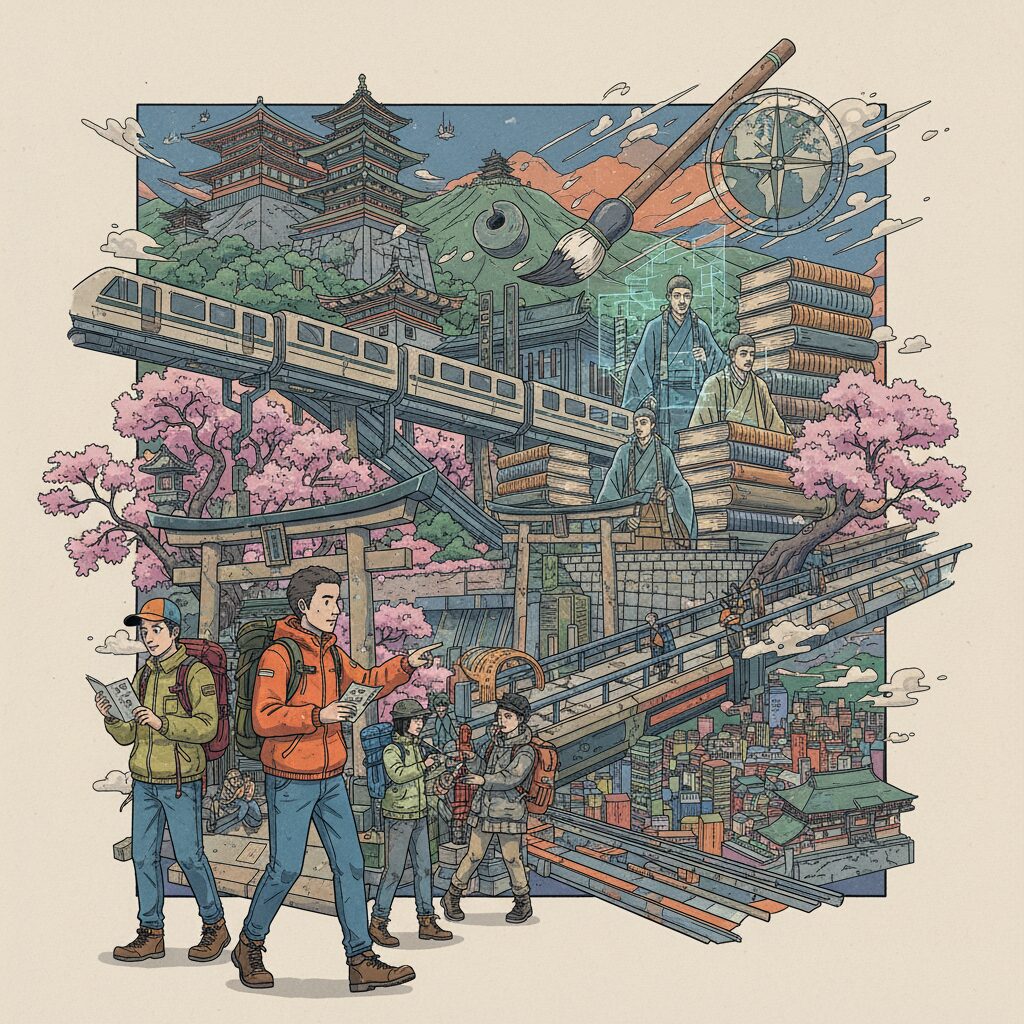
Getting to Dazaifu is easy, especially from Fukuoka, Kyushu’s largest city. The most convenient and scenic option is to take the Nishitetsu Railway from Tenjin Station in central Fukuoka. It’s a direct route on the Tenjin Omuta Line; simply transfer at Futsukaichi Station to the short Dazaifu Line. The entire journey takes around 30-40 minutes. The train station in Dazaifu drops you right at the beginning of the main sando path, placing you immediately in the heart of the action. Once there, the main attractions—Tenmangu Shrine, Komyozen-ji, and the Kyushu National Museum—are all within easy walking distance. Comfortable shoes are recommended since you’ll be on your feet a lot. For the more spread-out historical sites like the Government Office Ruins and Kanzeon-ji Temple, you can either enjoy a longer walk (about 20-25 minutes) or take the convenient “Mahoroba” community bus, which loops around all the major sights. Here are a few pro tips to enhance your visit. First, if possible, try to go on a weekday. Weekends, holidays, and especially exam season (January-March) can be very crowded. Arriving early in the morning is also a great way to avoid the crowds and experience the shrine in a more peaceful setting. Second, don’t just eat one umegae mochi. They’re a big deal here. Pick one up from a popular shop like Kasanoya on your way in, and maybe try another from a smaller vendor on your way out. Finally, allow yourself plenty of time. You could technically rush through the main shrine in an hour, but that defeats the purpose. To truly appreciate Dazaifu—to see the shrine, explore the museum, absorb the history at the ruins, and find your zen at a temple—you should plan for at least a half-day, if not a full day. It’s a place to be savored, not rushed.
Dazaifu’s Enduring Legacy: Why It Still Slaps
So why, after more than 1,300 years, does Dazaifu continue to captivate the Japanese imagination so profoundly? It’s because this city is more than just a collection of historical landmarks. It’s a living story. It tells the tale of Sugawara no Michizane—a timeless narrative of talent, betrayal, and eventual vindication that speaks to anyone who has ever faced adversity and yearned for justice. His elevation to the god of learning has cemented Dazaifu as a lasting symbol in the cultural landscape, a place of hope and inspiration for generations of young people. But it also represents the story of Japan itself. Dazaifu was the nation’s gateway to the wider world, a cosmopolitan center where ideas, art, and technology flowed in from across Asia, shaping the culture we recognize today. You can sense that international heritage in the progressive Kyushu National Museum just as much as you can feel the native spirituality beneath the ancient camphor trees of Tenmangu. Dazaifu holds all these different eras simultaneously: the solemnity of its ancient temples, the raw power of its governmental ruins, the lively energy of its pilgrim-filled streets, and the sleek sophistication of its modern art and architecture. It’s a place where you can pray for good grades, reflect on a thousand-year-old statue, enjoy a legendary snack, and marvel at a Kengo Kuma masterpiece all in one afternoon. It’s a city that respects its past without being trapped by it, a place where the echoes of history provide a powerful foundation for the vibrant rhythm of the present. A visit to Dazaifu is a journey into the very heart of Kyushu and a reminder that the quest for knowledge, art, and truth is eternal.