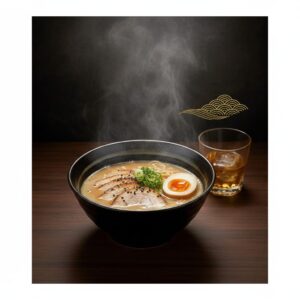
If you asked me to paint a picture of a typical meal out back in Australia, it would be full of noise. The clinking of wine glasses, the overlapping stories of friends catching up, laughter bouncing off the walls. Dining is, for the most part, a fundamentally social act. The food is important, of course, but it’s often the backdrop for connection, the fuel for conversation. Which is why the first time I peered into a classic, counter-only ramen shop in Tokyo, I felt a jolt of cultural whiplash.
Inside, there was no convivial chatter. No large tables of friends. Instead, a row of individuals sat shoulder-to-shoulder at a long wooden counter, their faces bowed over steaming bowls in a kind of reverent silence. The only sounds were the rhythmic slurping of noodles, the occasional clack of chopsticks against ceramic, and the low hum of the chef working with fierce, focused energy on the other side of the counter. They weren’t lonely figures grabbing a sad, solitary bite. They were participants in a ritual. Each person was cocooned in their own world, engaged in a deeply personal and intense communion with a bowl of soup. This, I quickly learned, wasn’t just about eating. It was about experiencing. This is the world of the solo slurp, an institution that reveals more about the Japanese approach to food, time, and personal space than a hundred fancy kaiseki dinners ever could.
This solo dining ritual is part of a broader cultural acceptance of eating alone, a concept deeply explored in our article on Japan’s ‘hitorimeshi’ culture.
The Counter as a Sacred Space

To truly grasp the solo ramen experience, you first need to understand the environment that shapes it. These establishments, called ramen-ya, are often remarkably compact, squeezed into narrow city lots where every inch of space is utilized. The design is intentional; it’s an architecture crafted for focus. The long, polished wooden or steel counter serves as the undeniable centerpiece. It’s not merely a place to eat; it’s the stage, the altar, and the front-row seat all rolled into one.
When sitting at the counter, you are instantly drawn into the chef’s realm. You witness steam rising from large vats of simmering pork bone broth, observe the swift, almost imperceptible flick of the wrist that drains noodles from a wicker basket, and hear the gentle splash as tare seasoning is poured into an empty bowl. It’s a display of pure, unembellished skill. There are no distracting decorations, no loud music (usually just a radio quietly playing, if anything), and no vast space to dilute the energy. Everything is concentrated on the craft unfolding right before you. This closeness forms an unspoken agreement of respect between diner and chef. They pour years of dedication into this one bowl for you, and your part is to give it your complete, undivided attention.
The seating arrangement itself encourages a specific behavior. The stools are fixed, with minimal space between diners. You are close enough to sense your neighbor’s presence, yet an invisible barrier exists. There’s no room for wide gestures, turning to chat, or spreading out your belongings. The space physically urges you to turn inward, focusing on the small section of counter before you. It’s a design that cleverly removes social distractions, creating a perfect vacuum for savoring the food. Some well-known chains, like Ichiran, push this concept to its extreme with their patented ‘Flavor Concentration Booths’—individual cubicles with dividers on both sides, ensuring absolutely nothing comes between you and your noodles. While it might seem clinical to a Westerner, in Japan, it’s regarded as the highest form of service: the gift of pure, unfiltered focus.
The Ritual Before the First Bite
The solo ramen experience begins before you even take a seat. In many of the most authentic ramen-ya, there’s no host greeting you or menu handed over. Your first interaction is with a machine.
The Vending Machine Oracle
Just inside or outside the entrance, you’ll find the ‘shokkenki’ (食券機), a ticket vending machine that resembles those dispensing cigarettes or train tickets. It’s covered with a grid of buttons, each displaying a picture and description of a different ramen bowl or side dish. Here, you make your selection and pay. You insert your yen, press the button for your chosen bowl—perhaps a rich, cloudy tonkotsu, a salty shio, or a soy-based shoyu—and a small plastic ticket pops out. This ticket is your order.
This system exemplifies Japanese efficiency. It streamlines ordering by removing the need for waitstaff to take orders and handle payments. Consequently, a tiny shop can operate with just one or two people—the master and possibly an apprentice. It also means that by the time you sit down, the transaction is already complete. Freed from ordering and payment formalities, you can focus entirely on the meal ahead. For diners, it provides a sense of comfortable anonymity. There’s no need to fumble with a Japanese order; you simply point, press, and present your ticket to the chef when a seat becomes available. It’s an elegantly impersonal system designed for seamlessness.
Crafting Your Perfect Bowl
After obtaining your ticket and settling at the counter, customization often begins. You hand your ticket to the chef, who may ask a series of questions. The most common is ‘men no katasa?’ (麺の硬さ?), or ‘How firm would you like your noodles?’ Options range from ‘barikata’ (extra firm) to ‘yawa’ (soft). This detail is far from trivial; it’s a vital part of the ramen experience, and aficionados are very particular about it. Some shops also inquire about broth richness (‘kotteri’ for rich, ‘assari’ for light) or the amount of garlic.
At places like Ichiran, this process is handled through a small paper form. You circle your preferences for noodle texture, flavor intensity, richness, garlic, green onions, and chashu pork. It feels less like ordering dinner and more like adjusting a precision instrument. The aim is not a standardized bowl but one perfectly and exquisitely tailored to your individual taste. This deep attention to personal preference underscores the solo nature of the meal. This bowl is for you, and you alone. It is your creation, your experience, and it answers to no one else’s palate.
The Sound and the Ceremony
With the preliminaries complete, the bowl arrives, placed before you with quiet reverence—a steaming, fragrant world in itself. Now, the central ritual begins: eating. And in Japan, that means slurping.
Why Slurping is a Compliment
In many Western cultures, slurping is considered highly rude, a sound reserved for cartoons or unruly children. But in a Japanese ramen-ya, the opposite holds true. The room is alive with a chorus of enthusiastic slurps, signaling deep enjoyment. Slurping is not only accepted; it is an essential part of the experience, serving two practical purposes.
First, it cools the hot noodles just enough to prevent burning your mouth, letting you savor their ideal texture. Ramen noodles, especially the thin Hakata-style variety, cook quickly and become soft and mushy if left too long in the broth. The slurp enables quick eating, ensuring the noodles remain perfectly ‘al dente.’ Second, and more importantly for aficionados, slurping aerates the noodles and broth, drawing air into your mouth along with the soup. This is said to open the palate and heighten the broth’s complex flavors, allowing full appreciation of its depth and aroma. A silent ramen diner is often a bored one; a loud, vigorous slurp is the highest praise you can give the chef—a wordless declaration that their creation is utterly delicious.
A Symphony of Silence
The silence at a ramen counter is not empty or awkward; it is full and purposeful—a sound of focus. You hear the deep, resonant slurps of fellow diners, the gentle click of chopsticks, the occasional sigh of satisfaction. In the background, the chef’s rhythm emerges: the sizzle of gyoza on the griddle, the steady chop of green onions, the gruff yet respectful ‘arigato gozaimashita!’ as a customer leaves.
This soundscape creates a shared, communal experience that is paradoxically individual. Everyone participates together, united in their singular goal of savoring a perfect bowl of ramen. There is a subtle choreography: diners deftly lift noodles from broth, sip soup from the spoon, bite into a perfectly jammy soft-boiled egg, then return to the noodles. It’s a refined dance shaped by countless bowls. By setting aside conversation, only the pure sounds of ritual and enjoyment remain, creating a meditative atmosphere where the outside world and its demands simply fade away.
The Philosophy of Eating Alone
Why does the culture of solo dining hold such prominence in Japan? It’s not merely a passion for noodles; rather, it reflects deeper societal frameworks, urban dynamics, and a distinctive cultural embrace of solitude.
Fuel for the Urban Machine
At its core, the solo ramen counter offers a practical answer to the realities of life in Japan’s vast, fast-moving cities. For millions of ‘salarymen’ and office workers, lunch is not a leisurely, hour-long break but a swift, efficient refueling stop in a jam-packed day. The ramen-ya serves as the perfect pit stop: you can be seated, enjoy a delicious, hearty, and affordable meal, and leave in just fifteen minutes. There’s no waiting for a table, no daunting menu to contemplate, no delay in settling the bill. It’s a system optimized for speed.
This efficiency relies on a foundation of mutual understanding. The diner knows they’re there for a quick bite, and the chef understands their role is to deliver it promptly. The relationship may be transactional and stripped of superfluous pleasantries, but it isn’t cold—it’s built on a shared respect for time and purpose.
The Rise of Ohitorisama
Beyond efficiency, the ramen counter acts as a refuge for the ohitorisama (お一人様), meaning ‘party of one.’ While dining alone may sometimes be perceived in Western societies as a sign of loneliness or social failure, Japanese culture has increasingly accepted and even celebrated solo experiences. Being alone is not viewed negatively but as a valid, often desirable choice—a moment for reflection, personal enjoyment, and pacing oneself.
An entire industry has emerged to accommodate the ohitorisama, from solo karaoke booths to single-person yakiniku (grilled meat) restaurants. The ramen counter stands as one of the original and most egalitarian of these spaces. It’s a spot where anyone—a student, a construction worker, a business executive, or a young mother grabbing a quiet moment—can enjoy a fulfilling meal without judgment or awkwardness. The anonymity of the counter levels the playing field. No one cares about your identity, occupation, or reasons for dining alone. The only focus is the bowl before you. This cultural acceptance of solitude is a profound and liberating feature of daily life in Japan.
Ramen as a Meditative Act
Perhaps the most compelling aspect of the solo ramen ritual is this: once social obligations, conversational distractions, and the pressure to perform for others are stripped away, eating becomes an act of mindfulness. You are compelled to be present and fully engage your senses.
You observe the way light shimmers on the fragrant oil floating atop the broth. You notice the noodle’s texture—their springiness, their resistance to your bite. You distinguish the soup’s layered flavors: the rich umami from pork and kombu, the salty tare, the sharpness of fresh garlic. You savor the contrast between tender, melt-in-your-mouth chashu pork and the crisp freshness of bamboo shoots. Each element is distinct, yet together they form a harmonious whole. In the ramen-ya’s quiet, focused atmosphere, a simple lunch transforms into a rich sensory experience—a fifteen-minute retreat from the city’s relentless noise and the clutter in your mind.
Navigating the Counter: A Practical Guide

For a first-time visitor, entering this quiet, focused environment can feel intimidating. However, by learning the unspoken rules, you can confidently participate in one of Japan’s most authentic culinary traditions.
The Unspoken Etiquette
The entire experience operates on a smooth, unspoken rhythm. The key rule is to be considerate of others, especially those waiting. This isn’t a place to linger over coffee or engage in lengthy conversations once you’ve finished. After your bowl is empty, it’s customary to leave promptly, allowing the next person to take your seat. If there’s a line, purchase your ticket from the machine first, then join the queue. The chef will usually keep track of the order and call you when a space becomes available.
Keep your belongings compact. There’s typically a small shelf beneath the counter or a hook on the wall behind you for bags or coats. Avoid spreading your items onto an empty adjacent stool, as it will soon be needed. While slurping is encouraged, loud conversations—especially on the phone—are considered a serious breach of etiquette. The aim is to be a quiet, respectful participant in the shared space.
Finding Your Perfect Solo Spot
Not all ramen shops are designed for this silent, solo dining experience. Many are larger, resembling typical restaurants with tables for families and groups. To find the classic solo-slurp ramen shop, look for certain signs: a long single counter dominating the space, a ticket machine near the entrance, and a focused, no-frills atmosphere. These shops are often tucked away in side streets near train stations, basement food halls, or in designated ‘Ramen Alleys.’
Don’t hesitate to try one. Even if you can’t read Japanese on the vending machine, the pictures are usually clear enough. Just point, pay, and take your ticket. The chefs are used to foreigners, and the process is intuitive. Embracing the initial moment of confusion adds to the experience. The reward is not only a fantastic bowl of noodles but also an authentic cultural insight.
Ultimately, the silent slurp is far more than a quick meal. It’s a reflection of Japanese culture—a celebration of craftsmanship where a single chef’s dedication is met with a diner’s focused appreciation. It’s a lesson in efficiency, a system perfected for the pace of modern urban life. Most importantly, it quietly affirms the profound satisfaction found in a moment of solitary reflection, accompanied only by a perfect, steaming bowl of ramen.