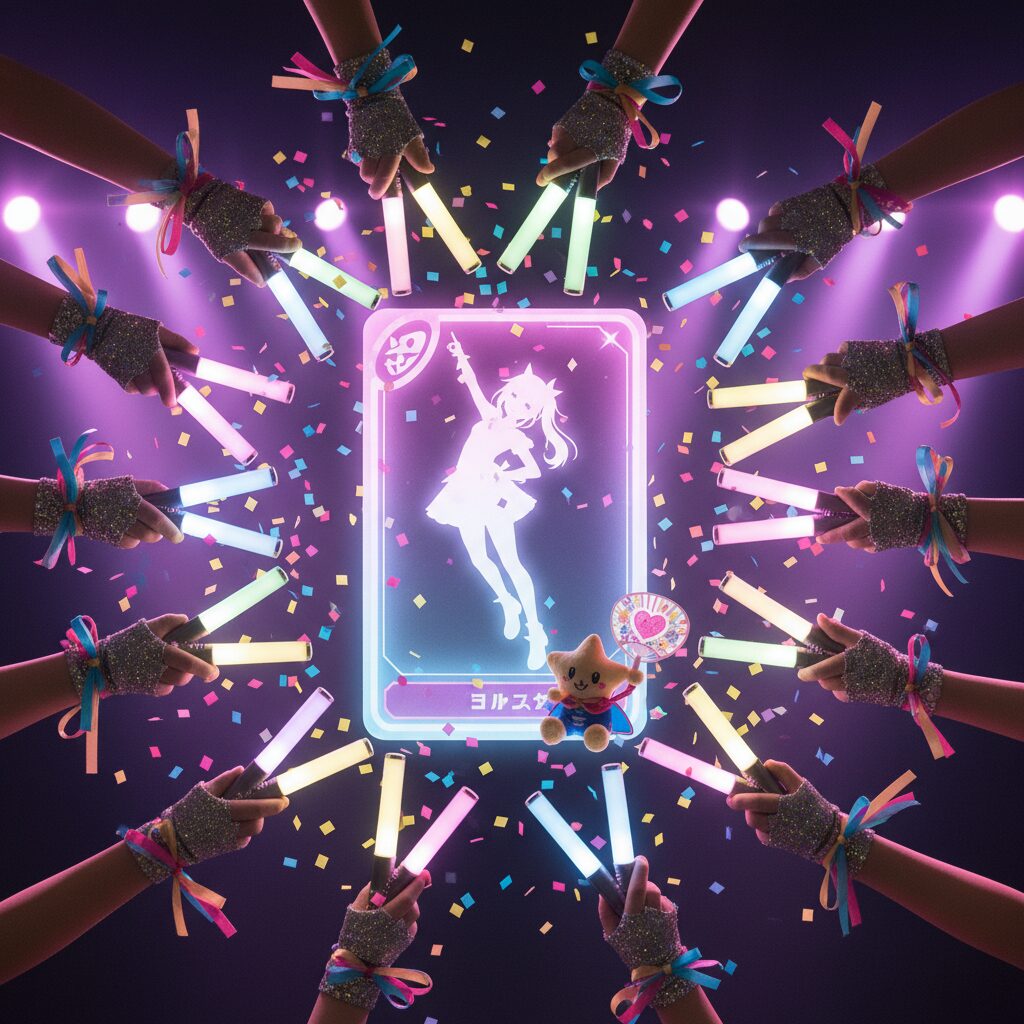
Okay, let’s spill the tea. You’ve probably seen it while scrolling through your feed—the videos from Japan that just hit different. A sea of people, all decked out in matching colors, waving glow sticks in hypnotic, perfectly synchronized patterns. You see tears, you hear fanatic chants, you feel an energy so intense it practically radiates through the screen. And at the center of it all is an idol—a pop star, an anime character, a stage actor—who seems to command a level of devotion that’s, let’s be real, kinda next level. You might have thought, “Wow, they must really love that singer.” But babe, it’s so much deeper than that. You’re not just looking at fandom; you’re witnessing an entire cultural phenomenon, a lifestyle, an economic engine, and a source of profound personal meaning. This, my friends, is ‘Oshikatsu.’ It’s the art and activity of dedicating a significant chunk of your life, energy, and yes, your wallet, to supporting your ‘oshi’—your one true favorite. It’s a universe with its own language, its own rituals, and its own unspoken rules. It’s confusing from the outside, I get it. It’s this wild, vibrant, and sometimes overwhelming part of modern Japanese culture that’s both fascinating and a little bit intimidating. But if you really want to get why Japan is the way it is, you have to understand the heart of oshikatsu. It’s not just about cute pop stars; it’s about community, purpose, and a very unique way of finding joy. So buckle up, because we’re about to do a deep dive into this world, starting at its very epicenter, the electric heart of otaku and idol culture, Akihabara.
This intense, often communal devotion can be contrasted with the growing trend of Japan’s “ohitorisama” solo culture, which offers a different path to personal fulfillment.
What Even IS an ‘Oshi’? Decoding the Lingo
Before diving into the ‘katsu’ (the activities), we need to first unpack the main concept: the ‘oshi’ (推し). This small word carries significant meaning and lacks a direct English equivalent. It’s more than just a “favorite,” stronger than a “crush,” and completely different in tone from the word “stan.” To truly understand it, you have to examine its origins and deeper implications. It’s the key to unlocking the entire philosophy behind this highly dedicated fan culture. The term itself signals that this isn’t about passive consumption—it’s a call to action.
From ‘Ichioshi’ to Your Singular Choice
The term ‘oshi’ is actually a shortened form of ‘ichioshi-men’ (一推しメン), a phrase that became widespread with the rise of huge idol groups like AKB48 in the mid-2000s. ‘Ichioshi-men’ means “my number one recommended member.” The root verb is ‘osu’ (推す), which means “to push,” “to endorse,” or “to recommend.” Consider that for a moment. Your favorite idol isn’t just admired from a distance—they are your chosen candidate. You are their champion, advocate, and personal promoter. Saying “This person is my oshi” essentially means, “This is the individual I am actively supporting towards success.” It’s a clear declaration of intent. This proactive attitude changes the fan from a passive consumer into an engaged participant in the idol’s journey. The idol’s achievements feel like your own because, in a very real way, you’re helping make them happen. This active ‘pushing’ is the fundamental foundation of oshikatsu.
Beyond the Stan: Oshi vs. Bias vs. Fave
How does this compare to Western fan slang? Calling someone your ‘fave’ sounds pretty casual, right? And while K-Pop fans have a ‘bias’ and a ‘bias-wrecker,’ ‘oshi’ has a distinct nuance. The term ‘stan,’ derived from Eminem’s song about a dangerously obsessive fan, carries a somewhat chaotic and unstable connotation, even as it’s become mainstream. It suggests an all-consuming, possibly unhealthy devotion. Oshikatsu can reach that level of intensity, but the core feeling of ‘oshi’ tends to be more wholesome and almost nurturing. It’s less about possessive, romantic fixation (though that can be part of it for some) and more about deep support. It can feel like a proud parent watching their child score the winning goal or a loyal knight serving their chosen monarch. You want to protect their happiness. You want to see them excel. You want to give them everything. This desire to support and nurture your oshi shapes the emotional landscape, creating a relationship that is both deeply personal and incredibly inspiring for the fan.
The ‘Katsu’ in Oshikatsu: It’s a Full-Time Job (That You Pay For)
If ‘oshi’ refers to the person, then ‘katsu’ (活) signifies the action. It’s a shortened form of ‘katsudou’ (活動), meaning ‘activity’ or ‘activities.’ Thus, ‘oshikatsu’ literally means ‘activities to support your favorite.’ And honey, these activities are extensive. It’s not just about streaming their new song or buying a tour t-shirt. Oshikatsu involves a carefully structured series of rituals and financial exchanges that the Japanese entertainment industry has refined to maximize engagement and, let’s be honest, profit. It’s a lifestyle centered around a schedule of events, release dates, and campaign objectives. Taking part in these activities is how you fulfill your responsibilities as a supporter. It’s how you demonstrate your devotion—not only to your oshi but also to the community you belong to. It’s a serious commitment, a parallel existence requiring strategic planning, budgeting, and a lot of passion.
The Rituals of Support: More Than Just Listening to Music
The checklist for a devoted fan is long and diverse. It’s a multi-platform, multi-dimensional show of support. First, there’s the merchandise. This isn’t limited to posters. It includes collectible acrylic stands (‘akusuta’) that you can carry around and photograph at cafes, custom-designed ‘uchiwa’ (うちわ) fans with encouraging messages to hold up at concerts, and penlights or ‘king blades’ whose colors you can adjust to match your oshi’s official ‘member color.’ Then there’s the ‘gacha’ aspect—blind-box keychains and trading cards you keep buying until you get your oshi, often leading to frantic trading sessions with other fans outside concert venues. It’s a whole sub-economy.
Beyond the goods, the main attractions are live interactions. Concerts are a given, but the Japanese idol industry has refined the ‘meet and greet’ experience. The most famous example is the ‘akushukai’ (握手会), or handshake event. To attend, you usually need to purchase a special edition of the idol’s latest CD. Each CD provides one ticket, which grants a handshake and about ten seconds of conversation. Want more time? Buy more CDs. For many, this is the ultimate pilgrimage—a chance to look their oshi in the eye and tell them directly they’re being cheered on. There are also ‘cheki’ events, where you can take instant Polaroid-style photos with your oshi. These events embody the industry’s core concept: idols you can meet. That sense of accessibility is a powerful, powerful lure.
The Economics of Emotion: Why You Buy 100 Copies of the Same CD
This is the part that usually puzzles outsiders the most. Why would anyone buy hundreds of copies of the exact same CD? The answer is simple and brilliant in its capitalist logic: your money is your vote. The model’s golden age was pioneered by AKB48 and their famous ‘Senbatsu Sousenkyo’ (選抜総選挙), or General Election. Here’s how it worked: each year, the group held an election to decide which members would feature in the next single. The highest-ranking members received prime spots in the music video, more screen time, and a significant career boost. How did fans vote? Using voting slips inside the latest single copies. One CD, one vote.
Suddenly, buying a CD wasn’t about the music anymore but about influence within the fandom. If you wanted your oshi to succeed and get the recognition you believed she deserved, you had to mobilize and buy as many CDs as possible. Fans pooled money, organized mass unboxing events, and strategized campaign efforts. It turned fandom into a gamified, high-stakes competition. You weren’t just a fan; you became a campaign manager, strategist, and donor. Your spending had a direct, visible, and immediate effect on your oshi’s career. This system brilliantly monetized fans’ desire to support and protect, converting emotional investment into cold, hard cash and sales figures. While the large-scale General Election is now a thing of the past, its legacy lives on in numerous voting-based events and the prevailing belief that financial contribution is the truest form of support.
The ‘Oshikatsu Budget’: A Serious Financial Commitment
Given this environment, it’s no surprise that oshikatsu can be an extremely costly hobby. For dedicated fans, it’s not just a casual expense; it’s a major line item in their monthly budget. Many people even take on part-time jobs—‘baito’—specifically to fund their oshikatsu. They keep separate savings accounts, carefully track release dates, and plan their finances around concert tours and merchandise launches. The costs add up fast. A single concert ticket can be expensive, and if you follow your oshi on a multi-city tour, travel and accommodation costs mount quickly. Then there’s the endless parade of merchandise: photobooks, DVDs, limited-edition collaborations, and birthday-themed goods. Don’t forget the themed cafes, where a latte with your oshi’s face and a keychain can cost a pretty penny. This spending isn’t viewed as frivolous. For many, it’s an investment in their own happiness. The pleasure they get from supporting their oshi, the excitement of the events, and the camaraderie of the community make it worthwhile. Prioritizing this source of joy is a conscious choice, and the entire market has grown to accommodate virtually every spending impulse.
The Social Heartbeat: Finding Your Tribe in a Sea of Penlights
Oshikatsu may focus on a single idol, but it is by no means a solitary pursuit. In fact, one of its greatest strengths is its social aspect. In a society that can often feel isolating, with strong pressure to conform and a cultural reluctance to openly express emotions in many public contexts, oshikatsu offers a built-in community and a safe haven. It’s a space where passion is valued, where niche interests are embraced, and where you can instantly connect with hundreds or even thousands of people who share the same intense love. The sense of belonging that results is a huge part of its appeal and what keeps fans so deeply committed.
It’s Not Just You and Your Oshi: The Power of Community
The moment you declare your oshi, you join a tribe. You instantly have a common ground with anyone sporting the same merch or member color. Waiting in line for concerts or merchandise drops isn’t dull; these moments become social gatherings. It’s a chance to trade photo cards, show off your custom “ita-bag” (a bag with a clear window showcasing all your oshi goods), and geek out with people who truly understand. You don’t need to justify spending your last paycheck on tickets—they did the same. This shared experience forges incredibly strong connections. Friend groups form, online communities thrive, and a genuine collective identity takes shape. For many, these fandom friendships become profoundly important, sharing joy in their oshi’s successes and offering comfort during hardships. This support network goes beyond the hobby itself, providing authentic human connection in an increasingly digital world.
The Unspoken Etiquette of the Fandom
Like any close-knit community, oshikatsu has a set of unwritten social rules and etiquette that are universally understood and essential for maintaining harmony. A crucial guideline is to respect everyone’s oshi. You never, under any circumstance, disparage another fan’s favorite or fellow group member. It simply isn’t done. Everyone recognizes how much their oshi means to them, so insulting someone’s oshi is the same as insulting them.
There’s also a captivating ritual around the live performances themselves. If you’ve attended a Japanese idol concert, you’ll notice that the crowd’s participation is just as choreographed as the show on stage. The synchronized waving of penlights, the specific chants and calls shouted at exact moments—this practice is known as ‘wotagei’ (ヲタ芸). It’s not random cheering but a coordinated performance by the audience, a way to send energy back to the idols and demonstrate unified support. Learning and joining in these calls is a major part of the experience, turning thousands of individuals into one powerful collective, creating a thrilling sense of unity and shared energy that’s truly electrifying to be part of.
The Psychology of Pushing: Why Does Oshikatsu Feel So Good?
So far, we’ve explored the what and the how. But the essential question—the one that truly gets to the heart of the matter—is why. Why is oshikatsu so deeply captivating? Why does it inspire such remarkable dedication? The answer lies in how it directly satisfies fundamental human and cultural needs: the need for purpose, community, and a dependable source of simple joy. It’s a perfectly crafted system for generating positive emotional feedback, giving people a sense of control and achievement in a world that can often feel chaotic and unpredictable.
A Modern-Day ‘Ikigai’: Finding Purpose Through Fandom
In Japan, there is a concept called ‘ikigai’ (生き甲斐), commonly translated as ‘a reason for being’ or ‘a reason to get up in the morning.’ It’s what gives life a sense of meaning and value. Traditionally, this might be found in one’s career, family, or craft, but for an increasing number of people, oshikatsu has become their ikigai. Supporting their oshi offers a clear set of goals and a tangible sense of mission. The objective is straightforward: help my oshi succeed. This mission is then divided into smaller, manageable tasks: streaming the new music video to boost its views, buying magazines featuring them to increase sales, voting for them in online polls, or trending supportive hashtags on their birthday.
Each of these small efforts delivers a little dopamine hit—a feeling of contributing to a larger cause. The idol’s journey—often portrayed as the story of an ordinary person with a dream, working hard against all odds—becomes a narrative that fans co-author. When their oshi performs at a larger venue, wins an award, or secures a center position, fans experience an intense sense of pride and accomplishment. It’s our victory. This vicarious success can be deeply fulfilling, offering a sense of progress and achievement that might be harder to find in one’s personal life.
The ‘Moe’ Factor and Parasocial Perfection
Another crucial psychological element is the uniquely Japanese concept of ‘moe’ (萌え). Moe is a challenging term to translate but refers to a strong, almost overwhelming feeling of affection, adoration, and protectiveness toward a character (in anime, manga, or games) or, by extension, a person like an idol. It’s that heart-clenching sensation you get when encountering something or someone unbearably cute, pure, or endearingly imperfect. Idols are frequently crafted to be ‘moe’ machines. Their personalities, backstories, and interactions are all designed to evoke this protective instinct in their fans. You don’t just admire them; you want to shield them from the world’s harshness.
This links to the nature of the parasocial relationship central to oshikatsu. It’s a one-sided connection, but it’s designed to feel intimate. Idols communicate with their fans through blogs and livestreams, using language that makes it seem as if they are speaking directly to you. They frequently express gratitude, reinforcing the belief that they couldn’t succeed without their fans. This creates a powerful emotional cycle. The idol provides a steady, reliable source of positivity, inspiration, and affection, and in return, the fan offers unwavering support. It’s the ideal relationship without the complications or demands of a real one. Your oshi will never have a bad day and snap at you. They will never forget your anniversary. They are a perfect, curated source of joy, and for many, that is an incredibly comforting and valuable presence in their lives.
The Dark Side of Devotion: When Pushing Goes Too Far
It wouldn’t be a truly honest deep dive without examining the less glamorous aspects of oshikatsu. Despite the joy and sense of community it fosters, the intense culture and industry structure can also create serious problems. The same factors that make it so captivating can become exploitative and harmful, both for the fans who devote their lives to it and for the young idols caught at the center. The distinction between healthy passion and unhealthy obsession is often very thin, and many people cross that line.
The Financial and Emotional Burden
The most obvious downside is the overwhelming financial strain. The continual release of new merchandise, limited editions, and event tickets can cause fans to spend well beyond their means, accumulating credit card debt and sacrificing their own well-being for their oshi. Social pressure within the fandom to prove devotion through spending is very real—if you’re not buying the latest goods or attending events, can you even be considered a true fan? This creates a toxic cycle of competition and guilt. The emotional toll is equally harsh. When your self-worth is deeply linked to someone else’s success, their setbacks can feel like personal failures. When an oshi inevitably ‘graduates’ (the industry’s polite term for leaving the group), becomes involved in a scandal, or simply fades from view, the loss can be devastating for devoted fans. It’s a high-stakes emotional investment with heartbreak that is all too real.
The Industry’s Control: Manufactured Dreams?
It’s important to critically examine the industry behind this culture. Is oshikatsu genuinely an organic expression of fan affection, or a cleverly engineered marketing system designed to exploit emotions for profit? The truth lies somewhere in between. Yet there’s no denying that entertainment companies have perfected the skill of manufacturing desire and profiting from devotion. Systems like handshake tickets included in CDs and gacha-style merchandise are carefully designed to promote compulsive spending. Idols themselves face strict rules and immense pressure—no-dating clauses, relentless schedules, and the demand to maintain a flawless, scandal-free public image. It’s a high-pressure career with a notoriously short lifespan. Fans’ intense, all-consuming love fuels this often unforgiving industry. It’s a symbiotic relationship, but one in which power is heavily tilted toward the corporations selling the dream.
Beyond Idols: The Universal Language of ‘Oshi’
What began in the trenches of idol fandom has, in recent years, fully broken into the mainstream. The idea of having an ‘oshi’ and participating in ‘oshikatsu’ has grown well beyond the realm of pop music. It has become a universal framework in Japan for expressing passionate support for virtually anything. This development highlights how deeply the ‘oshi’ mindset connects with people, offering a new language for love, dedication, and personal identity in the 21st century.
Your Oshi Can Be Anyone (or Anything)
The charm of the term ‘oshi’ lies in its versatility. Your oshi doesn’t need to be a J-pop idol. It could be a K-pop star, a voice actor (‘seiyuu’), a favorite character from an anime or video game, an actor in a 2.5D musical (stage plays based on anime/manga), a YouTuber, an athlete, a historical figure from the Sengoku period, or even, in some amusing cases, an inanimate object like a particular brand of sake or a historical castle. The term has been totally democratized. If there’s something you love and want to support, it can be your oshi. This has fueled the rise of a whole ‘oshikatsu’ lifestyle market. Now, you can buy customizable bags, phone cases, and planners in a rainbow of colors reflecting your oshi’s theme color. It has become an aesthetic—a way to organize your life and broadcast your passions to the world.
So, Is Oshikatsu Worth It? The Final Vibe Check
Returning to our initial question: what is this really about? Oshikatsu is far more than extreme fandom. It is a complex, multifaceted cultural practice that addresses deep-rooted social and psychological needs in modern Japan. It’s a response to loneliness, a quest for purpose, and a way to find a community. It’s a form of participatory entertainment where fans feel genuinely invested in the outcome. It provides a method to channel passion into a structured, goal-driven hobby that offers tangible feedback and a strong sense of achievement. Yes, it has its dark side. It can be financially draining, emotionally taxing, and operates within a ruthless commercial industry. But to dismiss it as merely obsessive behavior misses the point completely. For millions, oshikatsu brings immense, pure joy. It gets them through tough weeks at work, fuels their closest friendships, and serves as a vibrant, colorful, deeply human way of engaging with the world. It’s a whole vibe. It’s a lifestyle. And ultimately, it offers a uniquely Japanese response to the universal and timeless human desire to dedicate yourself to something you believe in. When you see that sea of perfectly synchronized penlights, you’re not just witnessing fans—you’re seeing a community, a support system, and thousands pushing their dreams forward, one glow stick at a time. And honestly? That’s kind of beautiful.