Yo, what’s the deal with Japan? For real. One minute you’re scrolling through a feed of hyper-futuristic cityscapes, serene temples, and mind-bendingly good food. It’s a vibe. You think, “I get it. It’s clean, it’s cool, it’s organized.” So you book a ticket, you land, and suddenly… you don’t get it. Not at all. You’re in a meeting, you make a suggestion, and the room goes dead silent. You’re out with new friends, you crack a joke, and it lands with the thud of a dropped bowling ball. The vibe is officially off. You can’t put your finger on it, but you know you did something. You broke a rule you never knew existed.
Welcome, my friend, to the world of “Kuuki wo Yomu” (空気を読む). The literal translation is “reading the air.” And trust me, it’s the most important skill you’ll ever need to navigate the social matrix of Japan. It’s the invisible instruction manual that everyone else seems to have been born with. It dictates what’s said, what’s left unsaid, and, most importantly, what’s understood without a single word. Not being able to do it makes you “KY” – Kuuki Yomenai – a person who can’t read the air. In the social currency of Japan, being KY is like being bankrupt. It’s peak cringe, and it can leave you feeling hopelessly isolated.
But here’s the real talk: it’s not magic. It’s not some mystical sixth sense unique to the Japanese. Reading the air is a learnable skill. It’s a complex system of social cues, historical context, and shared cultural values that, once you start to see the patterns, is totally decodable. It’s about understanding that in Japan, the context isn’t just part of the conversation; the context is the conversation. This guide is your cheat sheet. We’re going deep—no surface-level tourist fluff. We’re going to dissect this “air,” figure out where it came from, and give you the tools to not just survive, but actually thrive. It’s time to stop feeling like an alien and start understanding why Japan is like this. Let’s get it.
To truly master the art of reading the room in Japan, it helps to understand other unique cultural practices like the concept of inemuri, or sleeping on the job.
What is This “Air” You’re Supposed to Read? The Anatomy of Kuuki
Alright, so what exactly is this “air”? It’s not a single entity. It’s a whole ecosystem of communication, a shimmering, invisible field of social data. Think of it like Wi-Fi. It’s everywhere, carrying vast amounts of information, but you need the right receiver to connect to it. In Japan, that receiver is your sensitivity to nuance. This “air” consists of three main layers: the non-verbal signals constantly emitted by everyone, the overarching goal of group harmony, and the dual-layered communication style of public truth versus private feelings. Mastering Kuuki wo Yomu means learning to interpret all three layers at once.
Non-Verbal Cues: The Loudest Silence You’ll Ever Hear
In low-context cultures like the U.S., we’re taught that what you say matters most—words are king. But in Japan, words are often just the surface. The true meaning lies in the 90% beneath the surface—the non-verbal realm. If you focus solely on words, you miss the whole message.
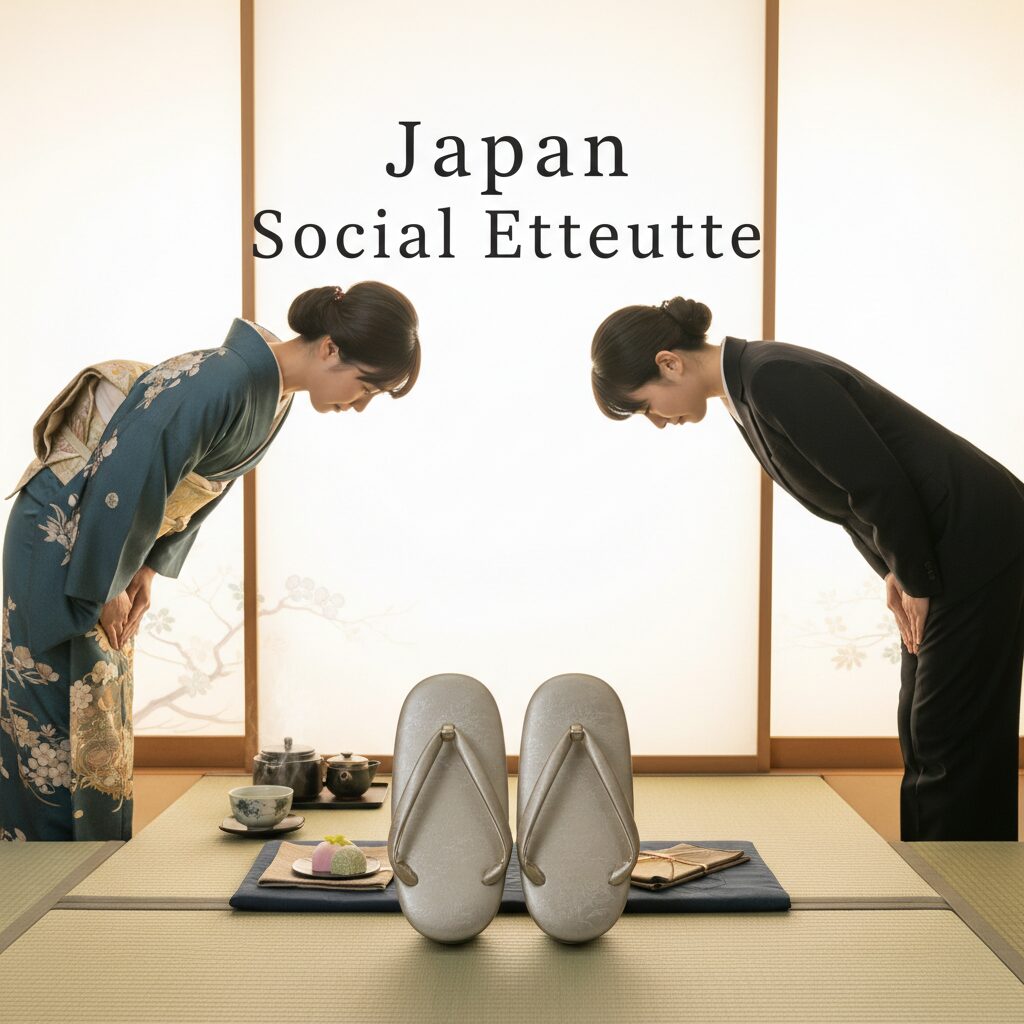
Let’s begin with the basics: body language. How a person carries themselves speaks volumes. For example, a slight bow when receiving a business card is not merely a quaint tradition; it physically expresses respect and acknowledges the other person’s status. The depth of a bow carefully measures the social context. A casual head nod (eshaku) among colleagues is about 15 degrees. A more formal bow of respect (keirei) to a client is 30 degrees. The deepest bow, expressing apology or profound gratitude (saikeirei), ranges from 45 to 90 degrees. Misjudging this—like offering a lazy nod to a senior executive—is a typical KY move. It signals a lack of understanding of social hierarchy.
Eye contact is another tricky area. In many Western cultures, direct eye contact shows confidence and honesty. In Japan, however, staring too long, especially at a superior, can come off as confrontational or aggressive. Usually, a gentler gaze aimed at the neck or chin with brief glances at the eyes is preferred. It’s a gesture of deference, not evasiveness. Foreigners who maintain intense eye contact can unintentionally create a tense, uncomfortable atmosphere.
Then there’s the orchestra of non-verbal sounds. The sharp, subtle intake of breath through the teeth often occurs after you say something inconvenient. It’s a bodily cue that says, “Oof, this is awkward; I don’t want to confront you directly, but you’ve put me in a difficult position.” It’s a prelude to “no.” Audible sighs, slight chuckles, or scratching the back of the head—all are data points. They’re the Japanese equivalent of someone saying, “Well, actually…”
We also need to discuss Aizuchi (相槌). These are the frequent verbal interjections during conversation: “hai” (yes), “un” (yeah), “ee” (yes, formal), “sou desu ne” (that’s right), “naruhodo” (I see). A non-Japanese speaker might mistake this for constant agreement; when you’re speaking, the other person keeps saying “yes, yes, yes,” so you assume they fully agree. Not true. Aizuchi don’t signal agreement—they signify active listening. They mean, “I’m here, I’m engaged, I’m following what you’re saying, please continue.” The absence of Aizuchi is the real indicator. If the other person is utterly silent while you talk, that’s a big red flag. It means they’ve checked out mentally or strongly disagree and are just waiting for you to finish. Learning to give and interpret Aizuchi is fundamental to reading the air. It’s the conversational equivalent of sending a ping to a server—just confirming the connection is still alive.
Finally, there’s silence. In many cultures, silence in conversation feels like a vacuum—an awkward pause that must be filled immediately. In Japan, silence is a deliberate tool. It carries meaning. It can be a moment for careful consideration before answering a serious question. It can indicate disapproval: a quiet, powerful rejection of an idea. It can also reflect comfort and mutual understanding between two people who don’t feel the need to fill every moment with words. Learning to sit comfortably with silence, not rush to fill it, and to interpret its significance is an advanced Kuuki-reading skill. Jumping in too quickly might make you seem impatient or superficial, as if the topic isn’t worthy of respect.
Group Harmony (和 – Wa): The Ultimate Social Aim
The second layer of the “air” is the all-encompassing idea of Wa (和). Often translated as “harmony,” it goes far beyond that. Wa is the ideal state of society—a smooth, frictionless, cooperative flow within a group. It’s the primary directive. The group’s needs outweigh individual desires. This isn’t just a corporate phrase; it’s a deeply embedded cultural value shaping every interaction—from the boardroom to the family dinner table. The ultimate goal of reading the air is to preserve Wa.
This explains why direct confrontation is rare. Openly disagreeing, especially in a group, is like throwing a wrench into the gears of a finely tuned machine. It disrupts Wa. It incites conflict, forces people to take sides, and causes someone to lose face. Such behavior is seen as selfish and extremely disruptive. Instead of saying, “I disagree with your proposal,” a Japanese colleague might say, “Thank you for the interesting idea. There are a few points we may need to consider further. Perhaps we can explore other options as well.” The message is a polite “no,” delivered in a way that preserves group harmony and lets the other person back down without embarrassment.
This emphasis on Wa clarifies the importance of consensus-building, or nemawashi (根回し). The term literally means “digging around the roots” of a tree before transplanting it. In business, it refers to speaking to every stakeholder individually and gaining their support before a formal meeting. The meeting itself isn’t for debate; it’s a ceremony to endorse decisions already made behind the scenes. A Western manager expecting a lively brainstorming session will meet polite silence instead. The Japanese team isn’t passive; they simply work within a different framework. The KY move is forcing debate in the formal setting, which pressures everyone and shatters the carefully built Wa.
Wa also explains why the group is the default identity unit. In many Western cultures, focus is on the individual—your achievements, your personality. In Japan, identity often derives from the groups you belong to: your company, university, family. A typical Japanese introduction isn’t “I’m Tanaka,” but “I’m Tanaka of Sony.” Your primary loyalty is to the collective. This is why you see groups of employees in matching uniforms or why after-work drinking parties (nomikai) are nearly mandatory. Such activities reinforce group cohesion and, by extension, Wa.
Tatemae and Honne: The Public Face and True Feelings
If Wa is the goal, then Tatemae (建前) and Honne (本音) are the tools to achieve it. This concept is often perplexing for outsiders and frequently misunderstood as duplicity or dishonesty. But that’s a fundamental error. Tatemae is the public face—what you express or how you act to maintain Wa and politeness. Honne is your genuine opinion or feeling, usually shared only with close friends, family, or trusted colleagues.
Everyone has some version of this. You wouldn’t tell your boss their new haircut looks awful, even if you thought so—that’s Tatemae. But in Japan, the distinction is much clearer and embedded in language and social customs. It isn’t considered deceitful but rather social intelligence and maturity: a form of kindness that protects others’ feelings and keeps interactions smooth.
Take a typical example. You’re invited to a Japanese person’s home. When leaving, they say, “Please come again anytime!” Your low-context mind hears a sincere, open invitation. But it could be Tatemae—a polite social formality. Their Honne might be, “I’m glad you came, but I’m tired and hope you don’t drop by unannounced tomorrow.” Reading the air helps you distinguish between these. Did they sound truly enthusiastic? Did they suggest a specific time? Or was it a generic phrase delivered with a polite but weary smile? Non-verbal cues guide you to the Honne.
In business, this skill is vital. A client might say, “We will review your proposal positively” (maemuki ni kentou shimasu). It sounds promising! Yet in Japan, this phrase is famous as a polite, non-confrontational way to say “no.” It’s a soft rejection. Their Tatemae says, “We’ll consider it,” but their Honne means, “This won’t happen.” A KY salesperson would get excited, follow up aggressively, and annoy the client. Someone who can read the air recognizes the finality, thanks them for their time, and moves on—preserving the relationship for future opportunities.
Navigating Tatemae and Honne means listening for subtext. It’s understanding that what’s said often masks what’s meant. The true conversation happens between the lines. The challenge—and the art—of Kuuki wo Yomu is reading that invisible text. The Japanese language abounds with vague, ambiguous expressions that facilitate this. Phrases allowing multiple interpretations are preferred over blunt, direct statements, giving both parties room to maneuver without causing loss of face.
The “Why” Files: Where Did Kuuki wo Yomu Come From?
So why did Japan develop such an incredibly complex, high-context social operating system? It didn’t emerge out of nowhere. Rather, it is the result of centuries shaped by specific geographic, agricultural, and political factors. Understanding the “why” is crucial to moving from confusion to genuine insight. This isn’t mere randomness or oddity; it’s a logical, albeit different, solution to the challenge of organizing society.
The Agricultural Roots: A Society Built on Cooperation
For most of its history, Japan was primarily a nation of rice farmers. Wet-rice cultivation is not an individual effort; it’s a large-scale, community-driven enterprise. You couldn’t simply manage your own small plot independently—you depended on a complex, shared irrigation system serving the entire village. Water had to be diverted from a river, routed through an intricate network of canals, and fairly distributed to every rice paddy. This required careful planning, ongoing maintenance, and above all, total cooperation.
If one family hoarded water or neglected their canal section, the whole village’s crop risked failure. Starvation was a persistent threat. In this context, the group was paramount. Individualism wasn’t merely discouraged; it was dangerous. Survival depended on everyone playing their part, adhering to established norms, and avoiding disruption. This lies behind the famous Japanese proverb, “The nail that sticks out gets hammered down” (Deru kui wa utareru). The principle wasn’t about enforcing bland conformity for its own sake; it was a vital survival rule. People conformed because the community’s survival—and thus their own family’s—depended on it.
This agricultural reality shaped a culture valuing consensus, predictability, and social stability above all else. People learned to anticipate others’ needs and to detect subtle signs of disapproval, since open conflict could undermine the delicate cooperation required for a successful harvest. Kuuki wo Yomu, in its earliest form, was a survival skill—being able to sense the village’s mood to avoid becoming the nail that gets hammered down.
High-Context Culture: The Island Nation Effect
Broadening the perspective, anthropology distinguishes high-context versus low-context cultures. Low-context cultures, like those of the United States, Australia, or Germany, often have histories of immigration from diverse origins. Because a common cultural shorthand is absent, communication tends to be explicit, direct, and detailed. People say exactly what they mean, expecting clarity because assuming mutual understanding isn’t reliable. Contracts are lengthy and precise, instructions explicit, and ambiguity is viewed as a communication failure.
Japan exemplifies a high-context culture. As an island nation largely isolated from external influence for over 200 years during the Edo period (1603–1868), it developed a remarkably homogeneous society. For centuries, nearly everyone shared the same language, ethnicity, religion, social structure, and historical references. This created an enormous shared pool of unspoken context. Explicit explanations were unnecessary because it was assumed all were following the same cultural script. A single word, a subtle gesture, or a meaningful pause could carry immense meaning because everyone recognized the implicit cultural rules.
This explains why translating Japanese into English is so challenging. It’s not only about words but about conveying a vast amount of invisible context underlying those words. This is why anime characters can have entire conversations through a few grunts, sighs, and “…”, with the Japanese audience filling in the gaps from their shared cultural background. This high-context style embodies the “air” one must read—you are expected to grasp the script without ever being handed a copy.
The Echo of Feudalism: Knowing Your Place
The third major influence is Japan’s long history of rigid, hierarchical social structures. For centuries, especially during the Edo period under the Tokugawa shogunate, society was strictly stratified. Samurai warriors were at the top, followed by farmers, artisans, and merchants at the bottom. Social class was determined by birth, with strict rules governing dress, residence, and behavior toward those above or below you.
Though this rigid hierarchy has largely disappeared, its cultural resonance remains strong. It is evident in the importance placed on seniority and rank in companies, the elaborate system of honorific language (keigo), and the clearly defined roles of senpai (senior) and kouhai (junior) in schools, clubs, and workplaces. The senpai-kouhai dynamic is more than age difference; it’s a built-in system of mentorship and respect. The kouhai is expected to show deference, run errands, and learn from the senpai, who in turn is responsible for guiding, protecting, and sometimes supporting the kouhai.
This historical conditioning means Japanese people are almost constantly and subconsciously assessing their relationship to the person they are interacting with. Are they older or younger? What is their job title? Which company do they work for? These questions determine the correct level of politeness, verb forms, and behavior. In this context, reading the air means accurately gauging the social hierarchy in any situation and adjusting accordingly. A foreigner who treats a 60-year-old department head with the same casualness as a 25-year-old colleague is making a significant social mistake—they are failing to read the hierarchical air.
The Modern Day KY: Reading the Air in the 21st Century
Alright, the history is interesting, but how does all this actually play out today? How does being “KY” sabotage you in real-life situations that foreigners commonly face? Let’s break it down into a few key areas: the workplace, social life, and everyday public settings. This is where the lesson gets practical.
The Office: Maneuvering Through the Corporate Environment
The Japanese workplace is probably the most intense Kuuki-reading setting you’ll ever experience. It’s filled with unspoken rules and rituals. Here, failing to read the air doesn’t just make you awkward; it can seriously harm your career.
The Notorious Nomikai (Drinking Party)
First up, the nomikai, or after-work drinking gathering. To outsiders, it may seem like a casual, optional social event. It’s not. It extends the workday and is crucial for social maneuvering. It’s where office hierarchy relaxes a bit, and where Tatemae can give way to more Honne (often helped by alcohol).
Here’s a checklist of classic KY mistakes at a nomikai. Number one: pouring your own drink. In Japan, you pour for others, and they pour for you—this is a mutual sign of respect. You should always watch your superiors’ glasses; if your boss’s glass is low, you’re expected to offer a refill. Pouring your own first is seen as selfish. Number two: sticking only to work talk. The nomikai is for building personal connections. Some work talk is expected, but the goal is to bond on a personal level by asking about hobbies, family, or recent trips. Number three: leaving whenever you want. You generally don’t just leave when tired. The evening has a flow, and you usually wait for a senior person’s cue that the party is ending. Leaving early without a good, pre-approved reason suggests you don’t value the team.
Reading the air at a nomikai means being an alert, engaged participant. It means joining in small talk, laughing at your boss’s bad jokes, and making sure everyone feels included. It’s a performance, and your role is to be a supportive team player.
Mastering the Indirect “No”
As mentioned earlier, directly refusing is a major faux pas in Japanese business because it disrupts Wa. You need to become fluent in polite evasions. Japanese colleagues rarely say “No, I can’t do that” or “That’s a bad idea” outright.
Instead, you hear subtle hints. Phrases like chotto muzukashii desu ne (“that’s a little difficult”) rarely mean “it’s tough, but I’ll try.” It usually means “no.” The phrase kentou shimasu (“I will consider it”) often politely ends the conversation with no intention of follow-up. Zensho shimasu (“I will handle it appropriately”) may sound positive but often signals “I’ll take care of this now, so please stop discussing it.”
A KY person takes these at face value, clings to hope, and keeps pressing. This is seen as dense and annoying. Someone who reads the air understands these as conversational exit points. They catch the subtext, accept the polite “no,” and move on without damaging the relationship. The trick is to notice what’s not being said. Is there a clear commitment, a deadline, or a next step? If the language is vague and non-committal, the answer is almost always no.
Social Gatherings: Friends, Dates, and Family Visits
Outside work, the rules loosen a bit, but the air remains thick with expectations. Whether you’re with friends, on a date, or visiting a Japanese family, your ability to read the atmosphere is continuously tested.
The Bill-Splitting Ritual
At the end of a meal, paying the bill can turn into a complex social dance. In the West, it’s common to say “Let’s split it” or use an app to divide expenses exactly. In Japan, it’s more subtle.
Often, one person pays for everyone, especially if they’re older or hold a higher-status job. This isn’t always pure generosity; it can demonstrate seniority or care for the group. The expected response is to politely protest a couple of times (“Oh no, you don’t have to do that!”) before graciously accepting. Letting someone pay without this token resistance can seem ungrateful. When the group splits the bill, it’s usually warikan—evenly divided, regardless of who drank more. Mentioning you ordered less and should pay less is a major KY move, since it prioritizes your personal finances over group harmony.
On a date, the rules are murkier and shifting, but traditionally the man often pays. Still, many women will pull out their wallet, and the man might accept a smaller contribution. It’s a dance. The key is to observe and be sensitive to hierarchy and context.
Gifting Culture: Beyond Just Souvenirs
Gift-giving in Japan is a language in itself. You never visit someone’s home for the first time without a small gift, called a temiyage. This is usually something simple, like a box of sweets or snacks. The value doesn’t matter much; the thoughtfulness matters. Forgetting a temiyage is like arriving empty-handed to a party—bad manners.
When traveling, it’s a firm social rule to bring back omiyage (souvenirs) for colleagues, friends, and family. These are typically locally wrapped snacks. The omiyage market is huge for a reason. Coming back from vacation without omiyage sends a clear message: “I didn’t think of you while I was gone.” It’s seen as selfish and careless.
There’s also a ritual to giving and receiving. When presenting a gift, it’s customary to downplay it with a phrase like, “Tsumaranai mono desu ga…” meaning “It’s nothing special, but…” This isn’t false modesty; it’s Tatemae showing humility. The recipient is expected to protest the gift’s excellence before accepting. The wrapping is highly important, sometimes more so than the gift itself, as it reflects the giver’s care and respect.
On the Streets: Unwritten Rules of Public Space
Even when just out and about, you’re expected to read and adapt to the ambient air. Japanese cities, despite being some of the world’s most crowded, feel remarkably calm and orderly. This isn’t accidental—it’s the result of millions collectively reading the air and following unwritten rules.
The most famous example is the train. During rush hour, trains are packed unbelievably tight. Yet, it’s almost completely silent. People don’t talk on phones, don’t hold loud conversations, and don’t play music loudly. This isn’t a law but a collective social contract. In a crowded space, maintaining Wa means minimizing your presence and respecting others’ personal space. Taking a loud phone call on a busy Tokyo train is perhaps the ultimate KY offense, met with cold stares and palpable disapproval.
This orderliness extends everywhere. People queue carefully for everything: at train platforms, bus stops, ramen shops, even restrooms. There’s an unspoken agreement to wait your turn. Cutting in line is unthinkable. On escalators, you stand on one side and leave the other open for walking. (This side changes by region—left in Tokyo, right in Osaka. Reading local air is essential!)
How to Level Up Your Kuuki-Reading Skills: A Practical Guide
Alright, you’re probably thinking, “This is crazy. How am I supposed to learn all this?” It’s definitely overwhelming. But keep in mind, it’s a skill, not a superpower. And like any skill, you can improve with practice. You’ll make mistakes—lots of them. But here’s a step-by-step guide to improving your perception and starting to tune into that invisible frequency.
Level 1: The Observer – Stay Quiet and Watch
This is the most crucial first step. When you first arrive in Japan, your natural reaction might be to speak up, ask questions, or fill the silence. Resist that urge. For the first few weeks or months, your main role is to act like an anthropologist. Keep your mouth shut and open your eyes and ears. Observation is your greatest asset.
In meetings, don’t be the first to talk. Pay attention to how others interact. Who defers to whom? Who starts the conversation? How are disagreements handled? Observe the unspoken rituals. Notice the bows, the seating order (the most senior person, the kamiza, is usually farthest from the door), and the two-handed exchange of business cards. At a restaurant with colleagues, observe who orders first, who pours drinks, and who initiates toasts. Imitation is your ally. When unsure, do what everyone else is doing. Mirror those around you. This is the safest and most effective way to fit in while you’re still learning the customs. Don’t try to stand out just yet. Your goal is to learn the standard behavior.
Level 2: The Listener – Hear What’s Left Unsaid
After you’ve gotten a grasp on the visual signals, it’s time to train your ears. You need to listen beyond the literal words and start catching the subtext. This means deciphering the ambiguity that is central to Japanese communication.
Pay close attention to hesitation. A pause before answering often holds more meaning than the answer itself. It can indicate reluctance, disagreement, or that the person is searching for the appropriate Tatemae response. Learn to spot the gentle, non-committal phrases mentioned earlier. When you hear a vague reply, don’t press for a direct “yes” or “no.” Instead, take it as your answer. The ambiguous language is the answer. If a friend replies to a movie invitation with, “Hmm, I’ll have to check my schedule,” don’t follow up with “Can you check it now?” You’ve already gotten your answer. It’s a soft no. A genuine “yes” sounds different—it’s enthusiastic and often includes a specific suggestion, like, “Yes, that sounds great! How about Saturday?”
Also, watch the flow of Aizuchi. Are you hearing a steady stream of “hai, hai, un, un” as you speak? Good, you have their attention. Does the Aizuchi suddenly stop? You may have said something off or uninteresting. It’s real-time feedback on how engaged the other person is.
Level 3: The Calibrator – The Skill of Trial Balloons
You can’t remain a passive observer forever. At some point, you need to participate. But you don’t want to come in aggressively. The advanced method is to use trial balloons to gently test the waters before making a firm statement or decision. This is essentially a mini version of nemawashi.
Instead of bluntly suggesting, “Let’s have Italian food for dinner,” which demands a yes/no answer and might put someone who dislikes Italian food in an awkward position, you float a trial balloon. For example, you might say, “I’m in the mood for something Western tonight, maybe pasta or something…” Then you pause and watch the reaction. If your colleague’s face brightens and they say, “Oh, there’s a great Italian place nearby!” you’ve found agreement. If they respond with a non-committal “hmmm” and say, “I could eat anything, really,” that signals they’re not excited. You can gently pivot: “Or, you know, some really good ramen would be nice too.”
This indirect way of proposing ideas lets you gauge the group’s mood without disrupting Wa. You’re reading the air by creating a small puff and seeing which way it blows. It’s a subtle, low-risk way to handle social situations and guide the group toward harmonious consensus.
The Cheat Code: Just Ask (Politely)
Here’s the good news. As a foreigner, you aren’t expected to be an expert at Kuuki wo Yomu. Everyone understands you’re working with a different cultural rulebook. You get a bit of a pass—a “gaijin card” you can use—but it must be played carefully.
The key is to present your directness as a humble request for guidance. It’s perfectly fine to precede a question or a potentially KY action with a phrase that acknowledges your lack of understanding. For example: “Sumimasen, nihon no shuukan ga yoku wakaranakute…” (“Excuse me, I don’t really understand Japanese customs, but…”). This simple phrase works wonders. It turns you from a clueless foreigner who’s breaking the rules into a respectful foreigner eager to learn them. It demonstrates humility and willingness to adapt, traits highly valued in Japan.
You can use this in any situation. “Excuse me, I don’t understand Japanese customs, but is it okay if I sit here?” “Excuse me, I’m not familiar with Japanese business etiquette, but should I bring a gift for our client?” Instead of being judged for your ignorance, you’ll almost always receive kindness and helpful explanations. Using this cheat code shows that you know there is an air to be read, even if you can’t read it perfectly yourself. And that awareness makes all the difference.
The Dark Side of the Air: When Harmony Becomes Pressure
Let’s be honest. The system of Kuuki wo Yomu and Wa, while effective in creating a smooth, orderly, and polite society, has significant drawbacks. Despite its strengths, it can also impose immense pressure, conformity, and anxiety. To truly understand Japan, you must consider both aspects.
The constant demand to read the air and conform to group expectations can suppress individuality and creativity. The fear of being the “nail that sticks out” often prevents people from expressing fresh ideas or challenging conventions, whether at work or in wider society. This can lead to groupthink, where decisions are made not because they are best, but because no one wants to disrupt harmony by dissenting.
Such pressure can also give rise to the darker side of group dynamics, especially ijime (bullying). Bullying in Japan frequently manifests as social exclusion. The victim is typically someone who is different or unable to conform to the group’s unwritten rules. The group maintains its unity by singling out and ostracizing the outsider. Failing to read the air can mark someone as a target, as their behavior is seen as deliberately disturbing the group’s Wa.
The ongoing effort to manage Tatemae and suppress Honne can be emotionally and mentally draining. It can result in feelings of alienation and the sense that you can never truly be yourself. This is a common grievance among Japanese youth and a factor contributing to the country’s mental health issues. The pressure to always consider others often leaves little space for one’s own needs and emotions. Additionally, a deep-rooted cultural belief discourages burdening others with personal problems, making it hard for people to seek help when struggling.
Therefore, while Kuuki wo Yomu is vital for social survival in Japan, it’s crucial to acknowledge that for many, it represents a heavy burden. The graceful, seamless social choreography observed on the surface is the product of immense, often stressful, effort behind the scenes by every participant.
Is Kuuki wo Yomu a Skill Worth Learning?
After all this, you might be questioning whether it’s truly worth the effort. It seems complicated and exhausting. But the answer is an unhesitating yes—and not just for surviving in Japan.
Learning to read the air is fundamentally an exercise in radical empathy. It requires you to step outside your own perspective and attempt to understand the world from someone else’s point of view. It trains you to be a sharper observer, a more attentive listener, and a more thoughtful communicator. This form of social and emotional intelligence holds value far beyond Japan’s borders.
Your aim shouldn’t be to “become Japanese” or flawlessly replicate every social nuance—that’s both impossible and inauthentic. As a foreigner, your background and perspective will always differ, and that’s perfectly fine. The true goal is to demonstrate that you are making an effort. The very attempt to read the air is a powerful sign of respect. It shows that you value the culture you’re in and are willing to adapt. This effort alone will open doors, build trust, and foster genuine connections that would be impossible if you simply blundered through, expecting others to adjust to you.
You will make mistakes. You will be KY. You will have moments when you say or do exactly the wrong thing and feel the atmosphere of a room shift because of it. This happens to everyone, even Japanese people. But don’t let the fear of mistakes paralyze you. The key is to learn from them, apologize if needed, and show that you are trying. Learning Kuuki wo Yomu is an ongoing journey, not a final destination. It’s about sharpening your social senses, and the skills you develop in Japan’s high-context environment will make you more perceptive, adaptable, and ultimately, a more globally-minded person, no matter where you go next.