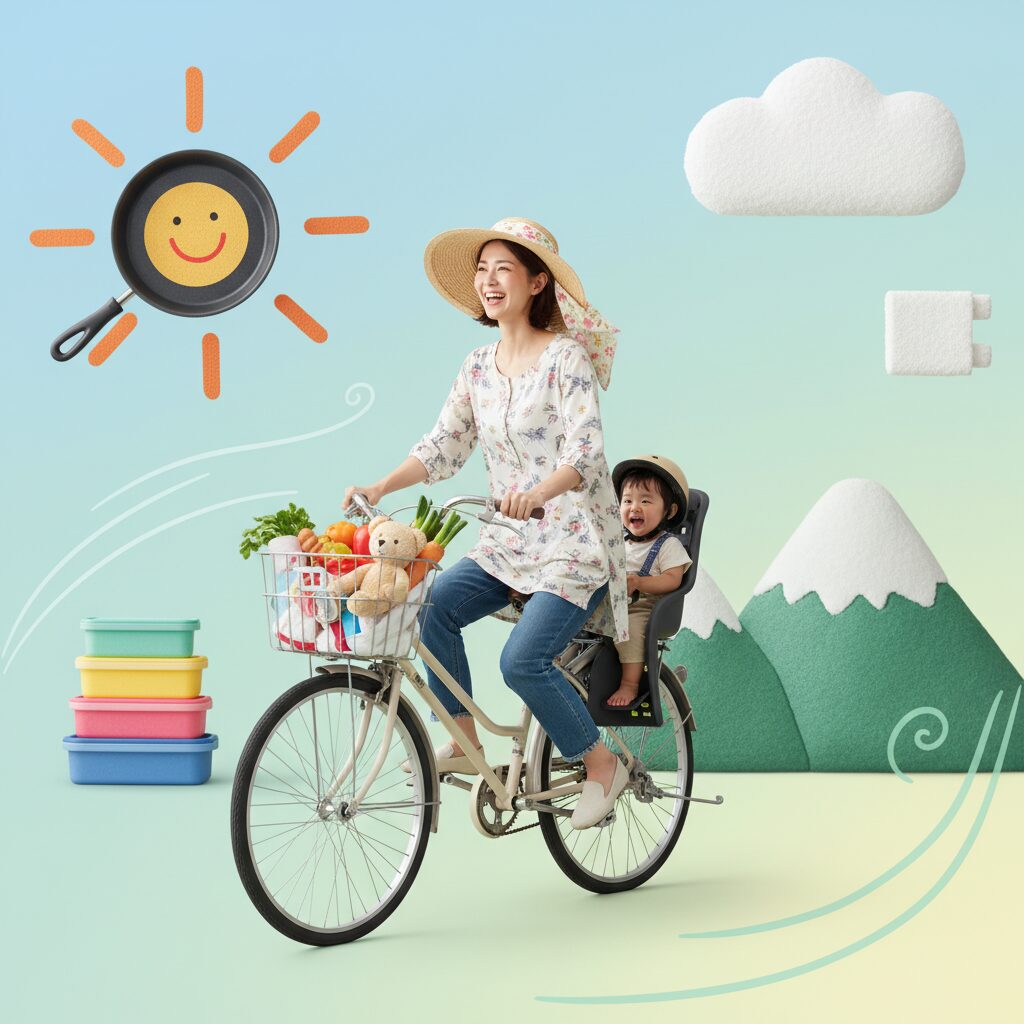
Yo, what’s up. Keiko here. Let’s get real for a sec. You’ve seen them, right? Scrolling through your feed, maybe on a trip to Tokyo. These Japanese moms, gliding through impossibly narrow streets on what looks like a bicycle that’s been seriously hitting the gym. There’s a kid in a high-tech seat in the front, another one in the back, and a mountain of groceries teetering in the basket. The mom herself? Totally unbothered, pedaling with the calm focus of a zen master, maybe even texting at a red light. It’s a whole mood. And your first thought is probably, “How? Just… how?” It looks like a physics-defying circus act, a beautiful, chaotic ballet of everyday life. But here’s the tea: this isn’t just a random quirky Japan thing. This is a system. A science. A culture on two wheels. And it’s governed by a thick, unwritten rulebook that every local mom seems to have downloaded directly into her brain. The bike is called a `mamachari`—literally, a “mom’s chariot”—and it’s more than just transportation. It’s the key to understanding the entire ecosystem of Japanese urban parenting. It’s a mobile command center, a symbol of freedom, and a ticket into a very specific, very powerful community. Forget the shrines and skyscrapers for a minute. If you really want to get why Japan is the way it is, you need to understand the way of the mamachari. It’s the realest look at the daily grind, the social pressures, and the low-key genius of modern Japanese life. So, buckle up—metaphorically, of course. We’re about to decode the unspoken rules of Japan’s ultimate mom-mobile.
If you’re inspired to explore more of Japan’s unique cycling culture beyond the city streets, consider experiencing the scenic beauty of the Shimanami Kaido cycling route.
Deconstructing the Beast: What Even Is a Mamachari?
More Than Just a Bike, It’s a Way of Life
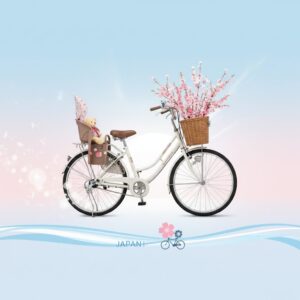
First things first, let’s dissect this machine. A mamachari is far more than just an ordinary bike with a basket. Calling it that would be like calling a high-end gaming PC a calculator. It’s a purpose-built urban assault vehicle crafted with meticulous attention to detail for one very specific user: the Japanese mom. Its design philosophy prioritizes practicality over aesthetics, and safety over speed. The frame gives the first hint—it’s almost always a low, swooping step-through style, sometimes called a U-frame. This isn’t merely for appearance; it allows a mom wearing a skirt or carrying a baby in a sling to get on and off without the impractical and frankly ungraceful high kick. It’s about preserving dignity and ease while managing a million tasks at once.
Next, there are the integrated features that come standard. Every mamachari includes a built-in lock on the rear wheel, known as the `o-gu rokku` (ring lock). You slide a lever, a metal bolt passes through the spokes, take the key, and you’re locked up—no hassle with heavy chains or U-locks. It’s a quick two-second process, essential for the many micro-stops throughout the day—post office, bakery, drugstore. The kickstand is another marvel of engineering—not a flimsy stick that lets the bike lean, but a wide, stable dual-leg stand that lifts the back wheel off the ground completely. When deployed, the bike stands perfectly upright and rock solid. Why? So you can safely load and unload squirming children and heavy groceries without fear of tipping over. It’s a genuine game-changer.
The swept-back handlebars encourage a comfortable, upright riding posture. You’re not hunched like a Tour de France cyclist; you’re sitting tall, like the captain of a ship, keeping watch for potential dangers. And the lighting—many models feature a dynamo hub on the front wheel, which powers the light automatically as you start moving. No batteries to worry about, no buttons to remember. It’s a foolproof safety feature because when you’re a mom, there’s already enough to keep in mind. The bike takes care of that for you. Every one of these design choices directly addresses an urban parenting challenge. It’s not just a bike; it’s a solution.
The Arsenal: Child Seats and Weather Gear
Now, let’s talk accessories, which are less “extras” and more like “essential life-support systems.” Child seats steal the show. In Japan, it’s legal to carry up to two children on a specially certified bicycle (`幼児2人同乗基準適合車`). Typically, this means one child in a seat mounted on the handlebars, and another in a larger seat on the rear rack. These aren’t just plastic buckets; they resemble personal safety pods from a sci-fi movie. Equipped with five-point harnesses, adjustable headrests, and foot guards to keep little feet from getting caught in the spokes. The front seat often has a small steering wheel or grab bar for the child to hold, giving them a sense of control while keeping them secure.
The real standout, though, is the weather gear. Japanese moms don’t let the weather slow them down. Rain? No problem. Transparent vinyl cocoons zip over the child seats, turning them into mini-greenhouses. The kids stay dry and entertained, peering out through their personal bubble, while mom takes the soak (usually protected by a high-tech poncho and rain boots). Summer? The fierce, humid Japanese summer is relentless. That’s when UV-blocking canopies and sunshades attach to the seats, shielding the kids from harsh rays. Winter? Handlebar mitts are essential—large, fleece-lined gloves permanently fixed to the handlebars, allowing moms to slide hands in and stay warm without fumbling for gloves. This gear isn’t a luxury; it’s standard equipment. The unspoken rule is the children’s comfort and safety come first. Mom is simply the engine, fueled by caffeine and sheer determination, braving whatever weather comes her way to complete the mission.
The Urban Jungle Gym: Why the Mamachari Reigns Supreme
The Geography of Convenience
So why this bike, and why in this place? The answer lies in the very structure of Japanese cities. Unlike the sprawling, car-reliant suburbs common in many Western countries, Japanese urban areas are remarkably dense. Everything you need for daily life is concentrated within a short radius around your neighborhood train station. Your apartment, the daycare (`hoikuen`), the supermarket, the pediatrician, the park, the post office—they’re all likely located within one or two kilometers. This is the mamachari’s domain. Using a car for these brief trips is completely unnecessary and a huge inconvenience. The streets are often frighteningly narrow, many are one-way, and finding parking is a persistent nightmare. You frequently have to pay for parking, even at the supermarket. In a city like Tokyo, a car is a luxury item, and for many young families, an expensive and nonessential one.
Public transportation, while world-class, has its drawbacks for a parent on a mission. Maneuvering a stroller, a toddler, and three grocery bags through a crowded train station at rush hour can be a particular ordeal. You have to navigate elevators, escalators, and the subtle yet intense social pressure of occupying too much space. In contrast, the mamachari offers complete, unfiltered freedom. It provides door-to-door service. You can load everything right at your apartment door and unload it immediately at the daycare entrance. It cuts through the hassles of urban living. It can weave through streets too narrow for cars, and with some skill, it can be parked in tiny spaces that cars can only dream of. The mamachari thrives in density. It’s the ideal vehicle for a world where everything is close—though not that close—and where space is the most precious commodity.
The Economics of the Daily Grind
Let’s talk finances, because that’s a big part of the picture. A decent, non-electric mamachari costs between 30,000 and 50,000 yen. A high-end electric-assist model from a leading brand like Panasonic, Yamaha, or Bridgestone can run upwards of 150,000 yen. That may sound expensive, but compare it to the cost of owning a car. In Japan, you don’t just buy a car; you must also prove you have a dedicated parking space (`shako shomei`), which in the city can cost 30,000 yen or more each month. Then there are expenses like insurance, fuel, and the biannual, wallet-draining vehicle inspection (`shaken`). Suddenly, that 150,000 yen bike looks like an amazing deal. It’s a one-time investment that provides years of nearly free transportation.
Even against public transit, the mamachari wins for the family’s Chief Logistics Officer (i.e., Mom). A short train ride costs a few hundred yen. If you’re making multiple trips a day—daycare drop-off, grocery run, park visit, daycare pick-up—those fares add up quickly. The running cost of a mamachari, especially a non-electric one, is practically zero. It represents economic sense and independence. For many families, particularly those living on a single primary income with one parent at home raising the children, the mamachari isn’t a choice; it’s a financial necessity. It’s the tool that keeps their entire household budget balanced. It enables access to all the city’s amenities without the staggering costs of car ownership or the daily expenses of riding the train. It’s the ultimate life hack for affordable urban living.
The Unspoken Code: Mastering the Art of the Ride

The Sidewalk is Lava (Except When It’s Not)
Now, here’s where things get interesting. This highlights the classic Japanese tension between the official rule (`tatemae`) and the reality of how things actually work (`honne`). Officially, bicycles are vehicles and should be ridden on the left side of the road alongside traffic. But in practice, if you’re a mom with two kids on a bike, cycling on a busy street with cars, buses, and trucks rushing past feels like a death wish. So, what’s the common solution? Everyone rides on the sidewalk. Although technically illegal in most cases, this is widely accepted and tolerated, especially for mamachari riders. However—this is a big however—you can’t just speed down the sidewalk as if it’s your domain. There’s a strict, unspoken code of conduct.
The top rule is that pedestrians reign supreme. You’re a guest in their territory. You must ride slowly and predictably, weaving gently around people and giving them plenty of space. You watch for the elderly’s cautious movements, the erratic paths of toddlers, and the salaryman absorbed in his phone. You become an expert in defensive riding. When the sidewalk is crowded, you dismount and walk your bike. Riding on the sidewalk means agreeing to a sacred contract: you will do everything possible to avoid disturbing, startling, or inconveniencing pedestrians. This is why you seldom see mamachari moms with headphones—they need all their senses to navigate this complex social environment. Break this code by riding too fast or aggressively, and you’ll earn disapproving glares and tuts, the ultimate tools of social enforcement in Japan.
The Art of the ‘Suzu’ (The Bell)
The bicycle bell, or `suzu`, is not an angry car horn. In the mamachari world, it’s a subtle communication tool with its own etiquette. Using it aggressively is a huge faux pas. You never ring it to demand someone move aside. Instead, its main purpose is to politely announce your presence. For example, when approaching a pedestrian quietly on the sidewalk and needing to pass, a soft, brief “chi-rin” from a safe distance means, “Excuse me, a friendly heads-up that I’m coming through on your right.” It’s almost an apology for your own presence. When nearing a blind corner where a bike or pedestrian might suddenly appear, a single ring serves as a precautionary warning. The loudest you should get is a couple of quick rings if another cyclist is about to swerve into your path without looking. But even then, it’s more like a startled “whoa there!” rather than an angry “get out of the way!” Tone is everything—it’s about harmony, minimizing friction, and maintaining the sidewalk as a peaceful, though sometimes crowded, shared space.
The Parking Game: A Battle of Inches
If riding is a dance, parking is a full-contact sport—a game of Tetris played with 20-kilogram machines. The designated bicycle parking lots outside train stations and supermarkets form a striking scene—a dense forest of silver bikes. Finding an empty spot during peak times is a small victory. But often, no defined spots exist—just a mass of bikes. This is where real skill is needed. You have to spot the negative space, the narrow gaps where your bike might fit. It demands a special kind of spatial reasoning.
Then comes the tricky part: often, you must gently move other people’s bikes to make room for yours. This is a delicate task. The unspoken rule is you can carefully slide a bike a few inches or lift its front wheel to angle it differently. You absolutely cannot be rough—you must avoid knocking the bike over or scratching it. The bike you move must remain stable and locked. This is a negotiation of space based on mutual respect. Everyone understands the challenge, so a bit of rearranging is tolerated as long as it’s done considerately. The worst offense is being a parking slob—leaving your bike at an odd angle, taking up two spots, or blocking the main pathway. You’ll be judged, and your bike may be among the first to receive some less-than-gentle rearranging by the next desperate parent trying to park before the grocery store sale ends.
The Social Fabric: Beyond Transportation
The Mamachari as a Status Symbol
Don’t be deceived by its practical appearance. The mamachari world is rich with social cues and status markers. While all mamacharis fulfill the same basic role, they are far from equal. There is a clear hierarchy, topped by the electric-assist (`denki-ashisuto`) mamachari. These are the Teslas of the playground. Equipped with a small electric motor that activates as you pedal, they make climbing hills and carrying heavy loads seem effortless. They come with a much higher price tag, and owning one sends a distinct message: “Our family invests in quality and convenience. I value my time and energy.” It’s a subtle yet powerful statement.
Brand loyalty also plays a huge role. The top three—Panasonic, Yamaha, and Bridgestone—are the Honda, Toyota, and Nissan equivalents of the mamachari world. They are viewed as dependable, safe, and wise choices. Opting for a cheap, no-name brand from a discount store might save money in the short term, but it can be perceived as cutting corners, something some might quietly equate with compromising child safety. Then comes customization, where personal style shines through. A cute, fashionable rain cover for the child seat, a premium helmet for the kid, a branded basket liner, or even a few well-placed stickers can transform an ordinary bike. This allows participation in consumer culture and identity expression within the tight boundaries of the “mom” role. The bike becomes an emblem of the family’s image: practical, safe, and just a bit stylish.
The ‘Mamachari Mafia’: Community or Clique?
You’ve likely heard rumors of the “Mamachari Mafia” or dreaded “park debut” tales. The stereotype is one of intimidating mom cliques, their identical high-end mamacharis lined up like a biker gang’s rides, silently sizing up newcomers at the park. While some mom groups can have cliquey tendencies, the reality is generally more ordinary and, honestly, more supportive. The mamachari is the vehicle that facilitates these essential social networks. These are not gangs; they’re support groups on wheels.
Moms gather during daycare drop-off and pick-up, parking their bikes side-by-side. They chat as their children play nearby, having all arrived on their trusted chariots. This is where vital, non-Googleable parenting information is exchanged. Which pediatric clinic is best? Is the produce at the new supermarket any good? How do you handle a picky eater? The mamachari serves as the linchpin of this hyperlocal, in-person social network. It offers mothers, who often feel isolated, a reason and a way to get out and connect with others navigating the same challenges. Of course, like any social group, dynamics can be complicated. There may be pressure to conform, to own the “right” bike, or to sign your children up for the “right” activities. But largely, the “Mamachari Mafia” is less about exclusion and more about solidarity in the shared, often exhausting experience of raising kids in the urban jungle.
The Dark Side: Perils and Pressures
It’s Not All Sunshine and Bento Boxes
Let’s be honest: the mamachari life is challenging. These bikes are incredibly heavy, especially the electric versions with their bulky batteries. A typical model can weigh over 20 kilograms. Add two kids (around 15kg and 10kg) and a week’s worth of groceries (another 10kg), and you’re maneuvering a 55kg (120lb) land yacht. Pedaling that monster up even a gentle slope feels like an Olympic-level workout. Your legs grow incredibly strong, but it’s physically demanding work. There’s a reason electric-assist models are so popular—they directly address this exhausting effort.
The weather is a constant foe. During the rainy season (`tsuyu`), you’re fighting heavy downpours. In summer, the heat and humidity are so intense that even a short ride leaves you soaked in sweat. In winter, the biting cold wind hits hard. Yet the schedule never changes. Daycare drop-off is at 9 AM, no matter rain, shine, typhoon, or heatwave. The mamachari mom has to be more reliable than the postal service. And then there are the hazards. Navigating traffic, even on side streets, is stressful. Cars emerge from blind driveways without a glance. Delivery scooters zip past. Pedestrians, glued to their phones, step into your path. Every ride demands hyper-vigilance. You carry the heavy psychological burden of knowing your children’s lives depend on you. It’s a huge responsibility, often invisible to the outside world that just sees a mom on a bike.
The Silent Rules of the Road
Beyond official traffic laws, there’s a subtler, more flexible set of rules guiding interactions in Japan’s cramped spaces. Who has the right of way in a narrow alley barely wide enough for one person? Is it the mamachari mom rushing to pick up a sick child, the elderly man on his daily walk, or the delivery worker on a tight schedule? There’s no written law for this. It’s an unspoken, instantaneous negotiation involving eye contact, a slight bow, or a subtle hand gesture. More often than not, everyone defers to everyone else in a dance of mutual politeness, with the mamachari mom usually given priority out of respect for her difficult task.
This reflects a culture of constant, low-level apology and consideration for others. The small nod you give a driver waiting for you to cross is a `gomen-nasai` (“I’m sorry for the trouble”). The soft bell ring is an apology for your presence. You are perpetually aware of your impact on the shared environment and strive to minimize it. This is a core principle in Japanese society—`meiwaku`, or not causing inconvenience to others. The mamachari rider masters this. They navigate not only physical space but social space, constantly calculating how to fulfill their mission without disturbing the fragile harmony of the street.
The Evolution and the Future
The Rise of the ‘Papachari’ and Beyond
The mamachari scene is gradually evolving. For starters, it’s no longer just associated with moms. As gender roles in Japan slowly shift, more fathers are actively engaging in daily childcare. Thus, the `papachari` has emerged. It’s essentially the same bike, but ridden by dads. Nowadays, it’s just as common to see a father in a suit dropping off his child at daycare on an electric mamachari before heading to the station. Bike makers are responding to this trend by offering models in more neutral, stylish colors like matte black or khaki, moving away from the traditional pastels and silvers. The bikes themselves are becoming sleeker, resembling urban cruisers more than the classic utility models.
Technology is also driving this evolution. Batteries are becoming lighter and longer-lasting. Digital displays are increasingly sophisticated. Safety features are continually upgraded. The mamachari is no longer a static object; it’s a constantly evolving product designed to meet the needs of the modern Japanese family, whatever form that family takes. It mirrors the gradual but steady changes occurring within Japanese society.
A Symbol of a Deeper Truth
Ultimately, the humble mamachari is far more than just a bicycle. It serves as a perfect microcosm of Japanese urban life. It embodies the phrase “necessity is the mother of invention.” It reflects a culture that prioritizes efficiency, safety, and clever design. It sheds light on urban geography realities, the economic pressures facing young families, and the crucial role of community networks.
The unwritten customs of riding a mamachari—the delicate maneuvers on sidewalks, the language of the bell, the courteous negotiation of space—mirror the unspoken rules of Japanese society in miniature. It’s about preserving group harmony (`wa`) while navigating a crowded, competitive environment. It captures the tension between formal regulations and practical necessities. It symbolizes the immense strength, resilience, and logistical brilliance of Japanese parents who perform remarkable multitasking feats every day to keep life running smoothly. So, next time you see a mom gliding by on her mamachari, with her kids and groceries in tow, don’t just view it as a quaint scene. See her as the captain of a well-oiled machine, a master of an unspoken code, and a true, unsung hero of the Japanese city. You’re not merely looking at a bike; you’re witnessing the heart of modern Japan.