
Walk down almost any major street in a Japanese city after dusk, and you’ll feel it before you see it. It’s a low, percussive hum that seems to emanate from the very concrete, a tidal wave of sound that spills out onto the pavement. Then, the light hits you—a pulsating, hypnotic wash of neon and LED, a digital siren call promising… well, what exactly? You’ve stumbled upon a pachinko parlor, a cornerstone of Japanese entertainment that is, for the uninitiated, as bewildering as it is dazzling. Forget what you know about casinos; this is something else entirely. It’s a vertical arcade, a cacophony of organised chaos, a place where millions of Japanese people come to engage in a ritual that’s part meditation, part sensory overload. This isn’t just about gambling; it’s about immersing yourself in a uniquely Japanese experience, a cultural phenomenon that’s straight-up a core part of the nation’s modern identity. It’s a loud, bright, and often misunderstood world, a real-life manifestation of the cyberpunk aesthetic that Japan so famously inspired. To step through those sliding glass doors is to step into a different dimension, one governed by the whims of a tiny silver ball.
The Symphony of Chaos: Deciphering the Pachinko Soundscape
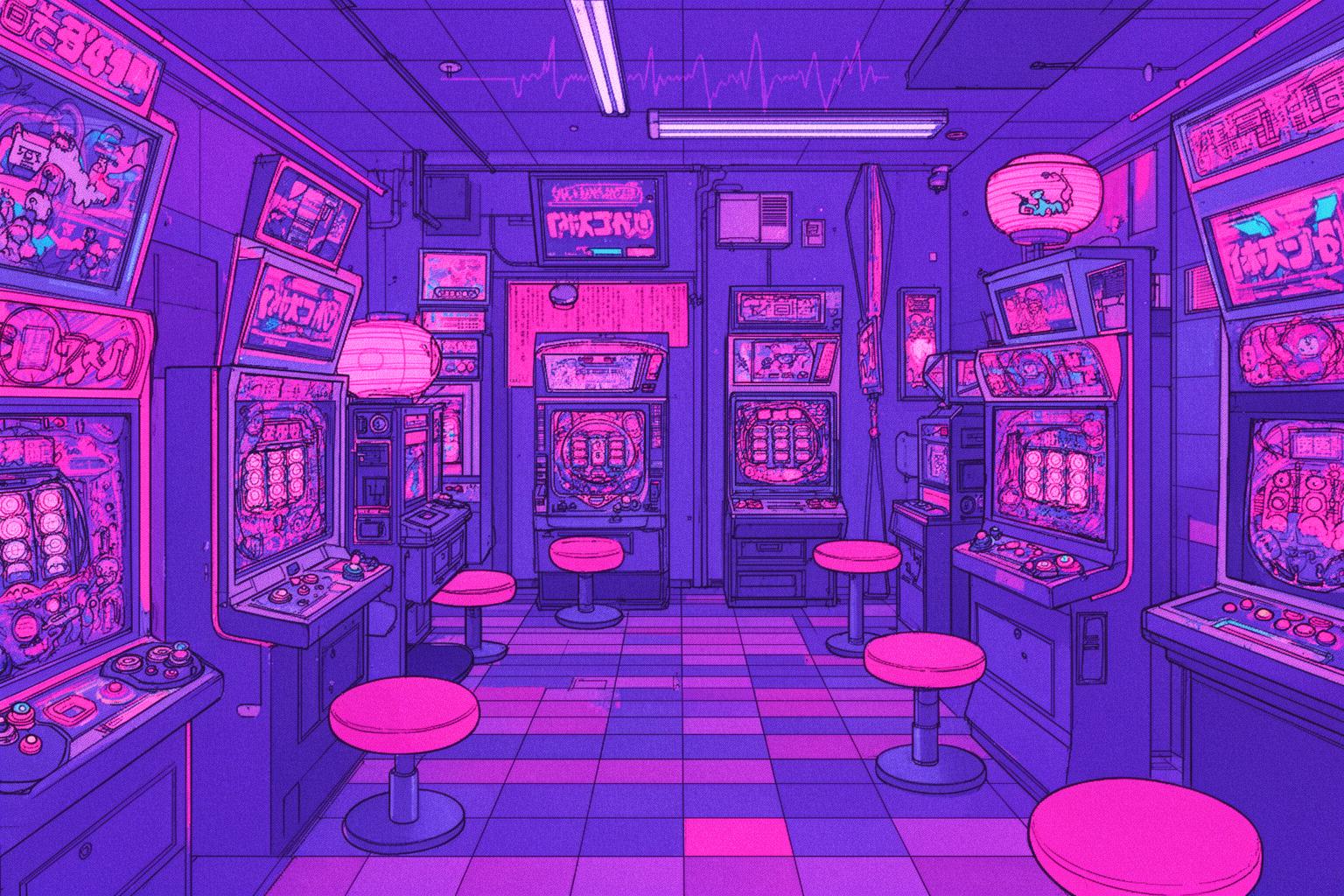
The first thing that really strikes you upon entering a pachinko parlor is the sound. It is a powerful, all-encompassing force. Calling it merely ‘noise’ would do it a disservice—it is a complex and layered acoustic environment that, in its own peculiar way, stands as a masterpiece of psychological engineering. It is a tangible presence, a wall of sound pressing in from every direction, vibrating through the floor and deep into your bones. To a newcomer, it’s an indistinct roar, the sound of countless tiny waterfalls tumbling over fields of metal pins. But listen more closely. Reflect on it for a moment, and the individual elements of this chaotic symphony start to emerge. The base layer is the relentless, percussive clatter of the silver balls themselves. It is the sound of possibility, of thousands of tiny destinies being determined every second. This is the parlor’s heartbeat, an unending metallic rain. It is the sound of the game at its most basic level—the kinetic energy of chrome-plated steel striking brass pins—a sound that has reverberated through these halls for nearly a century.
Above this foundation rises the electronic orchestra of the machines. Each pachinko machine is a self-contained universe of sound and light, a digital opera unfolding on a vertical stage. When a player hits a jackpot—an `ooatari` (大当たり)—the machine bursts into a celebratory crescendo. Alarms blare, speakers pump out triumphant tunes from popular anime or J-pop bands, and a synthesized voice congratulates the player with ear-piercing enthusiasm. In a large parlor filled with hundreds of machines, these jackpot anthems continually erupt from various corners, creating a disorienting yet exhilarating soundscape of overlapping triumphs. One moment you might hear the theme from Neon Genesis Evangelion, the next a hit from the pop group AKB48, merging and clashing into a surreal musical collage. This is no accident. The sound of winning is crafted to be contagious, to spark excitement and envy that urge others to keep playing, chasing their own moment of sonic glory.
Then come the more subtle yet essential sounds: the whirring of the ball-loading mechanisms, the gentle click-clack of the knob as a player finely adjusts the firing speed, and the near-silent tension of a `reach` (リーチ) sequence. A `reach` is a pre-jackpot animation—a dramatic build-up where the machine’s central LCD screen plays a cinematic clip, teasing the player with the promise of a big win. In these moments, the parlor’s background noise seems to fade for the player, their entire world contracting to that screen and its suspenseful music. The parlor’s overall atmosphere is carefully crafted. The constant clamor creates a sense of privacy within a crowded public space. It cocoons each player in a personal bubble of sound, allowing for an intensely intimate and meditative experience. Alone with your machine, locked in a duel of chance and slight skill, the outside world, with all its pressures and distractions, ceases to exist. It’s a mood, a trance-like state that is as much part of the experience as the game itself.
What Even Is This Game? A Beginner’s Guide to the Silver Ball
At its essence, pachinko is a deceptively simple game—a vertical pinball machine without flippers. You rent a bucket of tiny steel balls, load them into the machine, and turn a knob. That’s all there is to it. The knob adjusts the force with which a spring-loaded plunger shoots the balls, one by one, to the top of the game board. From that point, gravity takes charge. The ball tumbles down through a dense array of brass pins, following a chaotic and unpredictable path. The goal is to guide the ball into a specific winning gate, usually positioned near the center of the board. If you succeed, the magic begins. The machine springs to life, and a digital slot machine on the central LCD screen starts spinning. When the three symbols align, you hit the jackpot. The machine then releases a flood of thousands of new balls, which crash into the tray below with a thunderous and satisfying roar.
These balls represent your currency. They are what you play with and what you win. The more balls you collect, the better you’ve done. When you’re finished, you call a staff member who will pour your winnings into a special machine that counts them electronically and prints out a ticket with your total. This is where the system becomes a bit… complicated, but we’ll cover that later. For beginners, the sheer variety of machines can feel overwhelming. This is where the numbers come into play. You’ll see parlors advertising ‘4 Yen Pachinko’, ‘1 Yen Pachinko’, and even ‘0.5 Yen Pachinko’. This indicates the cost of a single ball. A standard 4-yen parlor is the high-stakes version. You can win big, but you can also lose your money very quickly. For those simply wanting to soak in the atmosphere and try it out, the 1-yen parlors are the way to go, no doubt. They are much more forgiving, letting you play for an hour or more with just a 1,000 yen bill. It’s the ideal place to get a sense of the game’s rhythm without spending too much.
It’s also important to distinguish between pachinko and its close relative, pachislot (パチスロ), which often share the same building, sometimes even the same floor. Pachislot machines are essentially Japanese slot machines. They use tokens or ‘medals’ instead of balls, and feature three spinning reels that players stop by pressing three separate buttons. While pachinko involves launching a ball and hoping for the best, pachislot offers a greater illusion of control, requiring players to time their button presses to halt the reels. In reality, both are largely games of chance, with outcomes mostly determined by the machine’s internal settings. However, they provide very different sensory experiences: pachinko focuses on the kinetic journey of the ball, whereas pachislot centers on the rhythmic challenge of stopping the reels. Both are essential to this neon-lit world, and many parlors split their space evenly between the two.
The Machines Themselves: A Universe of Digital Art and Mechanical Chance

The modern pachinko machine is a technological wonder, vastly different from the simple wooden boards of the post-war period. It combines high-definition video, complex mechanical parts, and advanced software, all encased in a flashy plastic-and-chrome frame. At the heart of almost every machine today is a huge LCD screen, often bigger than a tablet, which acts as the digital core of the game. This screen is where the true excitement happens. The slot machine animations have evolved far beyond just three basic spinning cherries; now, they offer an immersive cinematic experience. Most machines today are themed around licensed intellectual properties, such as popular anime, blockbuster films, well-known video games, or iconic pop stars. This is undoubtedly one of the main attractions for modern players. You’re not just playing pachinko—you’re engaging with your favorite fictional worlds.
Want to see mechs from Evangelion clash in battle? There’s a machine for that. Want to watch Kenshiro from Fist of the North Star unleash his famous moves? There’s a machine for that. Want to enjoy a virtual concert by a famous idol group? You can bet there’s a machine for that. These tie-ins are high-quality productions, featuring custom animations, original voice clips, and full soundtracks of classic songs. Playing one of these machines feels like watching a highlight reel of your favorite show’s most thrilling scenes, with the possibility of winning money. The visual and audio spectacle is the main draw. The `reach` sequences are the dramatic core of this experience. When a potential win is imminent, the machine doesn’t just spin reels—it may launch into a three-minute animated battle scene with multiple suspenseful stages. The hero might be losing, then a special character intervenes to help! Tension rises, the music swells, and flashing lights with moving plastic parts on the machine’s frame amplify the physical drama. It’s an adrenaline-filled piece of interactive theater designed to make your heart race, and it works incredibly well.
Beyond the screen, grasping the machine’s ‘state’ is essential. Two frequently mentioned terms are `kakuhen` (確変, short for 確率変動—probability variation) and `jitan` (時短, short for 時間短縮—time shortening). Hitting a normal jackpot is exciting, but achieving a jackpot that triggers `kakuhen` mode is the true objective. During `kakuhen`, the odds of hitting another jackpot increase dramatically, sometimes by tenfold. The machine enters a special ‘fever mode’ with unique animations and music, allowing the player to build a streak of consecutive wins, resulting in a huge payout of balls. This is the pachinko dream. `Jitan`, by contrast, is more of a consolation. After a non-`kakuhen` jackpot, you might enter a `jitan` phase lasting, say, 100 spins. During this time, the digital slots spin faster, and a small secondary gate on the board opens more frequently, helping you maintain your ball supply without needing to fire as many new balls. It gives you about 100 ‘free-ish’ chances to hit another jackpot before you return to square one. Understanding these modes, along with the data displays above the machine that indicate how many jackpots have occurred that day and how many spins have passed since the last one, is part of the deep meta-game that keeps experienced players coming back, hunting for the machine that’s ‘due’ for a win.
A Labyrinth of Legality: The Curious Case of Pachinko and Gambling
At the heart of the entire pachinko industry lies a central paradox—the well-known open secret sustaining its very existence. In Japan, gambling for cash is strictly illegal under Article 185 of the Penal Code, with a few notable exceptions such as horse racing and the lottery. Yet, pachinko is an industry worth trillions of yen, where players clearly enter with money and, if fortunate, leave with more. So, how does this happen? The answer is a clever, distinctly Japanese legal and logistical strategy called the `santen hōshiki` (三店方式), or the ‘three-shop system.’ This carefully crafted loophole allows the whole industry to function in a legal gray area, technically complying with the law’s letter while entirely bypassing its spirit.
Here’s how it operates. Once you finish playing and receive a ticket showing your winnings—say, 5,000 balls—you take it to a prize counter inside the pachinko parlor. Importantly, the staff there will not exchange your ticket for cash. Instead, they offer you a choice of ‘special prizes’ (特殊景品 – `tokushu keihin`), typically small, sealed plastic cases containing gold tokens, often ornately designed. These tokens’ value matches your winnings; for 5,000 balls, you might get one large gold token and several smaller ones. With these ‘prizes’ in hand, you leave the pachinko parlor. Nearby, often just around the corner, in a plain building or a small window marked ‘TUC’ (Tokyo Union Circulation), is the second shop. You take your gold tokens there, where an individual with no official connection to the pachinko parlor purchases them for cash. You hand over the plastic cases, they give you a bundle of yen, and the transaction ends.
But the cycle isn’t complete yet. The third ‘shop’ is a wholesaler. At the day’s end, this wholesaler buys all the gold tokens accumulated at the TUC shop and then sells them back to the pachinko parlor at the same price. The parlor is thus replenished with prizes for the following day. This intricate three-point system creates a crucial separation: the pachinko parlor never hands out cash directly, only prizes; the player legally sells a prize they’ve won to an independent business; and the wholesaler engages in simple commodity trading. No single step breaks the law on gambling. It is a masterpiece of legal fiction—an arrangement tacitly accepted and heavily regulated by the National Police Agency, which oversees the industry, sets machine standards, and ensures operations remain ‘above board.’ This system forms the foundation of the pachinko world, a complex choreography of plausible deniability that has let it thrive for decades despite a nationwide cash-gambling ban.
Exploring its history offers further insight. Pachinko originated in the 1920s with a children’s game called the ‘Corinth Game,’ but it truly surged in post-war Japan. In a resource-scarce country desperate for affordable entertainment and escape, pachinko parlors—requiring little more than mechanical boards and a supply of balls—became a national craze. From the outset, it was a gray market business operating in legal ambiguity. This ambiguity created vital economic opportunities for Japan’s Zainichi Korean community (ethnic Koreans residing in Japan). Facing systemic discrimination and exclusion from many mainstream careers, numerous Zainichi entrepreneurs turned to fringe industries like pachinko. They played a key role in building the industry from the ground up, and to this day, a sizable portion of pachinko parlor owners are of Korean descent. This complex legacy intertwines the industry with issues of immigration, identity, and the quest for economic survival in post-war Japan.
The Human Element: Profiles from Behind the Glass

Spend enough time in a pachinko parlor, and you’ll start to notice the people. At first glance, they may appear to be a uniform mass, rows of backs hunched over their glowing machines. But look more closely, and you’ll see a cross-section of Japanese society, each player absorbed in their own private world. The atmosphere is one of intense, almost meditative concentration. Social interaction is minimal. Conversation is nearly impossible over the noise, and players seldom speak to one another. There is an unspoken code: you do not touch another person’s machine, you do not comment on their play, and you certainly don’t celebrate loudly, disrupting the focus of those nearby. It is a deeply solitary activity carried out in a densely crowded space.
You will observe the elderly. For many senior citizens, especially in rural areas, the local pachinko parlor serves as a de facto community center. It is a place to go, a way to pass time, a daily ritual that structures their day. You will see grandmothers who have been occupying the same ‘lucky’ machine every morning for twenty years, their movements economical and practiced as they expertly flick the knob to find the perfect ‘sweet spot’ to launch the balls. You will notice the ubiquitous salaryman. After a grueling 12-hour day at the office, many men in suits stop by the parlor on their way to the train station. It acts as a pressure valve, a way to unwind and clear their minds before going home. For an hour, they don’t have to think about deadlines or bosses; their entire world narrows to the simple, hypnotic task of watching silver balls fall.
Then there are the devoted fans and the professionals. You’ll spot the anime otaku who come specifically to play the latest machine based on their favorite series, spending hours just to see all the special video clips and hear the character voice lines. In a corner, you might find a pachipro (パチプロ), a professional pachinko player. These are no ordinary gamblers. They are masters of data analysis, moving from parlor to parlor, studying the payout statistics of each machine, hunting for those that are statistically more likely to pay out. They play with cold, detached efficiency, their faces revealing no emotion, their goal not entertainment but profit. They represent the extreme end of the spectrum, turning this game of chance into a full-time, data-driven occupation. Together, these archetypes form the living, breathing ecosystem of the parlor, a silent community of individuals seeking different things—escape, entertainment, connection, or cold, hard cash.
Your First Spin: A Practical Playbook for the Intrepid Traveller
So, you’re ready to jump in. The idea of navigating this world can seem intimidating, but with a few simple steps, it’s surprisingly approachable. First, select your parlor. For beginners, large, bright, modern chains like Maruhan, Dynam, or D’Station are excellent options. They tend to be cleaner, less intimidating, and more used to seeing newcomers. As mentioned earlier, look for the ‘1 Yen Pachinko’ section, which will be clearly marked, often with a big ‘1円’ sign. This is your low-risk area.
Once inside, you’ll need to get some balls. In most modern parlors, you don’t use cash directly at the machines. Instead, find a machine resembling an ATM, insert a 1,000 or 10,000 yen bill, and receive a prepaid card. This card serves as your wallet for the day. Take the card to the pachinko machine you want to play. Choose one that’s empty and has a good number of balls left in the top tray from the previous player (a positive sign). Find the slot on the machine, usually to the left of the main knob, and insert your card. Press the ‘Tama Kashi’ (玉貸) button, meaning ‘ball rental.’ A few hundred balls, reflecting the amount of money you’ve loaded on your card, will be dispensed into the top tray. Now you’re ready to start playing.
Hold the large knob at the bottom right of the machine. Turning it clockwise launches the balls. A slight turn sends them weakly; a full turn sends them with maximum force. Your goal is to locate the ‘sweet spot’—the knob position that sends the balls into the most advantageous area of the playfield, usually down the left side. Observe where more experienced players aim their streams of balls. A constant stream is crucial; don’t just shoot one ball at a time. Settle in, find a good launch angle, and let the mesmerizing process begin. The balls will automatically be re-fed from your winning tray at the bottom back into the firing mechanism, so as long as you have balls in the tray, you can keep playing.
If you hit a jackpot, congratulations! The machine will go wild, and balls will pour out. Don’t panic. A staff member will likely notice and come to assist you. They’ll bring empty boxes and help transfer your winnings. If they don’t, just press the ‘yobidashi’ (呼出) or ‘call’ button, and someone will come over. When you’re ready to leave, press the ‘Card Return’ button to get your card back, then call the staff again. They’ll take your boxes of balls to a large counting machine near the prize counter. The machine will intake the balls and issue a ticket. Take this ticket, along with your prepaid card (which may still have remaining funds), to the prize exchange counter. They’ll give you your ‘special prizes’ and cash out any remaining balance on your card. Finally, find the small TUC window outside, hand over your prizes, and receive your cash. You’ve successfully completed the pachinko cycle. It’s a rite of passage and a story you’ll be sharing for years to come.
Beyond the Noise: Pachinko’s Place in Modern Japanese Culture

Despite its iconic status, the pachinko industry faces an uncertain future. By most measures, its golden era has ended. The number of parlors throughout Japan has been steadily declining for years. In the mid-1990s, there were over 18,000 parlors; today, that figure is less than half. The player base is also growing older. Younger generations, raised on smartphones and advanced console games, have not embraced pachinko with the same enthusiasm as their parents and grandparents. The sensory overload of the parlor now competes with the endless stream of entertainment accessible at your fingertips.
Government regulations have also tightened. In 2018, new rules were introduced that significantly limited the maximum amount a player could win in a single session. These changes were aimed at addressing gambling addiction, or `izonshō` (依存症), a serious social issue long linked to the industry. Although well-intentioned, these caps have diminished the ‘dream’ of a life-changing jackpot, reducing some of the high-stakes excitement for serious players and pushing them toward other, less-regulated gambling options. The COVID-19 pandemic also dealt a severe blow to the industry, as a business model relying on crowded, noisy spaces faced unprecedented challenges.
Yet, pachinko endures. It remains deeply woven into the cultural fabric. It reflects many aspects of the Japanese character: a love of intricate technology and dazzling spectacle, tolerance for ambiguity and ‘grey areas,’ the importance of ritual, and the notion of a contained, controlled escape from the immense pressures of a highly structured society. The parlor is a place where the rigid rules of the outside world are temporarily lifted, replaced by the simple, universal laws of gravity and chance. It is a site of escapism, a noisy sanctuary where, for a few hours, the only concern is the path of a tiny silver ball.
A Historian’s Final Thoughts
To dismiss the pachinko parlor as merely a low-end Japanese casino is to miss its true significance. It is far more than that. It is a living, breathing museum of post-war Japanese popular culture, a gallery showcasing evolving artistic and technological trends. The machines themselves are artifacts, time capsules of what was popular in a given year. It stands as a testament to the ingenuity of a society that created a multi-trillion-yen industry based on a legal fiction. It is a social space that serves a real purpose for millions, whether as a place for quiet reflection, a pressure-release valve, or a low-stakes community hub.
As a visitor to Japan, you owe it to yourself to at least take a peek inside. You don’t have to play for hours or spend much money. But to truly sense the pulse of urban Japan, you must experience that initial shockwave of sound and light. Stand for a moment and observe the ritual. Notice the intense focus on the players’ faces. Hear the cacophony of a dozen jackpots ringing out at once. In that moment, you are witnessing something uniquely Japanese. It is a noisy, chaotic, and beautiful part of the grand puzzle of this endlessly fascinating country. Go ahead, slide open the door. The silver balls are waiting.