
There’s a particular kind of density to a 1970s Japanese SLR. Pick one up for the first time—a Nikon F2, perhaps, or an Olympus OM-1—and the first thing that strikes you is the weight. It’s not the clumsy, plastic-heavy burden of a modern entry-level DSLR. It’s a cool, reassuring heft. It’s the weight of milled brass, steel gears, and polished optical glass. Your fingers naturally find the knurled metal dials, each one rotating with a satisfying, precision-engineered click. There is no menu button, no glowing LCD screen, no SD card slot. There is only a shutter speed dial, an aperture ring on the lens, and a film advance lever that you push with your thumb in a short, gratifying arc. When you press the shutter button, you don’t hear a synthesized chirp. You hear a sound—a swift, mechanical clack of a mirror flipping up and a shutter curtain slicing through the air. It’s the sound of a moment being captured by a purely physical process.
To hold one of these cameras is to hold a fascinating paradox. They are obsolete tools, long ago superseded by the digital convenience we carry in our pockets. Yet they are also, in many ways, perfect objects. They represent the absolute zenith of a certain kind of technology, a peak reached just before the digital avalanche changed everything. This wasn’t just any peak; it was a distinctly Japanese one. The 1970s were the golden decade when Japan’s camera industry, born from the ashes of war and forged through decades of relentless refinement, finally and indisputably ruled the world. The names that defined the era—Nikon, Canon, Olympus, Pentax, Minolta—became synonymous with quality, reliability, and innovation.
This isn’t an exercise in simple nostalgia, a wistful glance back at a bygone era. To understand these cameras is to understand a core tenet of the Japanese mindset towards manufacturing and craft. It’s to see how a national obsession with precision, durability, and thoughtful design could be distilled into a handheld machine. These cameras weren’t designed to be disposable. They were built to be companions, tools that would last a lifetime, document a family’s history, and maybe even be passed down to the next generation. They are still here, fully functional and eagerly sought after, not because of some retro fad, but because the philosophy that created them valued permanence over disposability. They are tangible, usable pieces of history, offering a direct connection to a time when making something well was, in itself, the ultimate goal.
This intrinsic dedication to precise, enduring craftsmanship in these vintage cameras echoes a broader cultural trend, exemplified by a mindful return to Japan’s traditional artistic practices that continue to influence modern innovation.
The Post-War Miracle and the Rise of the Camera Giants
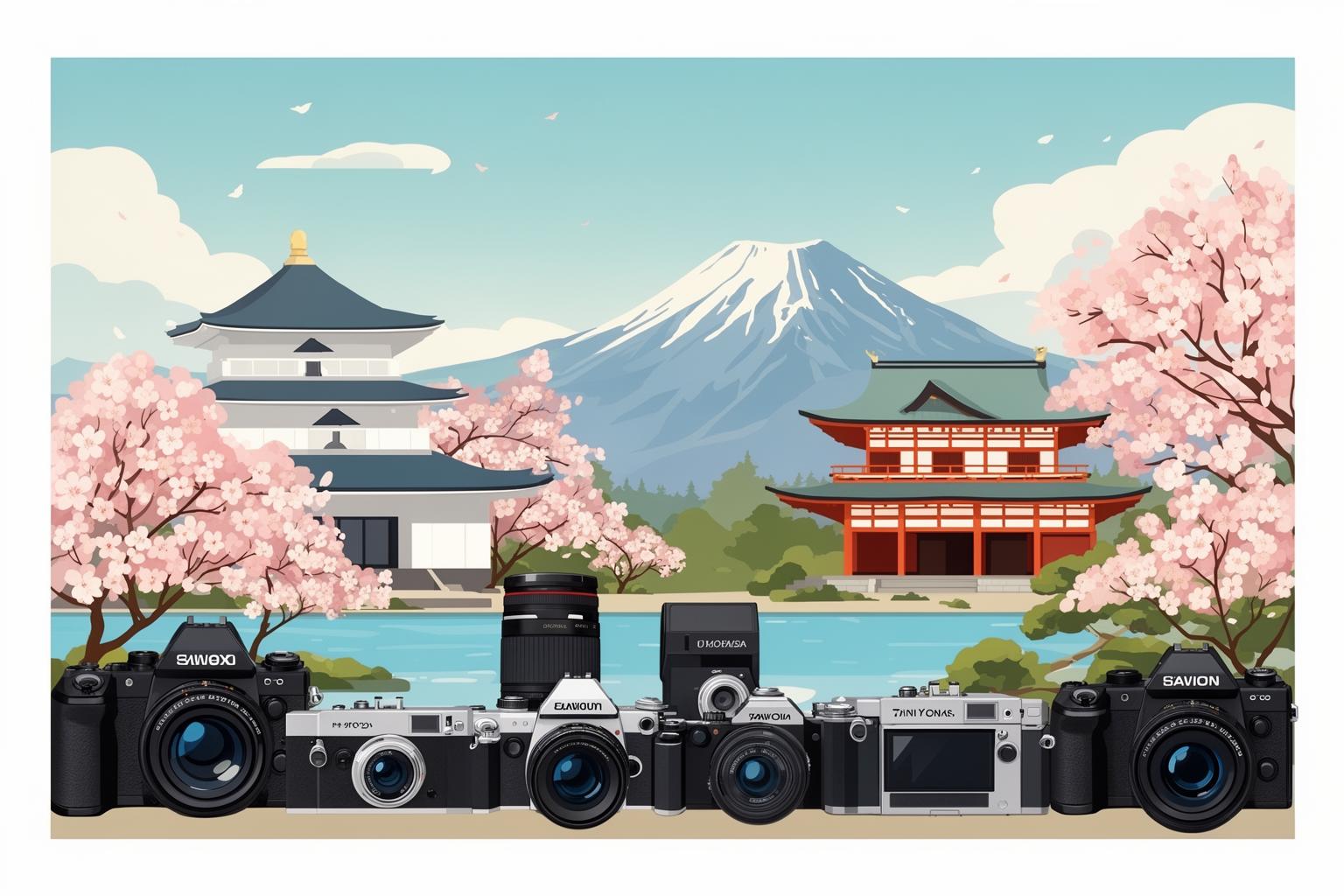
To truly appreciate the dominance of the Japanese camera industry in the 1970s, it’s essential to understand its origins. This success was not instantaneous but the result of a long, arduous ascent from the devastation of World War II. In the late 1940s and early 1950s, the gold standard for quality cameras was unmistakably German, with legendary brands such as Leica and Contax epitomizing excellence in optical and mechanical engineering. Early Japanese cameras, to say the least, were heavily influenced by these German designs. The companies that would later become industry leaders began by carefully dismantling, analyzing, and replicating these intricate devices.
From Imitation to Innovation
This initial stage of imitation is often misinterpreted. It wasn’t mere copying but a rigorous, nationwide apprenticeship. Japanese engineers were not simply reproducing blueprints; they were reverse-engineering a philosophy of precision. They mastered the intricate processes of lens grinding, gear milling, and metallurgical science. Through this, they didn’t just learn to imitate—they learned to enhance. They spotted flaws in the German designs, devised methods to streamline production while maintaining quality, and started introducing their own improvements. By the mid-1950s, the story began to change. Western photojournalists covering the Korean War noticed that lenses on their Japanese cameras—especially those from Nippon Kōgaku, later known as Nikon—were often sharper and more reliable than their German rivals. The student was rapidly becoming the master.
The SLR Revolution
The true turning point—when Japan claimed the crown—was their mastery and popularization of the single-lens reflex (SLR) camera. Unlike the rangefinder cameras that had dominated the high-end market, an SLR uses a mirror and prism system to let photographers see exactly through the camera’s lens. What you see is precisely what you get. This offered a tremendous advantage in composing shots accurately and working with various lenses. Although the Germans invented the concept, Japanese companies perfected it and made it the standard for serious photography. The decisive blow was the launch of the Nikon F in 1959. It was more than just a camera; it was a modular, professional system. With interchangeable viewfinders, focusing screens, motor drives, and an extensive collection of legendary Nikkor lenses, the Nikon F was a rugged, dependable workhorse capable of meeting any photographer’s demands. It soon became the preferred camera for photojournalists, from the battlefields of Vietnam to the pages of National Geographic.
The Electronics Race Begins
As the industry moved into the 1970s, a new frontier opened: electronics. This is what makes the decade particularly remarkable. Cameras remained fundamentally mechanical marvels but began incorporating increasingly sophisticated electronic components. The first major advancement was the through-the-lens (TTL) light meter, which measured light passing through the lens, providing much more accurate exposure readings than handheld meters. This technology flourished in the ’70s, leading to automatic exposure modes. Aperture-priority came first, allowing the photographer to set the lens aperture while the camera selected the correct shutter speed automatically. This was followed by shutter-priority, which operated in reverse. These innovations, pioneered by companies like Pentax and Canon, made photography more accessible without sacrificing manual control. Cameras in the 1970s struck an ideal balance: mechanically robust and repairable, yet smart enough to assist photographers. They represented the zenith of analog design, enhanced with just enough electronic intelligence to become incredibly versatile tools.
Anatomy of a Masterpiece: What Makes a ’70s Camera Endure?
Decades after their last production, thousands of these cameras are not merely collecting dust on enthusiasts’ shelves. Instead, they remain actively used worldwide every day. Their endurance and ongoing significance are no coincidence. This is a direct result of the design philosophy and material choices that shaped their creation—a philosophy deeply ingrained in Japanese culture.
The Philosophy of “Monozukuri” in Miniature
In Japan, there is a concept known as monozukuri. While often translated as “manufacturing,” this clinical English term falls short of conveying its true meaning. Monozukuri represents a fusion of technical skill, deep pride in one’s craft, and an unwavering quest for perfection. It embodies the spirit that drives a master swordsmith, a potter, or a team of engineers crafting a camera shutter. In the 1970s camera industry, monozukuri was the foundational principle. Every part, from the smallest screw to the intricate shutter mechanism, was designed and produced with meticulous attention to detail and durability. The objective was not merely to build a functioning product but to create a tool that felt intuitive, performed seamlessly, and inspired user confidence. This devoted craftsmanship is the key reason these cameras have so gracefully withstood the test of time.
Built to Last, Not to be Replaced
The idea of planned obsolescence would have been an anathema to designers of this era. These cameras were intended as lifetime investments. Their top and bottom plates were often crafted from heavy, chrome-plated brass. Over time, the chrome would wear off at the edges, revealing the warm, golden brass beneath—a patina called “brassing” that owners prize as a mark of honor, symbolizing a well-used instrument. The internal gears were made of metal, not nylon, and the chassis was a solid metal casting. Every component was built to be taken apart, serviced, and repaired by an experienced technician. This sharply contrasts with modern electronics, where the failure of a single chip can render the entire device expensive e-waste. A 1970s SLR can be cleaned, lubricated, and calibrated to factory specs, ready to serve for decades more.
The Tactile Sensation: Haptics and User Experience
Beyond mere durability, the brilliance of these cameras lies in their user experience. In an era before touchscreens and nested menus, the physical interface was paramount. Designers had a profound understanding of this. The positioning of every dial, the tension of every lever, the sound of every click—it was all part of a carefully orchestrated sensory feedback system. Moving the film advance lever on a Pentax K1000 offers a firm, ratcheted sensation. Adjusting the shutter speed dial on a Canon F-1 results in a series of clear, authoritative clicks that you can feel through your fingertips. The focusing rings on their lenses rotate with a smooth, dampened glide that makes achieving sharp focus a genuine pleasure. This tactile exchange between photographer and camera is nearly lost in the digital age. It forges a connection to the craft, making capturing a photo as fulfilling as the photo itself.
The Lens is the Heart
A camera body alone is incomplete without its lens, and the 1970s marked an extraordinary era for Japanese optics. Leading manufacturers invested heavily in lens development, producing some of photographic history’s most celebrated glass. This period was the golden age of the prime lens—a lens with a single, fixed focal length. Without the complexities of zoom mechanisms, designers could perfect sharpness, contrast, and color rendition. Each brand’s lenses bore a unique character. Pentax’s Super-Multi-Coated (SMC) Takumar lenses were acclaimed for their sharpness and exquisite rendering. Nikon’s Nikkors epitomized professional-grade durability and clarity. Olympus Zuiko lenses were remarkably compact yet optically outstanding. Minolta’s Rokkors were praised for their superb color and contrast. These lenses, with their all-metal construction and engraved markings, are optical gems that create images with a depth and character often elusive in modern, clinically perfect digital optics.
The Titans of the Decade: A Profile of the Key Players

While dozens of companies manufactured cameras, the 1970s market was dominated by a few giants, each with its own unique character and contribution to the photographic world. They were fierce rivals, and this competition accelerated innovation at an astonishing pace.
Nikon: The Professional’s Workhorse
Throughout the 1970s, Nikon remained the undisputed leader in the professional market. Its reputation was built on the F-system, with the decade belonging to its successor, the Nikon F2. Introduced in 1971, the F2 is widely considered by many as the finest purely mechanical 35mm SLR ever produced. While not revolutionary in its features, it was an evolutionary masterpiece of refinement and reliability. It was tougher, faster, and more ergonomic than the original F. The F2 was a completely modular system camera that could be tailored for any task, from studio portraiture to combat photography. It was the camera that recorded history, trusted by professionals who couldn’t afford to miss a moment. Holding an F2 today feels like holding a solid ingot of pure competence. Every control moves with the precision of a bank vault tumbler. It epitomizes the over-engineered, built-for-anything philosophy.
Canon: The Innovator and Challenger
If Nikon was the established ruler, Canon was the brilliant and ambitious challenger, constantly pushing technology to deliver advanced features to a broader audience. Canon’s defining camera of the decade was not its professional F-1 model (a worthy rival to the Nikon F2) but the revolutionary AE-1, introduced in 1976. The AE-1 was the world’s first SLR to incorporate a central processing unit (CPU). By employing microelectronics, Canon greatly reduced the number of moving parts, making the camera more affordable to produce and more reliable. It offered shutter-priority automatic exposure, a feature previously found only on costly professional cameras. Supported by a massive advertising campaign, the Canon AE-1 sold millions, becoming the camera that introduced a generation of amateurs to serious photography. It perfectly embodied the spirit of the late ’70s, blending mechanical tradition with the promise of an electronic future.
Olympus: The Genius of Compact Design
While Nikon and Canon competed for dominance with their large, heavy professional systems, Olympus took a radically different approach. Under the leadership of their legendary chief designer, Yoshihisa Maitani, Olympus challenged the notion that professional quality required size and weight. The result was the Olympus OM-1 in 1972, a sensation at the time. The OM-1 was a full-featured, professional-grade SLR that was significantly smaller and lighter than its rivals. Maitani and his team re-engineered every component to save space and reduce weight, while incorporating a viewfinder larger and brighter than nearly anything else on the market. The OM-1 was followed by the OM-2, which added a highly sophisticated automatic exposure system. The OM system was a triumph of design philosophy, proving that power and elegance could coexist in a compact package. It was a camera for the thoughtful photographer, the traveler, and the artist who desired capability without burden.
Pentax (Asahi Optical): The Quiet Achiever
Pentax carved out a distinctive niche as the thoughtful, user-oriented brand. It had a history of innovation, being the first Japanese company to introduce an instant-return mirror and TTL metering. In the 1970s, Pentax solidified its reputation with two iconic lines. The first was the Spotmatic series, culminating in the Spotmatic F, a beautifully crafted camera with an excellent feel. However, the camera that truly defined Pentax for a generation was the K1000. Introduced in 1976 and produced for over twenty years with minimal changes, the K1000 was the ultimate no-frills, purely manual camera. It featured a light meter and controls for shutter speed, aperture, and focus—and that was all. Its simplicity and remarkable durability made it the standard camera for photography students worldwide. It was a pure learning tool, a camera that forced users to grasp the fundamentals of exposure. Paired with the superb SMC Pentax lenses, the K1000 was a humble masterpiece of functional design.
Minolta: The Underdog with Bright Ideas
Often overshadowed by Canon and Nikon, Minolta was a hotbed of innovation throughout the decade. They consistently introduced clever features and formed strategic partnerships that advanced the industry. Their greatest achievement of the era was the XD series (known as the XD-11 in North America and the XD-7 in Europe and Japan), launched in 1977. The Minolta XD was the world’s first camera to offer both shutter-priority and aperture-priority automatic exposure, alongside a fully manual mode. It provided photographers with unprecedented creative flexibility. It was a quiet, refined, and highly capable camera, with a smooth, almost silent shutter. Minolta also famously collaborated with the German legends at Leica, co-designing the Leica CL and producing some exceptional lenses under both the Minolta Rokkor and Leica names. This partnership attested to the high esteem in which Minolta’s engineering and optical expertise were held.
The Experience of Shooting Film in a Digital World
Why bother with these old machines in an era when your phone can capture technically flawless images and instantly share them with the world? The appeal doesn’t lie in rejecting technology, but in embracing a different kind of process—one that is more deliberate, more tactile, and ultimately, for many, more fulfilling.
A Deliberate Pace: The “One Shot” Mentality
With a digital camera, memory is inexpensive and feedback is immediate. It’s easy to shoot hundreds of photos in an afternoon, often referred to as “spraying and praying.” Film, however, demands a different approach. A roll of film typically contains only 24 or 36 exposures. Each press of the shutter carries a real cost in both money and opportunity. This limitation is, paradoxically, freeing. It compels you to slow down. It encourages careful thought about what you observe—the quality of the light, the strength of the composition, the decisiveness of the moment. You become more invested in each frame because you know you have only one chance to get it right. It transforms your relationship with seeing, turning it from passive documentation into active creation.
The Community and the Ritual
Using a 1970s camera connects you to a vibrant, passionate global community. This subculture is built on shared knowledge and a love for the analog process. In Tokyo, legendary camera districts like Shinjuku and Ginza still abound, with shops filled floor-to-ceiling with vintage equipment, staffed by expert enthusiasts. Online forums and social media groups are full of people sharing their work, offering advice on rare camera repairs, and debating the virtues of different film stocks. There is also the ritual inherent in the process itself: loading film in the dark, the anticipation of finishing a roll, and the magic of seeing your images for the first time—not on a screen, but as physical negatives or prints. In this ritual, happy accidents—the unexpected light leak, pronounced film grain, subtle color shifts—are not viewed as flaws but as essential parts of the unique, analog character of the image.
Keeping the Classics Alive: Repair and Maintenance
The lasting usability of these cameras is a testament to their design. Being mechanical, they can be repaired. A smartphone with a fried logic board becomes a paperweight. A Nikon F2 with a sticky shutter can be taken apart, cleaned, lubricated, and restored by a skilled technician. Across Japan, and in pockets worldwide, aging masters dedicate their lives to servicing these cameras. They are the custodians of a mechanical legacy. This repairability also fosters a deeper sense of ownership and respect for the tool. You don’t just own it; you become its steward, responsible for maintaining a piece of precision engineering so it can continue to perform as intended.
To pick up one of these cameras today is to do more than indulge in a bit of retro tech. It’s to engage with a piece of cultural history, a time capsule from when Japan’s industrial ambition perfectly aligned with its deep-rooted tradition of craftsmanship. These cameras are not relics. They are beautifully crafted tools that still function as flawlessly as the day they left the factory. In a world of fleeting digital streams and disposable goods, they offer a compelling counterpoint: the quiet satisfaction of a well-made object, the measured pace of a thoughtful process, and the enduring magic of capturing light on film through a masterpiece of Japanese engineering.