You’ve probably seen the pictures, even if you don’t know the name. A giant, yellow pumpkin covered in black polka dots, sitting alone at the end of a pier, the calm sea stretching out behind it. That pumpkin, a creation by Yayoi Kusama, has become the unofficial mascot for Naoshima, an island in Japan’s Seto Inland Sea. It’s a striking, whimsical image. But it’s also a clever piece of misdirection. It hints at the art, but it tells you almost nothing about the island’s true, radical identity. Naoshima isn’t just a place with some quirky sculptures; it’s a grand, decades-long experiment in how architecture can heal a wounded landscape and fundamentally change our relationship with art and nature. It’s an island where monumental, severe concrete structures—the kind of thing you’d associate with imposing government buildings—are used to create moments of incredible intimacy with a single painting or a sliver of sky. The story of Naoshima is the story of an almost unbelievable transformation: how a remote island, scarred by industrial waste and facing depopulation, was reborn as a global pilgrimage site for lovers of art and architecture. It’s a place built on the audacious belief that the starkest of man-made forms can have a conversation with the softest of natural landscapes, and that in their dialogue, something profound can be created. This isn’t just about putting art on an island; it’s about embedding art into the island, burrowing it into the earth, and using architecture as the vessel for a unique kind of secular worship. To understand Naoshima is to understand the unlikely, powerful symbiosis of Brutalism and the serene Japanese coast.
This profound connection between environment and well-being is reminiscent of the principles behind the Japanese practice of Shinrin-yoku, or forest bathing.
The Island That Was Forgotten
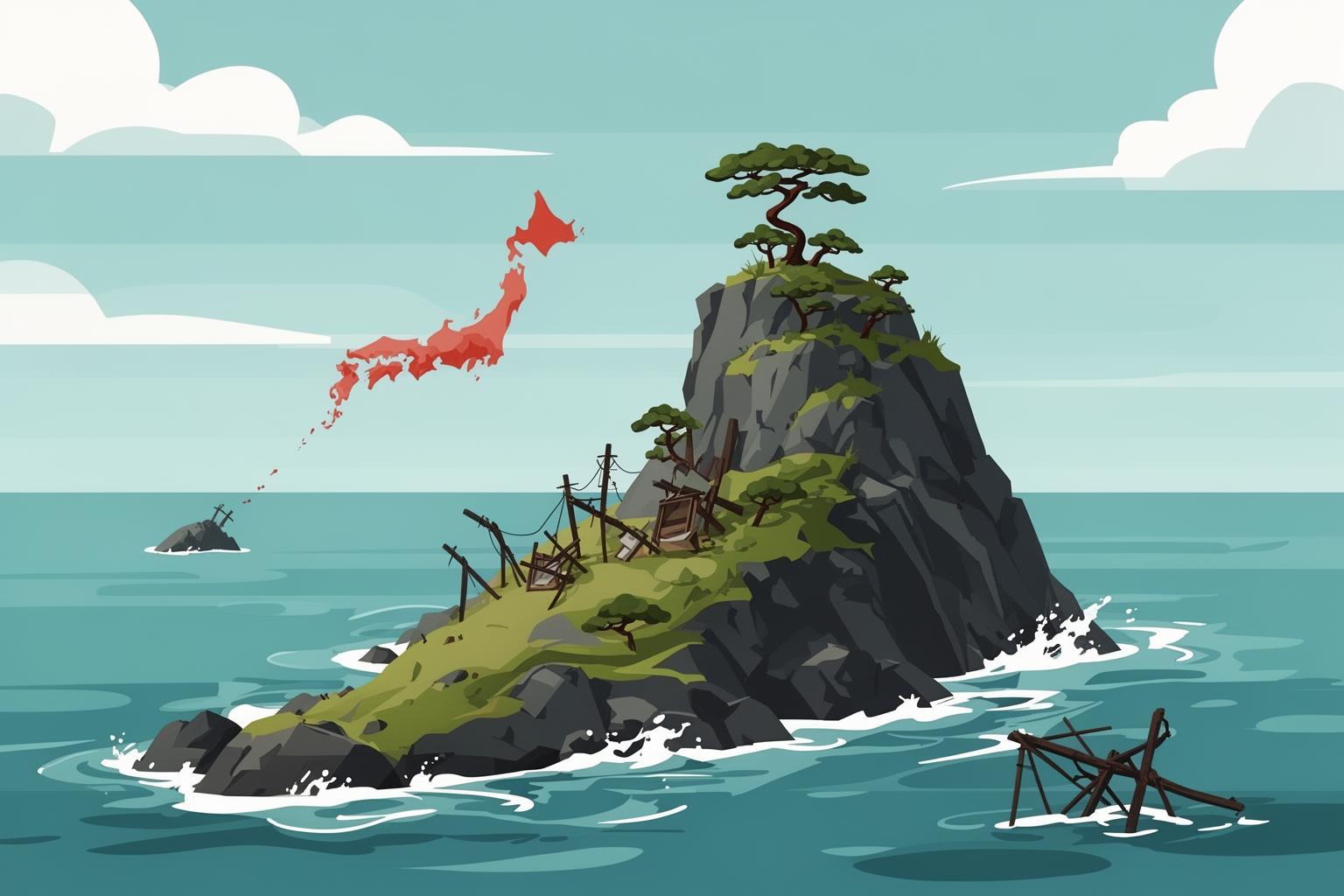
Before art, there was industry. Naoshima’s modern history is deeply intertwined with the Mitsubishi Materials corporation, which established a large-scale copper refinery on the island’s northern region in 1917. For decades, this refinery was the island’s lifeline, providing employment and shaping the local economy. However, it came at a significant environmental cost. The refining process emitted sulfur dioxide, causing acid rain that stripped the island’s hillsides bare, leaving them barren and red. Industrial waste, or slag, was carelessly discarded, forming toxic black heaps. By the latter half of the 20th century, as Japan’s industrial economy shifted, the refinery’s importance began to decline. Like many rural areas in Japan, the island faced the twin challenges of a faltering industry and a rapidly aging, shrinking population. The young moved away to seek opportunities in the big cities, and Naoshima risked becoming just another forgotten outpost, marked by a poisoned landscape and a fading future.
An Unlikely Visionary
The island’s destiny began to shift thanks to a man with a profoundly different vision. Soichiro Fukutake, the billionaire founder of the Benesse Corporation—a company primarily known for education and language correspondence courses—perceived something unique in Naoshima. His father, Tetsuhiko Fukutake, had dreamed of creating a place where children from around the world could gather in a beautiful natural environment. After his father’s passing, Soichiro embraced this vision but expanded it into a much more ambitious philosophy. He imagined a project that would integrate contemporary art, architecture, and the restored nature of the Seto Inland Sea. This was not merely about building a museum; it was a comprehensive concept he named “Benesse,” a blend of the Latin words bene (well) and esse (being). The goal was to create a space where people could contemplate the meaning of “well-being” through encounters with art and nature. Fukutake believed that economic decline and environmental degradation in places like Naoshima were symptoms of a society gone astray—one that had prioritized soulless capitalism over humanistic values. His remedy was art—not art confined to sterile urban galleries, but art that demanded a direct, physical, and emotional connection with its surroundings.
The Architect of Light and Shadow
To bring such a radical vision to life, Fukutake needed an architect sharing the same philosophical vision. He found his match in Tadao Ando, a self-taught, Pritzker Prize-winning architect from Osaka renowned for his masterful use of a single primary material: smooth, exposed concrete. At first glance, this choice seems puzzling. Why introduce the emblem of urban Brutalist architecture into a fragile island environment undergoing restoration? Why use a material that appears cold, hard, and unyielding in a place shaped by water, wind, and light? This question strikes at the core of what makes Naoshima unique. Ando’s architecture isn’t about dominating the landscape. It’s about employing the starkness of concrete to frame, shape, and ultimately intensify the viewer’s experience of the natural surroundings.
Tadao Ando’s Concrete Poetry
Though Ando’s work is often labeled minimalist, this isn’t entirely accurate. It is elemental. He treats concrete not as a low-cost building material but as a plastic, sculptural medium capable of forming vast, tranquil surfaces and sharp, dramatic shadows. His buildings practice restraint. He removes decoration, color, and distraction to direct your focus on three essentials: the texture of the material itself, the geometry of the space, and above all, the interplay of natural light. Light in an Ando structure is more than mere illumination; it is a fundamental building element. It streams through razor-thin skylights, slicing across concrete walls. It filters down long corridors, guiding your path. It floods into courtyards, making the sky appear impossibly blue against the gray walls. His spaces are designed as journeys. You don’t simply arrive at a viewpoint; you are led there through a carefully choreographed sequence of spaces—dark hallways opening into bright atriums, confined passages that abruptly reveal sweeping ocean views. This progression is intended to cleanse your mental palette, to shift you from everyday thoughts and prepare you for the aesthetic experience ahead.
Why Brutalism on a Rural Island?
The term “Brutalism” derives from the French béton brut, meaning “raw concrete.” It’s often linked to imposing, bulky structures that can feel oppressive. Yet Ando’s use of it on Naoshima is distinct. It is a refined, almost spiritual Brutalism. He recognized that revering nature doesn’t always mean imitating it. At times, the most powerful way to appreciate a tree, a patch of moss, or the sea is to view it framed by something entirely opposite. The smooth, precise geometry of an Ando wall accentuates the wild, organic texture of the surrounding foliage. A concrete corridor nestled into a hillside makes the final framed ocean view feel like a transcendent revelation. The architecture doesn’t compete with nature; it engages in dialogue with it. It is a man-made presence that is honest about itself, and in this stark honesty, it allows the natural world to resonate with greater clarity. The concrete is not there to dominate; it exists to serve. It serves the light, it serves the landscape, and ultimately, it serves the art.
Journeys into the Earth: The Museums of Naoshima
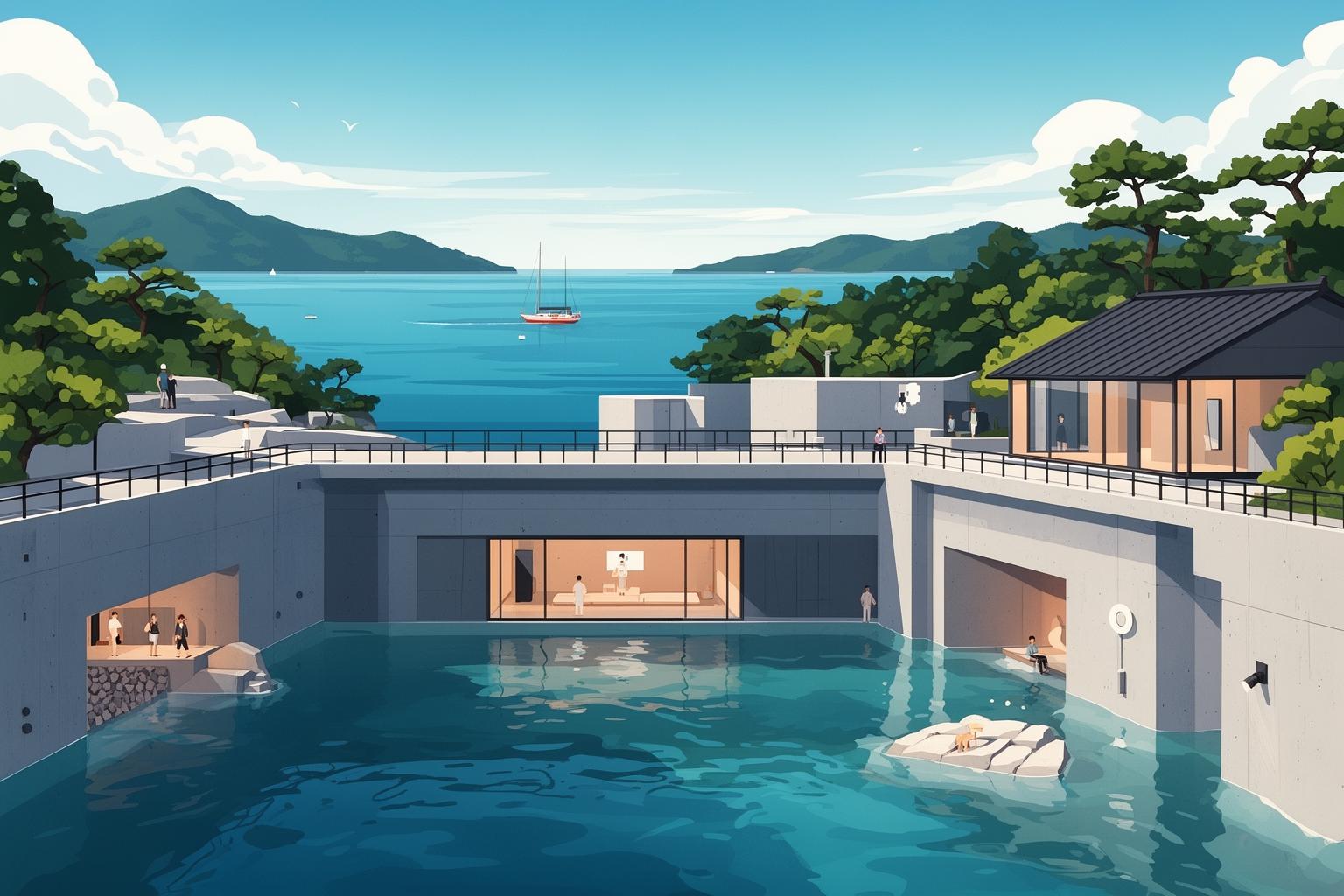
The architectural experience on Naoshima revolves around three key museum sites, all designed by Ando. Each site is a unique world, exploring the interplay between art, architecture, and nature in its own distinct way. They serve not only as containers for art but also as essential components of the artwork itself.
Benesse House: Sleeping Within the Museum
The first major project, which opened in 1992, is Benesse House. This building immediately blurs the traditional lines between museum and hotel. Its revolutionary concept invites you not just to visit the art, but to live alongside it. Positioned on a hill overlooking the southern coast, the structure comprises clean, geometric concrete forms that both cascade down the slope and command the landscape. The Museum wing houses galleries and guest rooms under one roof. You might find yourself walking from your room to breakfast past significant works by artists like Bruce Nauman or Yukinori Yanagi. The architecture masterfully frames the surroundings. Large picture windows transform views of the Seto Inland Sea and nearby headlands into living paintings. Long, open-air ramps and staircases compel you to move between indoors and outdoors, continually reconnecting with the sea breeze and the sound of waves. This building establishes Naoshima’s core principle: art is not a separate activity but an integrated part of your existence—something you wake up to and fall asleep with. Its quiet, solid presence fosters a meditative atmosphere, serving as a peaceful counterbalance to the ever-changing sea and sky.
Chichu Art Museum: A Sanctuary of Light
While Benesse House blends art with its landscape, the Chichu Art Museum—completed in 2004—takes the bold step of embedding itself within the landscape. “Chichu” means “in the earth.” From above, the museum is nearly invisible, with only the geometric outlines of sunken courtyards and skylights interrupting the green hillside. To protect the natural beauty of the park above, Ando chose to construct nearly the entire museum underground. Visiting the museum feels like a pilgrimage. You ascend a gentle hill, pass a garden inspired by Monet’s at Giverny, and enter a stark concrete portal. From there, you descend into subterranean corridors and chambers illuminated solely by natural light. The museum permanently houses works by just three artists, making it a sanctuary rather than a gallery with rotating exhibits. The first gallery is dedicated to Claude Monet, showcasing five of his late Water Lilies paintings in a vast, white-walled room with rounded corners. The floor consists of thousands of tiny marble cubes, and soft, diffuse light filters through a hidden skylight. Visitors are asked to remove their shoes, a small ritual that elevates the viewing experience into one of reverence. The architecture removes distractions, allowing Monet’s paintings to emanate an almost spiritual energy. The second space features Walter De Maria’s installation “Time/Timeless/No Time,” set in a cathedral-like hall. A massive polished granite sphere rests atop a grand staircase, flanked by gilded wooden sculptures along the walls. Light streams in from a long skylight above, shifting with the time of day and weather to alter reflections on the sphere and shadows in the room. The work meditates on cosmic scale and the passage of time, with the architecture actively enhancing this effect. Finally, James Turrell’s pieces use light itself as their medium. His works on Naoshima challenge perception, creating rooms where light feels tangible or dark chambers where faint geometric forms gradually emerge from the blackness. Here, the architecture becomes a perfect void, a blank canvas for Turrell’s striking manipulations of light and space. Upon leaving Chichu, you feel transported beyond ordinary time to a place where architecture is finely tuned to reveal light, color, and form.
The Lee Ufan Museum: A Conversation Between Stone and Steel
The third major museum is a collaboration between Ando and Korean minimalist artist Lee Ufan. Opened in 2010, this semi-underground museum offers a quieter, more contemplative atmosphere. Lee Ufan’s work often juxtaposes natural stones with industrial steel plates, creating a dialogue between the untouched and the manufactured. Ando’s architecture mirrors this philosophy. The approach to the entrance is a long, high-walled concrete corridor that isolates you from your surroundings, focusing your attention forward. The museum itself consists of a series of discreet galleries where Lee’s minimalist, powerful works have ample space to resonate. Here, the relationship between art and architecture is one of shared understatement. A single stone and a steel plate placed in a bare concrete room, illuminated by a narrow skylight, become a profound meditation on materiality, presence, and the space between objects. The building doesn’t shout—it whispers, crafting a serene environment for the quiet poetry of Lee Ufan’s art.
Art Breathes in the Village: The Honmura Art House Project
While the monumental museums on the south coast are Naoshima’s main attraction, the heart of the island’s revival can be found in the small port town of Honmura. Here, the Benesse Foundation launched the Art House Project, a distinctly different way of integrating art into the community. Rather than constructing new buildings, the project repurposes empty, abandoned traditional Japanese houses, transforming them into permanent art installations in collaboration with artists. This is where art literally becomes part of the neighborhood. Visitors purchase a combined ticket and explore the narrow, winding streets of the old village, searching for the seven “art houses.” Each one offers a unique encounter. At Kadoya, a 200-year-old home, you enter a dark room with a shallow pool of water, where a brilliant LED counter by Tatsuo Miyajima cycles through numbers at speeds set by local townspeople—a glowing, digital river of time. At Minamidera, Ando created a completely new wooden structure on the site of an old temple. You enter total, disorienting darkness and are guided to a bench. Gradually, over several minutes, as your eyes adjust, a faint, ethereal rectangle of light from a James Turrell installation emerges in the blackness before you. It’s a breathtaking experience that relies entirely on your own perception and patience. The Art House Project offers a gentler, more intimate form of intervention. It respects the history and architectural character of the village while breathing new life into it. It turns a stroll through town into a treasure hunt, blurring the boundary between everyday life and high art. You might see an elderly resident tending their garden beside a building that houses a world-class art installation. This project ensures that the art on Naoshima isn’t just for tourists visiting grand museums; it’s woven into the very fabric of the community it was designed to revive.
The Unspoken Language of Space

What truly defines the Naoshima experience isn’t simply the individual artworks or buildings, but the way the entire island operates as a carefully curated journey. The journey itself—a sequence of trains followed by a brief ferry ride—already initiates a sense of separation from the mainland and everyday life. Once on the island, moving between sites requires time and effort. You walk, take a shuttle bus, or perhaps rent a bicycle. This intentional pacing is part of the design, discouraging you from rushing through masterpieces in a checklist fashion. The spaces between the art are just as significant as the art itself. A ten-minute walk from Benesse House to the Lee Ufan Museum becomes an opportunity to breathe in the sea air, notice the light reflecting on the water, and decompress from one aesthetic encounter before starting another.
A Symbiosis, Not a Conquest
This brings us back to the central paradox: the concrete and the coast. After spending time on Naoshima, you realize Ando’s architecture is successful because it doesn’t attempt to imitate nature. It possesses its own integrity and quiet strength. Because of this, it forms the perfect contrast. A concrete wall stands as a constant reminder of human will and intellect, while the sea, visible through a perfectly square opening in that wall, symbolizes a force that is older, vaster, and untamable. On Naoshima, these two elements are not in conflict but exist in dynamic balance. The architecture offers the frame, the focus, the moment of stillness that allows you to perceive the chaos and beauty of the natural world with heightened clarity. You don’t just see the sea; you experience it as a composition, framed in gray. It’s a profound lesson in how human intervention in a landscape need not be destructive. Instead, it can act like acupuncture—a precise and thoughtful placement of elements that redirects the energy of a place, making it healthier.
The Enduring Paradox
Naoshima is not an immaculate, untouched paradise; rather, it is a carefully curated, man-made environment. The northern half of the island still houses its industrial refinery. The transformation remains a work in progress, an ongoing project. Yet, its success is undeniable. It has established a sustainable model for cultural tourism that has revitalized the local community and transformed a forgotten island into a global icon. More than that, it has created a new kind of space. It is neither a city nor wilderness. It is something else entirely: a landscape of contemplation. It stands as a testament to a long-term vision—one that recognized that pouring concrete, when approached with a poet’s sensitivity and a philosopher’s purpose, could become an act of healing. Naoshima demonstrates that the harshest materials can evoke the softest feelings, and that in the space between a concrete wall and a field of pampas grass, one can discover a profound sense of peace. The yellow pumpkin on the pier is a beautiful, welcoming symbol, but the island’s real power lies hidden in the hills, in the dark, silent corridors that unexpectedly open to the light.