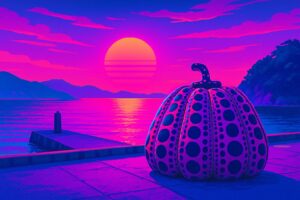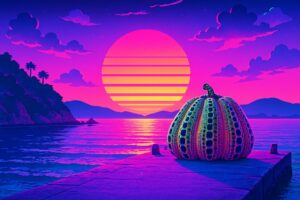
Yo, what’s good, world explorers! Taro here, coming at you live. So, let’s get real for a sec. You’ve seen Japan on your feed, right? The sleek neon of Tokyo, the quiet grace of a Kyoto temple, and maybe, just maybe, you’ve seen that iconic yellow pumpkin with black dots sitting on a pier, staring out at the sea. That’s Naoshima, the so-called ‘Art Island,’ the poster child for Japan’s now world-famous blend of contemporary art, stunning nature, and architectural flexes. You see these places, like the Setouchi Triennale or the Echigo-Tsumari Art Field, and you think, “Wow, Japan is on another level, putting massive, mind-bending art installations in the middle of rice paddies and on remote islands.” It feels futuristic, meticulously planned, and, let’s be honest, kinda perfect for the ‘gram. But here’s the question that really gets my brain firing: Where did this whole vibe even come from? Why is Japan the place that goes all-in on taking art out of the stuffy museum and dropping it into the wild? It feels like a slick, 21st-century move, but the real story, the origin myth, is way messier, way more chaotic, and a whole lot muddier. We gotta rewind the clock, fam. Back to a time when Japan was picking itself up from the rubble, a post-war landscape where everything was broken and everything was up for grabs. This is where we find the real OGs, the proto-‘Art Islands’ pioneers: a crew of artistic rebels called the Gutai Art Association. These guys didn’t have billion-yen budgets or famous architects. They had public parks, mud, plastic tubes, lightbulbs, and one simple, earth-shattering rule: “Do what has never been done before.” Before Naoshima was a global destination, Gutai was throwing wild, temporary art parties in the park, challenging the summer sun and changing the game forever. This is the story of their experimental art parks, the ground zero for Japan’s obsession with art in the open air. Peep this map of Ashiya, a city near Kobe, which became their legendary playground.
This experimental, rule-breaking spirit can be seen in other uniquely Japanese art movements, like the lost Heisei-era art of Deco-den.
The Vibe Check: Post-War Japan and the Birth of ‘Do Something New or GTFO’
To truly understand why Gutai emerged, you need to grasp the atmosphere of mid-1950s Japan. It was genuinely bleak. The nation was staggering from its defeat in World War II. Cities like Tokyo, Osaka, and Kobe had been completely destroyed, reduced to ashes and rubble by air raids. But the devastation wasn’t only physical. The national psyche was shattered. The emperor, once revered as a living god, was now simply a man. The military authority responsible for leading the country into ruin was dismantled. The old traditions, rigid social hierarchies, and the belief system that had defined Japan for centuries all seemed like a monumental failure. Imagine everything you believed in disappearing overnight. That’s the level of existential crisis they faced. It was a vacuum, a total void.
From Ashes to… Art?
While a vacuum can be frightening, it also presents an opportunity. For a generation of young people coming of age in this chaos, it was a chance for a complete reset. They hungered for freedom, new ideas, and a way to express themselves that wasn’t tied to the failed nationalism of the past. This wasn’t just about reconstructing bridges and factories; it was about rebuilding a soul, redefining what it meant to be Japanese, what it meant to be human, in this uncertain new world. At the heart of this creative surge in the Kansai region—the area around Osaka, Kobe, and Kyoto—was a visionary named Jiro Yoshihara. Yoshihara was the leader, mentor, financier, and philosophical cornerstone of what would become the Gutai Art Association, founded in 1954. He was an older, established painter from a wealthy family, but he felt bored with the art world’s status quo. Observing the stale, academic paintings celebrated in Tokyo, he thought, “No, this isn’t it.” He gathered a group of young, fearless artists, many without formal training, and gave them one legendary directive: “Do what has never been done before! Never imitate others!” Consider how radical that was. He wasn’t asking them to paint better landscapes or more beautiful portraits; he was telling them to break every rule. He gave them permission to fail, to be strange, to be misunderstood. The goal wasn’t to create a pretty object to hang on a wall; it was to create a new experience, a fresh relationship between artist, materials, and the world. This was a direct challenge to the traditional, conservative Japanese art scene, which valued technical mastery and respect for elders. Yoshihara and his group embraced raw energy, pure creativity, and the spirit of individual freedom.
‘Gutai’ – What’s in a Name?
Even the name they chose was a declaration. ‘Gutai’ (具体). Let’s break it down. ‘Gu’ (具) can mean tool, instrument, or means. ‘Tai’ (体) means body. Together, ‘Gutai’ means ‘concrete’ or ’embodiment.’ It’s the opposite of abstract. It’s about making something real, tangible. Their philosophy, strongly promoted by Yoshihara, was that art is the beautiful, living expression of the encounter between the human spirit and raw matter. Materials—paint, mud, wood, water, light—weren’t passive substances to be shaped; they were alive. And the artist’s spirit, their inner energy, could bring that material to life. The final ‘artwork’ wasn’t the focus. The action, the process, the performance of creation—that was the art. It’s like saying the beauty isn’t in the finished photograph, but in the thrill of the hike to capture the shot. It’s about the journey, not the destination. This was a revolutionary idea at the time. An artist didn’t just use a brush to apply paint; they could use their whole body. They could smash through materials, or let nature take its course. The emphasis shifted from the static object to the dynamic event. Essentially, they declared that art is a verb, not a noun. This simple yet profound concept—that spirit and body could make matter sing—became the foundation of one of the most radical art movements of the 20th century.
Ditching the Gallery: Taking Art to the Streets (and Parks, and Skies)
So you’ve got a group of energized artists tasked with creating something new. Where do you go? A traditional, white-walled gallery? Honestly, that was the last place they wanted to be. Galleries felt like mausoleums—quiet, sterile, and exclusive. They represented the old system, the art establishment they aimed to dismantle. To truly be radical, they had to break free from the box, literally. They needed a new stage, a fresh canvas—one that was alive, unpredictable, and open to everyone. Their solution was pure genius: the public park.
The ‘Experimental Outdoor Exhibition of Modern Art to Challenge the Midsummer Sun’
Here it is—the main event. Beginning in 1955, Gutai started holding these legendary outdoor exhibitions in a public park along the Ashiya River. The full title itself is a work of art, dripping with poetic, rebellious energy. They weren’t just displaying art outdoors; they were challenging the midsummer sun. It was a showdown between human creativity and the most powerful force in the solar system. That’s the level of ambition we’re talking about. Imagine the scene: a hot, humid Japanese summer. Families are having picnics, kids are running about, people are walking their dogs. It’s a slice of everyday, post-war life. And right in the middle of this normality are some of the wildest, most bewildering pieces of art you could ever imagine. There are no labels, no security guards, no velvet ropes. Just… stuff. Stuff hanging from trees, stuff protruding from the ground, stuff you can touch and walk on. This wasn’t art to be quietly admired. It was art to be stumbled upon, to be puzzled over, to be part of.
Let’s explore some of the iconic pieces that took place in these parks, because this is where the Gutai spirit truly comes alive. One of the most famous, rawest works was by a young artist named Kazuo Shiraga. For his piece titled ‘Challenging Mud’ (1955), he brought in a massive pile of cement, clay, and gravel. Then, stripped down to his shorts, he threw himself into the pile and wrestled with it. He kicked, punched, twisted, and thrashed in the mud, shaping it with his entire body. The audience watched this raw, violent, almost prehistoric struggle unfold. The final ‘artwork’ was the churned-up pile left behind, resembling a crater from some elemental battle. But the real art was the performance. Shiraga wasn’t shaping the mud with his hands; he was the sculpture. He erased the boundary between artist and material. It was a visceral scream against the polite, detached nature of painting. It was messy, exhausting, and unforgettable.
Then there was Shozo Shimamoto, who sought to completely disrupt your perception of something as simple as walking. His work ‘Please Walk on Here’ (1955) was a narrow wooden walkway. The twist? It was mounted on springs. When you stepped on it, the path became unstable, wobbly, and unpredictable. Your basic act of walking turned into a conscious, physical negotiation. You had to focus on your balance, on your body. It turned the viewer into a performer. The art wasn’t the wooden path itself; it was the sensation you experienced while engaging with it. It was interactive art before that term was even coined—a low-tech, high-concept triumph of audience participation.
Sadamasa Motonaga took a more lyrical, almost magical approach. For his ‘Work (Water)’ (1956), he filled long, transparent vinyl tubes with colored water—red, blue, green, yellow—and hung them between the branches of the park’s pine trees. The effect was stunning. As the sun, their co-challenger, moved across the sky, its light shone through the colored water, casting shifting, vibrant shadows on the ground beneath. The wind gently swayed the tubes, like strange, futuristic fruit. Motonaga used the elements—light, water, wind, gravity—as collaborators. The work was never static; it constantly changed with the time of day and weather. It was a perfect example of Gutai’s goal to dissolve the line between the man-made and natural worlds.
We can’t forget Atsuko Tanaka. While her most famous piece, the ‘Electric Dress’ (1956), was often shown indoors, its spirit was born from this same experimental energy. It was a wearable sculpture, a kimono-like garment made of tangled wires and around two hundred glowing, blinking incandescent bulbs and fluorescent tubes painted in bright primary colors. When Tanaka wore it, she became a dazzling, chaotic circuit board—a human firework display. It was beautiful but also slightly frightening—it hummed, it warmed, and it felt dangerous. The dress explored the collision of the human body with modern technology, a key theme in rapidly industrializing Japan. It questioned what clothing was, what the body was, and where the self ended and the machine began. Like all Gutai’s best work, it was a physical experience—a direct hit to the nervous system.
Why a Park? The Genius of the Location
Choosing a public park was arguably Gutai’s most revolutionary move. This choice was charged with meaning and has had a lasting impact we can still see today in places like Naoshima. First, it was a radical act of democratization. In the 1950s, art was for the wealthy and educated. It lived in intimidating museums and commercial galleries. By placing their art in a park, Gutai made it free and accessible to everyone—from a curious child to a skeptical grandmother. It declared that art belongs to the people, that it should be woven into daily life, not locked away in a treasure chest.
Second, it was about making nature a collaborator, not just a backdrop. Western land art often involves imposing structures on the landscape. Gutai’s approach was different—more integrated. They worked with the environment. Motonaga’s water tubes relied on trees for support and the sun for life. The wind, rain, shifting light—these weren’t inconvenient distractions; they were essential parts of the artwork. This also meant the art was ephemeral. It would fade, break, and decay. Typhoons could, and sometimes did, destroy pieces overnight. This embraced a deeply Japanese aesthetic, often linked with wabi-sabi—an appreciation for the transient, imperfect, and impermanent. A masterpiece didn’t have to last forever to be profound.
Finally, it was a proto-Instagram moment. Long before social media, Gutai recognized the power of spectacle. These outdoor exhibitions were events. They generated buzz. They were experiences people shared and talked about. They broke the ‘fourth wall’ of art, inviting confusion, laughter, and interaction. They created temporary communities around strange objects. This idea—that art can spark social interaction and cultivate a unique ‘sense of place’—is the foundational DNA of the massive art festivals and art islands that emerged decades later.
The Gutai Legacy: From Mud Pits to Billion-Dollar Art Islands
Gutai burned bright and fast. Following Jiro Yoshihara’s sudden death in 1972, the group disbanded. For a long time, they were mostly forgotten and dismissed as a quirky, provincial movement, particularly by the Western art world. Yet, their ideas were too powerful to remain buried. The seeds they planted in that Ashiya park grew into a vast forest, whose branches have spread worldwide and across decades. Their influence is the secret ingredient behind much of what is considered ‘contemporary’ Japanese art today.
The Ripple Effect: How Did We Get from Ashiya to Naoshima?
So, how did Gutai’s raw, punk-rock energy evolve into the polished, high-concept tourism of the Setouchi Triennale? The connection isn’t a direct line but a series of resonant echoes. Gutai’s core principles—art beyond the gallery, audience interaction, collaboration with nature, and prioritizing experience over objects—were absorbed into the cultural fabric. In Japan, movements like Mono-ha in the late 60s and 70s took up the mantle, intensifying the focus on the relationship between natural and industrial materials.
Internationally, Gutai’s impact was significant, even if not always acknowledged. Allan Kaprow, the American artist who coined the term ‘Happenings,’ saw photos of Gutai’s work in a journal and was amazed, admitting they had been doing years earlier what he was only beginning to theorize. The European Fluxus movement, with its emphasis on performance and blending art with life, shared much in common. In many ways, Gutai was ahead of its time—a global pioneer hiding in plain sight.
Fast forward to the late 1980s: Japan was in the midst of its ‘Bubble Economy.’ Capital was flowing, and large corporations sought to become cultural patrons. Soichiro Fukutake, billionaire owner of the Benesse Corporation (which operates tutoring schools), had a vision to create a cultural haven on the remote, depopulating islands of the Seto Inland Sea. He began with Naoshima, bringing in star architect Tadao Ando to design museums that are themselves monumental works of art, such as Benesse House and the almost entirely underground Chichu Art Museum. He commissioned works from international art stars like James Turrell, Walter De Maria, and, of course, Yayoi Kusama’s iconic pumpkin.
The project was hugely successful and led to the Setouchi Triennale, a festival spanning a dozen islands. A similar effort, the Echigo-Tsumari Art Triennale, emerged in Niigata’s rural, snow-heavy region, using art to rejuvenate aging farming communities. These projects are remarkable achievements: beautiful, thought-provoking, and they have brought real economic and social benefits to overlooked parts of Japan.
However, it is essential to recognize them as the descendants of Gutai. When you take a ferry to Teshima to visit the Teshima Art Museum, where a single giant drop of water continuously forms and reforms on a concrete floor beneath a massive open oculus, you are experiencing the Gutai spirit. It’s an artwork about time, nature, and pure sensory experience. Yet, there is a key difference in approach: Gutai was a chaotic, grassroots explosion of pure artistic rebellion—raw, temporary, and anti-commercial. In contrast, the modern Art Islands are highly curated, permanent, top-down projects driven by corporate philanthropy and regional revitalization strategies. They represent the stadium rock version of Gutai’s garage band punk. Neither is necessarily superior, but to truly understand Naoshima, one must deeply appreciate the pioneering spirit that first dared to confront the midsummer sun in Ashiya.
So, What’s the ‘Why Japan is Like This’ Takeaway?
Understanding Gutai unlocks core truths about Japanese culture that might seem perplexing to outsiders. It is a key to comprehending why Japan can appear both deeply traditional and radically futuristic simultaneously.
First, there is the concept of Embracing Impermanence. Gutai’s temporary, decaying outdoor art feels radical but directly taps into a long-standing Japanese aesthetic of appreciating transience and imperfection, often encapsulated by the term wabi-sabi. This isn’t merely about old, cracked tea bowls—it’s a worldview that finds beauty in aging and decay. Gutai took this quiet, philosophical idea and transformed it into a loud, energetic performance. Their art lived and died with the seasons, which was part of its power.
Second is The Power of the Group. Gutai was not merely a collection of solo artists; it was a collective, a close-knit group united by a shared philosophy and led by the charismatic Yoshihara. This structure reflects the group-oriented nature of Japanese society, where harmony and collective effort often take precedence over rugged individualism. The individual genius of artists like Shiraga or Tanaka was undeniable, but their impact was amplified through being part of a movement with a unified, rebellious spirit.
Third, and significantly, is the theme of Radical Re-Invention Post-Trauma. The Gutai movement exemplifies Japan’s capacity for rapid and radical transformation following crisis. The total devastation of the war created a space where such an extreme movement could take shape, wiping the slate clean. This pattern reappears after the economic bubble burst in the 1990s. The following ‘Lost Decades’ set the stage for the Art Islands, which served as creative responses to economic stagnation and rural depopulation. These moments of national upheaval often unleash remarkable creativity and a willingness to dismantle old systems in favor of entirely new models.
Finally, Gutai reveals a deep cultural tendency toward Blurring Boundaries. The lines between art and life, inside and outside, nature and man-made, creator and audience—Gutai was obsessed with dissolving these distinctions. This holistic worldview, where everything is interconnected rather than compartmentalized, recurs throughout Japanese culture, visible in practices ranging from garden design, where garden and house are integrated, to Shinto beliefs in spirits inhabiting natural objects.
Finding the Ghost of Gutai Today
Alright, so you’re excited. You want to feel this raw Gutai energy firsthand. Here’s the bittersweet truth: you can’t. The original outdoor exhibitions no longer exist. The artworks were designed to be temporary, and they’ve returned to the earth. You can’t visit Shiraga’s mud pit or walk on Shimamoto’s springy path. That fleeting quality is part of the legend. But don’t worry. The spirit of Gutai still lingers—you just need to know where to look.
Can You Still Connect with Gutai?
Your first stop should be a museum. The two key destinations for Gutai are in the Kansai region, where it all began. The Nakanoshima Museum of Art in Osaka, which opened in 2022, boasts a world-class collection. The building itself is a massive black box, a strikingly modern home for this groundbreaking art. Inside, you’ll find the ‘relics’ of the movement: Shiraga’s powerful abstract paintings made with his feet, the haunting photos and videos of their outdoor performances, and even Atsuko Tanaka’s ‘Electric Dress,’ preserved and exhibited like a futuristic artifact. Your other essential stop is the Ashiya City Museum of Art & History in the city where the park exhibitions originally took place. They have a strong connection to the movement and a remarkable collection that tells the story from a local perspective. Seeing these works in a museum setting is a different experience—less chaotic, more reflective—but it’s vital to grasp the extraordinary creative force behind these artists.
Once you’ve seen the evidence, it’s time to get out and feel the living spirit of Gutai. This is where the Art Islands come back into play. Now that you know the origin story, you can visit Naoshima, Teshima, and Inujima with fresh eyes. When you spot Kusama’s pumpkin on the pier, remember how Gutai’s experiments fifty years earlier helped normalize the very idea of placing a major sculpture on a windswept coast, exposed to salt and typhoons. When you explore the ‘Art House Project’ in Honmura, where artists have turned empty traditional houses into immersive installations, see it as a direct heir to Gutai’s mission to weave art into everyday life. See these sites not just as incredible photo opportunities, but as the refined, well-supported evolution of a wild, muddy rebellion.
Ultimately, Gutai’s most important legacy isn’t a museum piece or an island installation. It’s an attitude. It’s the radical belief that art isn’t just for looking at. It’s something you feel, experience with your entire body. It’s the bravery to break rules, collaborate with nature, challenge convention, and find beauty in the messy, unpredictable process of creation. It’s a spirit yelling, “do what’s never been done before!” And that, my friend, is a vibe that never fades. It’s a lesson that hits just as powerfully today as it did in a park by a river one summer in 1955.