
You’re standing in a Japanese garden, perhaps in Kyoto. The air is still, filled only with the sound of trickling water and the rustle of maple leaves. Before you lies a meticulously arranged world: moss-covered stones placed with intention, a gravel sea raked into perfect ripples, and a single, elegantly pruned pine tree. Everything feels contained, perfected, a miniature universe enclosed by a simple bamboo fence or an earthen wall. It seems to be a world unto itself. But then you look up, following the line of a strategically placed hedge, and you realize the garden doesn’t end at the wall at all. Through a carefully created gap, a distant, hazy blue mountain rises, its peak crowned with clouds. Suddenly, the small, enclosed garden feels boundless. That mountain, miles away and utterly beyond the garden owner’s control, is as much a part of this composition as the stone lantern at your feet.
This is shakkei, or “borrowed scenery.” It is one of the most profound and subtle principles in Japanese landscape design. The term itself, written with the characters for “borrow” (借) and “scenery” (景), is a declaration of intent. Rather than trying to possess or replicate nature, the garden designer humbly borrows it, incorporating a distant view into the garden’s design as its living, dynamic backdrop. This isn’t just about having a nice view. It’s a deeply philosophical act that intentionally blurs the line between the artificial and the natural, the owned and the unowned, the finite space of the garden and the infinite expanse of the world beyond. Why would a culture so renowned for its precision and control in design embrace a technique that relies on something so completely uncontrollable? The answer reveals a great deal about the Japanese relationship with space, nature, and the very idea of a boundary.
This seamless interplay between intentional design and nature’s vast unpredictability is further embodied by the way some gardens integrate whole mountain vistas to expand their perceptual boundaries.
The Illusion of a Limitless World
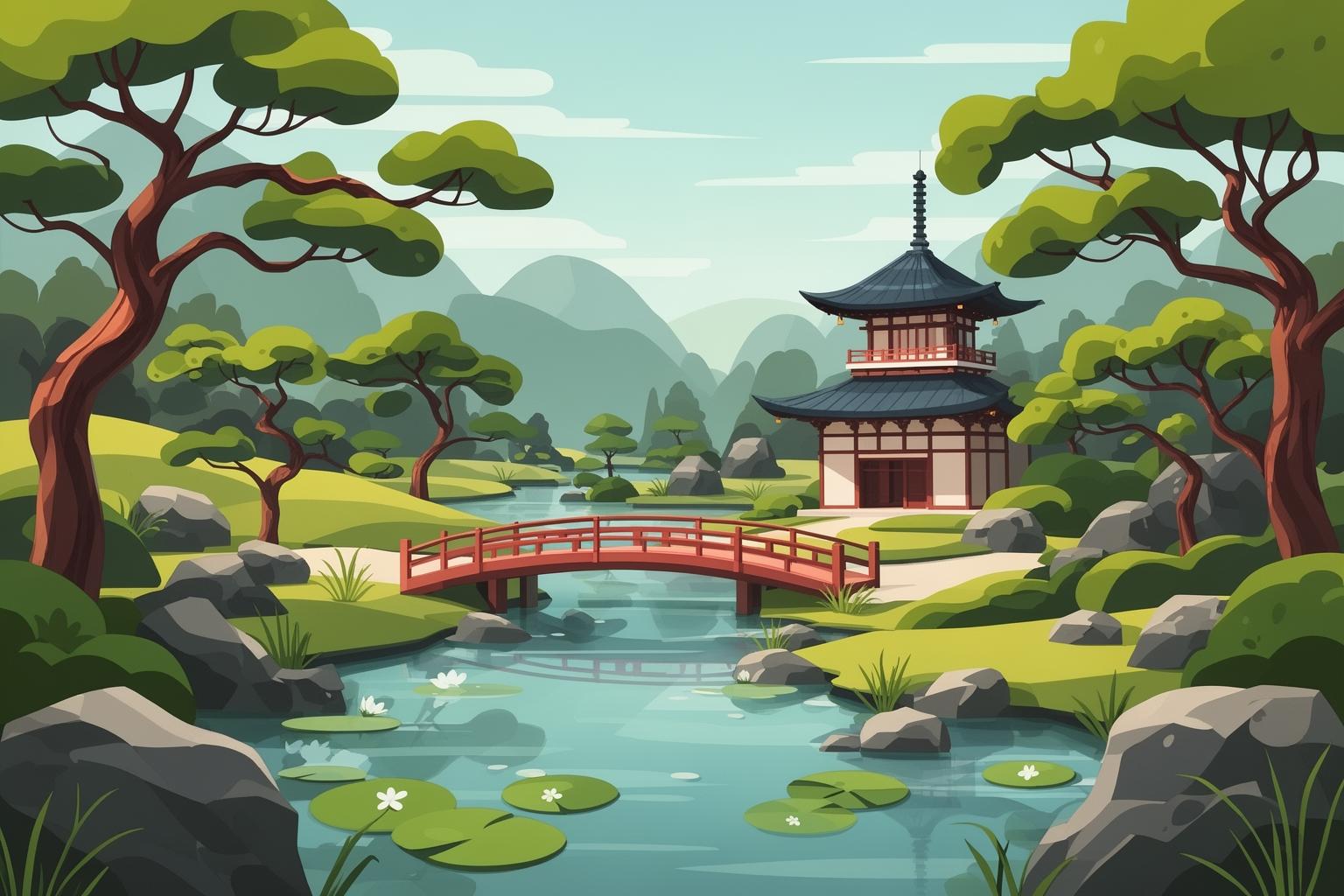
The fundamental purpose of a Japanese garden is not merely to be beautiful, but to evoke an emotion. It strives to be a microcosm of the natural world—a condensed, idealized landscape that encourages contemplation. Shakkei is the key that unlocks this potential, transforming a physically small plot of land into a psychologically expansive space.
A Frame, Not a Fence
In Western garden traditions, a wall or fence serves a clear function: to mark property boundaries, keeping things in and out. It acts as a barrier, a definitive end. In gardens using shakkei, these elements take on a completely different role. A wall becomes a canvas, a hedge a frame, and tree branches a delicate screen. Their main purpose is not enclosure but to guide the viewer’s gaze.
Think of it as cinematic direction. The garden designer employs middle-ground elements—trimmed bushes, stone walls, veranda pillars—to create a visual frame. This frame highlights a specific, desirable section of the distant landscape, excluding unsightly distractions such as neighboring rooftops or power lines. It curates the view, presenting the borrowed mountain or pagoda as a deliberate piece of art. Consequently, the boundary doesn’t represent an end, but rather the start of a carefully crafted visual journey, guiding the eye from the manicured foreground to the wild background. The space feels larger because it isn’t self-contained; it engages in a direct, visual dialogue with the world beyond.
The Psychology of Borrowing
This technique is a sophisticated manipulation of human perception. By creating a seamless visual connection between near and far, shakkei collapses perceived distance. The distant mountain doesn’t seem like a separate object; it becomes the garden’s own backdrop, the ultimate rock in its rock arrangement. This fosters a psychological sense of ownership over a view that can never be physically possessed. You cannot own the mountain, but you can borrow its grandeur. You cannot control the clouds, but you can frame their ephemeral passage across the sky.
This act of borrowing produces a dynamic, ever-evolving masterpiece. Unlike a static garden, a shakkei garden pulses with the rhythms of the wider world. The borrowed scenery shifts with the time of day—from the crisp morning light to dusk’s long shadows. It changes with the seasons: the fresh spring green on distant hills, the lush verdure of summer, the fiery reds and golds of autumn, and the stark, snow-dusted silhouette of winter. The garden becomes a stage where nature’s drama is the main performance, ensuring that no two visits are ever quite the same.
A Philosophical Blueprint of Harmony
Shakkei is more than just a clever design technique; it embodies several fundamental principles of Japanese philosophy in a tangible form. It conveys a worldview where humanity is not the ruler of nature, but rather a humble participant within it. Designing such a garden is an act of collaboration, not conquest.
Dissolving the Human-Nature Divide
At its core, shakkei is an expression of humility. It acknowledges that the greatest beauty often exists beyond human creation and control. The garden designer accepts that no rock they place or tree they prune can match the serene grandeur of a distant mountain peak. By choosing to incorporate that peak, they reflect a philosophy of integration rather than domination. The garden does not impose itself on the landscape; instead, it engages in a respectful dialogue with it.
This contrasts sharply with, for example, the formal gardens of Versailles, which showcase human triumph over nature through geometry, symmetry, and complete control imposed on the wild. Shakkei follows the opposite principle. It seeks harmony by blurring the boundary between human-made spaces and the natural environment. It implies that our world is not separate from the greater world, but an inseparable part of it. The garden acts as a permeable membrane through which the essence of the larger landscape flows.
Wabi-Sabi and the Uncontrolled Element
The aesthetic of wabi-sabi—the appreciation of beauty in imperfection, impermanence, and incompleteness—is deeply rooted in the practice of shakkei. The borrowed scenery represents the ultimate uncontrollable element. The designer cannot command the fog to settle in the distant valley or guarantee that the moon will rise perfectly above the borrowed pagoda.
This acceptance of the uncontrollable lies at the heart of wabi-sabi. The garden’s beauty is therefore never truly “complete” or static. It is constantly transformed by weather, light, and time. This transient, imperfect beauty is seen as more profound and more faithful to reality than a perfectly preserved, unchanging state. The borrowed view introduces an element of chance and impermanence that keeps the garden connected to the natural world’s ceaseless flow.
The Influence of Zen Buddhism
Shakkei also deeply reflects principles of Zen Buddhism, which have significantly influenced Japanese arts. Zen highlights interconnectedness—the idea that all things form a single, indivisible whole. A garden that borrows scenery perfectly illustrates this concept. It shows that the garden’s existence depends on the landscape beyond its boundaries; they are not separate entities but parts of one composition.
Moreover, Zen practice encourages seeing beyond the immediate and the illusory to perceive a broader reality. Gazing through the garden’s frame toward the distant view acts as a form of meditation. It invites the viewer to expand their awareness, to look beyond their immediate surroundings and reflect on their place within a much larger context. The garden becomes a tool for enlightenment, a space designed not only for aesthetic enjoyment but also for spiritual insight.
The Four Methods of Borrowing
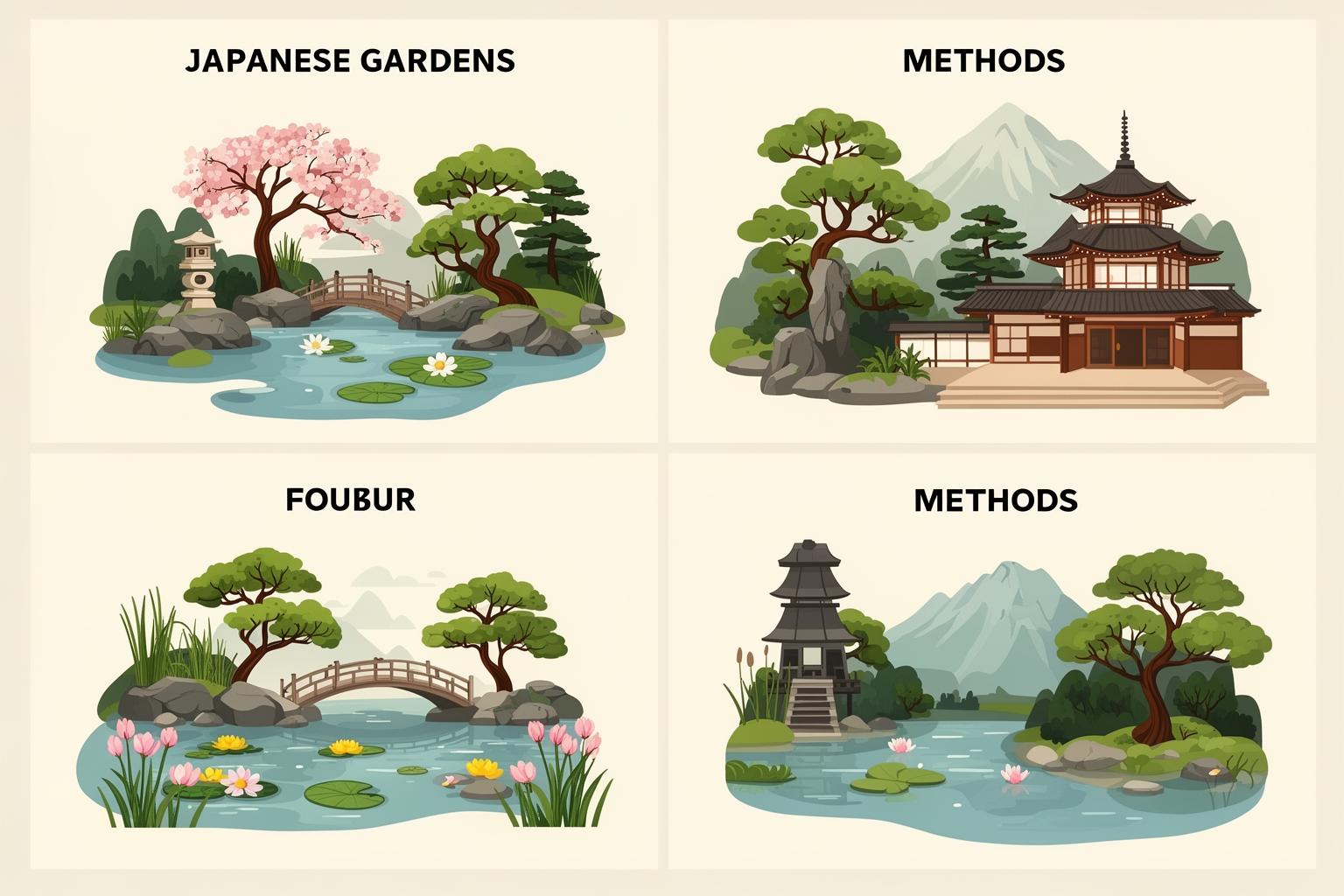
Japanese scholars and garden masters, following their customary approach, have classified the art of borrowing scenery into several distinct types. These categories, shaped by classical Chinese garden design texts like the Yuan Ye (園冶), highlight the subtlety and intentionality behind the practice. Understanding these types allows one to better appreciate the various ways a garden can interact with its surrounding environment.
Enshaku (遠借) – Distant Borrowing
This represents the most classic and striking form of shakkei. It entails integrating a large, prominent feature from the distant landscape, typically a mountain, but sometimes a castle keep, a pagoda, or a notable body of water. The entire garden is often arranged to enhance the presence of this single, commanding element. The distant view becomes the primary focal point, the grand culmination of the visual design. Tenryu-ji’s gardens, which use Mount Arashiyama as a backdrop, offer a quintessential example of enshaku.
Rinshaku (隣借) – Adjacent Borrowing
More intimate and subtle, rinshaku involves borrowing elements from an adjoining property. This might be a lovely grove of trees in a neighboring garden, the graceful roofline of an adjacent temple, or even a simple wall that has aged with beauty. This borrowing reflects a communal and shared appreciation of the landscape, where boundaries visually dissolve for mutual aesthetic enjoyment. It suggests a sense of community and trust, in which the beauty of one’s surroundings is meant to be shared rather than hidden behind tall walls.
Gyōshaku (仰借) – Upward Borrowing
This style of shakkei focuses on framing the view above. Rather than emphasizing the horizon, the attention is drawn to the sky itself. A designer might use tall trees or the eaves of a building to frame a segment of the sky, inviting contemplation of drifting clouds, soaring birds, the colors of sunset, or the stars at night. Gyōshaku reminds us that the sky is the garden’s canopy, making the celestial sphere an essential part of the earthly landscape.
Fushaku (俯借) – Downward Borrowing
Contrasting with upward borrowing, fushaku directs the gaze downward. This technique is often employed in gardens situated on slopes or hillsides, allowing one to borrow views of a river flowing in a valley below, a shimmering lake, or even a simple bed of rocks. A common method is using the reflective surface of a pond within the garden to borrow an upward view—reflecting the sky, clouds, or the leaves of an overhanging maple tree—thus bringing the heavens down to earth.
Shakkei in Practice: Seeing is Believing
While the philosophy is compelling, the true impact of shakkei is only fully realized through firsthand experience. Several gardens across Japan, especially in Kyoto, are regarded as masterpieces of this art, each offering a distinctive lesson in the technique of borrowing scenery.
The Imperial Canvas: Shugakuin Imperial Villa, Kyoto
Arguably the finest example of shakkei in Japan, the Shugakuin Imperial Villa is more than a single garden—it is a collection of pavilions and landscapes harmoniously integrated with the surrounding foothills of Mount Hiei. Constructed in the 17th century for Emperor Go-Mizunoo, its design is remarkably ambitious. From the upper villa, the view unfolds into a sweeping panorama. The garden’s large pond appears to blend effortlessly with the rice paddies and farmhouses in the valley below, which are further framed by encircling mountains. The designers even pruned hedges and trees on the intermediate hillsides to perfect this composition. Here, the borrowed scenery encompasses not just one mountain but the entire rural landscape, transformed into a living, functioning painting within the imperial grounds.
The Iconic Backdrop: Tenryu-ji Temple, Arashiyama
Situated in Kyoto’s lively Arashiyama district, the garden at Tenryu-ji stands as a masterful example of enshaku, evoking a sense of peaceful seclusion amid the crowds. The Sogenchi Teien (Cloud-Dragon Garden), created by the renowned Zen master Muso Soseki in the 14th century, centers around a large pond. While the foreground features carefully arranged rock formations and plantings, the true highlight is the background: the rich, seasonally shifting slopes of Mount Arashiyama and Mount Kameyama. The hills seem to rise directly from the pond’s far edge, forming an immaculate, unbroken composition celebrated through the ages. The garden skillfully employs its boundary trees to shield modern intrusions, maintaining the illusion of a secluded sanctuary nestled at the base of a wild mountain.
The Perfect Frame: Entsu-ji Temple, Kyoto
For a pure and profound lesson in shakkei, one must visit the small, tranquil temple of Entsu-ji in northern Kyoto. The garden itself is deceptively minimalist: a flat rectangle of moss accented by rocks, enclosed by neatly trimmed camellia and sasanqua hedges. The true enchantment occurs when you sit on the veranda of the temple’s main hall. The wooden pillars, combined with the horizontal lines of the floor and roof and the deep green hedges, compose a flawless, living picture frame. Through this frame, stripped of distraction, lies a pristine vista of Mount Hiei. The mountain seems astonishingly near, its presence commanding the serene scene. Entsu-ji shows that shakkei is not about having the largest garden or the most dramatic view, but about mastering the art of perfect framing and focused presence.
Beyond the Garden: A Modern Mindset
The principles of shakkei extended beyond traditional gardens. Its philosophy—blurring boundaries, framing views, and harmonizing with the environment—remains a powerful and enduring concept that continues to shape Japanese aesthetics and design today.
In Contemporary Architecture
Examine the work of contemporary Japanese architects like Kengo Kuma or Tadao Ando, and the essence of shakkei is evident throughout. They skillfully use materials and forms to connect interior and exterior spaces. A large plate-glass window in a concrete house might be placed not only to let in light but to perfectly frame a single tree in the yard. A series of vertical wooden slats on a facade could create a screened, curated view of the city beyond, transforming urban chaos into an organized landscape. This architectural style directly descends from the garden designer who framed a mountain using a hedge and a veranda pillar. It is about crafting spaces that aren’t closed boxes but engage in ongoing dialogue with their surroundings.
A Philosophy for Living
Ultimately, shakkei offers more than design insight; it provides a way of perceiving the world. It fosters an appreciation for the beauty that exists beyond our own boundaries and control. In an increasingly divided world focused on ownership and barriers, shakkei suggests a quieter, more harmonious path. It implies that true richness derives not from what we possess but from our capacity to recognize our connection to the greater whole.
It reminds us that often the most beautiful aspects of our lives aren’t those we create or contain, but those we simply welcome in. By thoughtfully framing—whether in a garden or in our minds—we can borrow the beauty of the world, making it a part of our experience without claiming ownership. The distant mountain does not belong to the garden, yet the garden would be incomplete without it. This subtle, profound interdependence is the timeless lesson of borrowed scenery.