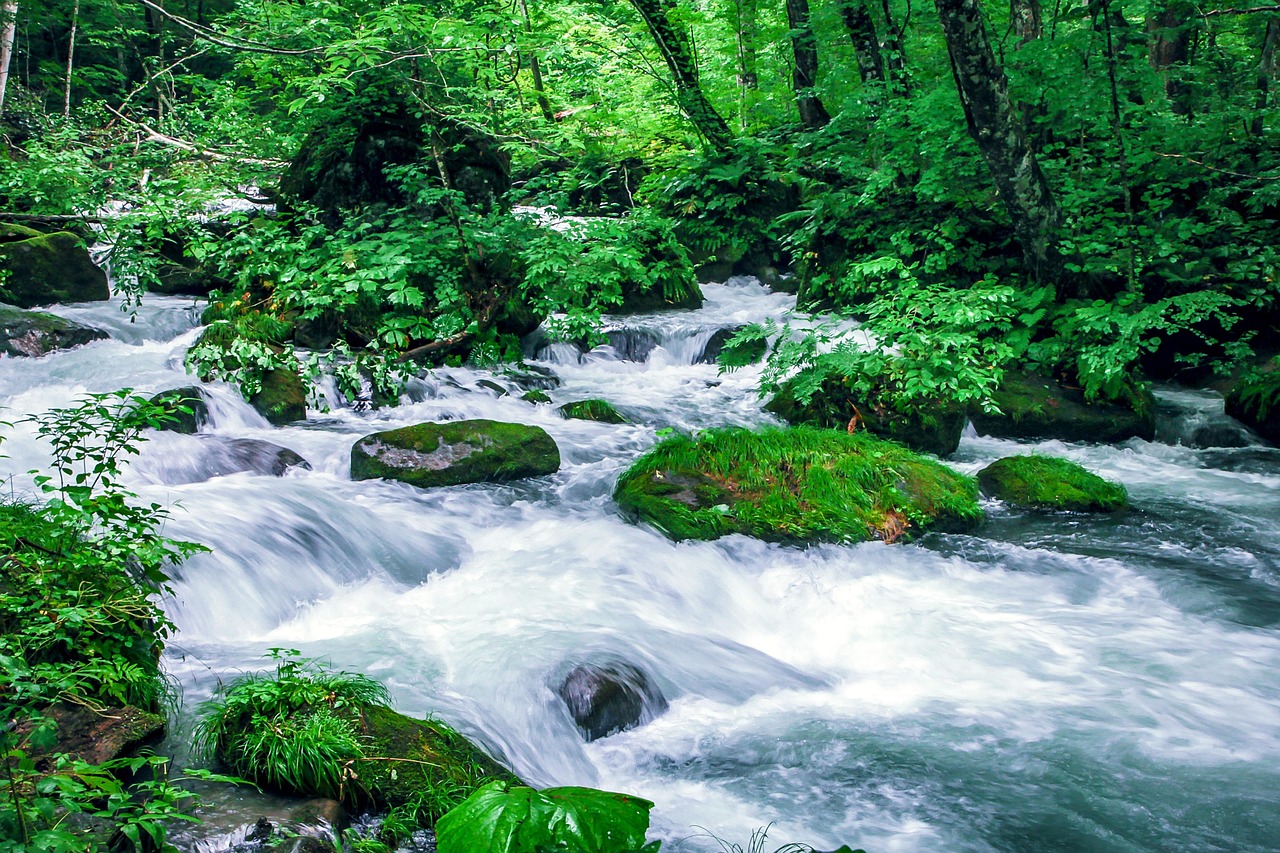
Yo, what’s up, world travelers? Alex here. Let me spill some tea on a place that completely rewired my brain. Picture this: you’re heading to the northernmost tip of Japan’s main island, to a place called Aomori. You’ve heard whispers of a spot whose name literally translates to “Fear Mountain.” Kinda intense, right? You’re expecting something straight out of a horror flick. But then you get there, and reality hits different. Osorezan, or Mount Osore, isn’t about cheap scares. Nah, this place is the real deal—a sacred, spiritual ground-zero that’s one of Japan’s three most holy mountains. It’s a volcanic caldera where for centuries, people have believed the worlds of the living and the dead get seriously close, like, close enough to chat. It’s a mind-bending mashup of jaw-dropping natural beauty and an atmosphere so thick with emotion you could cut it with a knife. This isn’t just a dot on a map; it’s a full-on journey into the heart of Japanese spirituality, a place where desolate, steaming hellscapes sit right next to a beach that looks like paradise. It’s a vibe check for your soul, and let me tell you, mine was shook. Bet.
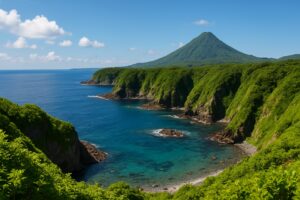
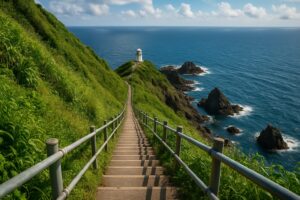
If you’re captivated by Aomori’s otherworldly landscapes, you should definitely explore the breathtaking coastal formations at Hotokegaura.
Dropping the Pin on the Underworld

Reaching Osorezan is an adventure in itself, and honestly, that’s part of what makes the experience so special. This isn’t just a casual day trip from Tokyo. You’re traveling far north to the wild and rugged Shimokita Peninsula, an area of Japan that feels ancient and untamed. The final stretch of the trip—a bus ride from Shimokita Station—is when the excitement truly begins. The bus snakes its way up twisting mountain roads, leaving civilization behind bit by bit. The air shifts, and you start to catch hints of sulfur—the familiar rotten-egg smell signaling volcanic territory. It’s a scent that instinctively warns of danger but here feels more like a proclamation: you’re arriving. After about 45 minutes of this scenic yet eerie ascent, you spot it—the grand, solemn gate of Bodai-ji Temple, standing seemingly isolated, guarding the caldera’s entrance. Stepping off the bus, the first thing that strikes you isn’t fear but awe. A deep sense of peace washes over you, mingling with an almost electric energy that’s impossible to ignore. You’ve truly left the ordinary world behind and stepped into a liminal space. The silence is profound, broken only by the cawing of crows—believed to be messengers of the gods—and the soft chime of wind bells. It feels less like arriving at a tourist spot and more like crossing into another dimension. No joke, the journey alone is the perfect preparation for the spiritual immersion that lies ahead.
The Realest Scenery You’ll Ever See
Let’s get one thing straight: the landscape at Osorezan is utterly, undeniably surreal. It’s a sensory overload in the most incredible way. You pass the main temple buildings and suddenly, it feels like you’re on another planet. The ground stretches out as a desolate expanse of grey and white volcanic rock, marked by patches of lurid yellow, blood red, and toxic green. Steam hisses from countless fumaroles, bubbling pits, and cracks in the earth. The ground seems to be literally breathing, while the air is thick with the sharp, heavy scent of sulfur. It’s a powerful, raw, and untamed environment that perfectly captures the Buddhist concept of Jigoku, or hell. As you walk through these landscapes, each named with terrifying titles like ‘Blood Pond Hell’ or ‘Hell of Unending Screams,’ it’s easy to understand why ancient pilgrims believed this to be a tangible representation of the underworld. It’s stark, harsh, and oddly beautiful.
But the real mind-blower is the contrast. After trekking through these hellish scenes, the path opens onto the shore of Lake Usori. And honestly, this view is breathtaking. Before you lies a stretch of pristine, brilliantly white sand called Gokurakuhama, or ‘Paradise Beach.’ The water is a calm, almost tropical blend of turquoise and emerald green—like a postcard from the Caribbean. Your mind struggles to reconcile this vision of paradise with the desolate hellscape you just traversed. Yet there’s a catch, a poetic paradox that defines Osorezan. The lake is so acidic from volcanic gases bubbling up from its depths that it is nearly devoid of life. It’s a stunning, sterile paradise—a perfect metaphor for the illusions of the physical world. Scattered everywhere, from temple steps to the deepest crevices of the volcanic fields, are small stone statues of Jizo Bodhisattva. They wear bright red bibs and tiny hats, offered by grieving parents. In their hands or nearby stand colorful pinwheels, spinning endlessly in the wind. Jizo is the guardian of children, especially those who have passed away, and of travelers in the afterlife. Seeing thousands of pinwheels, each representing a prayer, each a memory, is profoundly moving. Their soft, whirring sound forms the constant, gentle soundtrack of Osorezan. It’s not sadness that fills you, but a deep, resonant sense of love and remembrance. This place is a living, breathing memorial, and that energy is the most powerful force here.
So, What’s the Big Deal? The Spiritual Lowdown
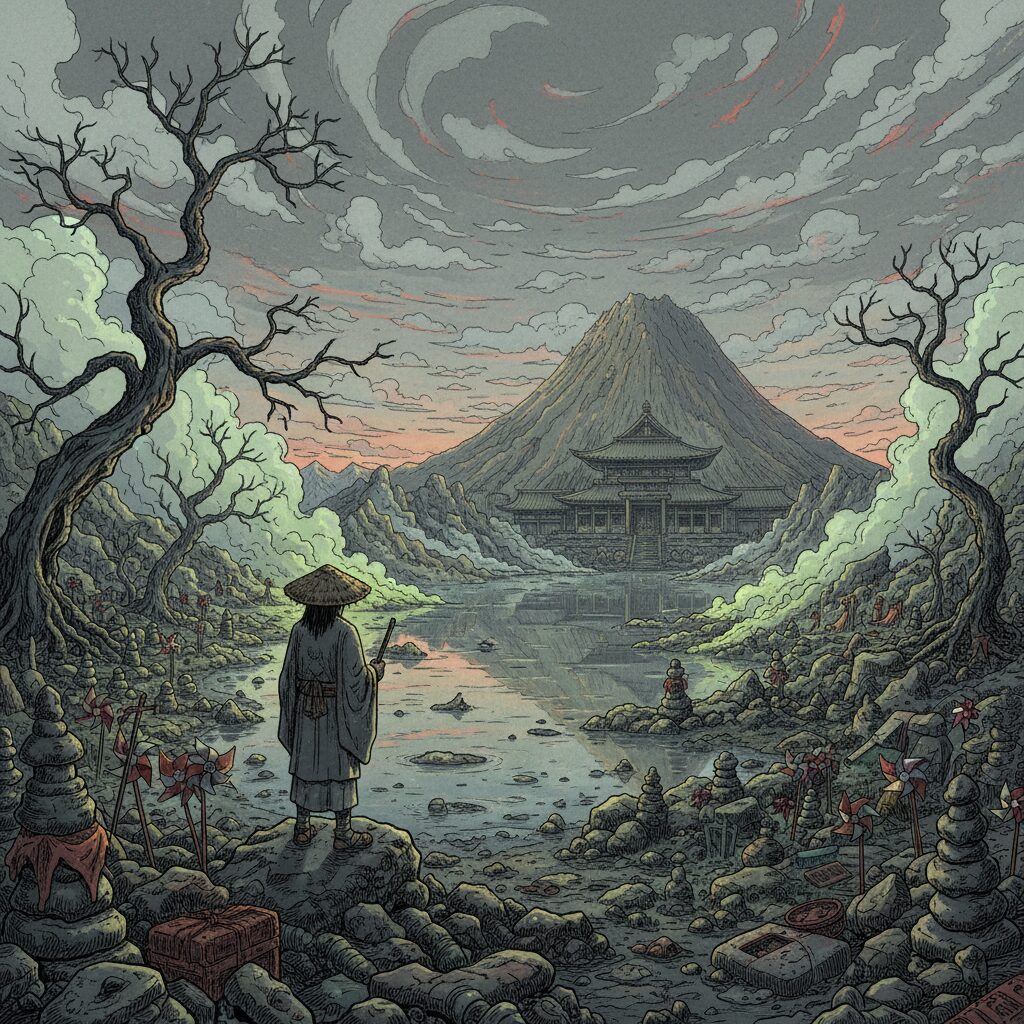
So, why is this remote volcanic caldera regarded as one of Japan’s most sacred sites? The story dates back more than a thousand years to a Buddhist monk named Ennin. According to legend, he had a dream revealing that he should journey to the northern tip of Japan to find a holy mountain that reflected the world of Buddha. Upon discovering this place—its eight surrounding peaks shaped like lotus flower petals and its otherworldly landscape—he knew he had arrived. There, he established Bodai-ji Temple, making Osorezan a significant center for worship and pilgrimage. However, its importance extends beyond history. Osorezan is viewed as a physical bridge between the world of the living (konoyo) and the world of the dead (anoyo), where the boundary between them is believed to be exceptionally thin.
This belief has given rise to Osorezan’s most unique and captivating tradition: the Itako. These are blind or visually impaired women who undergo rigorous spiritual training to become mediums, capable of communicating with the spirits of the departed. During the temple’s two main festivals—the Bodai-ji Taisai in summer (late July) and the Akimatsuri in autumn (early October)—the Itako set up tents on the temple grounds. Visitors from across Japan wait in long lines for a chance to experience a kuchiyose, a session to speak with their deceased loved ones. This ancient tradition is rapidly fading, and witnessing it firsthand is a deeply moving experience. Even without participating, observing the raw emotions—the tears, the smiles, the palpable sense of relief—is unforgettable. People come here not merely to visit a site, but to connect, mourn, find closure, and leave messages for those who have passed. Offerings are everywhere: small toys and snacks for children, cigarettes and sake for adults, coins pressed into the mud as a toll to cross the mythical Sanzu River, Japan’s equivalent of the River Styx. This is no museum—it is a living, breathing center of faith and memory, felt in every stone and gust of wind.
Your Quest Guide: How to Navigate Osorezan
Exploring the grounds of Bodai-ji feels like following a narrative trail. Your journey starts as you pass through the imposing Sanmon, the main temple gate. Just beyond lies the Taiko-bashi, a steep, red arched bridge symbolizing the boundary between the profane and sacred worlds. Interestingly, you’re not meant to physically cross it; it’s said that your spirit crosses as you enter the holy precincts. The main temple complex itself is a collection of beautiful, traditional wooden buildings. The air carries the scent of incense, accompanied by the soft hum of chanting from the main hall. It’s a peaceful oasis amidst the wild landscape.
From there, you follow a well-marked stone path leading on a circular route through volcanic fields. This is where you’ll encounter various ‘hells,’ each marked with a sign. The path crunches beneath your feet, and it’s important to stay on it, as the ground can be unstable and the steam vents are genuinely hot. Along the way, you’re surrounded by countless Jizo statues adorned with spinning pinwheels. The route naturally guides you through the harshest landscapes first, building a sense of tension and awe. Then the path descends, the sulfur smell fades, and you arrive at the shores of Lake Usori at Gokurakuhama. It feels like a true reward, a moment of peaceful reflection after the intensity of the hells. You can sit on the white sand (though swimming in the acidic water is prohibited) and simply soak in the incredible view. The entire walk takes about an hour, but you’ll want to allow much more time to pause, look around, and feel the energy of the place. It’s a walk that tells a story—a physical pilgrimage mirroring a spiritual journey from suffering to paradise. It’s a powerful example of environmental storytelling that has enchanted visitors for over a millennium.
Level Up Your Trip: The Onsen & Shukubo Experience
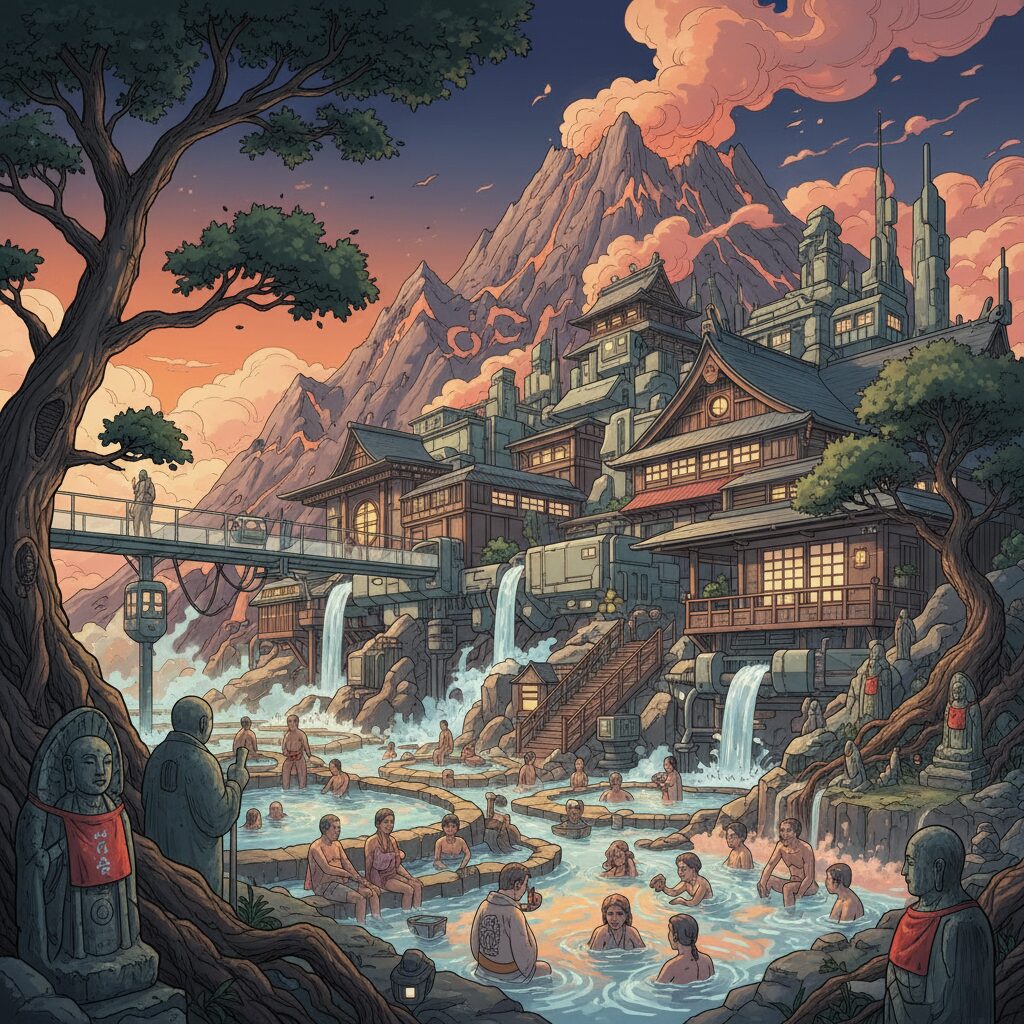
To fully experience Osorezan, you need to visit the onsen and, if you’re feeling adventurous, spend the night. Within the temple grounds are four simple, rustic wooden bathhouses (onsen). These aren’t luxurious spas; they serve as places for both spiritual and physical cleansing. The baths are supplied directly by volcanic hot springs, with milky, bluish-white water rich in sulfur and other minerals, believed to have remarkable healing qualities. There’s a hut for men, one for women, and two that are traditionally mixed-gender. Soaking in these ancient, powerful waters, surrounded by the temple’s sacred ambiance, is an extraordinary experience. It feels like you’re washing away not only the dirt from your journey but also some of your worldly worries. This is an essential part of the pilgrimage and shouldn’t be missed.
For the fullest immersion, staying in the shukubo, the temple lodging on-site, is a must. The accommodation is simple and no-frills, but its atmosphere more than makes up for the lack of luxury. You’ll rest on a futon in a traditional tatami room. The highlight is the food—shojin ryori, traditional Buddhist vegetarian cuisine. It’s an artful array of small, carefully prepared dishes that are simple, healthy, and surprisingly tasty, designed to nourish the body and soothe the spirit. The true magic of staying at the shukubo happens after the day visitors leave and the gates close. You’re left with almost the entire mystical world to yourself, in profound silence. Waking before dawn to join the monks in morning prayers is a deeply centering and special experience. The rhythmic chanting fills the ancient halls as the sun rises over the caldera. Staying at the shukubo turns your visit from a mere tour into a sincere pilgrimage. It’s a chance to unplug, detach from the noise of modern life, and connect with something deeper. If you want to grasp the true essence of Osorezan, it’s absolutely the way to go.
The Nitty-Gritty: Getting There and When to Go
Alright, let’s talk logistics, because getting to Osorezan needs a solid plan. This isn’t a quick trip from Shibuya, folks. The most common route is to take the Tohoku Shinkansen (bullet train) to either Hachinohe Station or Shin-Aomori Station. From there, transfer to the charmingly local Aoimori Railway line to Noheji, then switch to the JR Ominato Line to the final stop, Shimokita Station. From Shimokita Station, a local bus—the Shimokita Kotsu Bus—makes the 45-minute journey up to Osorezan a few times a day. Be sure to check the bus schedule carefully, as service isn’t frequent, especially outside peak season. The entire trip from Tokyo can take 6-7 hours, so plan accordingly. Alternatively, renting a car from Aomori City or Hachinohe offers much more flexibility to explore the stunning Shimokita Peninsula, which boasts incredible coastlines and wild horses—just be prepared for some winding mountain roads.
Now, the most important practical advice: Osorezan is CLOSED during winter. From roughly early November to late April, the area is buried under meters of snow, making the roads impassable. Always verify the official Bodai-ji Temple website for the exact opening and closing dates each year. So, when’s the best time to visit? Late spring (May-June) is beautiful, with fresh greenery contrasting the stark volcanic terrain and fewer crowds. Summer (July-August) is peak season, especially during the Itako Taisai festival, so expect it to be busy. The real highlight, in my opinion, is autumn (late September-October). The fall foliage covering the mountains around the caldera is absolutely breathtaking. The vibrant reds, oranges, and yellows set against the hellscapes and turquoise lake create a visual spectacle that will blow your mind. The temple grounds are generally open from 6:00 AM to 6:00 PM, with an entrance fee of a few hundred yen. Bring cash for everything—the entrance, the bus, offerings, and any snacks or souvenirs.
Keepin’ It Real: A Few Pro-Tips
Before you start packing, here are a few final tips to ensure your journey goes smoothly. First and foremost, respect is key. Keep in mind that this is one of the most sacred sites in Japan and, for many, it is an active place of mourning and remembrance. Speak softly, move carefully and respectfully, and absolutely avoid touching or disturbing any offerings. Taking photos is definitely allowed—the place is incredibly photogenic—but be discreet and avoid aiming your camera directly at people who are praying or having a private moment.
On a practical note, wear sturdy, comfortable shoes. The paths are uneven and rocky, so leave flimsy sandals behind. The weather on the mountain can change suddenly, so dressing in layers is wise, even during summer. The sulfur smell is strong and will stick to your clothes, so avoid wearing your favorite designer jacket unless you want it to smell like sulfur for days. Bringing a small towel is also a good idea if you plan to use the onsen. Lastly, don’t expect much English here. This is rural northern Japan. While the temple staff and bus drivers will be very kind and helpful, they might not speak English. Keep a translation app ready or embrace the adventure of pointing and smiling. It’s all part of the experience of exploring off the beaten path.
The Final Word: More Than Just a Mountain
Leaving Osorezan, you feel changed. The heavy sulfur scent clings to your clothes for a day or two, a physical reminder of the place. Yet the spiritual impression lasts far longer. It’s not a ‘fearful’ place in the way you might expect. Instead, it confronts you with profound ideas—life, death, memory, and love—in a direct and tangible way. The stark duality of the site lingers: the terrifyingly beautiful hells and the sterile, flawless paradise. The deep sorrow of loss and the lasting power of remembrance. It’s a landscape that feels both post-apocalyptic and sacredly ancient simultaneously. Osorezan isn’t just a tourist spot to tick off your list. It’s a profound, contemplative journey that draws you in and never lets go. It challenges you, stirs you, and ultimately leaves you with a peculiar sense of peace. If you seek a trip that goes beyond the surface and touches your soul, look no further. Aomori‘s mystical underworld awaits, and trust me, it’s a feeling you’ll never forget.